
An exploratory biomarker analysis from the randomized phase II neoHIP trial suggests that combining hormone receptor (HR) status, PD-L1 expression, and stromal tumor-infiltrating lymphocytes (sTILs) may help identify patients with HER2-positive early breast cancer who experience greater pathological complete response (pCR) benefit from adding pembrolizumab to taxane, trastuzumab, and pertuzumab (THP).
The analysis was reported at ESMO 2026 in abstract 541RO by David Page.
Background
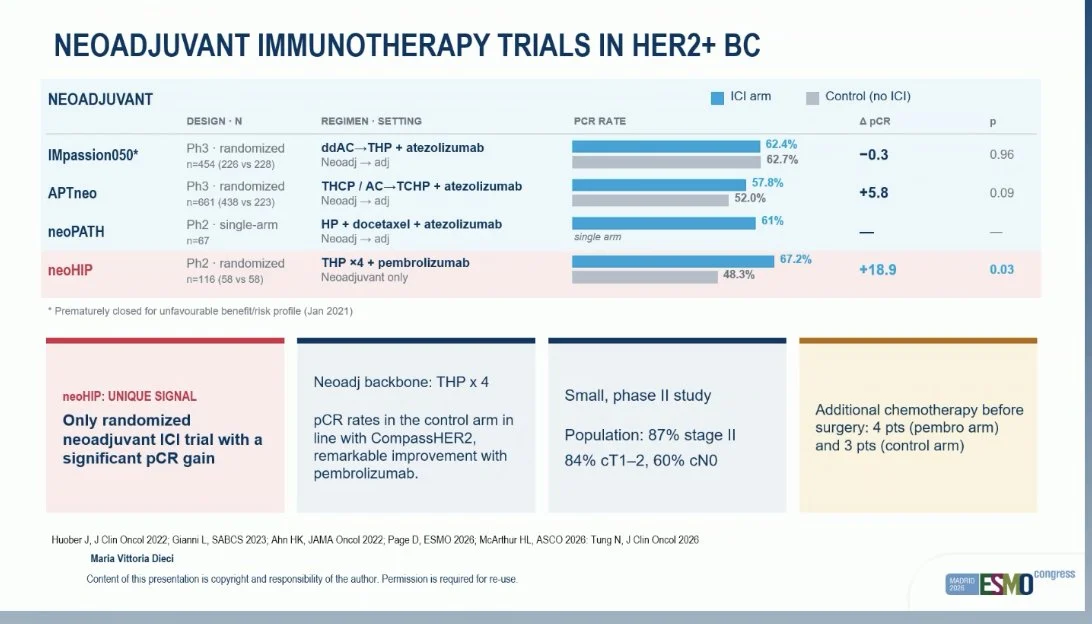
In neoHIP, adding four cycles of pembrolizumab to THP increased the overall pCR rate from 48.3% to 67.2%, an absolute improvement of 18.9 percentage points (P = 0.03).
The current exploratory analysis investigated whether individual or combined tissue biomarkers could identify patients with greater incremental pCR benefit from pembrolizumab.
Methods and Study Design
neoHIP randomized 116 patients with stage II/III HER2-positive early breast cancer equally to THP or THP plus pembrolizumab.
Tissue biomarkers were evaluable in 82 patients:
- THP arm (n = 45): Taxane, trastuzumab, and pertuzumab.
- Pembrolizumab-containing arm (n = 37): THP plus four cycles of pembrolizumab administered every three weeks.
The analysis evaluated HR negativity, defined as both ER and PR expression <1%; PD-L1 positivity, defined as a combined positive score (CPS) ≥10; and sTIL positivity, defined as sTILs ≥10%.
sTILs were scored according to International Immuno-Oncology Biomarker Working Group guidelines. Investigators assessed univariate associations with pCR and ranked combinations of biomarkers according to their ability to enrich for incremental pembrolizumab benefit.
Results
- Overall trial pCR: In the full randomized population, pCR occurred in 67.2% of patients receiving THP plus pembrolizumab versus 48.3% receiving THP alone, an absolute difference of 18.9 percentage points (P = 0.03). These results refer to the full trial population, rather than only the biomarker-evaluable subset.
- Individual biomarkers: Individual biomarkers were associated with pCR, but none alone clearly identified patients with greater incremental benefit from adding pembrolizumab.
- Leading combined approach: A rule incorporating HR-negative disease, PD-L1 CPS ≥10, or sTILs ≥10% identified 67% of the biomarker-evaluable population. Patients meeting at least one criterion showed greater incremental pCR benefit from pembrolizumab.
- PD-L1 or sTIL positivity: A rule requiring PD-L1 CPS ≥10 or sTILs ≥10% identified 47% of patients. The pCR difference favoring pembrolizumab was 33 percentage points among patients meeting either criterion, compared with 5 percentage points among those meeting neither criterion.
- HR negativity or sTIL positivity: This combination identified 62% of patients. Within the subgroup meeting either criterion, the pCR difference favoring pembrolizumab was 26 percentage points.
- Statistical uncertainty: The analysis involved a small biomarker-evaluable population, and treatment-effect estimates had wide confidence intervals. The apparent differences between biomarker-defined subgroups require prospective confirmation.
Interpretation
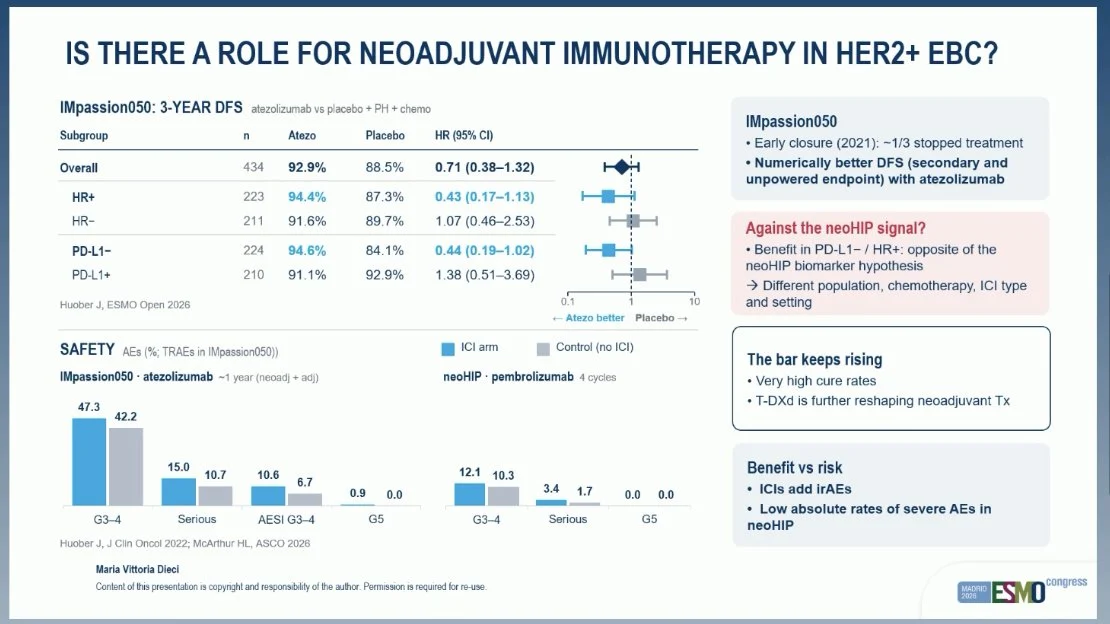
The findings suggest that an integrated assessment of tumor hormone receptor status and immune features may provide more information about incremental pembrolizumab benefit than any individual biomarker alone.
However, an association with pCR does not by itself establish a biomarker’s ability to predict treatment benefit. The exploratory assessment of multiple biomarker combinations, small subgroup sizes, and incomplete tissue availability limit definitive conclusions.
The overall pCR improvement also does not establish a survival benefit or demonstrate that additional chemotherapy can safely be omitted.
Conclusion
Combined assessment of HR status, PD-L1 expression, and sTILs may help identify patients with HER2-positive early breast cancer who experience greater incremental pCR benefit from adding pembrolizumab to THP.
These exploratory findings provide a rationale for prospective validation in a phase III trial. They do not yet establish a biomarker-guided treatment strategy or justify decisions to omit additional cytotoxic therapy. The role of neoadjuvant immunotherapy in HER2-positive early breast cancer remains to be clarified.