
At the ESMO GI Cancers Congress 2026, Sun Young Rha presented the first interim analysis of the phase 3 STAR-221 trial evaluating domvanalimab plus zimberelimab and chemotherapy versus nivolumab plus chemotherapy as first-line treatment for patients with HER2-negative advanced or metastatic gastric, gastroesophageal junction, or esophageal adenocarcinoma.
The presentation, titled “STAR-221: A phase III study of first-line domvanalimab, zimberelimab, and chemotherapy versus nivolumab plus chemotherapy in advanced HER2-negative gastric, gastroesophageal junction, or esophageal adenocarcinoma,” was presented as abstract 493O.
Background
Immune checkpoint inhibitors targeting PD-1 combined with chemotherapy have become a standard first-line treatment for HER2-negative advanced gastric and gastroesophageal cancers. However, long-term outcomes remain suboptimal, prompting investigation of additional immune checkpoints.
TIGIT is an inhibitory receptor expressed on T cells and natural killer cells that suppresses antitumor immune responses. Dual blockade of TIGIT and PD-1 has emerged as a promising strategy to enhance T-cell activation beyond PD-1 inhibition alone.
Domvanalimab is an Fc-silent anti-TIGIT antibody, while zimberelimab is an anti-PD-1 antibody. Earlier studies suggested encouraging clinical activity when these agents were combined with chemotherapy, leading to the global phase 3 STAR-221 trial.
Methods
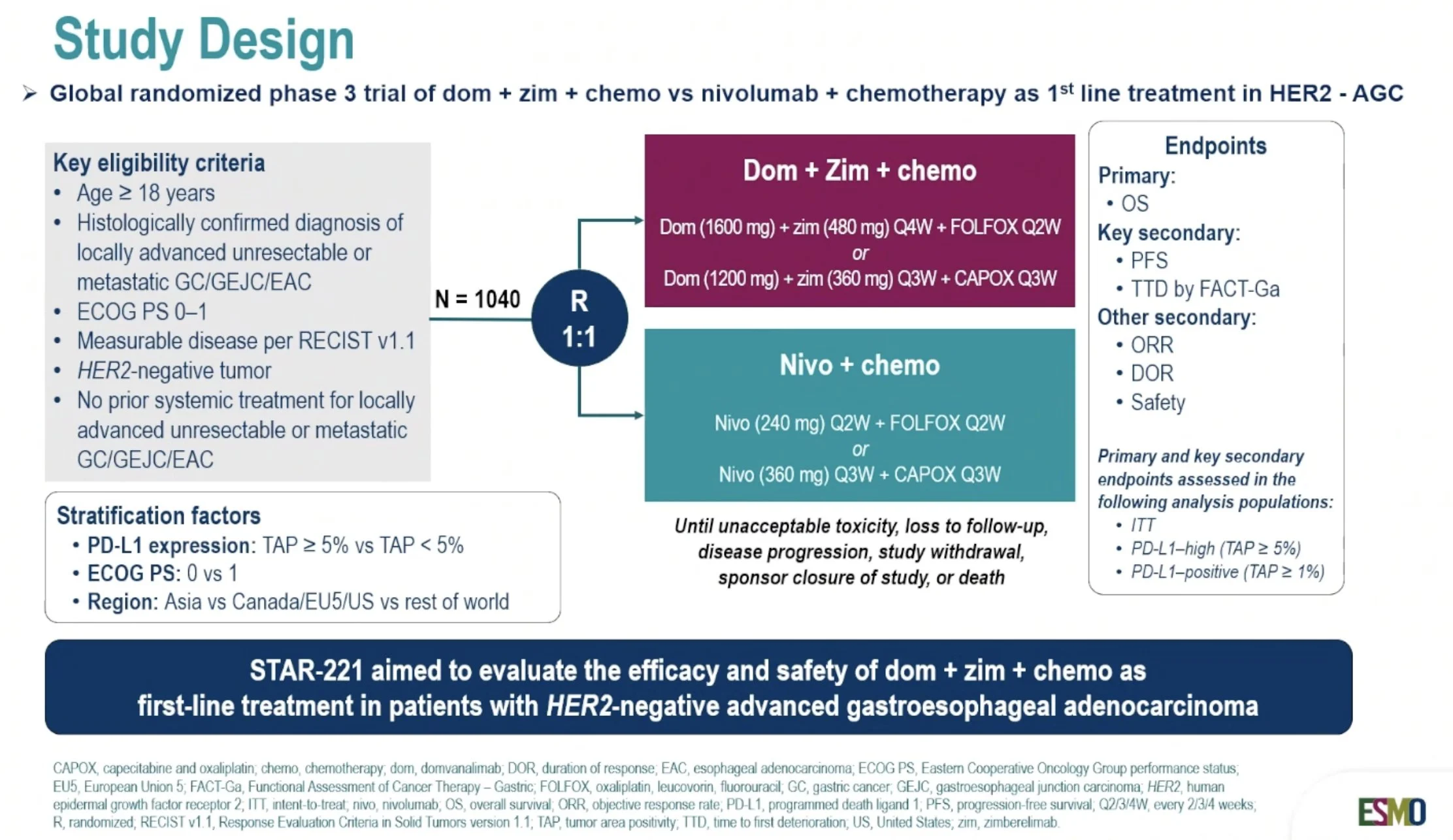
STAR-221 is a randomized, international phase 3 trial evaluating first-line treatment for patients with HER2-negative advanced or metastatic gastric, gastroesophageal junction, or esophageal adenocarcinoma (NCT05568095).
A total of 1,040 patients were randomized 1:1 to receive:
- Domvanalimab + zimberelimab + chemotherapy
- Nivolumab + chemotherapy
Chemotherapy consisted of either:
- FOLFOX
- CAPOX
The primary endpoint was overall survival (OS), tested hierarchically in the intention-to-treat (ITT) population, followed by patients with tumor area positivity (TAP) ≥5% and TAP ≥1%. Secondary endpoints included progression-free survival (PFS), objective response rate (ORR), and safety.
STAR-221 Results
Overall Survival
The study did not meet its primary endpoint of overall survival. After a median follow-up of approximately 13 months, median OS was 14.0 months with domvanalimab + zimberelimab + chemotherapy compared with 13.4 months with nivolumab + chemotherapy (HR 1.01; P = 0.526), demonstrating no significant survival advantage in the intention-to-treat population.
No improvement was observed in the biomarker-defined subgroups either. In patients with tumor area positivity (TAP) ≥5%, the hazard ratio for OS was 1.10, while in those with TAP ≥1%, the hazard ratio was 0.99, indicating no benefit from adding domvanalimab.
Progression-Free Survival
Progression-free survival was nearly identical between the two treatment arms. Median PFS was 8.4 months with domvanalimab + zimberelimab + chemotherapy and 8.3 months with nivolumab + chemotherapy, with no progression-free survival advantage observed in either the overall study population or the predefined biomarker subgroups.
Objective Response Rate
Objective response rates were also comparable between treatment groups. The ORR was 55% with domvanalimab + zimberelimab + chemotherapy and 56% with nivolumab + chemotherapy. Similar response rates were observed across the TAP-defined populations, providing no evidence of improved antitumor activity with dual TIGIT and PD-1 blockade.
Safety
The safety profiles were consistent across both treatment arms.
Key observations included:
- Similar rates of treatment-emergent adverse events.
- Comparable incidence of immune-mediated adverse events.
- Similar frequencies of treatment interruptions and discontinuations.
- No new safety signals were identified with dual TIGIT and PD-1 blockade.
Conclusions
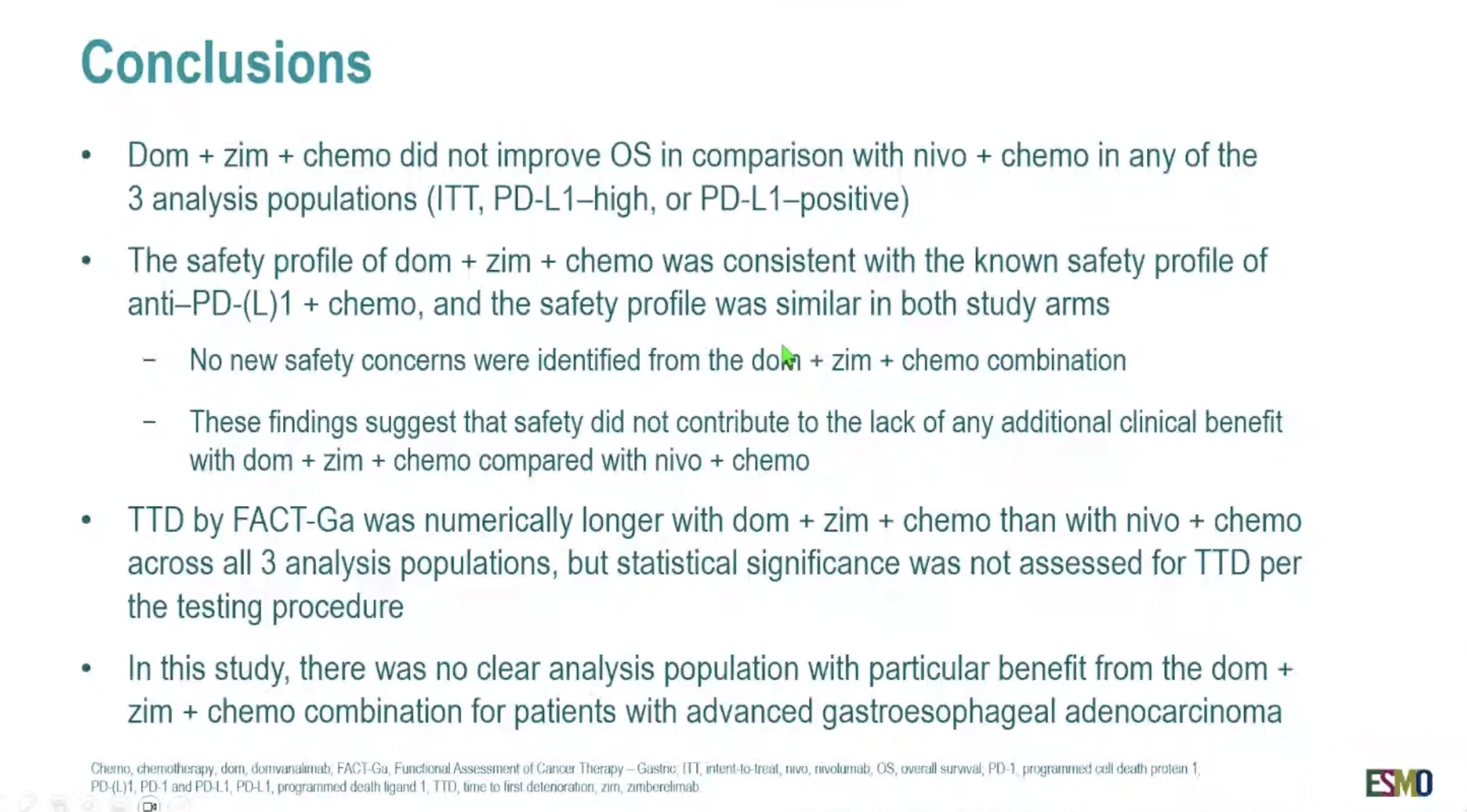
The phase 3 STAR-221 trial demonstrated that adding domvanalimab to zimberelimab and chemotherapy did not improve overall survival compared with nivolumab plus chemotherapy in patients with previously untreated HER2-negative advanced gastric, gastroesophageal junction, or esophageal adenocarcinoma.
Progression-free survival, objective response rates, and safety were also comparable between treatment arms, indicating that dual TIGIT/PD-1 inhibition did not provide additional clinical benefit over the current PD-1–based standard of care in this setting.
Why This Study Matters
STAR-221 represents one of the largest phase 3 evaluations of TIGIT inhibition in upper gastrointestinal cancers. Despite a strong biological rationale and encouraging early-phase data, the addition of domvanalimab failed to improve outcomes beyond established PD-1 blockade with nivolumab.
These findings underscore the ongoing challenge of translating promising immunotherapy combinations into meaningful survival gains and suggest that future development of TIGIT-targeted therapies may require improved patient selection, alternative biomarkers, or different combination strategies.
More details are available in the official ESMO Gastrointestinal Cancers Congress 2026 programme.