Authors: Harry H. Yoon, Ken Kato, Eric Raymond, Richard Hubner, Yongqian Shu, Yueyin Pan, Sook Ryun Park, Takashi Kojima, Chen-Yuan Lin, Lucjan Wyrwicz, David Tougeron, Ryu Ishihara, Kaijun Wang, Yanyan Peng & Jianming Xu
Immune checkpoint inhibitors have become an important part of first-line treatment for advanced esophageal squamous cell carcinoma (ESCC), but the durability of benefit matters just as much as the initial response.
The latest analysis of the phase III RATIONALE-306 trial provides a longer view. With at least three years of follow-up, patients receiving tislelizumab plus chemotherapy continued to live longer and remain progression-free for longer than those receiving placebo plus chemotherapy. The updated results also offer a closer look at PD-L1 scoring, long-term safety, and patient-reported quality of life.
How Was RATIONALE-306 Designed?
RATIONALE-306 was a global, randomized, double-blind phase III trial that enrolled 649 patients with unresectable locally advanced or metastatic ESCC who had not previously received systemic therapy for advanced disease.
Patients were randomized 1:1 to receive tislelizumab 200 mg plus investigator-chosen chemotherapy or placebo plus chemotherapy, given every three weeks. The chemotherapy backbone consisted of a platinum agent combined with either a fluoropyrimidine or paclitaxel.
The primary endpoint was overall survival, with progression-free survival, response, safety, and quality of life among the additional outcomes assessed. PD-L1 expression was not required for enrollment, allowing the investigators to evaluate outcomes across the full study population and later explore how treatment benefit varied according to different PD-L1 expression levels and scoring methods.
The Overall Survival Benefit Was Maintained at 3 Years
The original RATIONALE-306 analysis had already shown a clear survival advantage with tislelizumab. The longer follow-up confirms that this benefit was maintained.
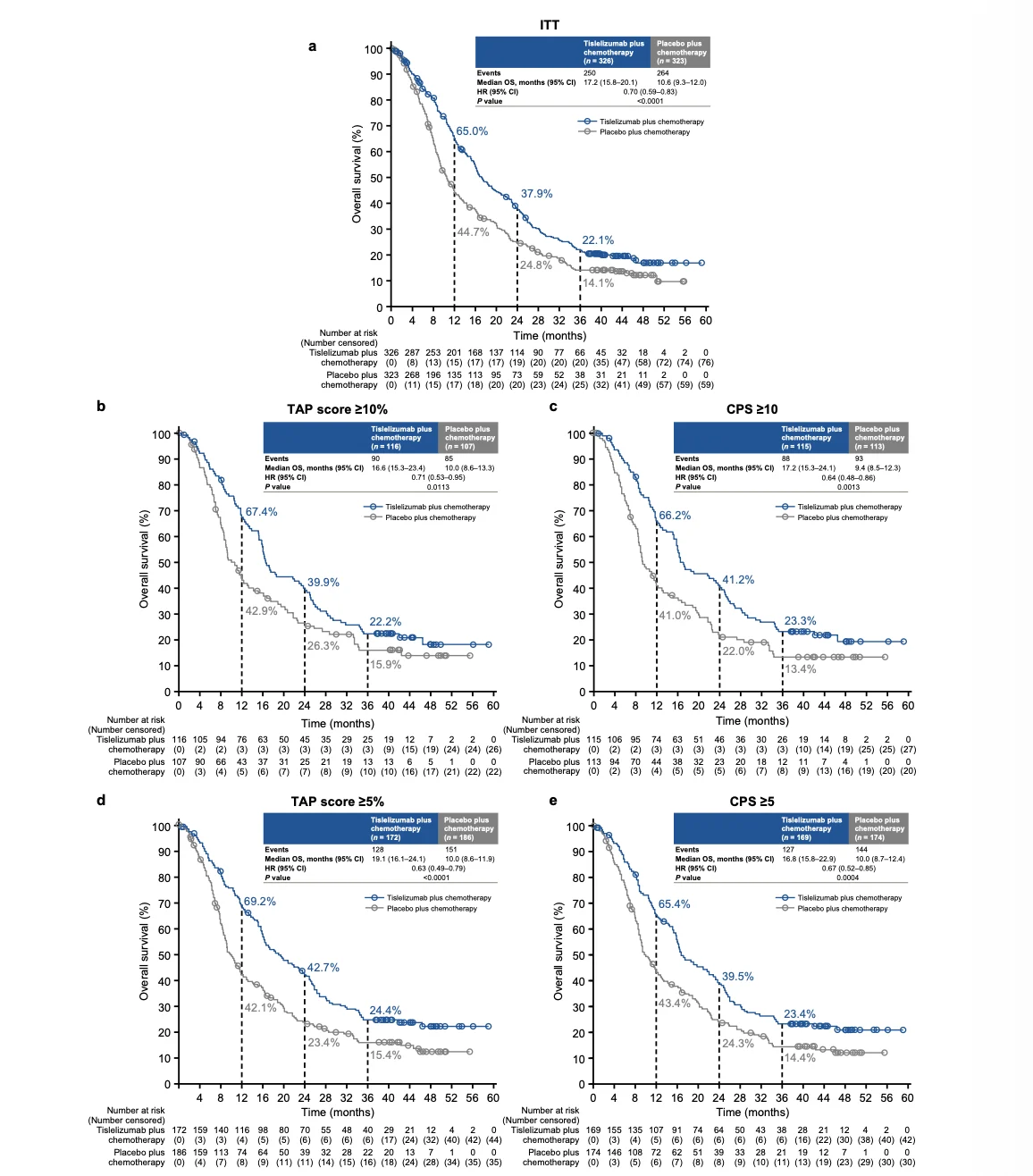
Median overall survival was 17.2 months with tislelizumab plus chemotherapy compared with 10.6 months with placebo plus chemotherapy, corresponding to a hazard ratio of 0.70.
The difference between the treatment groups remained visible over time. At one year, 65.0% of patients in the tislelizumab group were alive compared with 44.7% in the control group. At two years, the rates were 37.9% and 24.8%, and at three years they were 22.1% and 14.1%, respectively.
These longer-term results are important because they show that the benefit of adding PD-1 inhibition extends well beyond the first months of treatment.
Progression-Free Survival Also Favored Tislelizumab
The improvement in progression-free survival was also maintained with longer follow-up.
Median PFS was 7.3 months with tislelizumab plus chemotherapy compared with 5.6 months with placebo plus chemotherapy, with a hazard ratio of 0.60.
What stands out most is the difference at later time points. At three years, 15.0% of patients in the tislelizumab arm remained progression-free compared with 2.9% in the placebo arm. At two years, those rates were 18.1% and 7.2%, respectively.
This suggests that although most patients eventually experienced disease progression, a subset achieved substantially longer disease control with the immunotherapy-containing regimen.
What Did the Study Show About PD-L1?
The investigators also explored whether the treatment effect differed according to PD-L1 expression.
Two scoring methods were examined: the Tumor Area Positivity (TAP) score and the Combined Positive Score (CPS). Across several thresholds, survival generally favored tislelizumab plus chemotherapy.
For patients with a TAP score of at least 10%, median overall survival was 16.6 months with tislelizumab versus 10.0 months with placebo. In patients with CPS of at least 10, median overall survival was 17.2 months versus 9.4 months.
Similar trends were seen at lower thresholds, including TAP and CPS cutoffs of 5 and 1. These analyses are clinically interesting, but most were exploratory and post hoc, so they should be interpreted with more caution than the primary trial results.
TAP and CPS Did Not Always Classify Patients the Same Way
A particularly useful part of the updated analysis was the comparison between TAP and CPS.
At the highest and lowest levels of PD-L1 expression, the two methods showed good agreement. Among tumors with a TAP score of at least 10%, 88.3% were also classified as CPS 10 or higher. Similarly, 83.6% of tumors with TAP below 1% were also CPS below 1.
The agreement was weaker in the middle ranges. Only about half of patients with a TAP score between 5% and 9% fell into the equivalent CPS category.
That difference may have practical consequences. Regulatory approvals in different countries use different PD-L1 scoring systems and cutoffs, meaning that the same tumor could potentially be categorized differently depending on how PD-L1 is measured. The findings reinforce the need for greater consistency in biomarker assessment in ESCC.
Tumor Responses Were More Frequent With Tislelizumab
The response data were also consistent with the survival results.
An objective response was seen in 63.5% of patients treated with tislelizumab plus chemotherapy compared with 42.4% of patients receiving placebo plus chemotherapy. Complete responses occurred in 4.6% and 2.5% of patients, respectively.
Median duration of response was 7.1 months with tislelizumab and 5.7 months with placebo. At the time of the analysis, ongoing responses were still present in 13.0% of responders in the tislelizumab group compared with 2.9% in the control group.
Did Longer Follow-Up Reveal New Safety Concerns?
The longer follow-up did not identify any new safety signals.
Grade 3 or higher treatment-related adverse events occurred in 67.0% of patients receiving tislelizumab plus chemotherapy and 64.5% receiving placebo plus chemotherapy. The most common severe toxicities included decreased neutrophil count, anemia and decreased white blood cell count.
An interesting finding was that most severe treatment-related adverse events occurred during the first year of therapy, with considerably fewer events appearing later.
Immune-mediated adverse events were more common in the tislelizumab group, as expected with PD-1 inhibition. These occurred in 21.6% of patients compared with 5.9% in the placebo group. The most frequently reported immune-mediated events included hypothyroidism, skin reactions and pneumonitis.
What Happened to Quality of Life?
Longer survival is most meaningful when it is not accompanied by a major decline in quality of life.
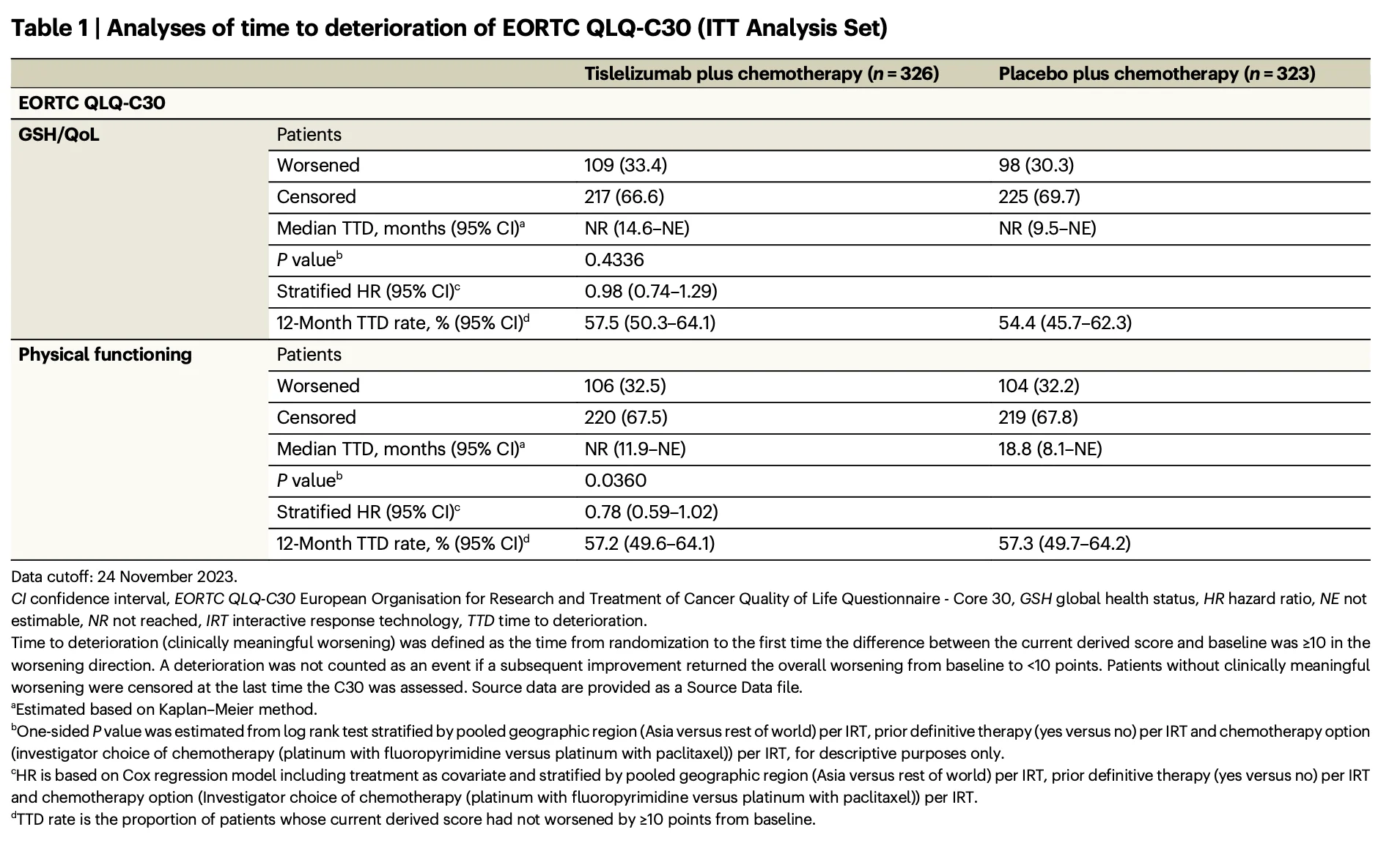
Patient-reported outcomes were assessed using the EORTC QLQ-C30 and the esophageal cancer-specific QLQ-OES18questionnaires.
For physical functioning, the median time to clinically meaningful deterioration was not reached in the tislelizumab group and was 18.8 months in the placebo group. Across most other quality-of-life measures, deterioration was broadly similar between the two treatment arms.
These findings suggest that the survival advantage achieved with tislelizumab did not come at the cost of a clear overall worsening in patient-reported quality of life.
What Do the 3-Year Results Mean for Clinical Practice?
The three-year update strengthens the evidence supporting tislelizumab plus chemotherapy as a first-line treatment option for patients with unresectable locally advanced or metastatic ESCC.
The most important finding is the durability of the benefit. Patients receiving tislelizumab plus chemotherapy continued to have better overall and progression-free survival with extended follow-up, without the emergence of unexpected long-term safety concerns.
The analysis also highlights a less settled issue: how best to use PD-L1 as a biomarker in ESCC. TAP and CPS generally tracked together, but not perfectly, particularly at intermediate expression levels. As different regions continue to use different assays and thresholds, this remains an important practical challenge.
Overall, the extended RATIONALE-306 data reinforce the role of PD-1 inhibition combined with chemotherapy in advanced ESCC, while also showing why longer follow-up is essential for understanding the true value and durability of immunotherapy.
Read the full article here.