A post hoc exploratory analysis of the phase III POTOMAC trial reported favorable disease-free survival (DFS) and cystectomy-free survival outcomes with durvalumab plus BCG induction and maintenance compared with BCG induction and maintenance alone in patients with BCG-naïve, high-risk non-muscle-invasive bladder cancer (NMIBC) with papillary-only tumors.
Fewer early high-risk disease events were observed with the combination, including in the T1 subset. These findings were accompanied by increased treatment-related and immune-mediated toxicity.
Background
POTOMAC previously demonstrated a statistically significant DFS benefit with durvalumab plus BCG induction and maintenance versus BCG induction and maintenance alone in the overall BCG-naïve, high-risk NMIBC population.
Patients with papillary-only tumors accounted for approximately 64–65% of participants in the treatment arms examined here. Many had T1 disease, for which recurrence or progression after BCG can lead to consideration of radical cystectomy.
This exploratory analysis examined disease outcomes, cystectomy-related endpoints, and safety in the papillary-only population, with additional analyses of its T1 subset.
Methods and Study Design
POTOMAC randomized eligible patients 1:1:1 to:
- Durvalumab plus BCG induction and maintenance.
- Durvalumab plus BCG induction only.
- BCG induction and maintenance alone.
The current post hoc exploratory analysis compared durvalumab plus BCG induction and maintenance with BCG induction and maintenance alone.
The papillary-only population included 217 patients in the combination arm and 220 in the BCG-alone arm. Within this population, the T1 subset included 137 and 145 patients, respectively.
Outcomes included DFS, high-risk disease events, BCG-unresponsive disease, time to cystectomy, cystectomy-free survival, and safety.
High-risk disease events comprised high-grade Ta/T1 or carcinoma in situ (CIS) recurrence, persistent CIS at six months, or muscle-invasive or metastatic disease. Early high-risk events were those occurring within one year of randomization.
Cystectomy-free survival was defined as time from randomization to cystectomy or death and should therefore be distinguished from time to cystectomy alone.
Results
The presentation reported a median follow-up of 60.7 months among censored patients for the DFS analyses.
- DFS in the papillary-only population: DFS events occurred in 37 of 217 patients (17%) receiving durvalumab plus BCG versus 65 of 220 (30%) receiving BCG alone. The HR was 0.56 (95% CI 0.37–0.84). Median DFS was not reached in either arm.
- DFS in the T1 subset: Events occurred in 22 of 137 patients (16%) with the combination versus 45 of 145 (31%) with BCG alone (HR 0.48; 95% CI 0.28–0.79). Median DFS was not reached in either arm.
- High-risk disease events: High-risk events occurred in 28 of 217 patients receiving durvalumab plus BCG versus 44 of 220 receiving BCG alone. These counts represent a different outcome from the total DFS event counts.
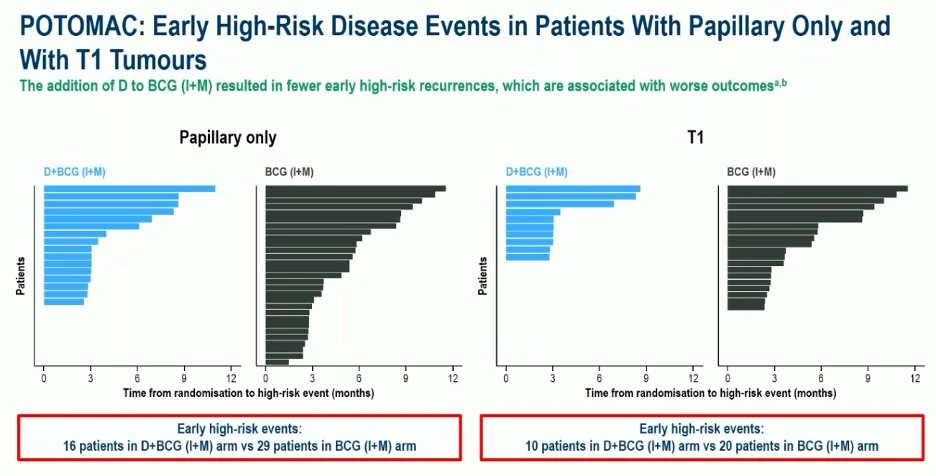
- Early high-risk events: Within the papillary-only population, 16 patients in the combination arm versus 29 in the BCG-alone arm experienced a high-risk event within one year. Among patients who experienced a high-risk event, these represented 57% (16/28) versus 66% (29/44), respectively. In the T1 subset, early high-risk events occurred in 10 versus 20 patients.
- BCG-unresponsive disease: Among patients with recurrence assessed for this outcome, BCG-unresponsive disease was reported in 11 of 18 patients (61%) receiving the combination versus 30 of 34 (88%) receiving BCG alone. These percentages do not represent rates in the full treatment populations.
- Time to cystectomy: The HR point estimate favored durvalumab plus BCG, but the confidence interval crossed 1 (HR 0.51; 95% CI 0.18–1.32).
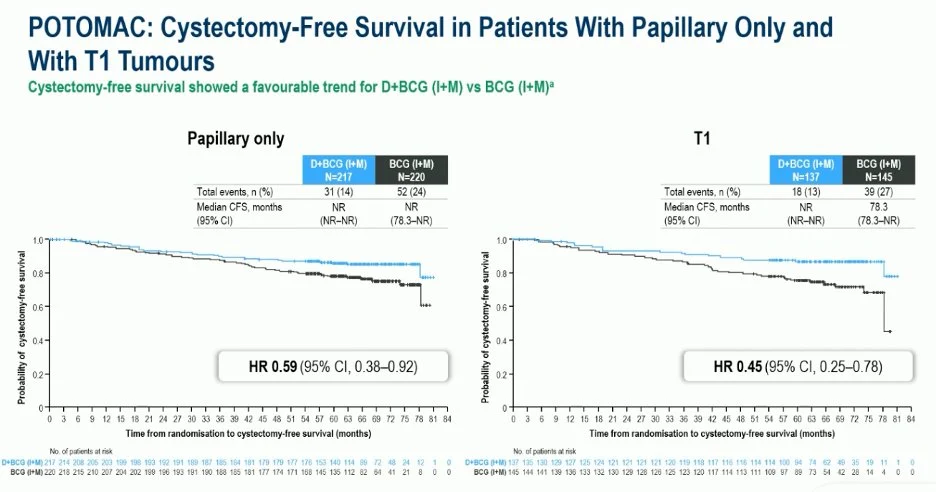
- Cystectomy-free survival in the papillary-only population: Cystectomy or death occurred in 31 of 217 patients (14%) with durvalumab plus BCG versus 52 of 220 (24%) with BCG alone (HR 0.59; 95% CI 0.38–0.92). Median cystectomy-free survival was not reached in either arm.
- Cystectomy-free survival in the T1 subset: Cystectomy or death occurred in 18 of 137 patients (13%) versus 39 of 145 (27%), respectively (HR 0.45; 95% CI 0.25–0.78).
- Treatment-related toxicity: Maximum grade 3/4 treatment-related adverse events occurred in 49 of 215 patients (23%) receiving durvalumab plus BCG versus 6 of 219 (3%) receiving BCG alone.
- Immune-mediated adverse events: In the combination arm, immune-mediated adverse events occurred in 58 of 215 patients (27%), including maximum grade 3/4 events in 20 patients (9%). Events were resolved or resolving in 35 of the 58 affected patients (60%).
Interpretation
The analysis showed favorable DFS and cystectomy-free survival estimates with durvalumab plus BCG induction and maintenance in the papillary-only population and its T1 subset. Fewer high-risk disease events occurred within the first year with the combination.
However, these were post hoc exploratory subgroup analyses. Nominal confidence intervals excluding 1 should not be interpreted as independently confirmatory evidence.
Cystectomy-free survival included both cystectomy and death. Its favorable HR therefore cannot be described as a reduction in cystectomy risk alone. The separate time-to-cystectomy estimate remained uncertain, with a confidence interval crossing 1.
The disease-control findings must also be weighed against substantially more frequent grade 3/4 treatment-related toxicity and the additional risk of immune-mediated adverse events.
Conclusion
In patients with BCG-naïve, high-risk papillary-only NMIBC, the exploratory POTOMAC analysis reported favorable DFS and cystectomy-free survival outcomes and fewer early high-risk disease events with durvalumab plus BCG induction and maintenance compared with BCG alone.
Similar findings were observed in the T1 subset. These results should be interpreted within their post hoc exploratory setting and alongside the increased treatment-related and immune-mediated toxicity associated with adding durvalumab.
EMERALD-3: Can STRIDE-Based Therapy Preserve Liver Function in HCC?