A post hoc exploratory analysis of the phase III EMERALD-3 trial reported stable mean liver function scores during treatment with STRIDE, with or without lenvatinib, plus transarterial chemoembolization (TACE).
Survival hazard ratio point estimates generally favored the STRIDE-based combinations over TACE alone across the analyzed baseline albumin–bilirubin (ALBI) groups. However, these exploratory findings do not establish a definitive overall survival (OS) benefit or preservation of liver function in every patient.
The analysis was reported at ESMO 2026 in abstract LBA48.
Background
EMERALD-3 previously met its primary progression-free survival (PFS) endpoint for STRIDE plus lenvatinib and TACE versus TACE alone.
STRIDE consists of a single priming dose of tremelimumab combined with durvalumab, followed by durvalumab maintenance. Preserving liver function is particularly important in hepatocellular carcinoma (HCC), as hepatic reserve influences prognosis and eligibility for subsequent treatment.
This post hoc analysis evaluated liver function during treatment and clinical outcomes according to baseline ALBI grade.
Methods and Study Design
Patients aged ≥18 years with embolization-eligible HCC were initially randomized 1:1:1 to:
- STRIDE plus lenvatinib and TACE: Tremelimumab 300 mg plus durvalumab 1,500 mg on day 1, followed by durvalumab 1,500 mg every four weeks, with lenvatinib 8 or 12 mg daily and TACE.
- STRIDE plus TACE: The same immunotherapy schedule combined with TACE.
- TACE alone.
After approximately 175 patients per arm had been enrolled, randomization continued 1:1 between STRIDE plus lenvatinib and TACE and TACE alone until approximately 275 patients per arm were reached.
Randomization was stratified by region, prior palliative embolization, and baseline tumor burden.
The primary endpoint was PFS for STRIDE plus lenvatinib and TACE versus TACE alone. Key secondary endpoints included OS for this comparison and PFS and OS for STRIDE plus TACE versus TACE. PFS2 was a secondary endpoint.
The post hoc analysis examined longitudinal ALBI and Child–Pugh scores, OS, PFS2, time to next treatment (TTNT), subsequent treatment use, and safety according to baseline liver function.
Comparisons involving STRIDE plus TACE used the corresponding TACE cohort from the initial randomization period.
Results
The data cutoff was February 23, 2026.
- Liver function: Mean ALBI and Child–Pugh scores remained stable among patients assessed during treatment across the reported baseline liver function groups in the safety analysis set.
- OS with STRIDE plus lenvatinib and TACE: Among patients with baseline ALBI grade 1, median OS was 44.6 months versus 39.2 months with TACE alone (HR 0.86; 95% CI 0.60–1.22). In the lower-liver-function subgroup, reported as ALBI grades 2/3 in the abstract-based analysis, median OS was 28.5 versus 22.1 months (HR 0.88; 95% CI 0.60–1.28).
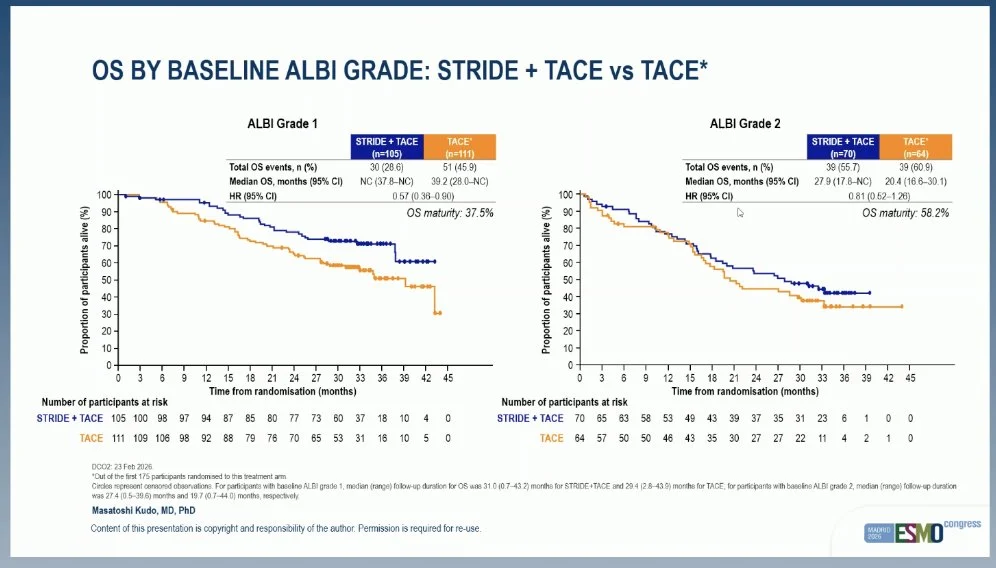
- OS with STRIDE plus TACE: In baseline ALBI grade 1, median OS was not calculable with STRIDE plus TACE versus 39.2 months with its corresponding TACE control (HR 0.57; 95% CI 0.36–0.90). This comparison included 105 versus 111 patients. In the subgroup labeled ALBI grade 2 on the presentation slide, median OS was 27.9 versus 20.4 months (HR 0.81; 95% CI 0.52–1.26), with 70 versus 64 patients.
- PFS2: HR point estimates favored STRIDE plus lenvatinib and TACE in ALBI grade 1 (HR 0.70; 95% CI 0.51–0.95) and the reported grades 2/3 subgroup (HR 0.74; 95% CI 0.52–1.05). Corresponding HRs for STRIDE plus TACE were 0.53 (95% CI 0.36–0.79) and 0.69 (95% CI 0.46–1.05).
- Time to next treatment: Median TTNT with STRIDE plus lenvatinib and TACE versus TACE alone was 21.1 versus 10.6 months in ALBI grade 1 and 14.0 versus 7.3 months in the reported grades 2/3 subgroup. With STRIDE plus TACE, corresponding medians were 20.3 versus 9.2 months and 13.4 versus 6.0 months.
- Subsequent treatment: Subsequent therapy was received by 43% of patients with ALBI grade 1 and 46% with reported grades 2/3 in the lenvatinib-containing arm. Corresponding proportions were 50% and 53% with STRIDE plus TACE and 72% and 68% with TACE alone.
- Safety: Grade 3/4 treatment-related adverse-event rates were similar across baseline ALBI groups within each regimen but were higher with combination treatment than with TACE alone. Rates with STRIDE plus lenvatinib and TACE were 62% in ALBI grade 1 and 64% in the reported grades 2/3 subgroup, compared with 18% and 20% in its TACE comparator.
Interpretation
The findings suggest that mean liver function scores can remain stable during STRIDE-based treatment combined with TACE. However, group averages do not capture deterioration in individual patients, and longitudinal assessments may be affected by missing data or treatment discontinuation.
The exploratory analyses also reported longer observed TTNT and survival HR point estimates favoring the combinations. These findings should not be interpreted as confirmatory evidence of an OS benefit. Even where a nominal confidence interval excluded 1, the post hoc subgroup setting limits definitive conclusions.
The treatment groups must also be compared with their corresponding TACE controls. The STRIDE plus TACE comparison used patients randomized during the initial three-arm period.
Similar toxicity rates across ALBI groups within a regimen do not imply similar toxicity between regimens: treatment-related toxicity was substantially more frequent with the lenvatinib-containing combination than with TACE alone.
Conclusion
This post hoc exploratory analysis of EMERALD-3 reported stable mean liver function scores among patients assessed during treatment, alongside longer observed time to next treatment and favorable survival HR point estimates with STRIDE-based combinations plus TACE.
These results do not establish preservation of liver function in every patient or a definitive OS benefit. Interpretation requires consideration of the exploratory design, the corresponding control populations, and the higher treatment-related toxicity associated with combination therapy.
BAT8008 Plus BAT1308: TROP2 ADC–Immunotherapy in First-Line NSCLC