The TROP2-directed antibody–drug conjugate (ADC) BAT8008 combined with the anti-PD-1 antibody BAT1308 showed preliminary antitumor activity in a single-arm phase II study in previously untreated advanced non-small cell lung cancer (NSCLC).
Updated results presented at ESMO 2026 reported an overall objective response rate (ORR) of 61.2%. Median progression-free survival (PFS) was 12.42 months in the displayed 98-patient PFS population. Grade ≥3 treatment-related adverse events occurred in 60.6% of the 104 enrolled patients, and one treatment-related death was reported.
The findings were reported in abstract 2631RO.
Background
TROP2-directed ADCs are being investigated in combination with immune checkpoint inhibitors to improve outcomes in advanced NSCLC.
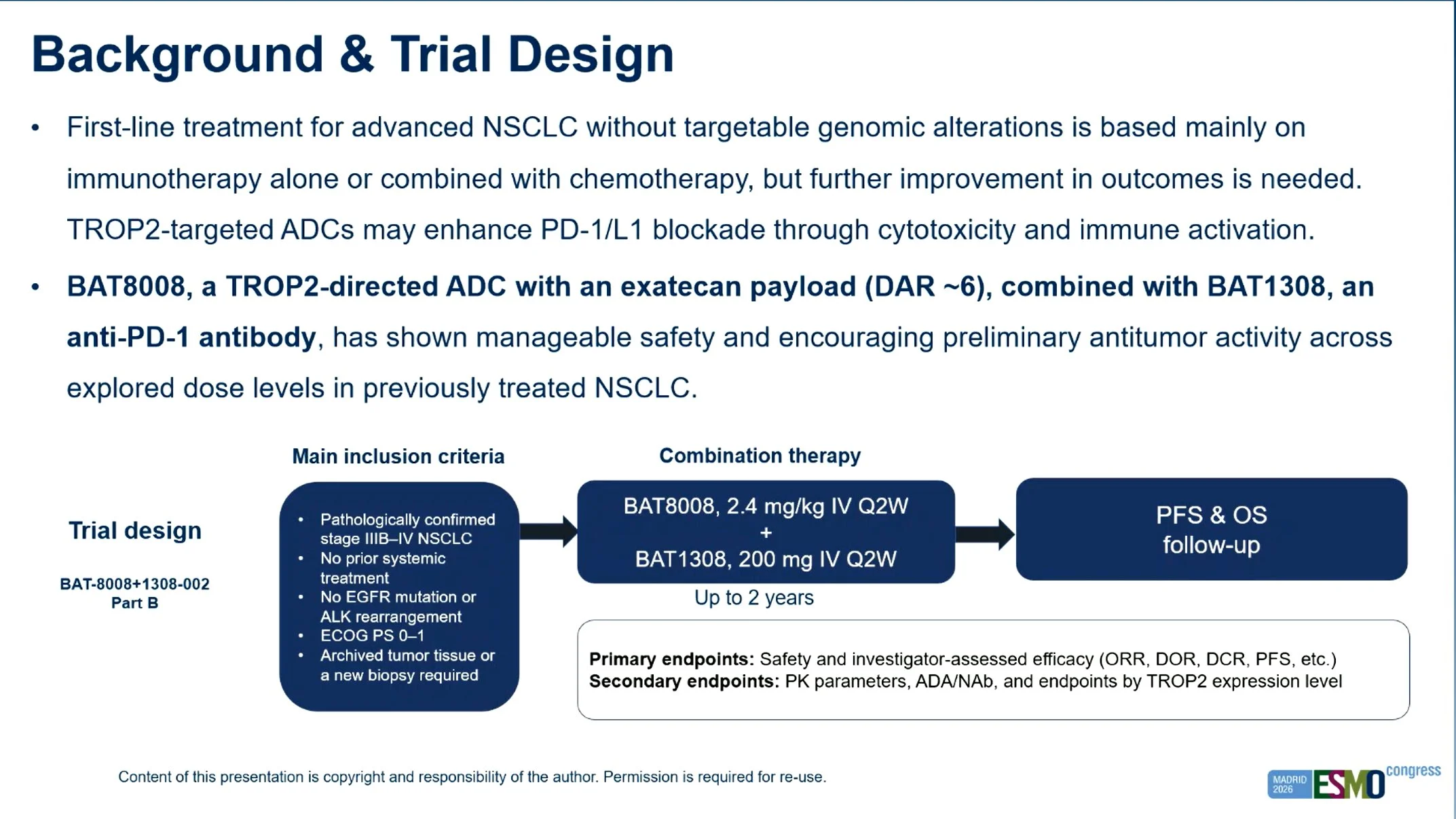
BAT8008 is a TROP2-directed ADC carrying an exatecan payload, with a drug-to-antibody ratio of approximately six. The study evaluated BAT8008 combined with BAT1308, an anti-PD-1 antibody, as first-line treatment.
Methods and Study Design
Part B of BAT-8008+1308-002 was a multicenter, open-label, single-arm phase II evaluation conducted in China.
Key eligibility criteria included pathologically confirmed stage IIIB–IV NSCLC, no prior systemic treatment, no EGFR mutation or ALK rearrangement, and ECOG performance status 0–1. Archived tumor tissue or a new biopsy was required.
Patients received:
- BAT8008: 2.4 mg/kg intravenously every two weeks.
- BAT1308: 200 mg intravenously every two weeks.
Treatment was administered for up to two years.
Primary endpoints included safety and investigator-assessed efficacy, including ORR, duration of response, disease control rate, and PFS. Secondary endpoints included pharmacokinetics, immunogenicity, and outcomes according to TROP2 expression. Patients were also followed for overall survival.
Results
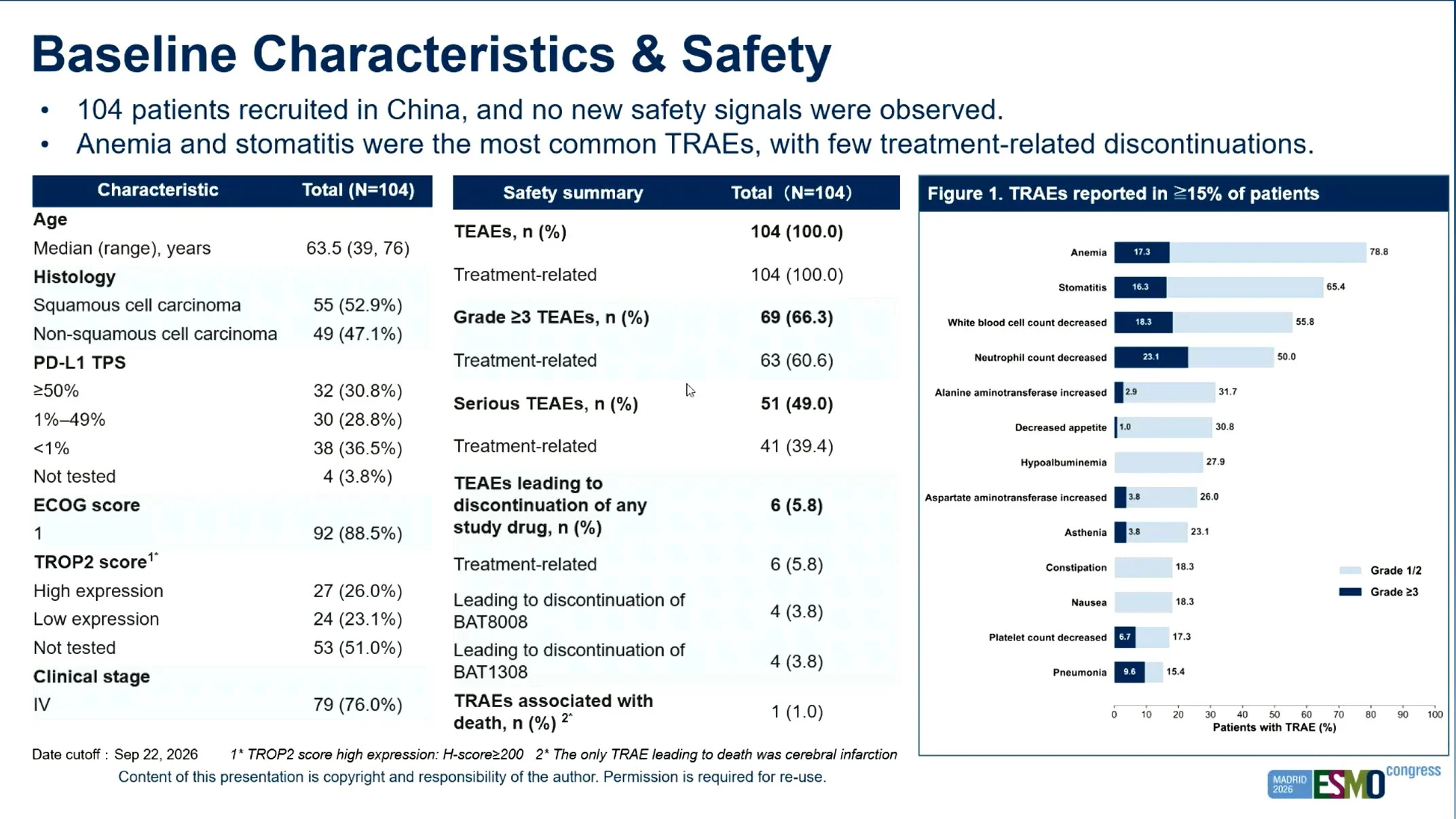
At the September 22, 2026 cutoff, 104 patients had been enrolled. Median age was 63.5 years; 52.9% had squamous and 47.1% had nonsquamous NSCLC. ECOG performance status was 1 in 88.5%, and 76.0% had stage IV disease.
Baseline PD-L1 tumor proportion score (TPS) was <1% in 36.5%, 1–49% in 28.8%, and ≥50% in 30.8%; 3.8% had not been tested.
Antitumor Activity
At a reported median follow-up of 8.9 months:
- Overall response: The presentation reported an ORR of 61.2%. The denominator underlying this percentage was not explicitly identified on the supplied efficacy slide.
- Response by PD-L1 expression: ORR was 47.2% in patients with TPS <1%, 58.6% with TPS 1–49%, and 83.3% with TPS ≥50%. These descriptive subgroup findings showed numerically higher response rates with increasing PD-L1 expression.
- Overall PFS: In the displayed PFS population of 98 patients, median PFS was 12.42 months (95% CI 6.67–not estimable).
- PFS by histology: Median PFS was 7.72 months (95% CI 5.26–not estimable) in patients with squamous NSCLC (n = 52). Median PFS was not reached in patients with nonsquamous NSCLC (n = 46; 95% CI 7.89–not estimable).
- Tumor shrinkage: Tumor shrinkage and objective responses were observed across PD-L1 subgroups, both major histologic subtypes, and the evaluated TROP2 expression categories.
The safety population included 104 patients, the displayed PFS analysis included 98, and the waterfall plot included 95. These populations should not be treated as interchangeable.
Safety
- Overall toxicity: All 104 patients experienced treatment-emergent adverse events and treatment-related adverse events.
- Grade ≥3 events: Grade ≥3 treatment-emergent adverse events occurred in 66.3% (69/104). Grade ≥3 treatment-related adverse events occurred in 60.6% (63/104).
- Serious adverse events: Serious treatment-emergent adverse events occurred in 49.0% (51/104), and serious treatment-related adverse events occurred in 39.4% (41/104).
- Common treatment-related adverse events: Anemia occurred in 78.8%, stomatitis in 65.4%, decreased white blood cell count in 55.8%, and decreased neutrophil count in 50.0%.
- Selected grade ≥3 toxicities: Decreased neutrophil count occurred in 23.1%, decreased white blood cell count in 18.3%, anemia in 17.3%, stomatitis in 16.3%, pneumonia in 9.6%, and decreased platelet count in 6.7%.
- Treatment discontinuation: Treatment-related adverse events led to discontinuation of any study drug in 5.8% (6/104). BAT8008 and BAT1308 were each discontinued because of adverse events in 3.8% (4/104).
- Treatment-related death: One treatment-related death (1.0%) was reported, attributed to cerebral infarction.
Investigators reported no new safety signals.
Interpretation
BAT8008 plus BAT1308 demonstrated preliminary activity across PD-L1 subgroups and both squamous and nonsquamous NSCLC. However, the single-arm design does not establish a PFS or survival benefit relative to established first-line treatments.
The PD-L1 subgroup findings are descriptive and do not establish PD-L1 as a predictive biomarker for this combination. Follow-up was limited, and the median PFS estimate requires further maturation.
Toxicity was substantial, particularly hematologic adverse events and stomatitis. The grade ≥3 treatment-related adverse-event rate and the reported treatment-related death are important considerations when assessing the regimen’s benefit–risk profile.
Conclusion
Updated phase II results suggest preliminary first-line antitumor activity with BAT8008 plus BAT1308 in advanced NSCLC without EGFR mutations or ALK rearrangements.
The findings warrant further investigation, but comparative efficacy remains unproven. Longer follow-up and randomized studies are needed to define the combination’s clinical role, with careful attention to hematologic toxicity, stomatitis, and serious adverse events.