The phase III KEYNOTE-B49 trial met its primary progression-free survival (PFS) endpoint with pembrolizumab plus chemotherapy compared with placebo plus chemotherapy in patients with PD-L1–positive, hormone receptor–positive (HR+), HER2-negative advanced breast cancer after endocrine-based therapy.
Median PFS was 6.7 versus 6.0 months, with a hazard ratio of 0.74. However, the final analysis did not demonstrate a statistically significant overall survival (OS) improvement. Treatment-related toxicity and discontinuations were more frequent with pembrolizumab.
The findings were reported at ESMO 2026 in abstract LBA51.
Background
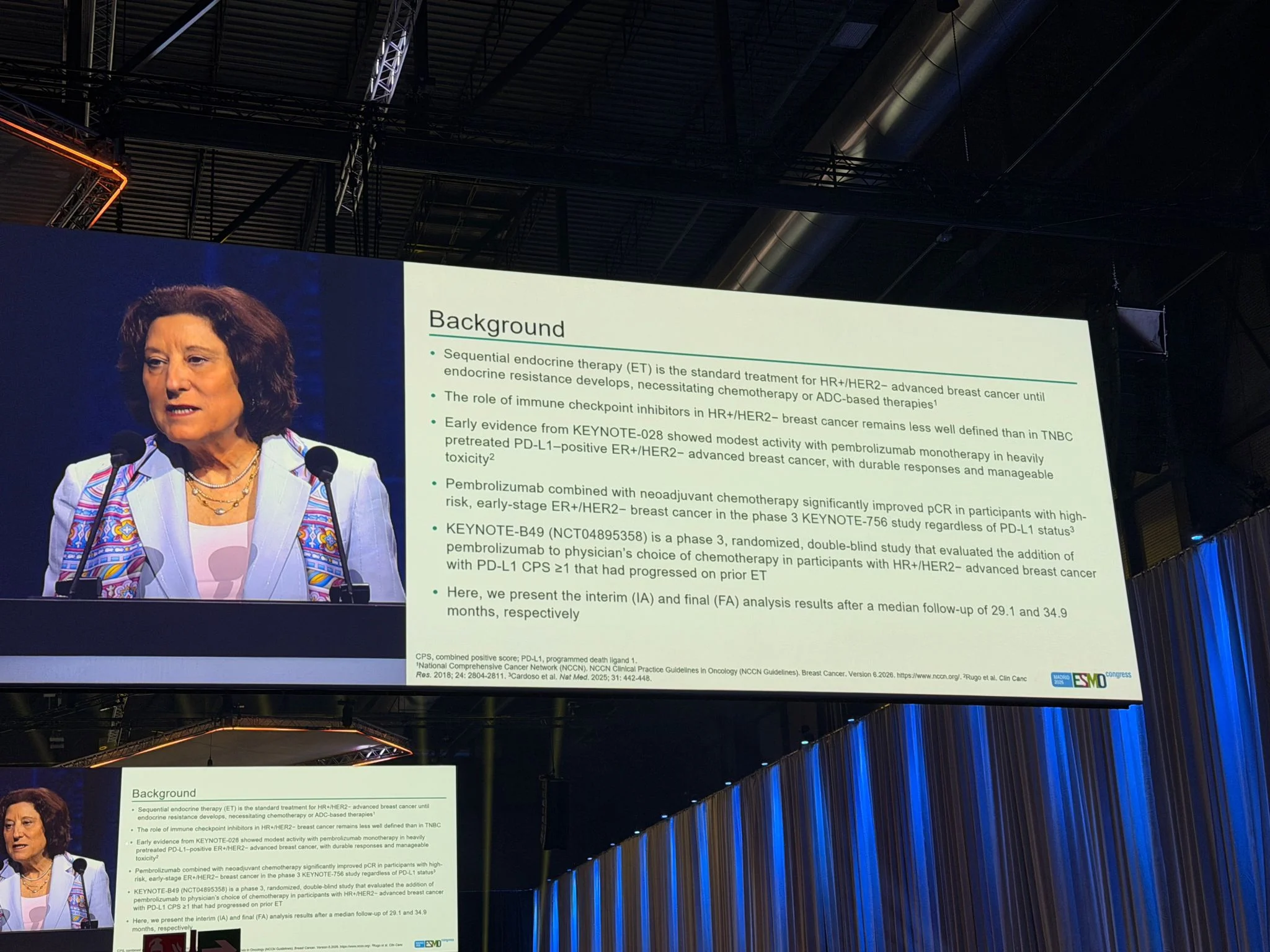
Patients with HR+/HER2− advanced breast cancer whose disease progresses after endocrine-based therapy need additional treatment options. The role of immune checkpoint inhibition in this setting remains less well defined than in triple-negative breast cancer.
KEYNOTE-B49 evaluated whether adding pembrolizumab to first-line chemotherapy could improve outcomes in patients with PD-L1–positive disease following progression on endocrine-based treatment.
Methods and Study Design
KEYNOTE-B49 (NCT04895358) was a randomized, double-blind, placebo-controlled phase III trial enrolling 342 patients with locally recurrent inoperable or metastatic HR+/HER2− breast cancer, PD-L1 combined positive score (CPS) ≥1, and prior endocrine therapy who were candidates for first-line chemotherapy.
Patients were randomized equally to:
- Pembrolizumab plus chemotherapy (n = 171): Pembrolizumab 200 mg every three weeks for up to 35 cycles, combined with physician’s choice of paclitaxel, nab-paclitaxel, liposomal doxorubicin, or capecitabine.
- Placebo plus chemotherapy (n = 171): Placebo on the same schedule, combined with one of the chemotherapy options.
The primary endpoint was PFS assessed by blinded independent central review according to RECIST v1.1 in the CPS ≥1 population. The key secondary endpoint was OS in the same population. Multiplicity was controlled at a one-sided α of 0.025.
A protocol amendment reduced the sample size because of low PD-L1 prevalence. Nearly all patients had previously received a CDK4/6 inhibitor: 99.4% in the pembrolizumab arm and 98.8% in the placebo arm.
Results
The primary PFS analysis used a September 22, 2025 data cutoff, with median follow-up of 29.1 months. The final analysis used a March 16, 2026 cutoff, with median follow-up of 34.9 months.
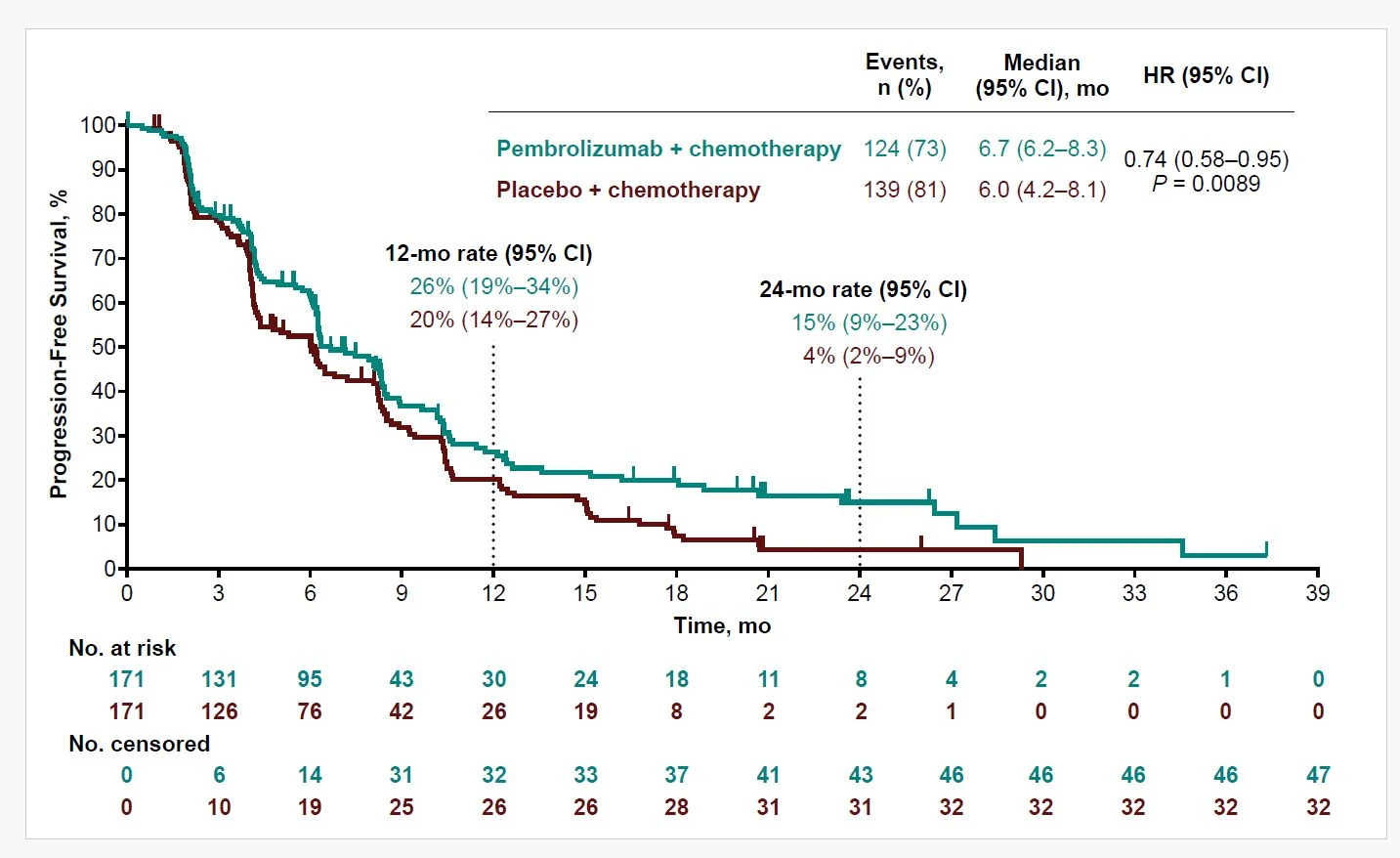
- Primary PFS endpoint: Median PFS was 6.7 months (95% CI 6.2–8.3) with pembrolizumab plus chemotherapy versus 6.0 months (95% CI 4.2–8.1) with placebo plus chemotherapy. The HR was 0.74 (95% CI 0.58–0.95; one-sided P = 0.0089), meeting the prespecified statistical criterion and corresponding to a 26% reduction in the hazard of progression or death.
- Landmark PFS: At the primary analysis, estimated 12-month PFS was 26.3% versus 20.3%, and estimated 24-month PFS was 15.0% versus 4.3%, respectively.
- Updated PFS: At the final cutoff, the descriptive PFS update remained consistent with the primary analysis (HR 0.74; 95% CI 0.58–0.95). Median PFS remained 6.7 versus 6.0 months. Updated 24-month PFS estimates were 14.1% versus 3.5%.
- PFS in the CPS ≥10 subgroup: At the primary analysis, median PFS was 7.5 months with pembrolizumab plus chemotherapy versus 4.4 months with placebo plus chemotherapy (HR 0.59; 95% CI 0.35–0.98). This subgroup result should be interpreted separately from the multiplicity-controlled primary analysis.
- Overall survival in the CPS ≥1 population: At the final analysis, median OS was 21.0 months (95% CI 18.9–22.9) versus 22.2 months (95% CI 17.6–26.3), respectively. There was no statistically significant improvement (HR 1.04; 95% CI 0.81–1.33; one-sided P = 0.6185).
- OS in the CPS ≥10 subgroup: Among 36 patients per arm, median OS was 22.9 versus 22.5 months (HR 0.82; 95% CI 0.47–1.43). These results did not establish an OS benefit in this subgroup.
- Safety: Grade ≥3 treatment-related adverse events occurred in 37.6% of patients receiving pembrolizumab plus chemotherapy versus 32.7% receiving placebo plus chemotherapy. Treatment-related adverse events led to treatment discontinuation in 11.2% versus 5.4%, respectively.
Interpretation
KEYNOTE-B49 demonstrated a statistically significant PFS improvement with pembrolizumab plus chemotherapy in the PD-L1 CPS ≥1 population. The difference in median PFS was modest, although the landmark estimates showed greater separation between treatment arms at later timepoints.
The PFS improvement was not accompanied by a demonstrated OS benefit, and treatment-related toxicity and discontinuations were more frequent with pembrolizumab.
The CPS ≥10 subgroup showed a numerically larger PFS treatment effect. However, this does not establish greater benefit relative to the CPS 1–9 subgroup without a treatment-by-biomarker interaction analysis.
Conclusion
KEYNOTE-B49 met its primary PFS endpoint in patients with PD-L1 CPS ≥1 HR+/HER2− advanced breast cancer after endocrine-based therapy but did not demonstrate an OS benefit.
The findings show improved disease control with pembrolizumab plus chemotherapy, accompanied by increased treatment-related toxicity and discontinuations. The CPS ≥10 subgroup findings require cautious interpretation and do not establish an OS benefit or a definitive threshold for selecting treatment.