Neoadjuvant immunotherapy is rapidly changing the treatment landscape of resectable stage III melanoma. Trials such as NADINA and SWOG S1801 have established the importance of administering immune checkpoint blockade before surgery, demonstrating that treatment during the presence of an intact tumor may generate powerful systemic antitumor immunity.
However, an important clinical question remains: what options exist for patients with locally advanced melanoma who have already relapsed after surgery, radiotherapy, or systemic treatment?
An updated analysis of the Phase III PIVOTAL trial provides new evidence for a different neoadjuvant strategy—direct intralesional immune modulation with daromun (L19IL2/L19TNF) before surgery.
The study, “Neoadjuvant Intralesional Daromun (L19IL2/L19TNF) in Resectable Locally Advanced Melanoma: An Update on the Efficacy and Safety Results of the PIVOTAL Phase III Trial,” by Axel Hauschild, Jessica Cecile Hassel, Mirjana Ziemer, Piotr Rutkowski, Friedegund Meier, Lukas Flatz, Caroline Gaudy-Marqueste, Katharina Charlotte Kaehler, and colleagues, reports updated efficacy and safety outcomes after a median follow-up of 36.8 months.
10 Ongoing Clinical Trials on Immunotherapy in Melanoma
What Is Daromun?
Daromun is an intralesional immunocytokine composed of two tumor-targeted cytokine fusion proteins, L19IL2 and L19TNF.
Its therapeutic concept is different from conventional systemic checkpoint blockade. Rather than exposing the entire body to high concentrations of cytokines, daromun is injected directly into accessible melanoma lesions, allowing concentrated immune stimulation within the tumor microenvironment while limiting systemic exposure.
The two cytokine components provide complementary immune effects.
Interleukin-2 (IL-2) promotes activation and expansion of T cells and other immune effector populations, while tumor necrosis factor (TNF) produces strong inflammatory and vascular-disrupting effects within the tumor.
Together, these mechanisms are intended not only to destroy the injected lesion but also to stimulate broader antitumor immunity. Earlier clinical studies reported regression of both injected and noninjected melanoma lesions, suggesting that localized treatment may generate systemic immune effects.
The Phase III PIVOTAL Trial
PIVOTAL was a randomized Phase III study evaluating neoadjuvant intralesional daromun in patients with fully resectable, locally advanced melanoma with at least one injectable skin or nodal lesion.
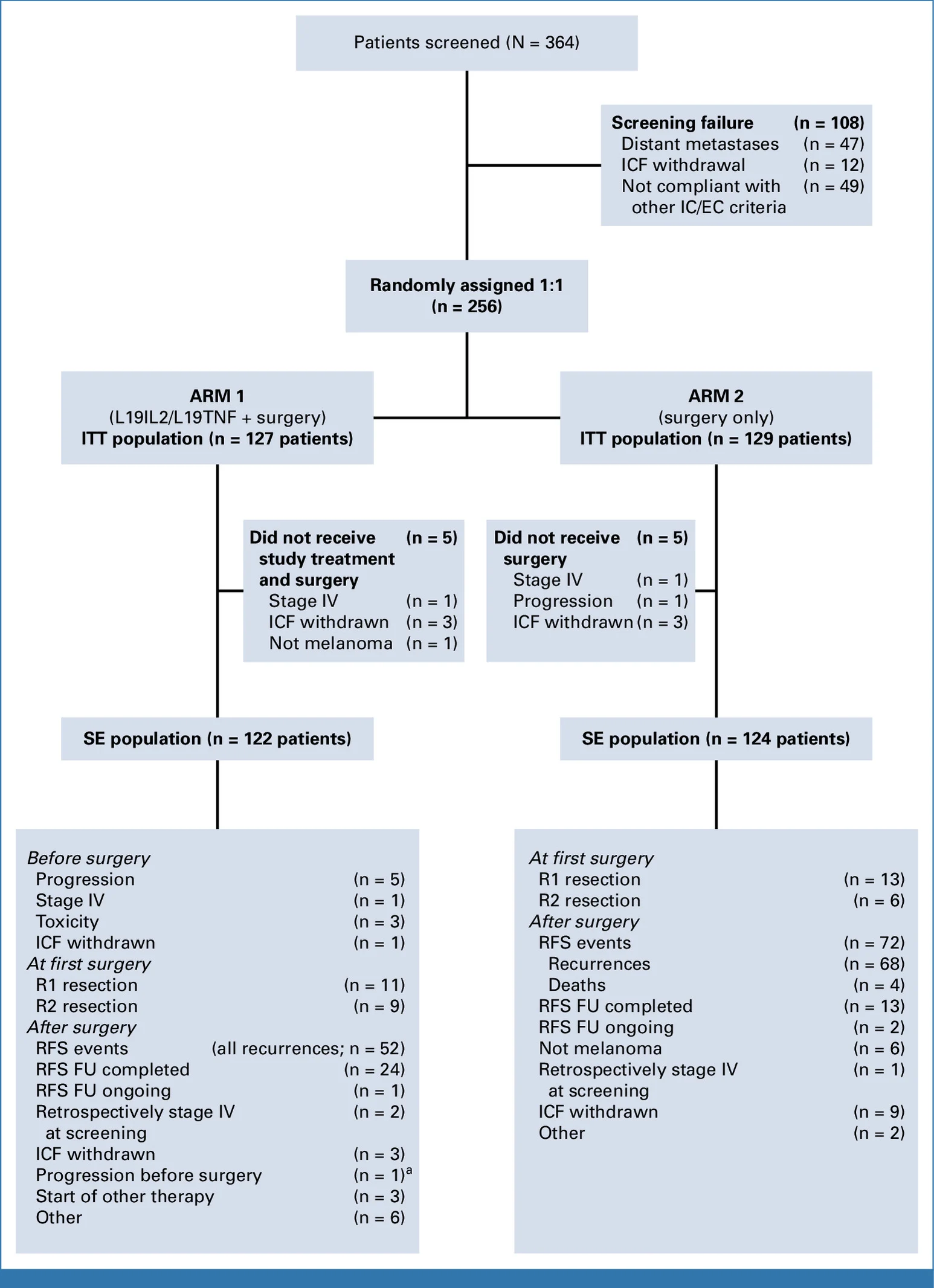
A total of 256 patients were randomized 1:1.
Patients received either neoadjuvant intralesional daromun followed by surgery or immediate surgery alone.
In the experimental arm, daromun was administered once weekly for up to four weeks at a dose of 13 million IU of L19IL2 plus 400 μg of L19TNF, followed by definitive surgical resection.
Importantly, prior treatment was permitted, including surgery, radiotherapy, and approved systemic therapies. Adjuvant treatment after surgery could also be administered according to the treating physician’s discretion.
A Particularly Relevant Patient Population
One of the most clinically interesting features of PIVOTAL is that it did not primarily study treatment-naïve patients.
Of the 256 randomized patients, only 34 patients (13%) had newly diagnosed stage III melanoma.
In contrast, 222 patients (87%) had recurrent disease after previous surgery with or without radiotherapy and/or systemic treatment.
This distinguishes PIVOTAL from landmark neoadjuvant checkpoint inhibitor studies such as NADINA and SWOG S1801, which enrolled patients without prior exposure to immune checkpoint inhibitors.
Updated Recurrence-Free Survival
The primary endpoint was recurrence-free survival assessed by blinded independent central review.
At the updated median follow-up of 36.8 months, the benefit of neoadjuvant daromun remained clinically and statistically significant.
Key results:
- RFS hazard ratio: 0.55 (95% CI, 0.38–0.78; P<.001)
- Median RFS: 23.8 months with daromun + surgery vs 6.5 months with surgery
- 1-year RFS: 63.5% vs 38.6%
- 2-year RFS: 49.2% vs 25.5%
- 3-year RFS: 35.7% vs 16.6%
The updated analysis therefore continued to demonstrate a substantial reduction in the risk of recurrence or death with neoadjuvant intralesional daromun.
Distant Metastasis-Free Survival
The benefit extended beyond local or regional disease control.
Neoadjuvant daromun significantly improved distant metastasis-free survival compared with immediate surgery.
Results:
- DMFS hazard ratio: 0.53 (95% CI, 0.33–0.83; P=.005)
- Median DMFS: 38.7 months vs 14.0 months
- 1-year DMFS: 76.3% vs 57.2%
- 2-year DMFS: 68.3% vs 39.3%
- 3-year DMFS: 51.2% vs 28.7%
These findings suggest that localized intratumoral immune stimulation before surgery may influence disease control beyond the injected tumor itself.
Event-Free Survival Supports the Primary Finding
Investigators also conducted a post hoc event-free survival analysis designed to capture events occurring before surgery that could potentially prevent definitive resection.
The analysis was consistent with the primary RFS results.
In the overall population:
- EFS hazard ratio: 0.71 (95% CI, 0.51–0.98; P=.034)
- Median EFS: 16.1 months with daromun + surgery vs 6.1 months with surgery
- 3-year EFS: 30.1% vs 15.7%
The consistency across RFS, DMFS, and EFS strengthens the evidence that the observed effect was not restricted to a single efficacy endpoint.
What Happened in Patients With Recurrent Melanoma?
The recurrent-disease population is particularly important because it represented 87% of the trial population.
Among these patients, daromun continued to demonstrate a significant RFS advantage.
Recurrent population:
- RFS hazard ratio: 0.50 (95% CI, 0.34–0.75)
- Median RFS: 23.8 months vs 6.1 months
- 3-year RFS: 39.2% vs 15.3%
The benefit was also observed irrespective of previous treatment history.
Among recurrent patients who had previously undergone surgery together with systemic therapy, the RFS hazard ratio was 0.53 (95% CI, 0.29–0.95).
Among those previously treated with surgery with or without radiotherapy, the RFS hazard ratio was 0.46 (95% CI, 0.27–0.78).
Exploratory EFS also favored neoadjuvant daromun in the overall recurrent population, with an HR of 0.68 (95% CI, 0.48–0.97). However, when recurrent patients were further divided according to previous systemic treatment, the EFS analyses showed strong trends but did not reach statistical significance.
What About Overall Survival?
Overall survival data remain immature.
At the updated database cutoff, only 37 of the 104 required OS events had occurred.
Longer follow-up will therefore be required to determine whether the improvements in recurrence-free and distant metastasis-free survival ultimately translate into an overall survival advantage.
Safety: Does Local Cytokine Delivery Limit Systemic Toxicity?
The updated analysis identified no new safety signals.
Grade ≥3 adverse events occurred more frequently in the daromun arm than in the surgery-alone arm, but severe treatment-related toxicity remained predominantly local.
Safety results:
- Grade ≥3 adverse events: 33.6% with daromun vs 11.3% with surgery
- Grade 3 treatment-related adverse events: 28.7% vs 7.3%
- Most frequent Grade 3 treatment-related event: injection-site reaction (12.3%)
- Grade >3 treatment-related adverse events: none
- Treatment-related deaths: none
The safety findings therefore remained consistent with the localized mechanism of administration and no new concerning signals emerged with longer follow-up.
Why Could Intralesional Immunotherapy Matter?
The PIVOTAL findings raise an important broader concept in immuno-oncology: systemic immune activation does not necessarily require systemic drug delivery.
Injecting an immune-modulating therapy directly into a tumor allows the tumor itself to become the site of immune activation.
Daromun combines IL-2–mediated stimulation of immune effector cells with TNF-mediated inflammation and vascular disruption. This may promote local tumor destruction while releasing tumor antigens and generating immune responses capable of extending beyond the injected lesion.
In this sense, intralesional immunotherapy may function not simply as local treatment, but as a strategy for using the tumor as an in situ source of systemic antitumor immune priming.
Where Could Daromun Fit in the Modern Melanoma Landscape?
The melanoma neoadjuvant landscape is changing rapidly.
Checkpoint inhibitor–based approaches have established neoadjuvant systemic immunotherapy as an important strategy for newly diagnosed resectable stage III disease. PIVOTAL addresses a somewhat different and clinically relevant population: patients with locally advanced, injectable and resectable melanoma, the majority of whom had already experienced recurrence after previous treatment.
The updated results suggest that tumor-targeted intralesional cytokine therapy may provide another way of generating effective antitumor immunity before surgery, including in previously treated disease.
However, several questions remain.
The study was open-label, some subgroup analyses were exploratory, and overall survival remains immature. The optimal integration of daromun with contemporary checkpoint blockade and targeted therapies also remains to be established.
A parallel Phase III neoadjuvant study, NeoDREAM (NCT03567889), is ongoing in patients with stage III resectable melanoma.
The OncoDaily IO Perspective
PIVOTAL adds another dimension to the rapidly evolving concept of neoadjuvant immunotherapy.
The central message may extend beyond daromun itself: the tumor can potentially be used as the site where systemic antitumor immunity is initiated.
With longer follow-up, neoadjuvant intralesional daromun continued to improve recurrence-free and distant metastasis-free survival compared with surgery alone, while maintaining a manageable safety profile. Particularly notable is that most participants had recurrent disease after previous treatment—a population that remains less well represented in landmark neoadjuvant checkpoint inhibitor trials.
Whether intralesional immunocytokines will ultimately become an independent perioperative strategy or be integrated with checkpoint blockade remains an important question for future trials.
But PIVOTAL provides compelling evidence that in melanoma, where immunotherapy is delivered may become almost as important as which immune pathway is targeted.
Read Full Article Here