The final analysis of the phase III PEARLS/KEYNOTE-091 trial showed a continued disease-free survival (DFS) benefit with adjuvant pembrolizumab versus placebo in completely resected stage IB–IIIA non-small cell lung cancer (NSCLC).
At a median follow-up of 87.7 months, median DFS was 58.7 versus 43.3 months. However, the final analysis did not demonstrate a statistically significant overall survival (OS) benefit.
Mary E. O’Brien presented the findings at ESMO Congress 2026 (abstract 2511O).
Background
PEARLS/KEYNOTE-091 previously demonstrated improved DFS with pembrolizumab in the intention-to-treat (ITT) population. Benefit was also observed among patients who had received adjuvant chemotherapy.
The final analysis provides longer-term results for DFS, OS, lung cancer–specific survival (LCSS), and safety.
Methods and Study Design
PEARLS/KEYNOTE-091 (NCT02504372) was a randomized, triple-blind, placebo-controlled phase III trial.
Eligible adults had completely resected NSCLC with negative surgical margins, comprising stage IB tumors ≥4 cm, stage II, or stage IIIA disease according to AJCC seventh-edition staging. Patients had no evidence of disease and ECOG performance status 0–1 at randomization.
Adjuvant chemotherapy was considered for stage IB disease and strongly recommended for stage II–IIIA disease, with treatment limited to four cycles.
A total of 1,177 patients were randomized 1:1 to:
- Pembrolizumab (n = 590): 200 mg intravenously every three weeks for up to 18 administrations, approximately one year.
- Placebo (n = 587): Administered intravenously on the same schedule.
Randomization was stratified by disease stage, PD-L1 tumor proportion score (TPS), receipt of adjuvant chemotherapy, and geographic region.
The dual primary endpoints were investigator-assessed DFS in the ITT population and in patients with PD-L1 TPS ≥50%. Secondary endpoints included OS, LCSS, and safety.
Adjuvant chemotherapy had been received by 506 patients in the pembrolizumab arm and 504 in the placebo arm.
Results
At the January 21, 2026 data cutoff, the median time from randomization to cutoff was 87.7 months.
- Overall survival: Six-year OS in the ITT population was 68.5% with pembrolizumab versus 66.4% with placebo. The HR was 0.98 (95% CI 0.81–1.18; one-sided P = 0.41826), with no statistically significant difference. Median OS was not reached in either arm.
- OS among patients receiving adjuvant chemotherapy: Six-year OS was 68.9% versus 65.4%, respectively (HR 0.91; 95% CI 0.74–1.12). An OS benefit was not established in this subgroup.
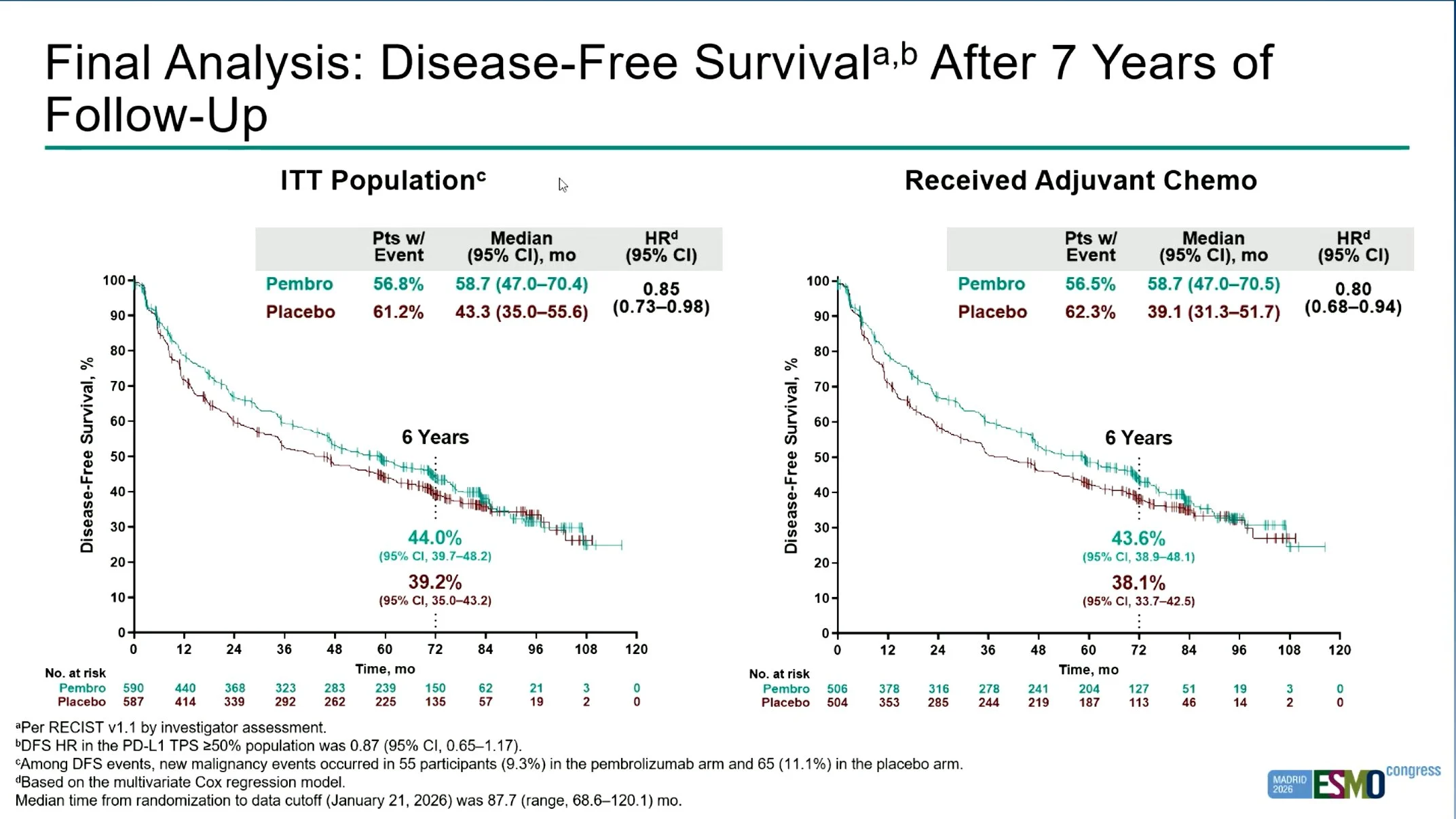
- Disease-free survival: In the ITT population, median DFS was 58.7 months (95% CI 47.0–70.4) with pembrolizumab versus 43.3 months (95% CI 35.0–55.6) with placebo. The HR was 0.85 (95% CI 0.73–0.98). Six-year DFS was 44.0% versus 39.2%.
- DFS among patients receiving adjuvant chemotherapy: Median DFS was 58.7 months (95% CI 47.0–70.5) versus 39.1 months (95% CI 31.3–51.7), respectively (HR 0.80; 95% CI 0.68–0.94). Six-year DFS was 43.6% versus 38.1%.
- DFS in the PD-L1 TPS ≥50% population: The HR was 0.87 (95% CI 0.65–1.17). A DFS benefit was not established in this dual-primary-endpoint population.
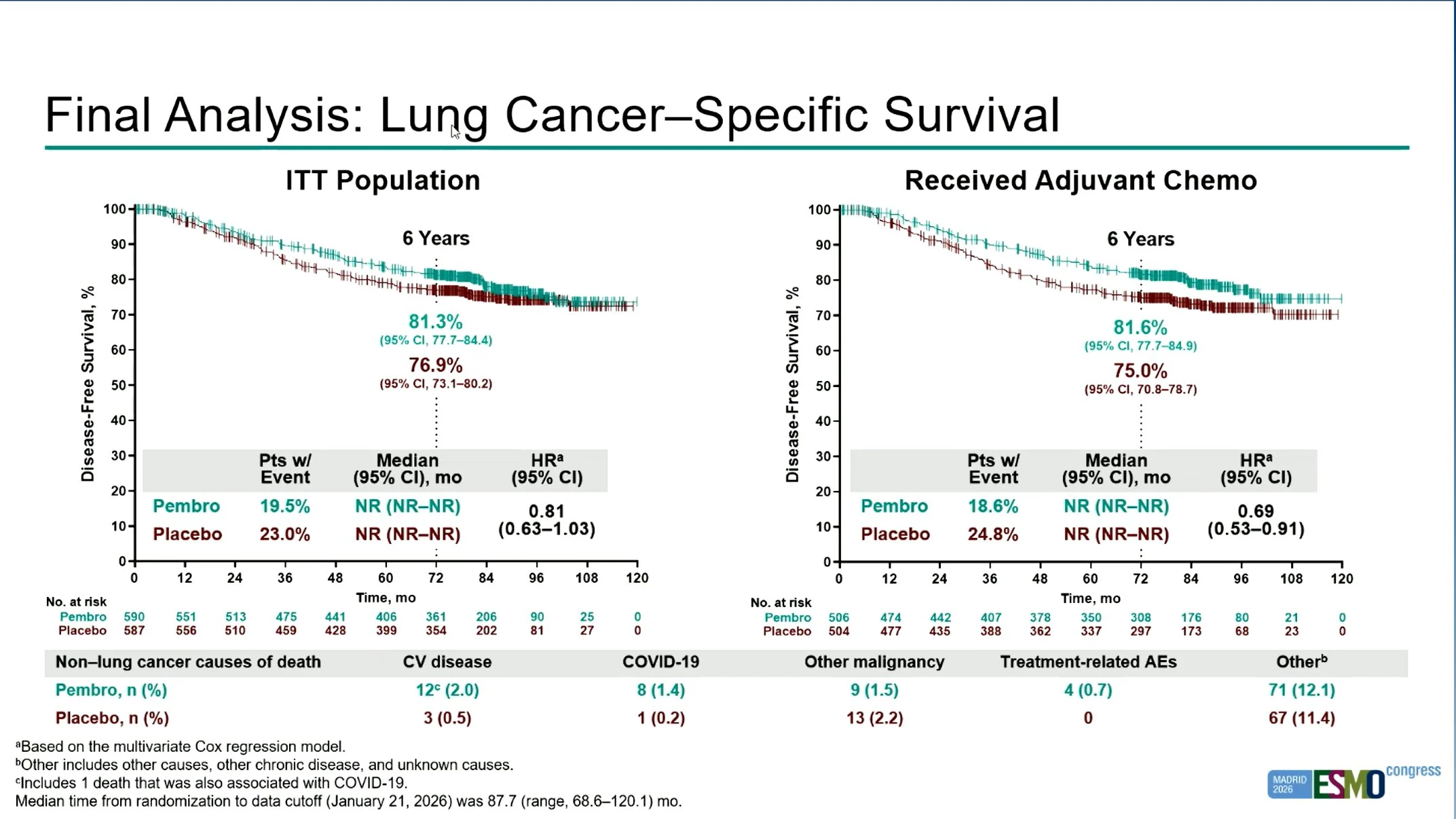
- Lung cancer–specific survival: Six-year LCSS in the ITT population was 81.3% versus 76.9% (HR 0.81; 95% CI 0.63–1.03). Among patients who received adjuvant chemotherapy, six-year LCSS was 81.6% versus 75.0% (HR 0.69; 95% CI 0.53–0.91). Median LCSS was not reached in either arm.
The reported final DFS, OS, and LCSS HRs were based on multivariable Cox regression models.
Safety
Grade ≥3 adverse events occurred in 34.0% of pembrolizumab-treated patients versus 25.6% receiving placebo.
Grade ≥3 immune-mediated adverse events and infusion reactions occurred in 7.9% versus 1.9%, respectively.
The presentation also reported four treatment-related deaths with pembrolizumab versus none with placebo.
Interpretation
The final analysis showed that the previously demonstrated DFS benefit in the overall population remained evident with extended follow-up. DFS findings also favored pembrolizumab among patients who received adjuvant chemotherapy.
However, this improvement did not translate into a demonstrated OS benefit. The ITT OS HR of 0.98 indicates no clear difference between treatment groups over the observed follow-up.
LCSS estimates favored pembrolizumab, particularly in the chemotherapy subgroup. These findings require cautious interpretation and should not be presented as establishing an overall survival benefit or proving that prior chemotherapy predicts benefit from pembrolizumab.
The PD-L1 TPS ≥50% population did not show a clear DFS benefit, despite being a dual-primary-endpoint population. The efficacy findings must also be considered alongside the higher frequency of severe adverse events with pembrolizumab.
Conclusion
After more than seven years of median follow-up, PEARLS/KEYNOTE-091 showed a continued DFS benefit with adjuvant pembrolizumab in completely resected stage IB–IIIA NSCLC, including among patients who received adjuvant chemotherapy.
The final analysis did not establish an OS benefit, and DFS benefit was not established in the PD-L1 TPS ≥50% population. LCSS findings favored pembrolizumab, particularly in the chemotherapy subgroup, but do not override the negative OS result. Severe adverse events were more frequent with pembrolizumab.
GDFather-NEO Trial: Visugromab Plus Nivolumab in Cisplatin-Ineligible MIBC