Final response results from the exploratory phase II GDFather-NEO trial showed numerically higher pathological and radiological response rates with neoadjuvant visugromab plus nivolumab than with nivolumab plus placebo in patients with muscle-invasive bladder cancer (MIBC) who were ineligible for or declined cisplatin-based chemotherapy.
By local review, the pathological complete response (pCR) rate was 33.3% with the combination versus 7.7% with control. Blinded central review also showed numerically higher response rates, although estimates differed between assessments.
Andrea Necchi presented the findings at ESMO 2026.
Background
Neoadjuvant immune checkpoint inhibition is being investigated in MIBC, including in patients who cannot receive or decline cisplatin-based chemotherapy. However, responses to PD-1 blockade remain variable.
Growth differentiation factor 15 (GDF-15) is a candidate mediator of immune resistance. Visugromab is a monoclonal antibody that neutralizes GDF-15 and is being investigated as a means of enhancing antitumor activity with PD-1 inhibition.
GDFather-NEO evaluated the contribution of visugromab to neoadjuvant nivolumab in checkpoint-inhibitor-naïve MIBC.
Methods and Study Design
GDFather-NEO (NCT06059547) was a multicenter, blinded, exploratory phase II trial enrolling patients with newly diagnosed cT2–T4aN0M0 MIBC who were cisplatin-ineligible or declined cisplatin. Other eligibility criteria included predominantly urothelial histology and ECOG performance status 0–1.
Thirty-one patients underwent stratified sequential allocation according to clinical tumor stage and locally assessed PD-L1 combined positive score (CPS):
- Visugromab plus nivolumab (n = 16): Visugromab 20 mg/kg plus nivolumab 480 mg intravenously every four weeks for three cycles.
- Placebo plus nivolumab (n = 15): Placebo plus nivolumab 480 mg on the same schedule.
Restaging CT was followed by radical cystectomy or repeat transurethral resection of the bladder tumor (re-TURBT), performed four to eight weeks after the last dose.
The dual primary endpoints were locally assessed pCR, defined as ypT0 N0/Nx, and objective response rate (ORR) according to RECIST 1.1.
Secondary endpoints included major pathological response (MPR; ≤ypT1 N0/Nx), central pathology and imaging review, event-free survival (EFS), time to relapse, overall survival, safety, and surgical delay. Biomarker analyses were exploratory.
Enrollment occurred between September 2023 and March 2025. The updated data cutoff was July 15, 2026, with median follow-up of 15.7 months. No formal hypothesis testing was planned.
Results
Locally Assessed Responses
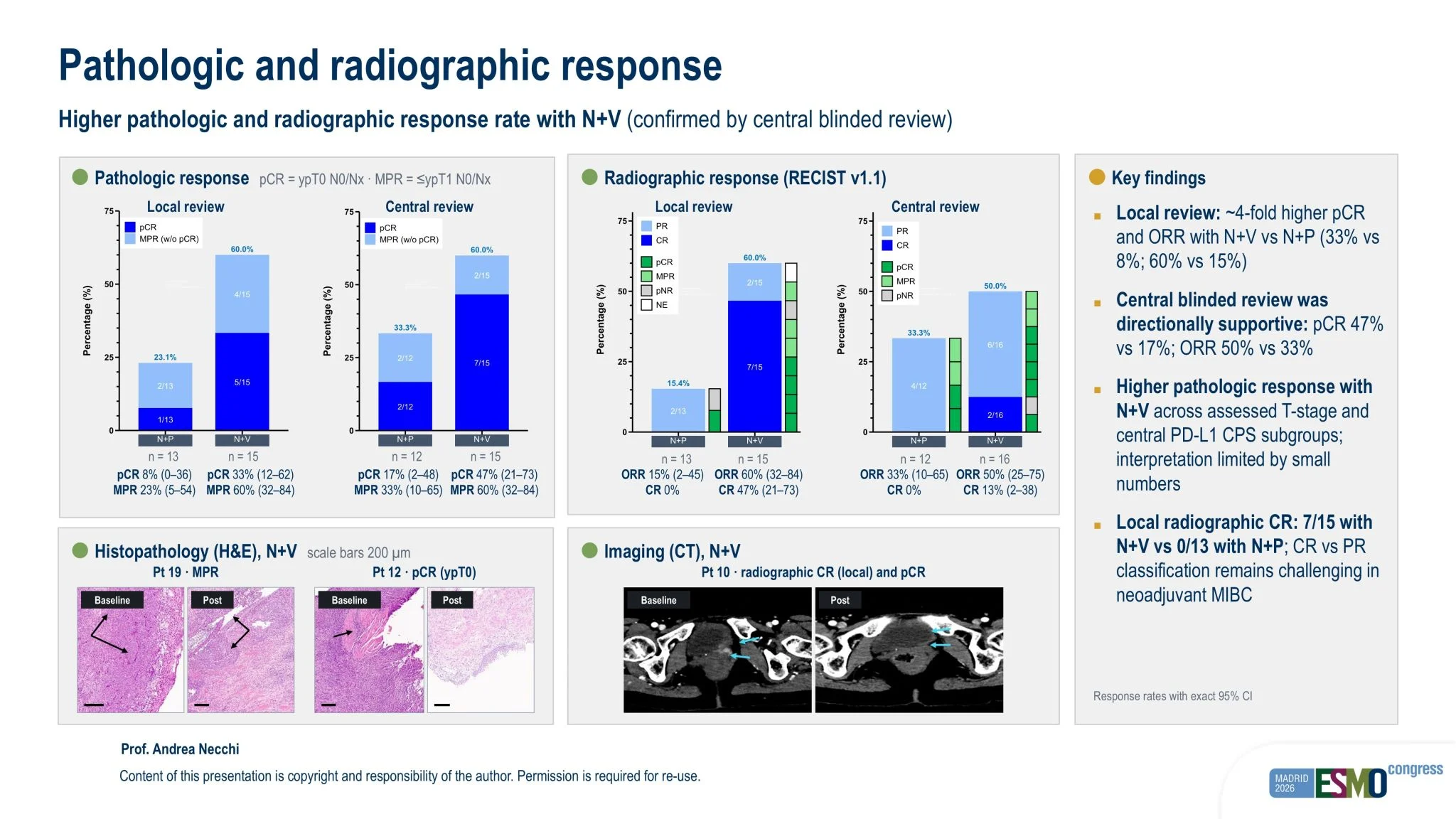
Local response analyses included 15 patients receiving visugromab plus nivolumab and 13 receiving nivolumab plus placebo.
- pCR: Five of 15 patients (33.3%) achieved pCR with the combination versus one of 13 (7.7%) with control.
- MPR: Nine of 15 patients (60.0%) achieved MPR with the combination versus three of 13 (23.1%) with control.
- Radiological response: ORR was 60.0% (9/15) versus 15.4% (2/13).
- Radiological complete response: Seven of 15 combination-arm patients achieved a complete response, compared with none of 13 control-arm patients.
Blinded Central Review
Central review was directionally supportive of higher response rates with the combination, but response classifications and evaluable populations differed from local review.
- pCR: Seven of 15 patients (46.7%) with visugromab plus nivolumab versus two of 12 (16.7%) with control.
- MPR: Nine of 15 patients (60.0%) versus four of 12 (33.3%).
- Radiological response: ORR was 50.0% (8/16) versus 33.3% (4/12).
- Radiological complete response: Two of 16 patients (12.5%) versus none of 12.
The difference between local and central radiological assessments highlights the challenges of distinguishing complete from partial responses in neoadjuvant MIBC.
Follow-Up and Bladder Preservation
At a median follow-up of 15.7 months, the presentation reported no recurrence among patients achieving pCR. Four patients receiving visugromab plus nivolumab who achieved pCR retained their bladder after re-TURBT alone.
These observations warrant further investigation but do not establish the long-term safety of omitting radical cystectomy. The subgroup was very small, and follow-up remained limited.
The supplied slides did not provide a comparative EFS estimate; an EFS benefit therefore cannot be established from these results.
Safety and Biomarkers
Investigators reported no new safety signals. Grade 3–4 treatment-related adverse events and immune-related adverse events were described as similar between arms. No treatment-related discontinuation, death, or surgical delay occurred with visugromab plus nivolumab.
Numerical adverse-event rates were not provided in the supplied presentation slides, limiting a detailed safety comparison.
Exploratory biomarker findings associated response to the combination with a pre-existing proliferative CD8-positive T-cell state. PD-L1 CPS and baseline serum or tumor GDF-15 did not distinguish responders from nonresponders.
These associations remain hypothesis-generating and do not establish a biomarker-based treatment-selection strategy.
Conclusion
Neoadjuvant visugromab plus nivolumab produced numerically higher pCR, MPR, and ORR than nivolumab plus placebo in this small exploratory MIBC trial. Blinded central review supported the direction of the response findings, although estimates differed from local assessment.
The results support further randomized evaluation of GDF-15 inhibition with checkpoint blockade. Mature survival data and prospective bladder-preservation studies are needed before the combination or omission of cystectomy can be considered established approaches.