
Over the past decade, programmed cell death protein 1 (PD-1) blockade has become a cornerstone of systemic cancer therapy. Pembrolizumab, nivolumab, and other PD-1/PD-L1 inhibitors can produce durable responses across multiple malignancies, but their limitations are equally established: many patients never respond, acquired resistance remains common, and activity can be limited in tumors with poorly inflamed or strongly immunosuppressive microenvironments.
Combination therapy has addressed some of these limitations by pairing checkpoint inhibition with additional immune or tumor-microenvironment targets. The trade-off is greater toxicity, treatment complexity, and exposure to multiple systemic agents.
PD-1-based bispecific antibodies take a different approach. Rather than administering two independent drugs, they incorporate PD-1 blockade and a second biological activity within a single engineered molecule. Two of the most clinically advanced strategies combine PD-1 targeting with either CTLA-4 inhibition or VEGF neutralization. Cadonilimab, a PD-1/CTLA-4 bispecific antibody, became the first bispecific cancer immunotherapy approved in China in 2022, while ivonescimab, targeting PD-1 and VEGF, has demonstrated superiority over pembrolizumab monotherapy in a phase III trial.
These developments raise a question that extends beyond whether dual pathway inhibition works: does integrating two mechanisms into one molecule provide a biological or clinical advantage over targeting the same pathways with separate drugs?
The answer will determine whether PD-1-based bispecifics represent simply another form of combination therapy or a distinct therapeutic platform in which molecular architecture can influence where, when, and how dual blockade occurs.
Why One Target May Not Be Enough
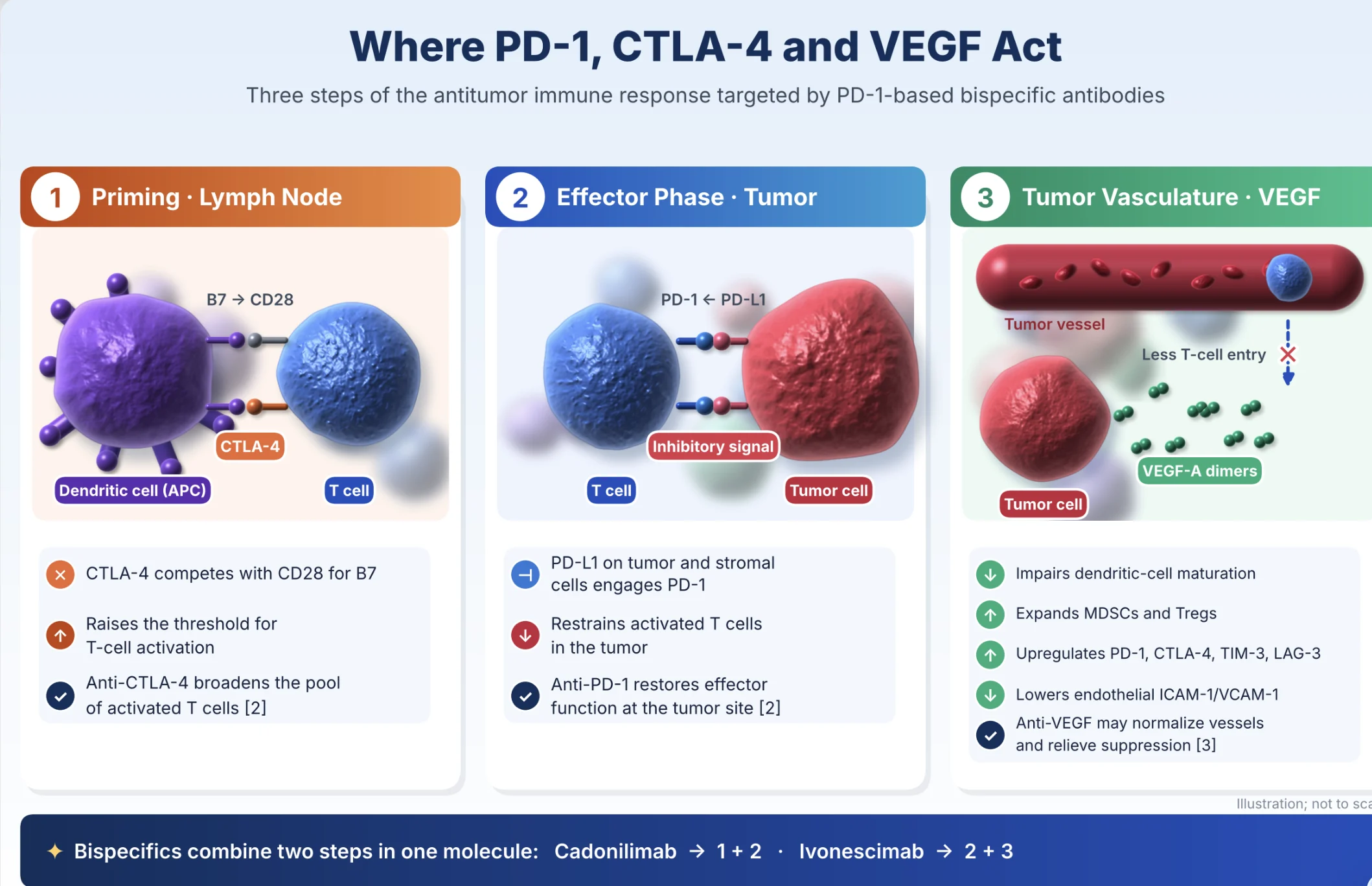
PD-1 and CTLA-4 both suppress T-cell activity, but they operate at different stages of the immune response. CTLA-4 acts predominantly during T-cell priming in lymphoid tissues, where it competes with the costimulatory receptor CD28 and increases the threshold required for T-cell activation. PD-1 acts mainly in peripheral tissues, including the tumor microenvironment, where engagement by PD-L1 restrains the function of previously activated T cells.
Simultaneous inhibition can therefore act at complementary stages: CTLA-4 blockade may broaden the pool of activated tumor-reactive T cells, while PD-1 blockade may help preserve their effector activity within the tumor.
Clinical experience supports the efficacy of this approach, but also demonstrates its toxicity. In the phase III CheckMate 067 trial in melanoma, nivolumab plus ipilimumab produced a median progression-free survival (PFS) of 11.5 months, compared with 6.9 months with nivolumab and 2.9 months with ipilimumab. Grade 3 or 4 treatment-related adverse events occurred in 55% of patients receiving the combination compared with 16% receiving nivolumab alone.
This efficacy–toxicity relationship provides an important rationale for PD-1/CTLA-4 bispecific design: not merely to reproduce dual checkpoint inhibition within one molecule, but potentially to alter its distribution and therapeutic index.
PD-1 and VEGF: Linking Vascular and Immune Suppression
VEGF is central to tumor angiogenesis, but its biological effects extend beyond blood-vessel formation. Experimental studies indicate that VEGF-A can interfere with dendritic-cell maturation, promote myeloid-derived suppressor cells and regulatory T cells, and contribute to inhibitory signaling within effector T cells. VEGF-driven vascular abnormalities can also restrict immune-cell trafficking into tumors.
Antiangiogenic treatment may partly reverse these conditions through vascular normalization and changes in immune-cell infiltration. This provides a mechanistic rationale for combining VEGF inhibition with checkpoint blockade: one component targets immune inhibition directly, while the other may modify vascular and immunosuppressive features of the tumor microenvironment.
The broader combination concept is already clinically validated. In IMbrave150, atezolizumab plus bevacizumab reduced the risk of death compared with sorafenib in unresectable hepatocellular carcinoma.
The question for PD-1/VEGF bispecifics is therefore not whether these pathways can be targeted simultaneously. It is whether placing both activities within a single molecule changes their pharmacology or spatial activity sufficiently to improve clinical outcomes.
One Molecule or Two Drugs?
This is the central scientific question for the bispecific field.
In principle, a single molecule can create properties that two independently administered antibodies do not necessarily share. Simultaneous engagement of both targets may increase avidity where they are co-localized, potentially biasing activity toward particular cellular or tissue environments. Fc engineering can further alter immune-effector functions, while a single molecule simplifies administration.
But bispecific architecture also introduces constraints. The relative exposure to each activity is determined by the molecular design and cannot be titrated independently. If toxicity emerges from one component, that activity cannot simply be discontinued while maintaining the other.
Most importantly, biological elegance does not establish clinical superiority. No randomized trial has yet demonstrated that a PD-1-based bispecific produces better efficacy or a superior therapeutic index than an appropriately matched two-drug combination targeting the same pathways.
That distinction should remain central when interpreting the emerging clinical data.
Cadonilimab: Can Molecular Architecture Improve Dual Checkpoint Blockade?
Cadonilimab (AK104) is a symmetric tetravalent IgG1 bispecific antibody containing two PD-1-binding sites and two CTLA-4-binding sites. Preclinical studies suggest that its tetravalent architecture produces greater binding avidity in environments where PD-1 and CTLA-4 are highly co-expressed, including tumor-infiltrating T cells. The molecule can engage both receptors on the same cell or bridge PD-1- and CTLA-4-expressing cells.
Cadonilimab also incorporates an Fc-null design intended to minimize Fc receptor-mediated effector activity. In vitro, the molecule produced minimal antibody-dependent cellular cytotoxicity, antibody-dependent cellular phagocytosis, and IL-6 or IL-8 release.
Together, these properties provide a plausible mechanism for concentrating dual checkpoint activity in environments where both targets are abundant while limiting some systemic immune effects.
But that remains a hypothesis.
The proposed advantages are derived predominantly from molecular, in vitro, and preclinical studies. No randomized trial has directly compared cadonilimab with nivolumab plus ipilimumab or another matched PD-1/CTLA-4 combination. It therefore remains unknown whether cadonilimab’s molecular architecture produces a clinically meaningful advantage over conventional dual checkpoint blockade.
Ivonescimab: Cooperative Binding Between PD-1 and VEGF
Ivonescimab (AK112/SMT112) is also a tetravalent, Fc-silent bispecific antibody, but combines PD-1 blockade with VEGF-A neutralization.
Its most distinctive proposed property is cooperative binding. Because VEGF exists as a dimer, ivonescimab can form complexes with VEGF that increase its avidity for PD-1. Developer-reported in vitro data indicate more than 18-fold greater PD-1-binding affinity in the presence of VEGF and more than fourfold greater VEGF-binding affinity in the presence of PD-1.
Because VEGF and PD-1-positive immune cells may coexist within the tumor microenvironment, this architecture could theoretically increase drug activity in tissues where both targets are abundant.
However, the mechanistic interpretation requires caution. Much of the cooperative-binding evidence comes from developer presentations rather than independent peer-reviewed studies, and it has not been established that this property is responsible for the clinical efficacy or safety observed with ivonescimab.
The clinical question is therefore not simply whether ivonescimab works, but whether its activity reflects the specific advantages of bispecific engineering or the established biological value of simultaneously inhibiting PD-1 and VEGF.
Ivonescimab in PD-L1-Positive NSCLC: HARMONi-2 and the Comparator Question
HARMONi-2 was a randomized, double-blind phase III trial conducted at 55 centers in China. It enrolled 398 patients with previously untreated, PD-L1-positive advanced NSCLC, defined as tumor proportion score (TPS) ≥1%, without EGFR or ALK alterations.
Ivonescimab significantly prolonged PFS compared with pembrolizumab monotherapy: median PFS was 11.1 versus 5.8 months, corresponding to an HR of 0.51. Objective response rates were 50% and 39%, respectively. A subsequent prespecified interim analysis reported a statistically significant overall survival benefit with ivonescimab.
These results provide important randomized evidence for the clinical activity of a PD-1/VEGF bispecific. Their interpretation, however, depends partly on the comparator.
Pembrolizumab monotherapy is an established first-line option for patients with high PD-L1 expression. In TPS 1–49% disease, its role is less compelling. In KEYNOTE-042, the overall survival benefit in the broader PD-L1-positive population appeared to be driven predominantly by patients with TPS ≥50%; in the exploratory TPS 1–49% subgroup, the HR was 0.92. For many fit patients with TPS 1–49%, chemoimmunotherapy represents the more relevant contemporary standard.
HARMONi-2 therefore demonstrates superiority to pembrolizumab monotherapy, but it does not establish that ivonescimab is superior to the strongest available first-line strategy across the entire PD-L1-positive population.
This is why HARMONi-3 may be particularly important. By comparing ivonescimab plus chemotherapy against pembrolizumab plus chemotherapy in a multiregional population, it will test the drug against a more demanding contemporary comparator.

Ivonescimab in EGFR-Mutant NSCLC: An Immunologically Interesting Signal
EGFR-mutant NSCLC provides a particularly interesting test of the PD-1/VEGF concept because checkpoint inhibition alone has historically shown limited activity in this population.
EGFR-mutant tumors often have relatively low tumor mutational burden and a less inflamed immune microenvironment, while several immunosuppressive mechanisms have been described. Consistent with this biology, PD-1/PD-L1 inhibitors did not improve overall survival over docetaxel among EGFR-mutant patients in pivotal second-line studies.
Against this background, the HARMONi-A results are notable. Ivonescimab plus chemotherapy significantly improved PFS compared with chemotherapy alone after EGFR-TKI therapy, including among patients previously treated with third-generation TKIs and those with brain metastases. The final analysis also demonstrated an OS benefit, with an HR of 0.74.
The global HARMONi study subsequently met its PFS endpoint, although its primary OS analysis narrowly missed statistical significance, with an HR of 0.79 and P=0.057. Longer follow-up produced an HR of 0.76, with consistent results reported across Asian and non-Asian populations.
The biological interpretation remains unresolved.
Because PD-1 blockade alone has generally been ineffective in EGFR-mutant NSCLC, VEGF inhibition may contribute substantially to the observed benefit through direct antiangiogenic activity, modification of VEGF-mediated immunosuppression, or both. Whether ivonescimab actually converts an immunologically unfavorable tumor microenvironment into one more responsive to checkpoint inhibition remains a hypothesis requiring translational validation.
This distinction is important: clinical activity of a PD-1/VEGF molecule does not by itself demonstrate restoration of antitumor immunity.
Cadonilimab and the Question of PD-L1-Low Disease
An important question emerging from the cadonilimab program is whether dual PD-1/CTLA-4 targeting can extend benefit into tumors with lower PD-L1 expression. Signals across PD-L1 subgroups in cervical and gastric cancer make this hypothesis interesting, but they do not establish that cadonilimab specifically overcomes PD-L1-associated resistance.
In the phase III COMPASSION-16 trial, 445 patients with previously untreated persistent, recurrent, or metastatic cervical cancer received cadonilimab or placebo with platinum-based chemotherapy, with or without bevacizumab. Cadonilimab improved median PFS from 8.1 to 12.7 months (HR 0.62) and improved OS (HR 0.64). Approximately one quarter of patients had PD-L1 CPS <1.
In COMPASSION-15, which enrolled 610 patients with HER2-negative gastric or gastroesophageal junction cancer, cadonilimab plus chemotherapy increased median OS from 10.8 to 15.0 months. Benefit was also observed among patients with CPS <5, with an HR of 0.70.
These findings raise a mechanistically interesting question: could adding CTLA-4 inhibition expand antitumor immunity in tumors with limited pre-existing PD-1/PD-L1 sensitivity?
The current trials cannot definitively answer it. PD-L1 subgroup analyses were not the primary endpoints, may have limited statistical power, and compared cadonilimab-containing therapy with chemotherapy rather than with PD-1 blockade plus chemotherapy. Consequently, neither the ability of dual PD-1/CTLA-4 blockade to overcome PD-L1-associated resistance nor an advantage specific to the bispecific format has yet been established.
Direct randomized comparisons will be needed to separate these possibilities.
Pancreatic Cancer: A Provocative but Early Signal
Pancreatic ductal adenocarcinoma is characterized by a strongly immunosuppressive tumor microenvironment and has historically demonstrated limited sensitivity to checkpoint inhibition.
At AACR 2026, the phase II COMPASSION-26 study reported that first-line cadonilimab plus chemotherapy achieved a median PFS of 11.1 months and median OS exceeding 23 months among patients with locally advanced disease.
These results are provocative, but they should not yet be interpreted as evidence that PD-1/CTLA-4 bispecific therapy has overcome immune resistance in pancreatic cancer.
The data come from a subgroup of a single-arm phase II study without a randomized comparator and have primarily been reported through conference and company communications. The particularly favorable results were observed in locally advanced disease, a population with a different prognosis from metastatic pancreatic cancer. A retrospective real-world study of cadonilimab plus nab-paclitaxel and gemcitabine reported a median OS of 11.45 months, illustrating how strongly outcomes may be influenced by patient selection and disease setting.
Randomized evidence will therefore be required before conclusions can be drawn about whether cadonilimab meaningfully changes the biology or clinical course of pancreatic cancer.
Does Bispecific Design Improve the Therapeutic Index?
One of the most attractive arguments for bispecific antibodies is that molecular engineering could improve the therapeutic index: maintaining or increasing efficacy while reducing the toxicity associated with systemic exposure to two independently administered agents.
This remains unproven.
No randomized trial has yet compared a PD-1-based bispecific directly with a matched two-drug regimen targeting the same pathways. Current studies can therefore establish the activity and safety of individual bispecifics, but they cannot determine whether their architecture itself improves the efficacy–toxicity balance.
The available safety data are consistent with the biological mechanisms being targeted. PD-1/VEGF agents produce angiogenesis-associated toxicities such as hypertension and proteinuria, whereas PD-1/CTLA-4 agents produce immune-mediated adverse events involving organs such as the skin, gastrointestinal tract, and endocrine system.
In HARMONi-2, grade ≥3 treatment-related adverse events occurred in 29% of patients receiving ivonescimab and 16% receiving pembrolizumab, while grade ≥3 immune-related adverse events occurred in 7% and 8%, respectively. The excess severe toxicity therefore appears more consistent with the addition of VEGF-related toxicity than with an increase in severe immune-mediated events, although attribution from aggregate adverse-event patterns remains indirect.
In COMPASSION-16, grade ≥3 immune-related adverse events occurred in 10% of patients receiving cadonilimab compared with fewer than 1% receiving placebo, while treatment-related deaths occurred in 4% and 3%, respectively. In COMPASSION-15, treatment-related adverse events resulted in discontinuation in 23.9% versus 6.6% of patients.
Cross-trial comparisons with nivolumab plus ipilimumab or other dual-target regimens are tempting but unreliable because tumor types, treatment backbones, patient populations, dosing, and follow-up differ.
The therapeutic-index hypothesis will ultimately require randomized trials against biologically matched combinations, ideally with efficacy and toxicity endpoints designed to determine whether bispecific architecture itself changes the balance between the two.
Open Questions
Several unresolved questions will determine whether PD-1-based bispecific antibodies become a major therapeutic platform or remain another way of delivering combination therapy.
Do the results generalize? Much of the mature phase III evidence for cadonilimab and ivonescimab has come from China and from developer-sponsored studies. The global HARMONi program and studies such as HARMONi-3 and COMPASSION-37 will therefore be important for evaluating activity across broader populations and against contemporary standards of care.
Is the molecule better than the combination? This remains perhaps the most important unanswered question. Cadonilimab has not been randomized against nivolumab plus ipilimumab, and ivonescimab has not been compared directly with PD-1 blockade plus bevacizumab. Until such studies are available, it will remain difficult to determine how much of the observed benefit results from bispecific engineering and how much simply reflects dual pathway inhibition.
Is PD-L1 sufficient for patient selection? Probably not as a universal biomarker for this increasingly heterogeneous class. For PD-1/VEGF bispecifics, future biomarker strategies may need to integrate immune and angiogenic biology rather than relying on PD-L1 alone. Candidate approaches include measures of CD8-positive T-cell infiltration, inflamed gene-expression profiles, angiogenesis-related signatures, and potentially circulating markers of VEGF biology. For PD-1/CTLA-4 agents, markers reflecting T-cell priming, regulatory T-cell biology, and spatial immune organization may be more relevant. These approaches remain investigational rather than validated selection tools.
What comes after PD-1/CTLA-4 and PD-1/VEGF? The broader platform is already expanding. Bispecific strategies involving PD-1/PD-L1 together with TGF-β, CD47, 4-1BB, LAG-3, and other immune-regulatory pathways are in development.
As these molecules become more complex, the challenge will not simply be adding another target. It will be demonstrating that molecular design changes therapeutic biology in a way that produces a clinically meaningful advantage.
Conclusion
PD-1-based bispecific antibodies represent an important evolution in immuno-oncology. Cadonilimab and ivonescimab show that PD-1 blockade can be incorporated into engineered molecules that simultaneously target another checkpoint or a major component of the tumor microenvironment. Randomized trials have already demonstrated clinically meaningful activity across several disease settings.
The evidence nevertheless requires careful interpretation. Much of the phase III experience remains concentrated in China, comparator selection in key studies remains open to debate, and some of the most provocative signals—including pancreatic cancer—come from uncontrolled early-phase data. Most importantly, current trials demonstrate the activity of dual-targeting molecules, but they do not establish that bispecific architecture itself provides greater efficacy, spatial selectivity, or safety than targeting the same pathways with separate agents.
That distinction will define the next phase of the field. Global randomized trials, clinically relevant comparators, direct evaluation against matched combination strategies, and biomarker programs aligned with the biology of each bispecific will be needed to determine whether these molecules represent a true therapeutic advance over conventional combinations.
If that advantage is demonstrated, the implications extend beyond cadonilimab and ivonescimab. PD-1 may increasingly function less as a standalone therapeutic destination and more as a backbone for spatially and mechanistically coordinated immunotherapy, with molecular engineering determining which additional resistance pathway is targeted—and potentially where that combined activity occurs.
Written by Manushak Ghukasyan, MD