
The phase III HARMONi-2 trial has moved beyond its previously reported progression-free survival advantage to demonstrate a statistically significant overall-survival benefit with ivonescimab, a PD-1/VEGF bispecific antibody, compared with pembrolizumab monotherapy in previously untreated PD-L1–positive advanced non–small cell lung cancer.
Presented at the 2026 World Conference on Lung Cancer in Seoul, the second prespecified interim OS analysis showed a median overall survival of 30.8 months with ivonescimab versus 22.6 months with pembrolizumab, corresponding to a 27% reduction in the risk of death (HR 0.73; 95% CI, 0.57–0.95; P=0.009).
The result is clinically relevant because HARMONi-2 directly compared two chemotherapy-free first-line immunotherapy strategies in patients with PD-L1 tumor proportion score of at least 1% and no sensitizing EGFR or ALK alterations. Ivonescimab had already demonstrated a substantial PFS advantage; the new OS analysis now shows that improved disease control can translate into longer survival.
At the same time, the trial was conducted entirely in China, and the subgroup findings—particularly according to PD-L1 expression, require careful interpretation. The data therefore establish a strong efficacy signal while leaving important questions regarding international generalizability, comparative safety, and the eventual place of ivonescimab within global first-line NSCLC treatment.
HARMONi-2 Directly Tested Dual PD-1 and VEGF Targeting Against Pembrolizumab
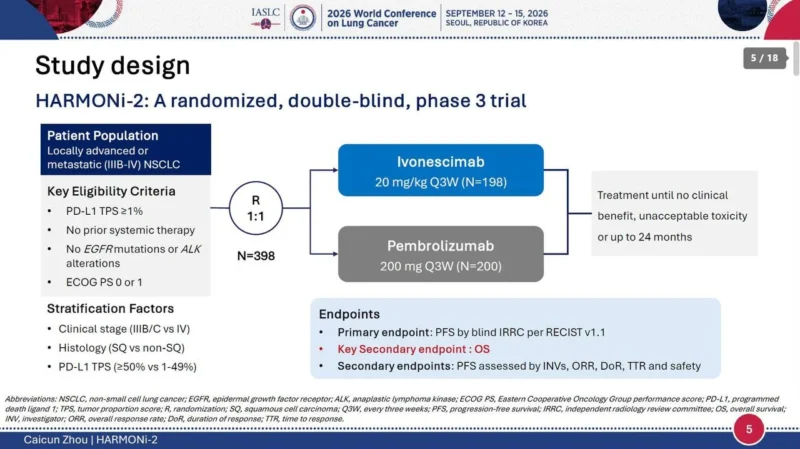
HARMONi-2 was a randomized, double-blind phase III trial enrolling 398 patients with previously untreated stage IIIB–IV NSCLC and PD-L1 TPS ≥1%. Patients were required to have ECOG performance status 0 or 1 and no EGFR mutations or ALK alterations. They were randomized 1:1 to receive:
- ivonescimab 20 mg/kg every three weeks
or
- pembrolizumab 200 mg every three weeks
for up to 24 months or until loss of clinical benefit or unacceptable toxicity.
Randomization was stratified by disease stage, squamous versus nonsquamous histology, and PD-L1 expression of 1%–49% versus ≥50%. The trial’s primary endpoint was independently assessed PFS, while OS was the key secondary endpoint.
The study had already reported median PFS of 11.1 months with ivonescimab versus 5.8 months with pembrolizumab, with an HR of 0.51. The WCLC 2026 analysis addressed the critical next question: whether that PFS benefit would translate into improved survival.
Median Overall Survival Improved by More Than Eight Months
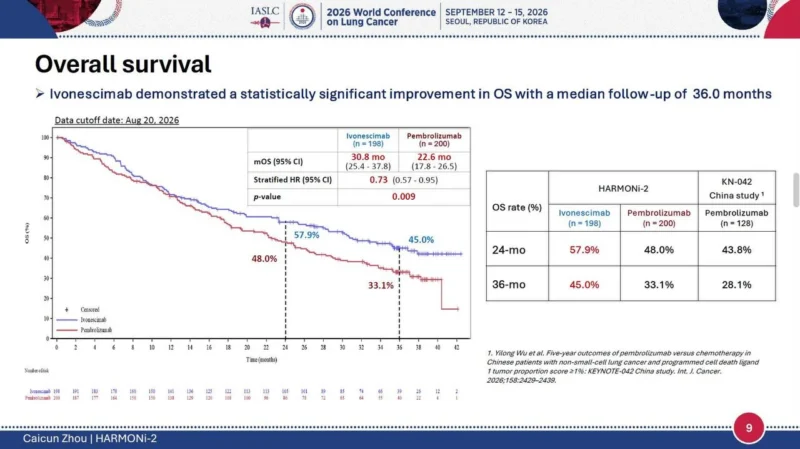
At the August 20, 2026 cutoff, 234 OS events had occurred and median follow-up was approximately 36 months.
Median OS was:
- 30.8 months with ivonescimab
versus
- 22.6 months with pembrolizumab
with a stratified HR of 0.73 (95% CI, 0.57–0.95; P=0.009).
The result crossed the prespecified statistical boundary at the second interim analysis. The landmark survival rates also showed persistent separation. At 24 months, OS was 57.9% with ivonescimab versus 48.0% with pembrolizumab. At 36 months, OS was 45.0% versus 33.1%, respectively.
These data add important context to the median OS difference. Rather than reflecting only an early separation, the survival advantage remained evident three years after randomization.
The OS Result Complements a Strong PFS Signal
HARMONi-2 is particularly notable because the treatment effect is coherent across its major efficacy endpoints. The previously reported PFS HR of 0.51 represented a 49% reduction in the risk of progression or death, with median PFS almost doubling from 5.8 months with pembrolizumab to 11.1 months with ivonescimab.
The current OS analysis demonstrates that this improvement was not limited to radiographic disease control. The OS HR of 0.73 is less pronounced than the PFS HR, which is common in first-line metastatic trials where subsequent therapies can influence survival. Nevertheless, demonstrating statistically significant superiority in both PFS and OS against an established checkpoint inhibitor is an important result.
The trial therefore provides randomized evidence that simultaneously targeting the PD-1 and VEGF pathways can improve long-term outcomes compared with PD-1 blockade alone in this population.
PD-L1–High Disease Showed the Strongest Survival Signal
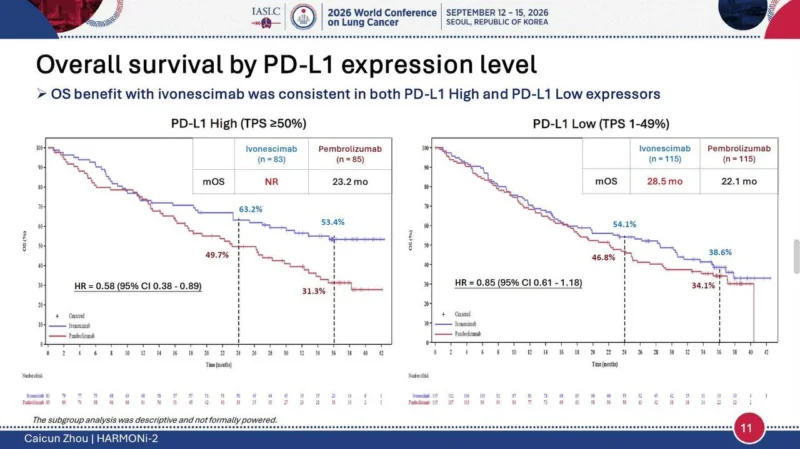
The subgroup analysis by PD-L1 expression is one of the most clinically interesting aspects of the WCLC presentation. Among patients with PD-L1 TPS ≥50%, median OS had not been reached with ivonescimab, compared with 23.2 months with pembrolizumab.
The HR for death was:
- 0.58 (95% CI, 0.38–0.89).
At 24 months, OS was 63.2% versus 49.7%, and by 36 months the difference had widened to 53.4% versus 31.3%.
This is particularly relevant because pembrolizumab monotherapy is an established first-line option for patients with high PD-L1 expression. Demonstrating a survival improvement against that benchmark suggests that adding VEGF pathway engagement within a bispecific molecule may provide meaningful incremental benefit even in tumors already expected to respond relatively well to PD-1 inhibition.
However, the subgroup analysis was descriptive and not formally powered, so the magnitude of benefit should not be treated as a definitive independent estimate.
The PD-L1 1%–49% Population Requires More Caution
Among patients with PD-L1 TPS 1%–49%, median OS was 28.5 months with ivonescimab versus 22.1 months with pembrolizumab.
The HR was:
- 0.85 (95% CI, 0.61–1.18).
The confidence interval crosses 1, meaning that this subgroup analysis does not establish a statistically significant survival benefit on its own. At 24 months, survival was 54.1% versus 46.8%, while at 36 months it was 38.6% versus 34.1%. The direction favored ivonescimab, but the treatment effect was less pronounced than in the PD-L1 ≥50% subgroup.
This distinction is clinically important because pembrolizumab monotherapy is not the dominant first-line strategy for many patients with PD-L1 1%–49% disease in routine international practice. Chemoimmunotherapy is often used because of its greater initial disease-control potential.
HARMONi-2 therefore establishes ivonescimab’s superiority to pembrolizumab monotherapy in the overall PD-L1 ≥1% population, but it does not directly determine how ivonescimab compares with modern chemoimmunotherapy in the PD-L1 1%–49% setting.
 Why Combine PD-1 and VEGF Inhibition?
Ivonescimab is designed to engage both PD-1 and VEGF within a single bispecific molecule.
The biological rationale extends beyond simply combining two established anticancer pathways. VEGF promotes angiogenesis but also contributes to an immunosuppressive tumor microenvironment by affecting immune-cell trafficking, antigen presentation, vascular architecture, and T-cell function.
Simultaneous inhibition of PD-1 and VEGF may therefore enhance antitumor immunity through complementary mechanisms. The HARMONi-2 results provide clinical support for this concept. The PFS and OS improvements suggest that the approach can provide greater antitumor activity than PD-1 blockade alone without requiring cytotoxic chemotherapy.
This chemotherapy-free aspect is important, particularly for patients in whom maintaining long-term treatment tolerability is a priority.
Greater Efficacy Came With More Treatment-Related Toxicity
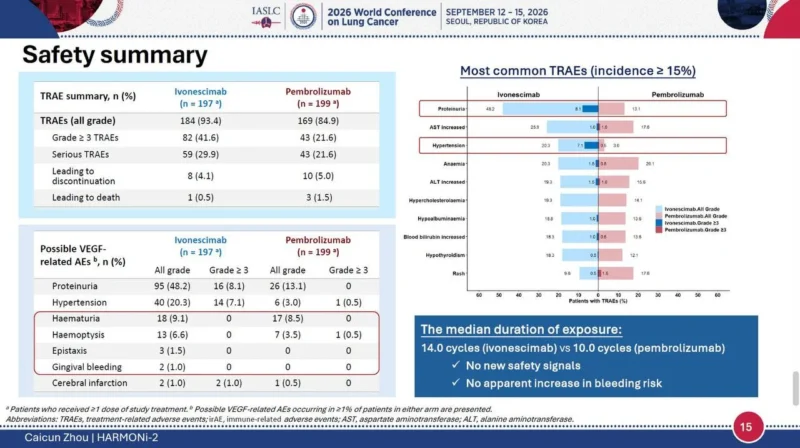
The safety analysis requires a balanced interpretation. Any-grade treatment-related adverse events occurred in 93.4% of patients receiving ivonescimab compared with 84.9% receiving pembrolizumab.
Grade ≥3 TRAEs were also more frequent:
- 41.6% with ivonescimab versus 21.6% with pembrolizumab.
Serious treatment-related adverse events occurred in 29.9% versus 21.6%, respectively. Despite this greater overall toxicity burden, permanent treatment discontinuation due to TRAEs remained relatively similar at 4.1% with ivonescimab and 5.0% with pembrolizumab. Treatment-related deaths occurred in 0.5% and 1.5%, respectively.
The safety profile therefore does not support describing the two therapies as equally toxic. Ivonescimab produced more high-grade treatment-related events, although discontinuation rates remained low. That distinction matters when evaluating the benefit-risk profile of a treatment intended to replace established monotherapy.
VEGF-Related Toxicities Reflect the Drug’s Mechanism
The addition of VEGF inhibition produced a recognizable class-specific toxicity profile. Proteinuria occurred in 48.2% of patients receiving ivonescimab, including grade ≥3 events in 8.1%, compared with 13.1% with pembrolizumab.
Hypertension occurred in 20.3%, with grade ≥3 hypertension in 7.1%, compared with 3.0% and 0.5%, respectively, with pembrolizumab. Bleeding-related events included hematuria, hemoptysis, epistaxis, and gingival bleeding, although most were low grade. The investigators reported no apparent overall increase in clinically significant bleeding risk.
These adverse events are mechanistically consistent with VEGF pathway inhibition and require appropriate blood-pressure, renal, and bleeding surveillance. The median duration of exposure was longer with ivonescimab, 14 treatment cycles versus 10 with pembrolizumab—which should also be considered when comparing crude adverse-event incidence.
Histology Did Not Appear to Eliminate the Benefit
The OS effect was also examined according to histology. For squamous NSCLC, the reported OS HR was 0.65 (95% CI, 0.45–0.95). For nonsquamous NSCLC, the HR was 0.79 (95% CI, 0.55–1.14). As with the PD-L1 analyses, these subgroup comparisons were not independently powered and should not be used to conclude that one histology benefits more than another.
The overall direction of effect was favorable across the prespecified groups, supporting the broader trial result rather than defining separate treatment indications.
The China-Only Population Is the Major Generalizability Question
One of the most important limitations of HARMONi-2 is geographic. All 398 patients were enrolled at centers in China. That does not diminish the internal validity of the randomized comparison, but it does matter when extrapolating the exact magnitude of benefit to populations in Europe, North America, Latin America, and other regions.
Differences in patient characteristics, tumor epidemiology, treatment after progression, supportive care, and other clinical variables can influence both efficacy and survival outcomes.
The control-arm OS is itself relevant to this discussion. The WCLC presentation compared pembrolizumab outcomes from HARMONi-2 with historical data from the Chinese KEYNOTE-042 population, showing broadly compatible results. But cross-trial comparisons cannot substitute for international randomized validation.
For global practice, ongoing and future multinational studies of ivonescimab will therefore be particularly important.
HARMONi-2 Raises a Broader Question About the Future of Immunotherapy
Pembrolizumab helped establish PD-1 blockade as a foundation of first-line NSCLC therapy. The next generation of immunotherapy development is increasingly attempting to improve on checkpoint inhibition not by replacing immune therapy, but by adding a second biologically relevant target within the same treatment strategy.
Ivonescimab represents one of the clearest examples of this evolution. Its success suggests that bispecific immune–angiogenic therapy may provide one pathway beyond conventional single-target checkpoint inhibition. The implications extend beyond this individual drug. Multiple bispecific antibodies targeting combinations of immune checkpoints, angiogenic pathways, and tumor-associated antigens are advancing through clinical development.
HARMONi-2 provides phase III evidence that this strategy can translate into both PFS and OS superiority against an established immunotherapy comparator.
How Should the Result Be Viewed Clinically?
For patients with PD-L1–positive, EGFR/ALK-negative advanced NSCLC, HARMONi-2 demonstrates that ivonescimab can outperform pembrolizumab monotherapy. The evidence is particularly compelling in the overall trial population and appears strongest among patients with PD-L1 TPS ≥50%. However, treatment selection cannot yet be reduced to ivonescimab versus pembrolizumab alone.
In contemporary clinical practice, first-line options depend on histology, PD-L1 expression, disease burden, symptoms, comorbidities, molecular testing, and whether rapid tumor reduction is required. Many patients—particularly those with PD-L1 1%–49% disease—receive chemoimmunotherapy rather than checkpoint-inhibitor monotherapy.
HARMONi-2 therefore answers an important but specific question: ivonescimab is superior to pembrolizumab monotherapy in the studied population. It does not establish superiority over every contemporary first-line NSCLC regimen.
The Bottom Line
HARMONi-2 now demonstrates improvement in both major time-to-event endpoints with ivonescimab versus pembrolizumab in previously untreated PD-L1–positive advanced NSCLC. With approximately three years of follow-up:
- Median OS: 30.8 vs 22.6 months
- OS HR: 0.73
- 24-month OS: 57.9% vs 48.0%
- 36-month OS: 45.0% vs 33.1%
These results follow the previously reported PFS improvement:
- Median PFS: 11.1 vs 5.8 months
- PFS HR: 0.51
The survival signal appeared particularly pronounced in PD-L1–high disease, where the OS HR was 0.58, although subgroup analyses were descriptive.
Ivonescimab was associated with more treatment-related toxicity, particularly proteinuria and hypertension consistent with VEGF inhibition, but permanent treatment discontinuation remained uncommon. HARMONi-2 therefore provides important phase III evidence that dual PD-1/VEGF targeting can improve survival beyond PD-1 blockade alone without chemotherapy.
The next question is no longer whether ivonescimab can outperform pembrolizumab in this setting. It is how this strategy will compare with contemporary chemoimmunotherapy, whether the magnitude of benefit is reproduced internationally, and which patients derive the greatest advantage from combined immune and angiogenic inhibition.