Osteosarcoma remains a difficult setting for immunotherapy. Despite the success of immune checkpoint blockade across multiple malignancies, osteosarcoma is typically characterized by limited T-cell infiltration, prominent immunosuppressive myeloid populations, and a dense extracellular matrix that contributes to an immunologically cold tumor microenvironment. At the same time, doxorubicin, a cornerstone of osteosarcoma chemotherapy, can induce immunogenic cell death but rarely generates sufficient immune activation to overcome this environment on its own.
A 2026 study by Matsuo et al., “Collagen targeting IL-12 combined with doxorubicin enhances the anti-tumor effect against osteosarcoma,” explores a different strategy: rather than trying to bypass the collagen-rich extracellular matrix, the investigators use collagen itself as an anchor for localized immunotherapy.
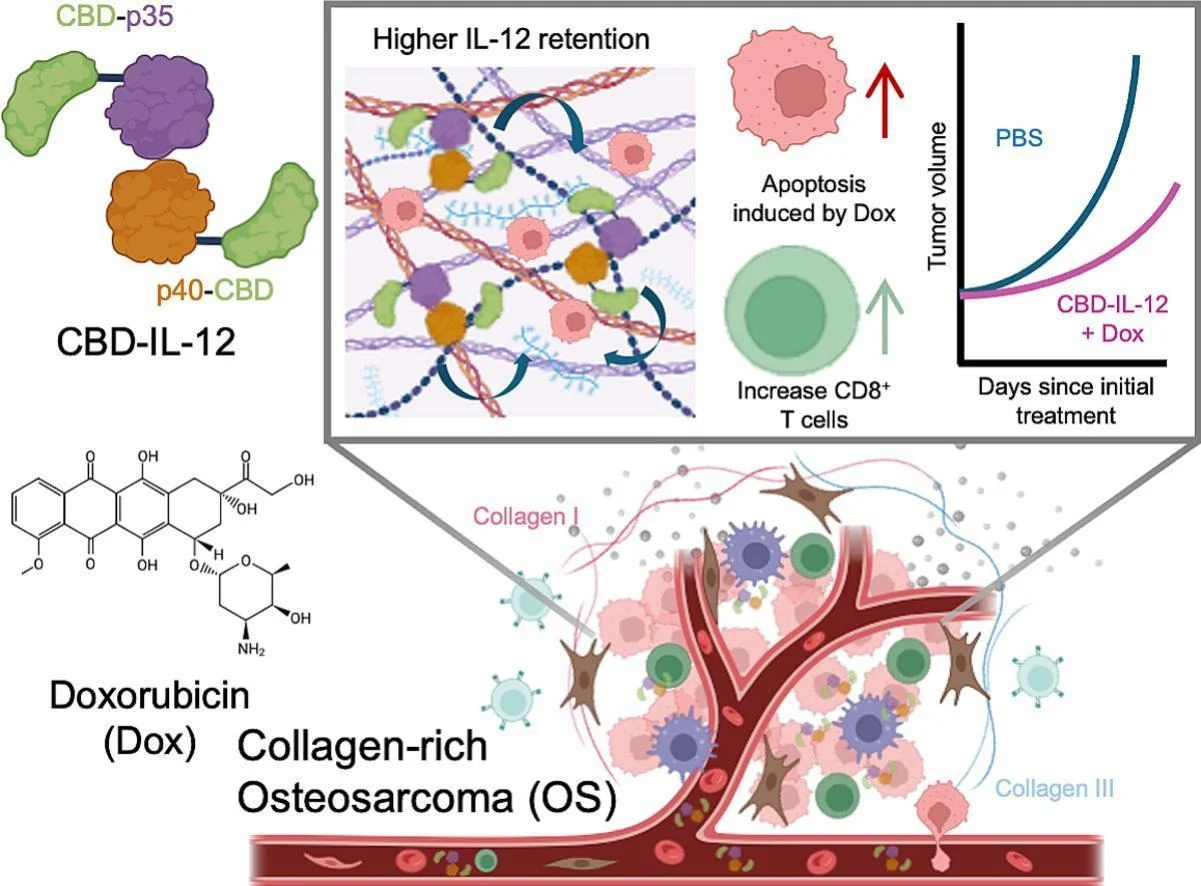
The approach couples interleukin-12 (IL-12) to the A3 collagen-binding domain (CBD) of von Willebrand factor, creating CBD-IL-12. The goal is to concentrate IL-12 within collagen-rich osteosarcoma tissue while limiting systemic cytokine exposure. Doxorubicin is then added to provide tumor-cell killing and immunogenic signals that may complement local IL-12-driven immune activation.
In murine osteosarcoma models, the combination increased local immune activity, prolonged survival, reduced experimental pulmonary metastatic burden, and produced substantially less systemic inflammatory exposure than unmodified IL-12.
The work remains entirely preclinical, but it raises an interesting immuno-oncology concept: a structural feature associated with immune exclusion may also provide the address for delivering immune activation directly into the tumor.
Osteosarcoma Institute Research Grants 2026–2027
Collagen as a Therapeutic Anchor
The extracellular matrix is often discussed as an obstacle to antitumor immunity. Dense collagen networks can contribute to abnormal tissue architecture and impaired immune-cell penetration. In osteosarcoma, however, collagen is particularly relevant because malignant osteoid and the surrounding tumor matrix provide abundant extracellular structural proteins.
The investigators first asked whether collagen I and III were sufficiently represented in osteosarcoma to support a collagen-targeted strategy.
Analysis of human transcriptomic data showed significantly increased COL3A1 expression in osteosarcoma compared with normal bone, while COL1A1 did not differ significantly. Importantly, collagen expression was preserved in lung metastatic samples. Proteomic analysis also detected COL1A1 in 29 of 33 osteosarcoma samples and COL3A1 in 6 of 33, while immunofluorescence demonstrated collagen I and III networks in both murine and human osteosarcoma tissue.
This provided the structural basis for CBD-IL-12.
After intravenous administration in BVM03O osteosarcoma-bearing mice, CBD-IL-12 achieved approximately fourfold greater tumor accumulation than an equimolar dose of unmodified IL-12. Importantly, enhanced accumulation was observed in the tumor without a corresponding increase in the other evaluated organs.
The extracellular matrix was therefore no longer simply a physical component of the immunosuppressive microenvironment. It became a retention platform for cytokine delivery.
Localizing IL-12 Changes the Immune Contexture, but Is Not Sufficient Alone
IL-12 is an attractive antitumor cytokine because it can promote Th1 immunity, stimulate cytotoxic lymphocytes and induce IFNγ-mediated immune activation. Its clinical development, however, has historically been constrained by systemic inflammatory toxicity. The challenge is therefore not simply whether IL-12 can activate antitumor immunity, but whether sufficient cytokine activity can be generated inside the tumor without producing excessive systemic exposure.
CBD-IL-12 produced measurable immune remodeling in the osteosarcoma model.
In untreated tumors, CD8+ T cells represented only 0.7% of CD45+ cells. CBD-IL-12 increased CD8+ T-cell infiltration approximately 2.2-fold, while the proportion of effector-memory CD8+ T cells increased approximately twofold.
Yet immune infiltration did not translate into durable tumor control.
CBD-IL-12 transiently slowed BVM03O tumor growth, but tumors subsequently resumed progression. The observation is important because it separates immune activation from therapeutic sufficiency. Increasing intratumoral T cells alone was not enough to produce sustained control of established osteosarcoma in this model.
That created the rationale for combining localized cytokine activation with tumor-cell killing.
Doxorubicin Provides an Immunogenic Signal
Doxorubicin is generally considered primarily through its cytotoxic effects, including DNA intercalation and topoisomerase II inhibition. But anthracyclines can also induce immunogenic forms of tumor-cell death, releasing danger-associated molecular patterns that influence dendritic-cell recruitment and antigen presentation.
In the current study, doxorubicin treatment increased extracellular HMGB1, a damage-associated molecular pattern associated with immunogenic cell death. In vivo, doxorubicin produced approximately threefold greater TUNEL positivity than control treatment and decreased Ki67 and CD31 expression, indicating effects on apoptosis, proliferation and tumor vasculature.
Despite these biological effects, the low-dose doxorubicin regimen used in the BVM03O model did not significantly suppress tumor growth as monotherapy.
The two components therefore addressed different limitations. Doxorubicin could kill tumor cells and generate immunogenic signals but did not generate durable tumor control. CBD-IL-12 could recruit and activate immune populations but also produced only transient control.
Their combination was designed to connect the two processes: tumor-cell death and antigen release followed by localized immune amplification.
CBD-IL-12 Plus Doxorubicin Extends Survival Across Two Osteosarcoma Models
The combination produced stronger antitumor activity than either biological mechanism achieved alone.
In the BVM03O model, CBD-IL-12 initially delayed tumor growth for approximately one week. When combined with doxorubicin, suppression was maintained for approximately 20 days after treatment initiation. Median survival was prolonged by 12 days compared with PBS and by 6 days compared with CBD-IL-12 alone.
The investigators then tested the strategy in the independent K7M2 osteosarcoma model. Again, the combination suppressed tumor growth, in this case for approximately two weeks, and extended median survival by 7 days compared with PBS-treated animals, without significant body-weight loss.
These are modest survival extensions in mouse models rather than evidence of curative efficacy, but reproducibility across two biologically distinct osteosarcoma models strengthens the preclinical signal.
More interesting from an IO perspective is what occurred inside the tumors.
The Combination Recruits cDC1 and Expands an Effector CD8+ Population
The immune analysis suggests that the combination does more than simply add cytokine activity to chemotherapy.
Compared with doxorubicin alone, CBD-IL-12 plus doxorubicin increased the overall number of intratumoral CD45+ immune cells. The combination also significantly increased KLRG1+CD127− CD8+ T cells, a differentiated effector population associated with immediate cytotoxic activity.
A particularly relevant finding involved dendritic cells.
The combination increased conventional dendritic cells and, specifically, XCR1+ cDC1, while also increasing CD80 expression on dendritic cells. cDC1 are central to antitumor immunity because of their capacity for cross-presentation of tumor-derived antigens to CD8+ T cells.
The macrophage compartment also shifted, with a higher M1-like/M2-like macrophage ratio after combination therapy.
Together, these observations suggest a plausible immunological sequence: doxorubicin damages tumor cells and releases immunogenic material; dendritic-cell recruitment and activation increase in the presence of tumor-localized IL-12; cDC1 can process and cross-present tumor antigens; and the CD8+ compartment shifts toward a more differentiated cytotoxic state.
The study does not formally prove every step of this causal sequence. Nevertheless, the concurrent HMGB1 release, cDC1 enrichment and effector CD8+ expansion support the proposed interaction between chemotherapy-induced tumor-cell death and IL-12-mediated immune activation.
Can Tumor Targeting Solve the IL-12 Toxicity Problem?
The therapeutic potential of IL-12 has been recognized for decades, but systemic administration has been limited by a narrow therapeutic window and substantial inflammatory toxicity.
The collagen-binding strategy attempts to change the pharmacological distribution of the cytokine rather than weaken its immune activity.
This distinction became apparent in the toxicity experiments.
Systemic unmodified IL-12, alone or with doxorubicin, produced high circulating IFNγ concentrations approaching 100 ng/mL by day 3. In contrast, circulating IFNγ concentrations with CBD-IL-12 and CBD-IL-12 plus doxorubicin were approximately 10-fold lower at the same time point.
The difference was also reflected in liver toxicity. ALT was significantly increased in mice receiving unmodified IL-12 or IL-12 plus doxorubicin compared with the corresponding CBD-IL-12 groups. The investigators did not detect significant short-term changes in BUN, creatinine, blood counts, or histological damage in the evaluated major organs with the collagen-targeted combination.
These findings should be interpreted cautiously because the experiments involved very small animal cohorts and short toxicity assessment periods. They do not establish clinical safety.
Still, they address one of the central translational problems of cytokine immunotherapy: how to uncouple strong intratumoral immune activation from systemic cytokine exposure.
Targeting Pulmonary Metastases Through Their Matrix
The metastatic experiment may be particularly relevant to osteosarcoma, where pulmonary metastasis represents a major clinical challenge.
The investigators used an experimental K7M2 lung metastasis model to determine whether systemically administered CBD-IL-12 could distinguish tumor-bearing lung tissue from healthy lung.
It did.
CBD-IL-12 accumulation was significantly greater in lungs containing osteosarcoma metastases than in healthy lungs, while accumulation in the other evaluated organs remained comparable. Immunofluorescence further showed localization of IL-12 at tumor sites rather than preferential distribution throughout healthy lung tissue.
Therapeutically, doxorubicin alone did not significantly reduce the metastatic mCherry signal. CBD-IL-12 monotherapy and the combination both reduced metastatic signal, while CBD-IL-12 plus doxorubicin reduced total radiance to levels comparable with healthy mice in this experimental model.
The result is intriguing because the targeting mechanism does not depend directly on a tumor-cell surface antigen. Instead, the therapy recognizes an extracellular structural feature retained within the metastatic niche.
This could theoretically offer an advantage in heterogeneous tumors in which cancer-cell antigen expression varies between clones or changes under therapeutic pressure. However, whether collagen accessibility and CBD-mediated retention are sufficiently consistent across human osteosarcoma metastases remains unanswered.
From an Immune Barrier to a Drug-Delivery Compartment
Perhaps the most interesting conceptual aspect of the study is the reinterpretation of the extracellular matrix.
Collagen-rich tumor stroma is usually discussed in immuno-oncology as part of the problem. Dense extracellular matrix can contribute to immune exclusion, altered tissue mechanics and restricted drug distribution.
Here, that same matrix becomes part of the therapeutic design.
Instead of eliminating collagen to improve drug penetration, the investigators exploit exposed collagen I and III as a local reservoir for immune activation. The collagen-binding domain retains IL-12 in the tumor environment, increasing local exposure while reducing systemic cytokine concentrations.
This approach therefore differs from conventional tumor targeting based on malignant-cell antigens. The target is not necessarily a molecule uniquely expressed by cancer cells; it is a structural property of the tumor microenvironment that becomes accessible because of tumor architecture and vascular abnormalities.
That distinction could be important beyond osteosarcoma. It suggests that extracellular-matrix components associated with immune resistance may also be exploitable as spatial anchors for cytokines or other immune-modulating agents.
The Translational Gap Remains Substantial
The results provide mechanistic support for collagen-targeted IL-12, but they remain preclinical.
The therapeutic experiments were performed in murine BVM03O and K7M2 models. Although the investigators demonstrated collagen expression in human osteosarcoma tissue and used human transcriptomic and proteomic datasets to support the targeting rationale, there are no human pharmacokinetic, safety or efficacy data for this particular osteosarcoma strategy in the study.
Several questions therefore remain before clinical translation.
First, collagen abundance alone may not determine effective targeting. Accessibility of collagen to a circulating fusion protein, vascular permeability, matrix architecture and intratumoral heterogeneity could all influence drug distribution.
Second, IL-12 toxicity cannot be considered resolved on the basis of short-term mouse experiments. Even if tumor targeting substantially reduces systemic cytokine exposure, the therapeutic window will need careful evaluation in humans.
Third, the immune mechanism requires deeper characterization. Increased cDC1 and cytotoxic CD8+ populations are consistent with enhanced antitumor immunity, but the study does not establish whether the therapeutic effect requires specific T-cell clones, whether durable immunological memory develops, or whether tumors eventually acquire immune escape mechanisms.
Finally, the experimental metastatic model cannot reproduce the full biological complexity of spontaneous human pulmonary metastases.
The study should therefore be viewed as a mechanistically informative proof of concept rather than evidence that CBD-IL-12 plus doxorubicin is ready to alter osteosarcoma treatment.