Natural killer (NK) cells are a specialized population of cytotoxic lymphocytes that belong to the innate immune system and represent one of the body’s first lines of defense against cancer. Unlike T cells, which require antigen presentation and prior immune priming, NK cells can rapidly recognize and eliminate malignant cells without prior sensitization, allowing them to respond within hours of cellular transformation.
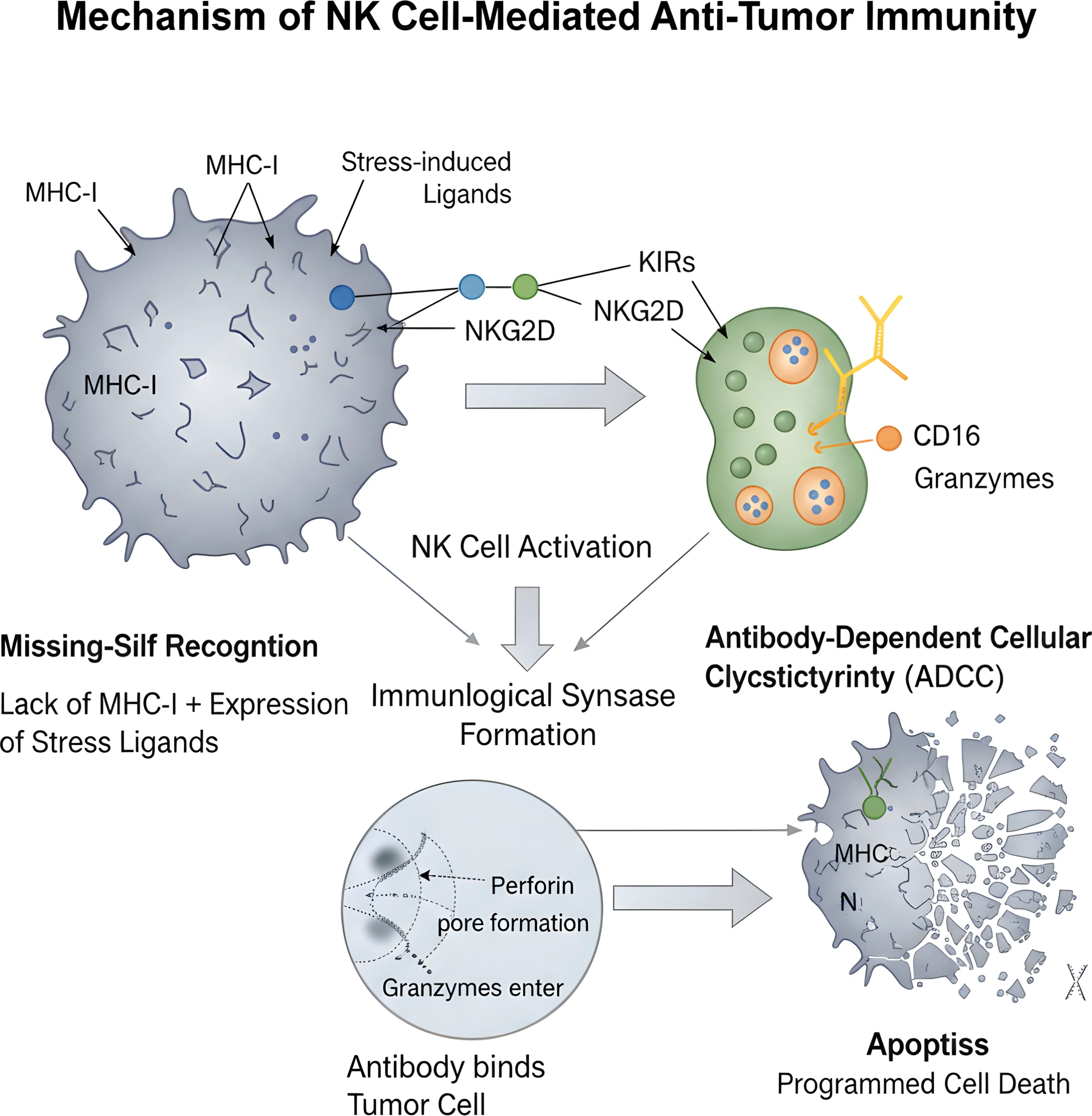
Their activity is governed by a delicate balance between activating and inhibitory receptors. Under physiological conditions, healthy cells express major histocompatibility complex class I (MHC-I) molecules that engage inhibitory receptors on NK cells and prevent immune attack. During malignant transformation, however, many tumor cells lose MHC-I expression while simultaneously increasing stress-induced ligands such as MICA, MICB, and ULBPs. This phenomenon—known as “missing-self” recognition—removes inhibitory signals and triggers NK-cell activation.
Once activated, NK cells eliminate cancer cells through several complementary mechanisms. They release perforin and granzymes that induce apoptosis, activate death receptor pathways through Fas ligand (FasL) and TRAIL, mediate antibody-dependent cellular cytotoxicity (ADCC) via CD16, and produce cytokines including interferon-γ (IFN-γ) and tumor necrosis factor-α (TNF-α), which stimulate dendritic cells, macrophages, and cytotoxic T lymphocytes, thereby linking innate and adaptive immunity.
Because NK cells recognize tumors independently of antigen presentation, they remain active against cancers that evade T-cell immunity through MHC-I downregulation. Moreover, NK-cell therapies generally carry a lower risk of cytokine release syndrome, neurotoxicity, and graft-versus-host disease than engineered T-cell therapies, making them attractive candidates for allogeneic “off-the-shelf” cellular immunotherapy.
Why Are NK Cells Attracting So Much Attention?
The remarkable success of immune checkpoint inhibitors and CAR-T cell therapy has transformed cancer treatment. Nevertheless, many patients fail to respond, others eventually develop acquired resistance, and CAR-T therapy continues to face significant challenges, including individualized manufacturing, prolonged production times, cytokine release syndrome, immune effector cell-associated neurotoxicity syndrome (ICANS), and limited efficacy in most solid tumors.
NK cells offer a fundamentally different therapeutic approach. Their ability to recognize malignant cells independently of MHC presentation enables them to target tumors that have escaped T-cell surveillance. Their favorable safety profile, compatibility with allogeneic manufacturing, and broad antitumor activity have made NK cells one of the fastest-growing areas of cellular immunotherapy research.
Two Recent Reviews Highlight the Rapid Evolution of NK-Cell Immunotherapy
The rapidly expanding field of NK-cell therapy is comprehensively summarized in two recent reviews.
The first, “NK Cell Therapy: A Rising Star in Cancer Treatment,” by Nawen Du, Feifei Guo, Yufeng Wang, and Jiuwei Cui, provides an overview of NK-cell biology, mechanisms of tumor recognition, immune evasion, and the major therapeutic strategies currently under development, including allogeneic NK-cell products, CAR-NK cells, cytokine-based approaches, immune checkpoint blockade, and combination therapies.
Complementing this work, “A New Era of Natural Killer Cell Immunotherapy in Tumor Treatment: Latest Advances and Cutting-Edge Perspectives from Basic Research to Clinical Practice,” by Xin Du, Shixin Shi, and Haiyan Liu, focuses on emerging translational and clinical evidence. The review summarizes recent clinical studies evaluating cytokine-induced memory-like NK cells, antibody-directed NK-cell therapies, checkpoint inhibitor combinations, strategies to overcome the immunosuppressive tumor microenvironment, and the future direction of NK-cell immunotherapy.
Together, these reviews illustrate how NK-cell therapy is rapidly evolving from an experimental concept into one of the most promising next-generation immunotherapy platforms.
Why NK Cells Are Different From T Cells
Unlike cytotoxic T lymphocytes, NK cells do not require peptide antigens to be presented through MHC molecules before initiating an immune response.
Many cancers evade adaptive immunity by downregulating MHC-I expression, effectively becoming invisible to T cells. Ironically, this same immune escape mechanism increases susceptibility to NK-cell attack. NK cells continuously monitor tissues for the loss of inhibitory MHC-I signals while simultaneously detecting stress-induced activating ligands expressed by transformed cells.
This unique biology allows NK cells to eliminate a broad spectrum of malignant cells regardless of tumor-specific antigen expression, making them particularly attractive for treating tumors that have become resistant to checkpoint inhibitors or T-cell–based therapies.
Current Therapeutic Strategies in NK-Cell Immunotherapy
As summarized by Nawen Du and colleagues, several complementary strategies are currently being explored to maximize NK-cell activity.
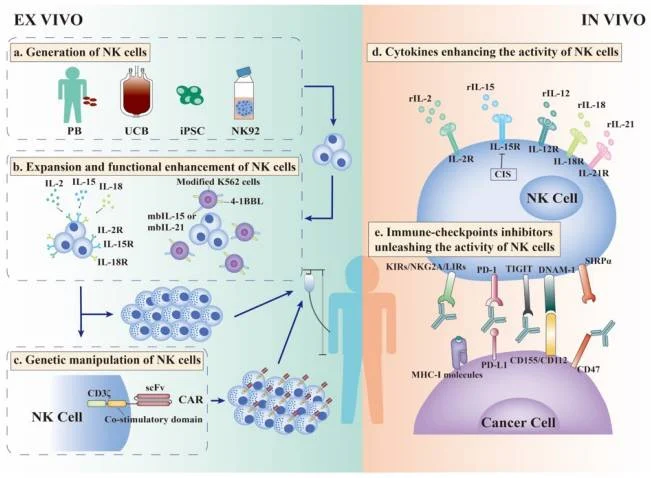
One of the most advanced approaches is the development of allogeneic NK-cell therapies, which can be manufactured from healthy donors, umbilical cord blood, induced pluripotent stem cells (iPSCs), or established NK-cell lines. Because NK cells rarely induce graft-versus-host disease, these products can potentially be manufactured in advance and administered as standardized “off-the-shelf” therapies.
Another rapidly growing area is CAR-NK therapy, in which NK cells are genetically engineered with chimeric antigen receptors to recognize specific tumor antigens. CAR-NK cells combine the antigen specificity of CAR technology with the intrinsic safety profile of NK cells and have already demonstrated encouraging activity in both hematologic malignancies and early solid tumor studies.
Additional strategies include cytokine support—particularly IL-15 agonists—to enhance NK-cell expansion and persistence, together with NK-specific immune checkpoint inhibitors targeting NKG2A, KIR, TIGIT, TIM-3, LAG-3, PD-1, and CD47/SIRPα.
Clinical Data on Non–CAR NK-Cell Therapy
While CAR-NK therapies have received considerable attention, the review by Xin Du, Shixin Shi, and Haiyan Liuhighlights several clinically important approaches that do not require genetic engineering.
These include adoptive allogeneic NK-cell infusion, cytokine-induced memory-like NK cells, antibody-armed NK cells, and combinations with immune checkpoint inhibitors. Collectively, these strategies aim to improve NK-cell persistence, enhance tumor recognition, and overcome immune suppression within the tumor microenvironment.
Cytokine-Induced Memory-Like NK Cells
One of the most important recent developments is the generation of cytokine-induced memory-like (CIML) NK cells.
Conventional NK cells often persist for only a limited period after infusion. To enhance their functional capacity, NK cells can be briefly exposed ex vivo to IL-12, IL-15, and IL-18 before infusion. This short cytokine stimulation induces durable epigenetic and transcriptional reprogramming, enabling NK cells to mount a stronger response upon subsequent encounters with tumor cells.
Unlike conventionally expanded NK cells, which frequently disappear within one or two weeks, CIML-NK cells have been detected for several months and, in some patients, for more than one year following infusion.
The review summarizes encouraging early clinical data in relapsed or refractory acute myeloid leukemia, where CIML-NK therapy produced:
- Overall response rate: 55% (5 of 9 patients)
- Complete response rate: 45% (4 of 9 patients)
- Prolonged in vivo persistence compared with conventional NK cells
- Sustained expansion without prolonged high-dose IL-2 administration
Although based on a small cohort, these findings represent one of the strongest early clinical signals for non-genetically engineered NK-cell therapy.
Antibody-Armed NK Cells Show Remarkable Early Activity
Another promising strategy involves redirecting native NK cells using bispecific antibodies rather than genetic engineering.
One of the best examples discussed in the review is AFM13, a bispecific antibody that simultaneously binds CD30 on lymphoma cells and CD16A on NK cells. Before infusion, donor-derived NK cells are precomplexed with AFM13, allowing them to specifically target CD30-positive tumor cells while retaining their natural cytotoxic machinery.
Early clinical results in relapsed or refractory CD30-positive lymphoma were particularly impressive:
- Overall response rate: 92.9%
- Complete response rate: 66.7%
- Two-year overall survival: 76.2%
- Eleven patients maintained complete remission for approximately 14–40 months
Although these findings originate from an early-phase study, they demonstrate the potential of antibody-directed NK-cell therapy to substantially enhance antitumor efficacy without requiring permanent genetic modification.
Combining NK Cells With Immune Checkpoint Inhibitors
The review also discusses emerging evidence supporting combinations of NK-cell therapy with immune checkpoint inhibitors.
While PD-1/PD-L1 blockade is primarily designed to restore exhausted T-cell function, increasing evidence suggests that tumor-infiltrating NK cells also express inhibitory receptors including PD-1, TIGIT, and TIM-3. Blocking these pathways may therefore enhance the activity of infused NK cells.
In patients with chemotherapy-resistant biliary tract cancer, allogeneic SMT-NK cells combined with pembrolizumab achieved:
- Disease control rate: 73.9%
- Median progression-free survival: 4.1 months
Although preliminary, these findings suggest that checkpoint inhibition may potentiate NK-cell activity beyond what can be achieved with NK-cell therapy alone.
Why Antibody Combinations Are Particularly Attractive
NK cells naturally express CD16A, the receptor responsible for antibody-dependent cellular cytotoxicity.
When therapeutic antibodies bind tumor-associated antigens, NK cells recognize the Fc portion of these antibodies and become rapidly activated. This mechanism provides a compelling rationale for combining NK-cell therapy with monoclonal antibodies such as rituximab, trastuzumab, cetuximab, or novel bispecific NK-cell engagers.
Rather than relying solely on stress-ligand recognition, antibodies provide NK cells with an additional, highly specific mechanism for identifying malignant cells, thereby improving tumor targeting and cytotoxic activity.
Why Conventional NK-Cell Therapy Has Been Less Successful
Despite their favorable safety profile, early studies of unmodified NK-cell infusion generally demonstrated only modest clinical efficacy, particularly in solid tumors.
The review identifies three principal biological barriers.
First, infused NK cells often exhibit limited persistence, with many disappearing within days or weeks after infusion.
Second, NK cells frequently fail to infiltrate solid tumors efficiently because their chemokine receptors do not match the chemokines produced by the tumor microenvironment, while abnormal tumor vasculature and dense extracellular matrix create additional physical obstacles.
Third, once NK cells enter tumors, they encounter a profoundly immunosuppressive microenvironment dominated by TGF-β, prostaglandin E2, adenosine, kynurenine, lactate, hypoxia, regulatory T cells, myeloid-derived suppressor cells, and tumor-associated macrophages, all of which suppress NK-cell proliferation, cytokine production, and cytotoxicity.
Hypoxia: A Major Barrier to NK-Cell Function
Among these suppressive mechanisms, hypoxia receives particular attention.
Many solid tumors contain regions where oxygen concentrations fall below 1%. Under these conditions, NK-cell proliferation, degranulation, and IFN-γ production decline substantially as hypoxia-inducible factor-1α (HIF-1α) alters cellular metabolism.
Interestingly, the review notes that expanded NK cells appear more resistant to hypoxic stress than freshly isolated resting NK cells, suggesting that manufacturing methods may significantly influence the effectiveness of NK-cell products within hypoxic tumor microenvironments.
Radiotherapy and Chemotherapy Can Enhance NK-Cell Activity
The review also emphasizes that conventional anticancer therapies may sensitize tumors to NK-cell killing.
Radiotherapy and chemotherapy can induce immunogenic cell death while increasing expression of NK-cell activating ligands including MICA/B, other NKG2D ligands, Fas, and TRAIL receptors. These molecular changes make tumor cells more susceptible to NK-cell recognition.
Similarly, targeted therapies may further enhance NK-cell activity. For example, bortezomib increases expression of the TRAIL receptor DR5 on multiple myeloma cells, while histone deacetylase inhibitors can upregulate NKG2D ligands, thereby improving NK-cell recognition.
These findings provide a strong biological rationale for combining NK-cell therapy with radiotherapy, chemotherapy, targeted therapy, and antibody-based treatments.
Looking Ahead
Together, these two reviews demonstrate that NK-cell immunotherapy is rapidly entering a new phase of development. Although conventional NK-cell monotherapy has historically produced modest clinical activity, advances in cytokine-induced memory-like NK cells, antibody-directed NK-cell therapies, checkpoint inhibitor combinations, and improved manufacturing technologies are substantially expanding the therapeutic potential of this platform.
Early clinical studies have already produced encouraging signals, including a 55% overall response rate with CIML-NK therapy in relapsed or refractory AML and a 92.9% overall response rate with AFM13-precomplexed NK cells in relapsed or refractory CD30-positive lymphoma. While these findings require validation in larger randomized trials, they suggest that the future of NK-cell therapy may lie not simply in infusing more NK cells, but in engineering their biology, enhancing their persistence, improving tumor trafficking, and integrating them into multimodal immunotherapy strategies.
As our understanding of NK-cell biology continues to evolve, these innate immune cells are increasingly positioned to become a central component of the next generation of cancer immunotherapy.