
Immune checkpoint inhibition has transformed the treatment of microsatellite instability-high/mismatch repair-deficient (MSI-H/dMMR) metastatic colorectal cancer (mCRC), but the much larger microsatellite stable/mismatch repair-proficient (MSS/pMMR) population remains largely resistant to current immunotherapy. MSS/pMMR tumors account for approximately 95% of colorectal cancers and generally lack several features associated with checkpoint inhibitor sensitivity, creating a major challenge for extending immunotherapy beyond the MSI-H/dMMR subgroup.
One strategy has been to target additional inhibitory checkpoints beyond PD-1. Lymphocyte-activation gene 3 (LAG-3) is commonly coexpressed with PD-1 on exhausted T cells, providing a biological rationale for simultaneous blockade of both pathways. This approach has already demonstrated clinical activity in melanoma, where relatlimab plus nivolumab improved progression-free survival compared with nivolumab alone. Early studies of the LAG-3 inhibitor favezelimab combined with pembrolizumab also generated signals of activity in PD-L1-positive MSS/pMMR colorectal cancer, providing the rationale for phase III evaluation.
The phase III KEYFORM-007 study tested whether this strategy could translate into a survival advantage. The answer was negative: coformulated favezelimab plus pembrolizumab did not improve overall survival (OS) compared with standard later-line therapy in PD-L1-positive MSS/pMMR mCRC. Beyond the primary endpoint, however, the trial addresses a larger immuno-oncology question: is resistance in MSS colorectal cancer something that can be overcome by releasing additional immune checkpoints, or does the disease require a fundamentally different strategy to generate effective antitumor immunity?
Why Target LAG-3 Together With PD-1?
PD-1 and LAG-3 represent distinct inhibitory pathways involved in regulating T-cell function. Their coexpression on exhausted T cells provides a rationale for dual blockade, with preclinical models showing improved antitumor T-cell responses when both pathways are inhibited. The clinical relevance of this strategy has been demonstrated most clearly in melanoma, where the fixed-dose LAG-3/PD-1 combination relatlimab plus nivolumab improved median PFS from 4.6 to 10.1 months compared with nivolumab alone in RELATIVITY-047, together with higher response rates and more durable responses.
Whether the same biology applies to MSS/pMMR colorectal cancer is less certain. Unlike MSI-H/dMMR tumors, MSS/pMMR colorectal cancers have historically shown little sensitivity to checkpoint inhibitor monotherapy. Early clinical evaluation of favezelimab plus pembrolizumab nevertheless suggested greater PFS, OS, and objective response rates among patients whose tumors had PD-L1 CPS ≥1, raising the possibility that PD-L1 enrichment combined with simultaneous PD-1 and LAG-3 blockade might identify a subgroup in which checkpoint resistance could be overcome.
KEYFORM-007 was designed to test that hypothesis at phase III level.
KEYFORM-007: Testing Dual Checkpoint Blockade in PD-L1-Positive MSS CRC
KEYFORM-007 was a randomized, open-label, active-controlled phase III study enrolling patients with unresectable or metastatic colorectal adenocarcinoma, centrally confirmed pMMR disease, and PD-L1 combined positive score (CPS) ≥1. Patients had experienced progression on or intolerance to fluoropyrimidine, oxaliplatin, and irinotecan-based treatment, with prior targeted therapy incorporated when clinically appropriate. Patients with MSI-H/dMMR disease or previous PD-1, PD-L1, PD-L2, or LAG-3-directed therapy were excluded.
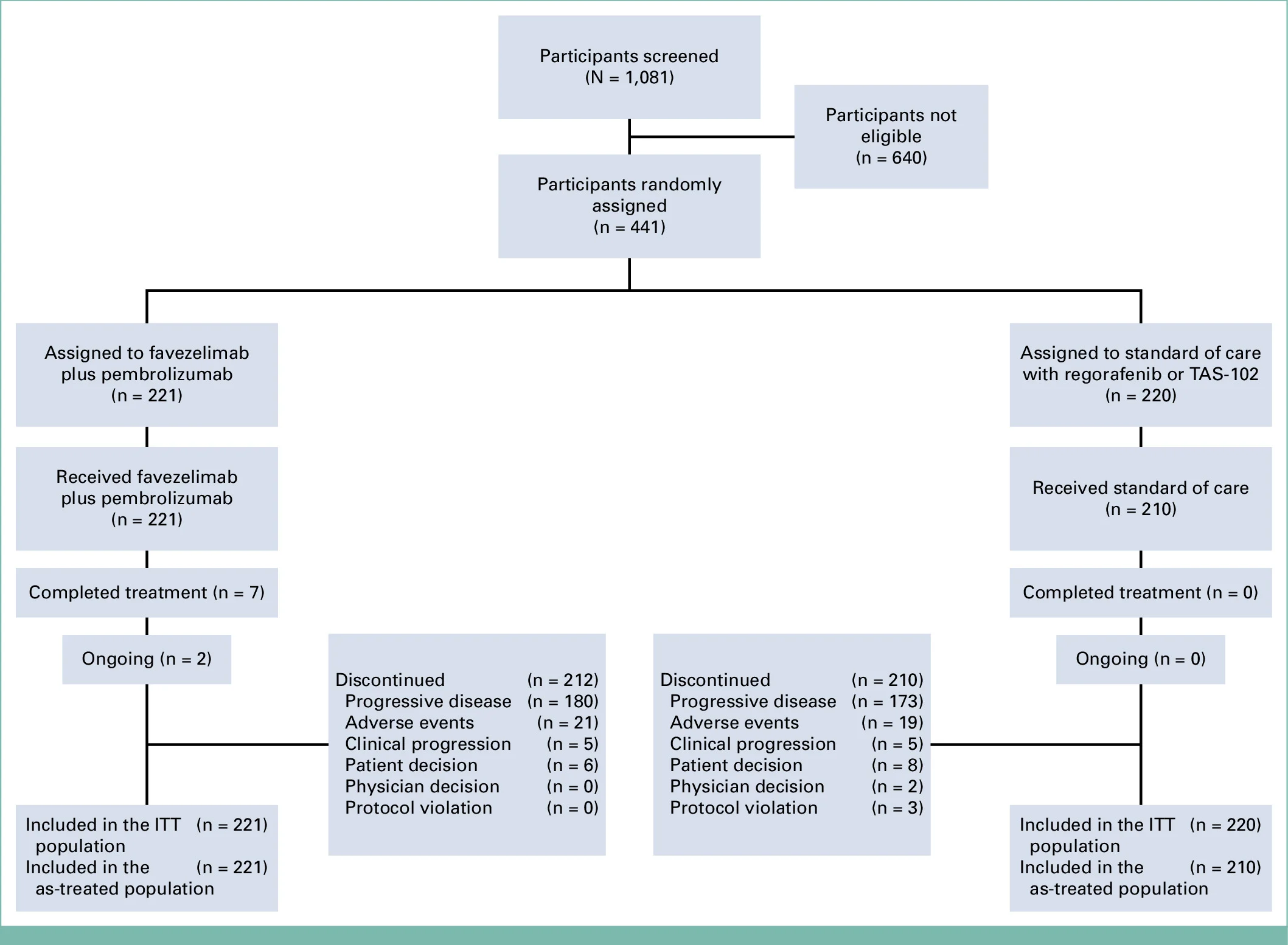
A total of 441 patients from 117 centers across 20 countries were randomized 1:1 to receive coformulated favezelimab 800 mg plus pembrolizumab 200 mg intravenously every three weeks for up to 35 cycles or investigator-selected standard of care consisting of regorafenib or trifluridine-tipiracil (TAS-102). Randomization was stratified by geographic region, presence of liver metastases, and time from diagnosis of metastatic disease. The primary endpoint was OS, while secondary endpoints included PFS, objective response rate (ORR), duration of response (DOR), health-related quality of life, and safety.
The population represented heavily pretreated MSS/pMMR disease. Median age was 59 years, 70% of patients had left-sided tumors, 59% had RAS-mutant disease, and importantly, 78% had liver metastases at baseline.
Dual PD-1/LAG-3 Blockade Did Not Improve Survival
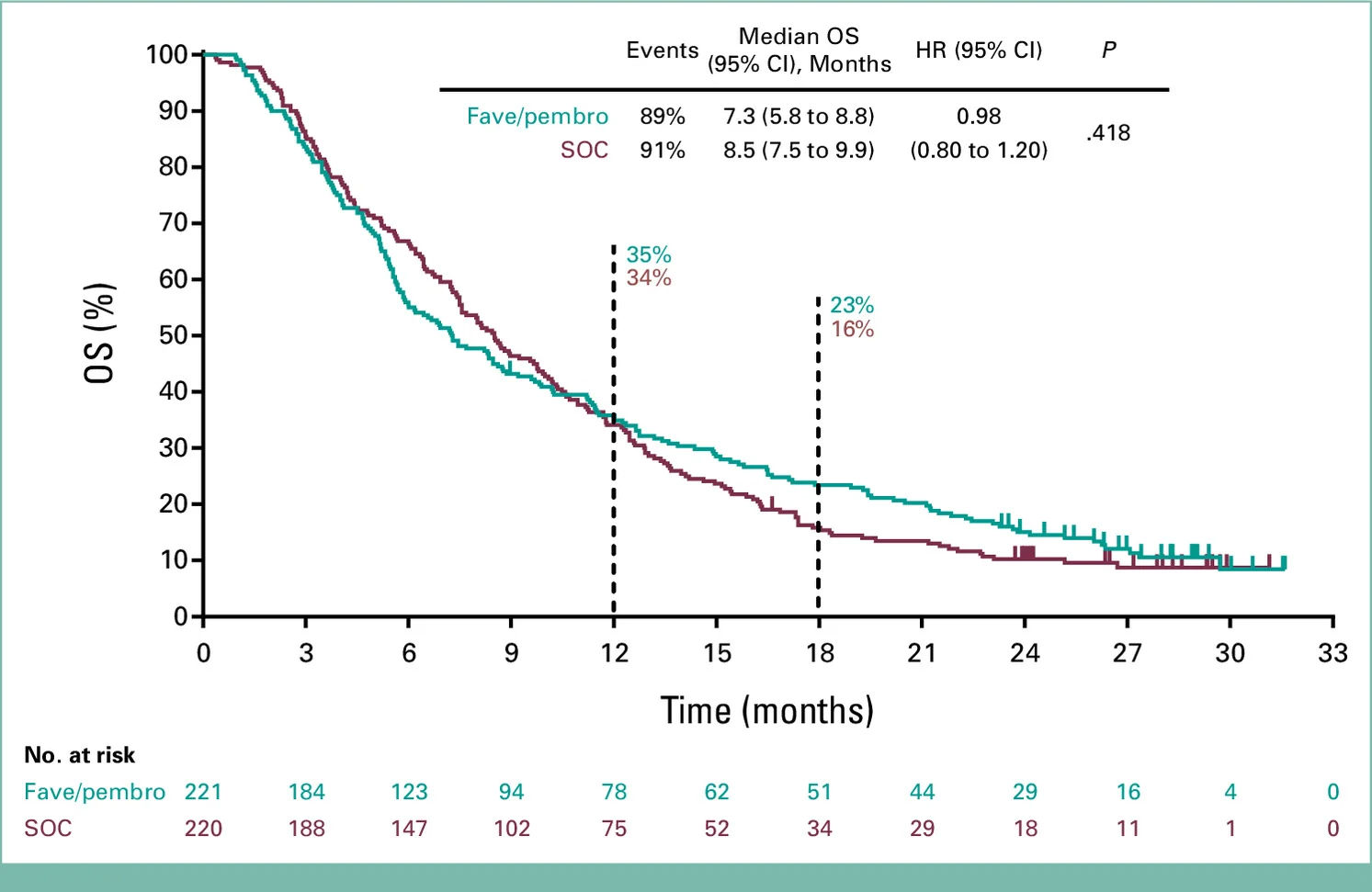
At the prespecified final analysis, after a median follow-up of approximately 28 months, 395 patients had died. Median OS was 7.3 months with favezelimab/pembrolizumab compared with 8.5 months with standard of care, corresponding to an HR of 0.98 (95% CI, 0.80–1.20; P=.418). The trial therefore did not meet its primary endpoint, and the absence of an OS benefit was generally consistent across the prespecified subgroups.
PFS also did not favor dual checkpoint blockade. Median PFS was 2.1 months with favezelimab/pembrolizumab versus 2.6 months with standard therapy, with an HR of 1.34. Because the OS hypothesis was negative, PFS and ORR were not formally tested for statistical significance under the study’s multiplicity strategy, and the reported P values for these endpoints were nominal.
These results are important because KEYFORM-007 did not simply test PD-1 blockade again in an unselected MSS population. Patients were selected for PD-L1 CPS ≥1, and a second inhibitory checkpoint was simultaneously targeted. Despite these measures, there was no population-level improvement in survival, reinforcing how difficult it is to reverse the immunotherapy-resistant phenotype of MSS/pMMR colorectal cancer through checkpoint inhibition alone.
A Higher Response Rate Without a Survival Advantage
Although the primary result was negative, the response data provide an important nuance. The ORR was 6.8% with favezelimab/pembrolizumab compared with 0.9% with standard of care. Fifteen patients receiving the immunotherapy combination achieved an objective response, including one complete response and 14 partial responses, compared with two partial responses in the control arm. Median DOR was not reached among the 15 responders to favezelimab/pembrolizumab, with observed response durations ranging from 1.8 to more than 16.8 months.
This response signal did not translate into improved PFS or OS across the overall population. Progressive disease was the best overall response in 65% of patients receiving favezelimab/pembrolizumab compared with 43% receiving standard therapy, suggesting that while a small subset could respond, most patients derived little or no disease control from the checkpoint combination.
The existence of a small responding population nevertheless raises an important biological question: who were these patients? A post hoc analysis found no clear clinical, pathological, or molecular characteristics capable of identifying responders. Responses occurred irrespective of race, geographic location, primary tumor sidedness, RAS/BRAF mutation status, and time from metastatic diagnosis.
The trial therefore leaves two findings that need to be considered together. PD-1/LAG-3 blockade was ineffective as a population strategy in PD-L1-positive MSS/pMMR CRC, but rare and potentially durable responses indicate that immunotherapy sensitivity is not completely absent. The challenge is that PD-L1 selection did not identify that responsive minority.
Why Was PD-L1 Positivity Not Enough?
KEYFORM-007 specifically enrolled patients with PD-L1 CPS ≥1, based partly on the signal observed in earlier studies of favezelimab plus pembrolizumab. The phase III result shows that this enrichment strategy was insufficient to identify a population deriving meaningful survival benefit from dual checkpoint blockade.
This distinction is important because PD-L1 expression reflects only one component of the cancer–immune interaction. A tumor can express PD-L1 without necessarily containing the broader biological conditions required for effective checkpoint inhibition. In MSS/pMMR CRC, the failure of PD-L1 selection to enrich sufficiently for benefit suggests that checkpoint expression alone does not define an immunotherapy-responsive state.
The result also contrasts with tumor types in which checkpoint inhibition has established activity and where LAG-3 blockade can add to PD-1 inhibition. In melanoma, dual LAG-3/PD-1 blockade improved outcomes over PD-1 blockade alone, whereas the RELATIVITY-123 study of relatlimab plus nivolumab in previously treated MSS/pMMR mCRC was stopped for futility. KEYFORM-007 now provides additional phase III evidence that targeting LAG-3 does not reproduce the melanoma experience in MSS colorectal cancer.
The implication is not that LAG-3 is biologically irrelevant in colorectal cancer, but that blocking another inhibitory receptor may be insufficient when the dominant barrier to effective immunity extends beyond checkpoint-mediated T-cell exhaustion.
Does the Liver Matter?
One exploratory finding deserves particular attention because 78% of patients enrolled in KEYFORM-007 had liver metastases, and liver involvement has repeatedly been considered relevant to immunotherapy outcomes in metastatic cancer.
Among the relatively small subgroup without liver metastases at baseline, median OS was 14.4 months with favezelimab/pembrolizumab versus 12.9 months with standard of care, while the 18-month OS rates were 37% and 28%, respectively. ORR was also numerically higher with immunotherapy at 12.2% versus 2%. However, median PFS did not favor the experimental treatment, at 2.4 versus 4.4 months.
These findings are hypothesis-generating rather than evidence of a liver-metastasis-defined treatment effect. The analysis was ad hoc, non-alpha-controlled, involved only 49 patients without liver metastases in the favezelimab/pembrolizumab arm and 47 in the control arm, and was not statistically powered to establish differential efficacy according to metastatic site. The authors appropriately caution against drawing firm conclusions from this subgroup.
Nevertheless, the observation is biologically interesting because a similar numerical pattern had been reported in LEAP-017, where lenvatinib plus pembrolizumab produced an OS HR of 0.65 among patients without liver metastases compared with 0.91 among those with liver metastases. KEYFORM-007 cannot establish that hepatic metastases caused resistance to PD-1/LAG-3 blockade, but it adds to the rationale for prospectively studying metastatic site as part of the immune biology of MSS colorectal cancer.
Is MSS CRC Resistance Bigger Than T-Cell Exhaustion?
The negative result of KEYFORM-007 becomes more informative when viewed together with other checkpoint-based strategies.
LAG-3 and PD-1 are both associated with dysfunctional or exhausted T-cell states, so blocking both pathways is conceptually attractive when inhibitory receptor signaling is a major limitation on an existing antitumor T-cell response. The success of LAG-3/PD-1 blockade in melanoma demonstrates that this principle can work clinically.
KEYFORM-007 suggests that this may not be the dominant problem in most MSS/pMMR colorectal cancers. If an effective tumor-reactive immune response is weak or absent to begin with, releasing an additional inhibitory checkpoint may not be enough to generate one. The failure of PD-1 plus LAG-3 blockade therefore supports a shift in emphasis from simply removing more inhibitory signals toward strategies capable of changing the underlying immune context of MSS disease.
The study itself does not establish which mechanisms are responsible for resistance, and KEYFORM-007 was not designed to test whether inadequate antigenicity, impaired immune-cell recruitment, liver-associated immune effects, or other microenvironmental factors explain the negative result. What it does establish is that PD-L1 positivity plus dual PD-1/LAG-3 blockade was insufficient to overcome that resistance at the population level.
Safety: Less Toxicity Did Not Translate Into Greater Efficacy
The negative efficacy result was not accompanied by an unexpected safety problem. Treatment-related adverse events occurred in 66% of patients receiving favezelimab/pembrolizumab and 80% receiving standard therapy, while grade ≥3 treatment-related events occurred in 20% and 36%, respectively. Treatment-related adverse events led to discontinuation in 7% versus 4%, and one treatment-related death occurred in each group.
Immune-mediated adverse events and infusion reactions occurred in 38% and 6% of patients receiving favezelimab/pembrolizumab, respectively, and no new safety signals were identified. Health-related quality-of-life analyses also showed no clinically meaningful difference between treatment groups at week 8.
The combination therefore produced a manageable safety profile and fewer grade ≥3 treatment-related adverse events than the regorafenib/TAS-102 control strategy, but tolerability alone cannot compensate for the absence of survival benefit. The final conclusion of the study is accordingly clear: the favezelimab/pembrolizumab coformulation is not recommended for this patient population.
What Does KEYFORM-007 Tell Us About the Next Immunotherapy Strategy?
Negative phase III trials can be particularly informative when they test a biologically plausible hypothesis at sufficient scale. KEYFORM-007 enrolled a biomarker-selected population, targeted two inhibitory immune checkpoints, and included patients across 20 countries, yet the strategy did not improve OS or PFS.
The findings argue against assuming that the solution to MSS colorectal cancer is simply more checkpoint blockade. PD-L1 enrichment did not identify a sufficiently responsive population, and adding LAG-3 inhibition to PD-1 blockade did not convert MSS/pMMR CRC into a broadly checkpoint-sensitive disease. This conclusion is consistent with the paper’s clinical relevance assessment, which emphasizes the need to explore strategies capable of modifying tumor immunogenicity rather than relying exclusively on additional checkpoint inhibition.
At the same time, the 6.8% response rate and potentially durable responses in a small subset argue against concluding that immune-based therapy has no role whatsoever in MSS CRC. Instead, they reinforce the need for more informative biomarkers capable of identifying rare immune-responsive tumors and for therapeutic strategies that can create or amplify antitumor immunity before checkpoint inhibition is expected to sustain it.
You Can Read Full Article Here