
Neoadjuvant immunotherapy has changed the treatment strategy for resectable stage III melanoma by moving immune checkpoint inhibition to a time when the tumor and tumor-draining lymphatic tissue are still present. Randomized studies have already demonstrated improved event-free survival with neoadjuvant anti-PD-1-based approaches compared with postoperative anti-PD-1 therapy, supporting the incorporation of neoadjuvant immunotherapy into clinical practice. However, several questions have remained unresolved, particularly whether early pathological response predicts durable survival, whether patients who respond still require postoperative systemic therapy, and how treatment should be adapted for patients who do not respond.
An updated pooled analysis from the International Neoadjuvant Melanoma Consortium (INMC), published in Nature Medicine in 2026, provides long-term data addressing these questions. The analysis included 1,038 patients with clinically detected, resectable stage IIIB–IV melanoma treated at 26 international centers with neoadjuvant immune checkpoint inhibitors (ICIs), BRAF/MEK inhibitors, or ICI combined with targeted therapy. The results establish a strong association between pathological response to neoadjuvant immunotherapy and long-term outcome, while also providing important data on treatment after surgery and on clinical and molecular subgroups that have been underrepresented in prospective trials.
More Than 1,000 Patients Treated With Neoadjuvant Therapy
The analysis included patients treated between 2011 and 2024. Of the 1,038 patients, 735 received neoadjuvant ICIs, 119 received BRAF/MEK inhibitors, and 184 received ICI plus targeted therapy. Within the ICI population, 242 patients received anti-PD-1 monotherapy and 489 received anti-PD-1 combined with another immuno-oncology agent. The latter group included 386 patients treated with PD-1 plus CTLA-4 blockade, 58 with PD-1 plus LAG-3 blockade, and 45 with other IO combinations.
Most patients, 96.6%, had stage III disease, while 3.4% had resectable oligometastatic stage IV melanoma. Nearly half of the overall population, 49.1%, had a BRAF V600 mutation. Importantly, the analysis incorporated both clinical-trial patients and patients treated outside trials: 755 patients, or 72.7%, were treated within clinical studies and 283, or 27.3%, outside a trial.
Pathological response was evaluated according to the INMC criteria using the percentage of residual viable tumor. Pathological complete response (pCR) represented complete absence of viable tumor, near-pCR represented ≤10% viable tumor, pathological partial response (pPR) represented >10% to ≤50%, and pathological nonresponse (pNR) represented >50% residual viable tumor. Major pathological response (MPR) therefore included both pCR and near-pCR.
This distinction becomes central to understanding the long-term results.
Neoadjuvant ICI Produces High Rates of Major Pathological Response
Among patients with available pathological assessment, MPR occurred in 57.8% of patients treated with ICIs, compared with 51.4% receiving BRAF/MEK inhibition and 44.6% receiving ICI plus targeted therapy. The corresponding pCR rates were 46.8%, 38.7%, and 30.7%, respectively.
Within the immunotherapy cohort, combination therapy was associated with a higher probability of MPR than PD-1 monotherapy. MPR occurred in 61.4% with PD-1 plus another IO agent compared with 49.5% with PD-1 alone, while pathological nonresponse occurred in 27.5% and 37.0%, respectively. MPR rates were 62.5% with PD-1 plus CTLA-4 and 63.2% with PD-1 plus LAG-3, although the number of patients and follow-up differed across the individual combination regimens.
These comparisons need careful interpretation because the pooled analysis was not a randomized comparison of neoadjuvant regimens. Treatment selection, trial eligibility, patient characteristics, and calendar period could influence outcomes. Nevertheless, the dataset provides an opportunity to examine whether differences in pathological response are associated with durable differences in recurrence and survival.
Five-Year Outcomes Confirm Durable Disease Control After Neoadjuvant ICI
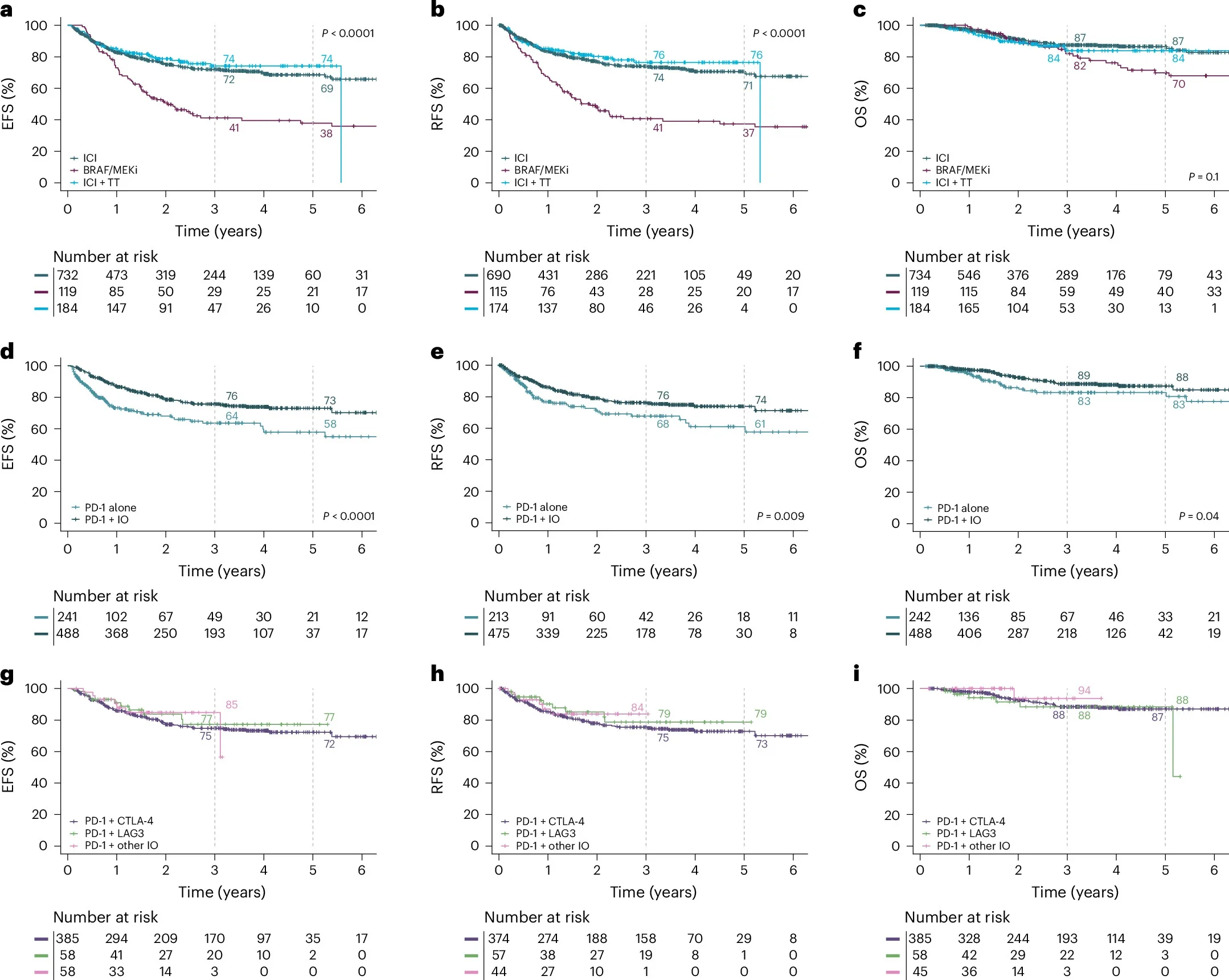
Long-term outcomes were favorable among patients treated with neoadjuvant immunotherapy. Across the ICI population, 5-year event-free survival (EFS) was 68.5%, 5-year recurrence-free survival (RFS) was 70.6%, and 5-year overall survival (OS) was 86.5%.
When the ICI population was separated according to treatment, 5-year RFS was 61.0% with PD-1 monotherapy and 73.9% with PD-1 plus another IO agent. Five-year OS was 83.3% and 87.5%, respectively. Within the combination group, 5-year RFS was 72.8% with PD-1 plus CTLA-4 and 78.7% with PD-1 plus LAG-3, while 5-year OS was 87.0% and 88.4%, respectively.
The investigators attribute much of the difference between PD-1 monotherapy and combination immunotherapy to their different MPR rates. They also caution that confidence intervals for some long-term estimates remain wide, particularly for PD-1 monotherapy and newer combinations. The dataset therefore supports the effectiveness of neoadjuvant anti-PD-1-based treatment but should not be interpreted as a randomized comparison establishing the superiority of one combination over another.
Pathological Response Strongly Stratifies Long-Term Outcome
The most clinically important finding is the durability of survival among patients who achieve a major pathological response.
Among patients receiving neoadjuvant ICI who achieved MPR, the 5-year RFS rate was 91.2%. Within this group, 5-year RFS was 79.6% after PD-1 monotherapy and 92.8% after PD-1 plus another IO agent.
The relationship was even more striking for OS. Among all ICI-treated patients with MPR, 5-year OS was 98.0%. It reached 98.8% after PD-1 monotherapy and 97.9% after PD-1 plus IO, suggesting that once MPR was achieved, long-term survival was excellent across both treatment approaches.
When pathological response was examined in greater detail, ICI-treated patients achieving pCR had a 5-year RFS of 92.7% and 5-year OS of 98.4%. Patients with near-pCR also had favorable long-term outcomes, with 5-year RFS of 86.4% and OS of 96.6%. In contrast, patients with pathological nonresponse had a 5-year RFS of only 35.2% and 5-year OS of 71.6%.
These data strengthen the role of pathological response as a prognostic marker after neoadjuvant immunotherapy. They also support the use of MPR, rather than pCR alone, as a clinically meaningful response category, because patients with near-pCR experienced long-term outcomes approaching those observed after complete pathological response.

10 Ongoing Clinical Trials on Immunotherapy in Melanoma
Pathological Response May Become a Tool for Treatment Adaptation
The importance of pathological response extends beyond prognosis. Neoadjuvant treatment provides information about tumor sensitivity while the patient is still in a potentially curative treatment pathway, creating an opportunity to adapt subsequent therapy according to response.
Patients with MPR represent a particularly favorable group. Their approximately 98% 5-year OS after neoadjuvant ICI raises the question of whether additional systemic treatment after surgery provides meaningful benefit when substantial tumor eradication has already been demonstrated.
Conversely, pathological nonresponse identifies a group with a markedly higher risk of recurrence. A 5-year RFS of approximately 35% after pNR indicates that failure to respond to neoadjuvant ICI is not simply an early pathological observation; it is associated with substantially worse long-term disease control.
This creates a potential response-adapted framework in which effective therapy could be de-escalated for patients with MPR while alternative or intensified postoperative strategies are investigated for patients with pNR. The current analysis strongly supports the prognostic component of this approach, although treatment decisions based on these observations require prospective validation.
Do Patients With MPR Need Adjuvant Immunotherapy?
One of the most provocative findings concerns treatment after surgery.
Among 681 ICI-treated patients with pathological response assessment, 358 received postoperative ICI, 44 received BRAF/MEK inhibitors, and 279 received no adjuvant systemic therapy. Because postoperative treatment was not randomly assigned, these comparisons are observational and susceptible to treatment-selection bias.
Among patients who achieved MPR after neoadjuvant ICI, however, long-term outcomes were almost identical whether adjuvant immunotherapy was given or not. Five-year RFS was 90.6% without adjuvant systemic therapy and 90.8% with adjuvant ICI. Five-year OS was 98.4% without adjuvant therapy and 97.6% with adjuvant ICI.
A similar absence of a clear RFS or OS difference was observed among patients with pPR. In patients with pNR, by contrast, adjuvant ICI and BRAF/MEK inhibition showed trends toward improved outcomes, although the analysis cannot establish a treatment effect.
These results should not be interpreted as randomized evidence that adjuvant ICI can be omitted in every patient achieving MPR. The authors specifically acknowledge potential bias by indication because postoperative treatment was not randomly assigned and call for prospective investigation.
Nevertheless, the findings provide long-term support for one of the central concepts emerging from neoadjuvant melanoma research: pathological response could eventually help determine the amount of treatment patients require after surgery rather than committing every patient to a predetermined course of postoperative systemic therapy.
Pathological Response Does Not Have the Same Prognostic Meaning Across Treatment Classes
The analysis also provides an important observation about the relationship between pathological response and treatment mechanism.
Neoadjuvant BRAF/MEK inhibition produced an MPR rate of 51.4%, which was not dramatically lower than the 57.8% observed with ICI. Yet long-term outcomes were substantially poorer. Five-year RFS was only 37.4% with BRAF/MEK inhibition compared with 70.6% with ICI, while 5-year OS was 69.8% versus 86.5%.
Even among patients achieving MPR, the difference remained apparent. Five-year RFS after MPR was 91.2% with ICI but 57.4% with BRAF/MEK inhibition. Five-year OS after MPR was 98.0% with ICI compared with 84.2% with BRAF/MEK inhibitors.
These findings suggest that the prognostic implications of tumor regression cannot automatically be transferred from one therapeutic class to another. A pathological response induced by targeted therapy may not represent the same long-term disease control as a similar degree of pathological response following immunotherapy.
The comparison remains nonrandomized, and the BRAF/MEK cohort had important baseline differences, including greater tumor burden and enrichment for stage IIIC disease. The investigators nevertheless conclude that long-term outcomes with neoadjuvant BRAF/MEK inhibition were unfavorable and support anti-PD-1-based immunotherapy as the preferred neoadjuvant systemic approach, including for patients with BRAF V600-mutant melanoma.
BRAF V600-Mutant Melanoma Still Responds to Neoadjuvant Immunotherapy
Among ICI-treated patients, 283 had BRAF V600-mutant melanoma. Their MPR rate was 46.3%, compared with 55.6% in BRAF wild-type disease. BRAF V600-mutant patients receiving PD-1 plus another IO agent had an MPR rate of 51.0%, compared with 35.6% with PD-1 monotherapy.
BRAF V600 mutation was associated with poorer EFS and RFS but not OS in the ICI-treated cohort. In multivariable analysis, BRAF V600 status was a negative predictive factor for pCR but not for MPR.
These results are relevant because BRAF-mutant melanoma offers both immunotherapy and highly active BRAF/MEK-directed therapy. The long-term findings in this analysis support neoadjuvant ICI despite the availability of targeted therapy and despite somewhat lower pathological response rates in the BRAF V600-mutant subgroup.
Acral Melanoma Remains a More Difficult Population
The analysis also provides data for acral melanoma, although the sample size was small.
Among 26 ICI-treated patients with acral melanoma, 21 had pathological response assessment. Eight achieved MPR, corresponding to an MPR rate of 38.1%, while 57.1% had pathological nonresponse. At five years, EFS was 26.0%, RFS 28.5%, and OS 73.1%, although confidence intervals were wide because of the limited cohort size.
The investigators conclude that neoadjuvant ICI appears active in acral melanoma but that outcomes remain poorer than in non-acral melanoma. Dedicated prospective studies are needed before defining the optimal neoadjuvant strategy for this biologically distinct melanoma subtype.
Can Surgery Also Be De-Escalated?
The ability of pathological response to identify an extremely favorable group has implications beyond systemic therapy. It also raises the possibility of reducing the extent of surgery.
Less extensive approaches, such as resection of an index lymph node rather than therapeutic lymph-node dissection, are already being investigated. However, the INMC analysis emphasizes that pathological response currently provides better prognostic information than CT or FDG-PET response, and there is not yet sufficient evidence to omit therapeutic lymph-node dissection routinely based on imaging alone.
Previous response-adapted studies such as PRADO have provided encouraging evidence that index-node pathological response may represent the wider nodal basin, but further prospective validation is required. The randomized phase III MSLT-3 and phase II OMIT trials are among the studies addressing whether nodal surgery can be safely reduced after neoadjuvant therapy.
The long-term INMC findings therefore support pathological response as an increasingly important decision point while simultaneously showing why imaging response alone cannot yet replace tissue-based assessment.
The Patients Who Do Not Respond Are Now the Major Unmet Need
As neoadjuvant immunotherapy becomes increasingly effective, the therapeutic challenge shifts toward patients who fail to achieve pathological response.
Patients with pNR after neoadjuvant ICI had a 5-year RFS of 35.2%, compared with 92.7% after pCR. Five-year OS was 71.6% after pNR compared with 98.4% after pCR.
These differences identify pNR as a clinically meaningful high-risk state in which simply continuing the same checkpoint inhibitor after surgery may not be the optimal strategy. The pooled analysis showed only observational trends toward improved outcomes with postoperative systemic therapy in nonresponders, leaving the optimal management of this population unresolved.
The authors therefore propose a future strategy centered increasingly on predicting resistance before treatment and developing new postoperative approaches for patients with inadequate pathological response. Multi-omic, radiological, and clinical prediction models are already being investigated, including in the ongoing NeoIRENIE trial, which uses a predictive model to allocate patients between standard and experimental neoadjuvant immunotherapy strategies.
Important Limitations of the Analysis
Despite its size and long-term follow-up, this study should not be interpreted as a randomized comparison of the different treatment strategies. The dataset pools patients from multiple clinical trials and nontrial settings, with differences in treatment regimens, follow-up, patient selection, and postoperative management.
Approximately 73% of patients were treated within clinical trials, and patients treated outside trials were still managed at specialized cancer centers with substantial neoadjuvant experience. This may limit generalizability to routine oncology settings where multidisciplinary coordination, surgical planning, and standardized pathological assessment may be less established. Nontrial patients also had poorer EFS and RFS than trial participants, although OS was similar.
Several subgroup analyses, including acral melanoma, in-transit disease, and oligometastatic stage IV disease, involved relatively small numbers. Central pathological and radiological review was not feasible, and postoperative treatment was not randomized. These limitations are particularly important when interpreting apparent differences between treatment regimens or drawing conclusions about the value of adjuvant therapy.
Read Full Article Here