
For more than two decades, cisplatin-based concurrent chemoradiotherapy followed by brachytherapy has defined curative treatment for locally advanced cervical cancer. That backbone remains intact in the newly published 2026 ESMO Clinical Practice Guideline, which continues to recommend external-beam radiotherapy with concurrent cisplatin followed by image-guided adaptive brachytherapy for locally advanced disease. Modern radiotherapy quality is central to this strategy: IMRT or VMAT is recommended for external-beam treatment, while MRI-based image-guided adaptive brachytherapy is considered the standard brachytherapy approach.
What has changed is what can now be added to that backbone.
Immunotherapy, initially established in persistent, recurrent, and metastatic cervical cancer, has crossed into the curative-intent setting. In KEYNOTE-A18, pembrolizumab given with chemoradiotherapy and continued as maintenance improved both progression-free survival (PFS) and overall survival (OS). The 2026 ESMO guideline now recommends this strategy for selected patients with locally advanced disease. At the same time, INTERLACE has introduced another approach to treatment intensification, using six weeks of weekly carboplatin and paclitaxel immediately before chemoradiotherapy.
These developments create a more sophisticated question than whether locally advanced cervical cancer should receive “more treatment.” KEYNOTE-A18 and INTERLACE intervene at different points, through different mechanisms, and in somewhat different patient populations. The challenge is now determining who should receive immune intensification, who may benefit from induction chemotherapy, and how contemporary radiotherapy changes the place of each strategy.
From Metastatic Disease to Curative-Intent Immunotherapy
The development of checkpoint inhibition in cervical cancer began in advanced disease.
The phase III KEYNOTE-826 trial established pembrolizumab in the first-line treatment of persistent, recurrent, or metastatic cervical cancer. At final analysis, pembrolizumab added to platinum–paclitaxel chemotherapy, with or without bevacizumab, improved median OS from 16.8 to 26.4 months in the overall population. Among patients with PD-L1 combined positive score (CPS) ≥1, median OS was 28.6 versus 16.5 months. In the prespecified PD-L1 CPS <1 subgroup, however, a statistically significant OS improvement was not demonstrated.
The next question was whether immune checkpoint blockade could contribute much earlier, when treatment is intended not simply to control disease but to cure it.
There was already reason for caution. The randomized phase III CALLA trial evaluated durvalumab concurrently with chemoradiotherapy followed by maintenance durvalumab for up to 24 cycles. In a biomarker-unselected population, the trial did not significantly improve PFS compared with chemoradiotherapy alone: 76.0% versus 73.3%, respectively (HR 0.84; P=0.17).
The negative CALLA result is important context for KEYNOTE-A18. It shows that adding checkpoint inhibition to definitive chemoradiotherapy does not automatically translate into improved outcomes. Differences in checkpoint target, study population, treatment schedule and other trial characteristics may have contributed to the divergent results, but the available evidence does not establish a single explanation.
KEYNOTE-A18 was therefore testing a therapeutic concept that had not yet been validated in a phase III cervical cancer trial.
KEYNOTE-A18: Pembrolizumab Enters Curative Treatment
ENGOT-cx11/GOG-3047/KEYNOTE-A18 was a randomized, double-blind, placebo-controlled phase III trial evaluating pembrolizumab with definitive chemoradiotherapy in newly diagnosed, high-risk locally advanced cervical cancer.
The trial enrolled 1,060 patients with FIGO 2014 stage IB2–IIB node-positive disease or stage III–IVA disease regardless of nodal status. Patients were randomly assigned to pembrolizumab plus chemoradiotherapy or placebo plus chemoradiotherapy.
Pembrolizumab was administered at 200 mg every three weeks for five cycles concurrently with chemoradiotherapy, followed by 400 mg every six weeks for 15 cycles. Definitive treatment included weekly cisplatin with external-beam radiotherapy followed by brachytherapy.
The study had dual primary endpoints of PFS and OS.
At the initial analysis, the estimated 24-month PFS was 68% with pembrolizumab versus 57% with placebo, corresponding to an HR for progression or death of 0.70 (95% CI 0.55–0.89; P=0.0020).
Longer follow-up subsequently established an OS benefit.
The new ESMO guideline reports the mature 36-month results: PFS was 69.3% with pembrolizumab versus 56.9% with control (HR 0.68; 95% CI 0.56–0.84), while OS was 82.6% versus 74.8%, respectively (HR 0.67; 95% CI 0.50–0.90; P=0.0040).
The significance of KEYNOTE-A18 therefore extends beyond another positive checkpoint-inhibitor study. It demonstrates that PD-1 blockade can improve outcomes when incorporated into treatment delivered with curative intent.
But the overall positive result contains an important clinical nuance: the strength of evidence was not identical across all disease groups enrolled in the trial.
The FIGO Question: Not All Stage III Disease Represents the Same Evidence
KEYNOTE-A18 included two major stage-defined populations: FIGO 2014 stage III–IVA disease regardless of nodal involvement and stage IB2–IIB disease considered high risk because of positive lymph nodes.
The subgroup findings differed between them.
For PFS, the HR was 0.59 (95% CI 0.43–0.82) in FIGO 2014 stage III–IVA disease compared with 0.91 (95% CI 0.63–1.31) in patients with node-positive FIGO 2014 stage IB2–IIB disease.
Understanding this difference requires attention to how cervical cancer staging changed.
FIGO 2018 incorporated nodal involvement into stage assignment. Pelvic nodal metastasis is classified as stage IIIC1 and para-aortic nodal involvement as stage IIIC2, irrespective of the local extent of the primary cervical tumor. The 2026 ESMO guideline emphasizes that FIGO 2018 incorporates nodal status and distinguishes pelvic from para-aortic involvement.
Consequently, a patient with a relatively limited primary cervical tumor and positive pelvic nodes may be categorized as FIGO 2018 stage IIIC1, while having disease that belonged to the FIGO 2014 stage IB2–IIB node-positive subgroup in KEYNOTE-A18.
This staging transition is clinically important because it can obscure the population in which the pembrolizumab signal was strongest.
We asked Giuseppe Caruso, MD, PhD, how this difference should influence treatment decisions:
“The difference reflects the protocol-specified overall survival subgroup analysis of KEYNOTE-A18. The survival benefit of adding pembrolizumab was clear in FIGO 2014 stage III–IVA disease, but not evident in stage IB2–IIB node-positive disease, which largely corresponds to FIGO 2018 stage IIIC defined by nodal involvement alone. This matters for two reasons. First, immunotherapy is what has truly changed outcomes in persistent, recurrent, or metastatic disease, as shown by KEYNOTE-826. If we move it earlier, we should do so where we are confident it adds benefit, and potentially cure; otherwise, we risk weakening its role in the setting where the evidence is strongest. Second, immune-related adverse events can be serious, and this strategy means about two years of treatment for often young women, with a real impact on quality of life. Without clear efficacy data, that burden is hard to justify. For node-positive IB2–IIB disease, the INTERLACE approach is a reasonable complementary option.”
The newly published ESMO guideline now provides important contemporary context for precisely this issue.
The 2026 ESMO Guideline Narrows the Immunotherapy Population
ESMO does not simply recommend pembrolizumab for every patient who carries a FIGO 2018 stage III designation.
The guideline recommends pembrolizumab added to standard concurrent chemoradiotherapy, followed by brachytherapy and 15 cycles of pembrolizumab maintenance, for FIGO 2018 stage IIIA, IIIB, or IVA locally advanced cervical cancer, with Level I, Grade A evidence.
Notably, FIGO 2018 stage IIIC is not included in that recommendation simply on the basis of nodal involvement.
The guideline also notes that pembrolizumab with chemoradiotherapy has received FDA and EMA approval for FIGO 2014 stage III–IVA locally advanced cervical cancer.
This is more than a technical staging distinction. It illustrates how subgroup evidence can influence the translation of a positive overall trial into clinical recommendations.
The result is an increasingly selective approach to curative-intent immunotherapy: pembrolizumab is not being positioned simply according to the presence of high-risk disease, but according to the population in which the evidence supporting additional benefit is strongest.
For patients outside that group, another positive phase III strategy enters the discussion.
INTERLACE: Moving Systemic Therapy Before Chemoradiotherapy
INTERLACE tested a fundamentally different approach.
Instead of adding immune checkpoint blockade during and after chemoradiotherapy, the trial investigated whether systemic chemotherapy delivered before definitive treatment could improve disease control.
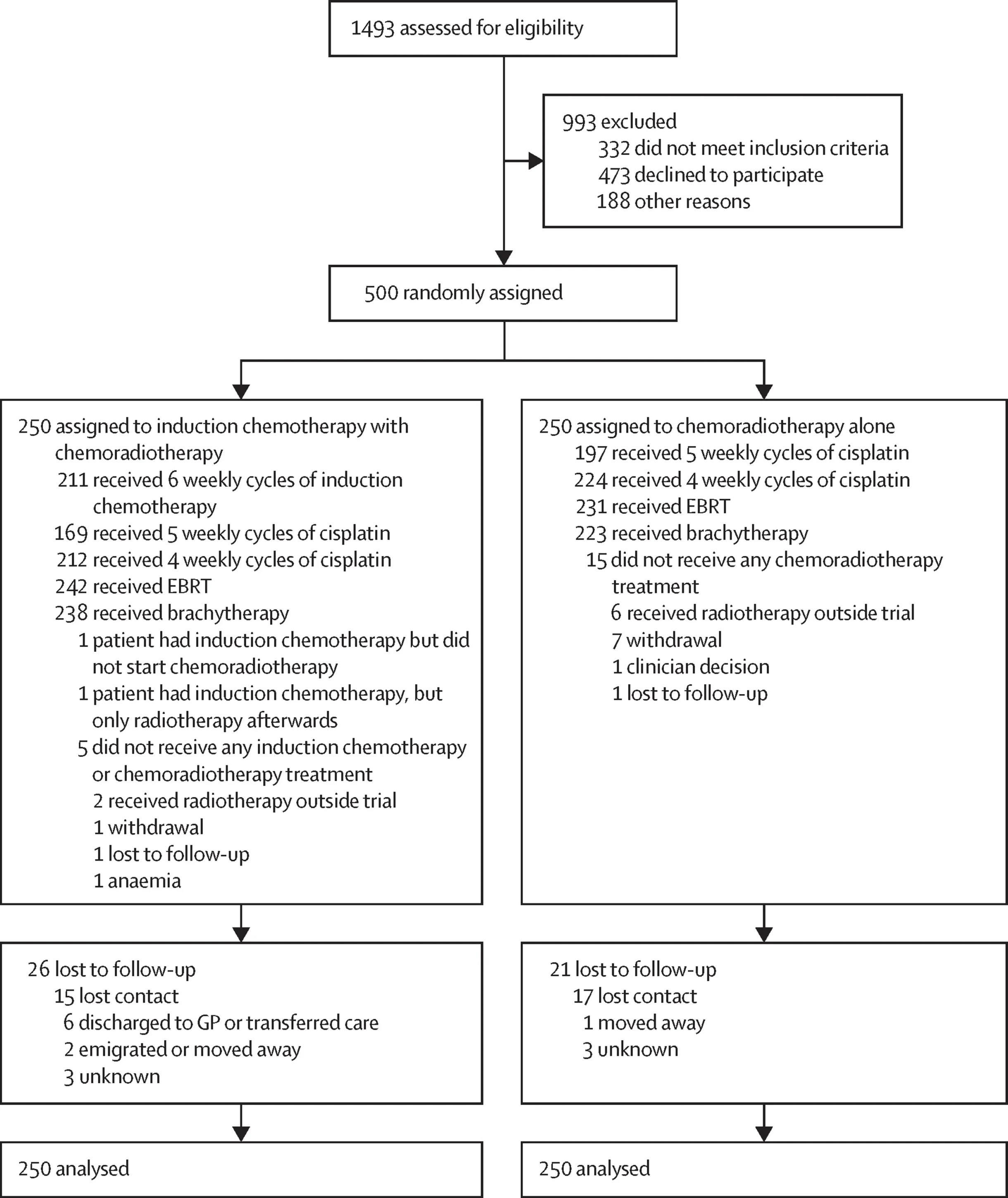
The international randomized phase III study enrolled 500 patients with locally advanced cervical cancer and compared standard chemoradiotherapy with six weeks of induction chemotherapy followed immediately by the same chemoradiotherapy.
The induction regimen consisted of weekly carboplatin AUC2 and paclitaxel 80 mg/m² for six cycles. Standard chemoradiotherapy then included weekly cisplatin 40 mg/m² with external-beam radiotherapy and brachytherapy.
Timing was a critical component of the strategy. Ninety-two percent of patients received at least five induction cycles, and the median interval between completion of induction chemotherapy and initiation of chemoradiotherapy was only seven days.
After a median follow-up of 67 months, induction chemotherapy improved both major survival endpoints.
Five-year PFS increased from 64% with chemoradiotherapy alone to 72% with induction chemotherapy followed by chemoradiotherapy (HR 0.65; 95% CI 0.46–0.91; P=0.013).
Five-year OS increased from 72% to 80%, corresponding to an HR for death of 0.60 (95% CI 0.40–0.91; P=0.015).
Distant-only recurrence occurred in 7% of patients receiving induction treatment compared with 12% receiving chemoradiotherapy alone, supporting the concept that earlier systemic therapy may contribute to controlling occult disease outside the radiation field.
The improvement came with greater toxicity. Grade 3–4 adverse events occurred in 59% versus 48% of patients, with hematologic toxicity accounting for much of the difference.
But the new ESMO guideline adds an important qualification to how these results should be interpreted today.
Modern Radiotherapy Changes How INTERLACE Is Interpreted
The 2026 ESMO guideline recognizes the survival benefit demonstrated by INTERLACE but highlights several characteristics of the study that limit broad extrapolation.
Approximately 86% of patients had FIGO 2008 stage IB2–IIB disease, only 43% had positive lymph nodes, and patients with para-aortic nodal involvement or lower-third vaginal involvement were excluded. ESMO therefore describes the study as including a locally advanced population with relatively favorable prognostic characteristics.
More importantly, the radiotherapy used in INTERLACE differs from contemporary optimal treatment.
According to the guideline, approximately 70% of patients did not receive image-guided adaptive brachytherapy, now considered the standard approach. The mean cervical tumor dose was 79.4 Gy at point A, lower than what can be achieved with contemporary MRI-based image-guided adaptive brachytherapy.
ESMO consequently interprets the INTERLACE benefit cautiously, suggesting that induction chemotherapy may, at least in part, have compensated for suboptimal brachytherapy in this particular study population.
This interpretation directly influences the guideline recommendation.
For FIGO 2018 stage IB3–IIB disease, six weekly cycles of carboplatin–paclitaxel followed by chemoradiotherapy and brachytherapy within seven days may be considered when IMRT/VMAT and/or image-guided adaptive brachytherapy are not available, with a Level II, Grade B recommendation.
The guideline therefore does not position INTERLACE as a universal replacement for contemporary chemoradiotherapy or as an interchangeable alternative to pembrolizumab.
KEYNOTE-A18 or INTERLACE?
There has been no randomized head-to-head comparison between induction chemotherapy according to INTERLACE and pembrolizumab-containing chemoradiotherapy according to KEYNOTE-A18.
Cross-trial comparison is particularly problematic because the trials used different FIGO staging systems, enrolled different risk populations, and were conducted in different radiotherapy contexts.
The more useful question is how the two strategies might occupy different clinical spaces.
For patients who could potentially be considered for either approach, Dr Caruso views them as complementary rather than competing:
“When both options are genuinely available, meaning pembrolizumab can be used within its FDA and EMA label for FIGO 2014 stage III–IVA disease, I have no doubt: I choose pembrolizumab with chemoradiotherapy. The rationale is solid and the data are robust. I would reserve induction chemotherapy for patients outside that label or with a contraindication to immunotherapy. I see the two strategies as complementary rather than competing: pembrolizumab for high-risk locally advanced disease, INTERLACE for the others.”
The new ESMO guideline reinforces the need for this type of selection, while adding another variable that is easy to overlook: radiotherapy quality.
Treatment choice is no longer determined only by stage or systemic therapy eligibility. Access to IMRT/VMAT, MRI-based image-guided adaptive brachytherapy, the ability to complete definitive radiation without delay, contraindications to checkpoint inhibition, and individual disease characteristics all influence how the evidence should be applied.
This also argues against simply combining every successful intervention.
Whether induction carboplatin–paclitaxel followed by pembrolizumab-containing chemoradiotherapy could further reduce recurrence remains an interesting research question, but increased treatment intensity could also increase toxicity and compromise treatment delivery. Such a strategy requires prospective evaluation.
Toxicity Becomes More Complex When Immunotherapy Meets Pelvic Radiation
The introduction of pembrolizumab into definitive chemoradiotherapy also changes toxicity assessment.
Patients are simultaneously exposed to cisplatin, pelvic radiation, brachytherapy, and PD-1 blockade. Some adverse events have relatively recognizable etiologies, whereas others overlap substantially between treatment modalities.
In KEYNOTE-A18, grade ≥3 adverse events occurred in 75% of patients receiving pembrolizumab plus chemoradiotherapy and 69% receiving placebo plus chemoradiotherapy. Potentially immune-mediated adverse events occurred more frequently with pembrolizumab.
Thyroid dysfunction provided one of the clearest immune-related signals. Hypothyroidism occurred in 19% versus 5%, while hyperthyroidism occurred in 11% versus 2%. Colitis was less frequent, occurring in approximately 3% versus 2%.
In practice, however, the difficult cases are not always the toxicities that are easily classified.
Diarrhea can result from pelvic radiotherapy or immune-mediated colitis. Fatigue may reflect radiation, chemotherapy, immunotherapy, anemia, or several factors simultaneously. Skin toxicity may be restricted to the radiation field or represent a systemic immune-mediated eruption.
Dr Caruso explains how he approaches this distinction:
“The toxicity profile of immunotherapy is usually different from that of chemotherapy or radiotherapy. Fortunately, most immune-related events are mild. Thyroid dysfunction, mainly hypothyroidism, and diffuse arthromyalgia are typical and easy to recognize, and are managed with levothyroxine (the former) or low-dose steroids (the latter), often prednisone 5–10 mg daily or equivalent. Location also helps: radiation dermatitis is confined to the pelvic field, whereas a rash elsewhere or widespread points to immunotherapy. Some toxicities overlap, such as fatigue, and there the cause can be hard to pin down. Colitis deserves attention: a severe course is more typical of immunotherapy than of pelvic radiotherapy and should raise an alarm. Even when the exact cause remains unclear, the practical answer is often the same, namely steroids. For mild events, we usually continue pembrolizumab, with at most low-dose steroids. Severe cases requiring interruption are less common.”
Toxicity attribution becomes particularly important in a curative setting because unnecessary interruption of radiotherapy may compromise definitive treatment, while failure to recognize a clinically important immune-related adverse event can allow toxicity to progress.
The goal is therefore not merely to determine which treatment “caused” a symptom, but to make a sufficiently accurate clinical distinction to protect both treatment efficacy and patient safety.
How Long Does Pembrolizumab Need to Continue?
KEYNOTE-A18 established the benefit of a specific therapeutic strategy: pembrolizumab begins concurrently with chemoradiotherapy and then continues as maintenance.
The trial does not separate the contribution of these two phases.
It therefore cannot tell us whether the survival benefit is driven primarily by immunotherapy during chemoradiotherapy, prolonged suppression of PD-1 signaling afterward, or the combination of both.
Nor does it establish the minimum duration of pembrolizumab required to preserve benefit.
In KEYNOTE-A18, patients received five cycles of pembrolizumab 200 mg every three weeks followed by up to 15 maintenance cycles of 400 mg every six weeks. The 2026 ESMO guideline recommends the regimen as studied, including the maintenance component.
This creates an important question for patients who complete chemoradiotherapy and achieve complete remission.
At that point, continued immunotherapy is no longer treating radiographically measurable disease. Its purpose is to reduce the probability that residual microscopic malignant cells eventually produce recurrence.
Dr Caruso believes this is an important area for future de-escalation research:
“This question applies to immunotherapy across solid tumors, and there is growing evidence and consensus that 12 months may be enough in patients who achieve a complete response. At ASCO 2026, a randomized prospective trial in advanced solid tumors (abstract 2514) compared one year of PD-1/PD-L1 inhibition with treatment until progression, and one year was not inferior for overall survival. In gynecologic oncology, the long-term overall survival curves of RUBY also seem to plateau after two years of treatment. The direction is de-escalation, perhaps to one or two years in complete responders. Circulating tumor DNA (ct-DNA) could help identify who needs to continue, based on the presence or absence of minimal residual disease. That is where I believe the next trials should focus.”
The distinction between current evidence and future research is important. KEYNOTE-A18 supports the pembrolizumab schedule that was actually tested. Evidence from other solid tumors cannot yet establish that shorter treatment is equally effective in locally advanced cervical cancer.
But the question becomes increasingly relevant as immunotherapy moves into curative disease.
A patient with no visible tumor after chemoradiotherapy may not necessarily need the same duration of immune checkpoint blockade as a patient receiving treatment for measurable metastatic disease. Conversely, radiographic complete response does not guarantee eradication of microscopic residual cancer.
This is where biomarkers such as circulating tumor DNA could eventually become useful.
Rather than prescribing maintenance duration solely according to a fixed calendar, future trials could investigate whether molecular residual disease identifies patients who remain at sufficient risk to justify continued immunotherapy and, conversely, whether persistently negative ctDNA could support treatment de-escalation.
For now, that remains investigational.
Immunotherapy Is Expanding, but Selection Is Becoming More Important
The 2026 ESMO guideline places these developments within a broader evolution of cervical cancer immunotherapy.
In recurrent and metastatic disease, pembrolizumab plus platinum–paclitaxel chemotherapy with or without bevacizumab is recommended for tumors with PD-L1 CPS ≥1. Cemiplimab remains an option after platinum-based treatment for ICI-naive patients regardless of PD-L1 status, while pembrolizumab monotherapy remains an option in selected PD-L1-positive, ICI-naive disease. In locally advanced disease, however, the question is different.
The patient may already be curable with optimized chemoradiotherapy. The threshold for adding prolonged systemic treatment therefore has to account not only for relative risk reduction but also for absolute benefit, long-term toxicity, quality of life, and the strength of evidence in the particular disease subgroup.
The new ESMO guideline explicitly emphasizes that treatment impact on health-related quality of life should be incorporated into decision-making and discussed with patients. It also places considerable emphasis on survivorship, including management of menopause, sexual health, pelvic rehabilitation, renal dysfunction, nutrition, and other long-term consequences of treatment.
These considerations become increasingly relevant as survival improves and systemic treatment becomes longer.