One of the most remarkable features of cancer immunotherapy is that its effects can outlast the treatment itself. Some patients remain in remission years after checkpoint inhibitors have been discontinued, suggesting that successful therapy can leave behind something fundamentally different from a transient pharmacological effect: an immune system that has learned to recognize cancer and retains the capacity to respond if malignant cells return.
But cancer creates an unusually difficult problem for immune memory. Unlike an acute infection that is cleared and leaves memory cells behind, a tumor can persist for months or years, continuously exposing T cells to antigen. That prolonged stimulation can sustain antitumor surveillance, but it can also drive exhaustion, restrict proliferative capacity and eventually lock tumor-reactive cells into dysfunctional states. The same antigen that teaches the immune system what to remember can therefore contribute to destroying the cells responsible for remembering it.
Recent work is beginning to reveal that durable antitumor immunity depends on more than simply maintaining large numbers of activated T cells. It appears to require renewable stem-like populations, protected anatomical reservoirs, appropriate metabolic and epigenetic states, and a balance between activation and restraint that allows immune cells to remain responsive without becoming terminally exhausted.
The next challenge for immunotherapy may therefore be more ambitious than generating an initial response. Can we deliberately create an antitumor immune response that is built to last?
Immune Memory Is Not Simply a Weaker Version of an Effector Response
During an acute immune response, activated CD8+ T cells proliferate rapidly and generate large populations of cytotoxic effectors. Most disappear after the antigen is eliminated, while a smaller population survives as memory cells capable of responding rapidly to future exposure.
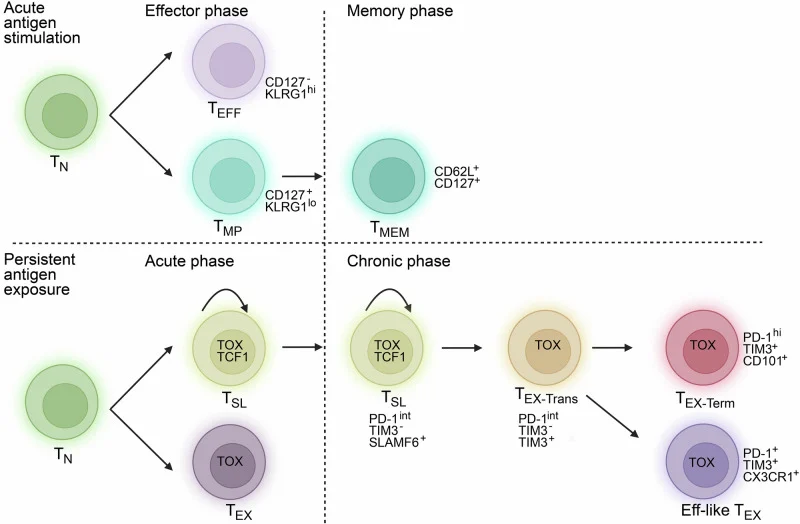
Cancer does not follow this clean sequence. Tumor antigens can remain continuously present, producing chronic T-cell receptor stimulation rather than a discrete phase of activation followed by antigen clearance. Under these conditions, tumor-reactive T cells enter a differentiation landscape that includes stem-like or progenitor-exhausted states as well as progressively more differentiated and terminally exhausted populations.
A 2026 review by Luxenburger, Thimme and Hofmann, “T Cell Adaptation in Chronic Infections and Tumors,”emphasizes that exhaustion should not be interpreted simply as immune failure. It represents an adaptation to persistent antigen exposure. Stem-like progenitor-exhausted cells retain self-renewal and proliferative capacity, while more terminally differentiated populations progressively lose functional plasticity.
This creates an important distinction between the cells responsible for immediate tumor killing and those responsible for sustaining the response. Highly differentiated cytotoxic cells may dominate the battle occurring inside the tumor today, while a smaller and less conspicuous stem-like population preserves the ability to generate another wave of effectors tomorrow.
Long-term immunity may therefore depend less on preserving every effector cell than on preserving the cells capable of replacing them.
The Cells That Remember Cancer May Not Be Inside the Cancer
One of the most interesting recent developments is the realization that some of the most important tumor-reactive T cells may reside outside the tumor itself.
In 2025, Sharanya Wijesinghe, Lisa Rausch, Sarah Gabriel, Axel Kallies and colleagues reported “Lymph-Node-Derived Stem-Like but Not Tumor-Tissue-Resident CD8+ T Cells Fuel Anticancer Immunity” in Nature Immunology. Using single-cell RNA sequencing and genetic tumor models, the investigators compared cytotoxic T-cell states inside tumors with those in tumor-draining lymph nodes.
They found that MYB-dependent stem-like precursor-exhausted CD8+ T cells residing in tumor-draining lymph nodes continually supported infiltration of new CD8+ T cells into tumors and were important for checkpoint blockade response. By contrast, intratumoral TCF1+ precursor cells and their descendants increasingly acquired tissue-residency programs that limited their contribution to sustained tumor control. TGFβ was a central regulator of this balance, promoting residency within tumors while restricting the abundance and differentiation capacity of stem-like cells in draining lymph nodes. Similar relationships were identified in human cancer.
This changes the anatomical model of antitumor immunity. Instead of imagining the tumor as a self-contained battlefield in which the same population of T cells must survive indefinitely, the immune response may operate through continuous replenishment. The tumor contains differentiated cells engaged in immediate cytotoxic activity, while the draining lymph node maintains a renewable reservoir capable of producing new tumor-directed cells.
In this model, durable immunity is not simply persistence. It is regeneration.
Cancer Immunity May Require a Two-Stage T-Cell Response
Earlier human and experimental work helps explain how this distributed system develops.
A study by Prokhnevska and colleagues examining human tumor-draining lymph nodes found activated CD8+ T cells with transcriptional, functional and epigenetic characteristics resembling stem-like tumor-infiltrating populations. T-cell receptor overlap suggested that these lymph-node cells were precursors of tumor-resident stem-like populations. Experimental models supported a two-stage model in which tumor-specific T cells were initially activated in draining lymph nodes but acquired full effector differentiation only after entering tumors and receiving additional costimulatory signals from antigen-presenting cells.
This architecture solves an important biological problem. If every tumor-reactive cell differentiated immediately into a highly activated effector, the immune response could consume its own regenerative potential. Separating initial stem-like activation from later effector differentiation allows the system to maintain a source population while continuously producing cells capable of killing cancer.
It also suggests that therapies should not necessarily maximize differentiation at every stage. A treatment that produces an enormous wave of cytotoxic cells but eliminates the precursor reservoir could potentially generate impressive early tumor regression without establishing the biological conditions required for durable control.
The quality of an immune response may therefore depend on whether it produces both an army and a reserve.
PD-1 May Protect the Very T Cells That PD-1 Blockade Needs
Perhaps the most counterintuitive recent finding in this field concerns PD-1 itself.
PD-1 is usually described as an inhibitory receptor that restrains antitumor T cells. Blocking the PD-1 pathway can restore immune activity and generate profound clinical responses. Yet physiological PD-1 signaling may also perform a protective function within the stem-like compartment.
In the 2026 Nature study “Inhibitory PD-1 Axis Maintains High-Avidity Stem-Like CD8+ T Cells,” investigators used three-dimensional multiplex imaging to identify specialized antigen-presentation niches within tumor-draining lymph nodes containing TCF1+PD-1+SLAMF6-high stem-like CD8+ T cells. These niches supported expansion, maintenance and affinity evolution of tumor-reactive stem-like populations.
Importantly, PD-1 signaling helped preserve high-avidity stem-like cells by restraining excessive T-cell receptor signaling and premature differentiation. Rather than functioning only as a brake on useful immunity, the inhibitory pathway could help protect the regenerative population from overstimulation.
This introduces an important paradox. Checkpoint inhibition works because immune restraint can prevent effective tumor control, yet some degree of restraint may also be necessary to maintain the cells capable of sustaining immunity over time.
The goal may therefore not be maximal T-cell activation. The goal may be sufficient activation while preserving stemness.
The Immune System Can Remember, but Exhaustion Can Be Written Into Chromatin
Long-term T-cell behavior is not determined only by which receptors are present on the cell surface. Persistent antigen exposure can progressively alter the way the genome itself is regulated.
The 2026 Nature Reviews Cancer article “Epigenetic Regulation of T Cell Exhaustion in Cancer,” by Tae Gun Kang, Jordan Johnson, Caitlin Zebley and Ben Youngblood, describes exhaustion as a transcriptionally and epigenetically organized cell state. Chronic stimulation reshapes chromatin accessibility, DNA methylation and transcription-factor networks, gradually restricting the developmental options available to tumor-reactive T cells.
This helps explain an important limitation of checkpoint blockade. Removing PD-1 signaling can restore function in responsive T-cell populations, but it does not necessarily erase the underlying epigenetic architecture created by chronic stimulation. Once cells become terminally exhausted, their ability to return to a true memory-like state is limited.
The distinction between functional reinvigoration and biological reprogramming is important. A T cell may temporarily regain cytotoxic activity after checkpoint blockade without recovering the developmental flexibility of a less differentiated memory cell.
This means that timing may matter. Preventing irreversible exhaustion could ultimately be easier than attempting to reverse it after its epigenetic program has become fixed.
Stemness and Exhaustion Exist on a Continuum We May Be Able to Manipulate
The 2026 review “Regulation of T Cell Exhaustion and Stemness: Molecular Mechanisms and Implications for Cancer Immunotherapy” describes the competing transcriptional programs that shape this differentiation landscape. TCF1, MYB and other regulators contribute to preservation of less differentiated populations, while chronic antigen signaling and transcriptional networks involving factors such as TOX and NR4A family members promote exhaustion-associated states.
The therapeutic implication is intriguing. Instead of treating exhaustion only after it appears, future therapies could attempt to influence the developmental trajectory itself.
Experimental strategies are already exploring regulators of chromatin and transcription that might preserve T-cell stemness or prevent irreversible terminal differentiation. LSD1 inhibition, for example, has been investigated as a means of modifying transcriptional programs associated with T-cell differentiation, while NR4A and other exhaustion-related regulatory pathways have emerged as potential targets for maintaining functional antitumor states.
These approaches remain largely experimental, and manipulating fundamental differentiation pathways can produce effects beyond tumor-reactive cells. Nevertheless, they introduce a new therapeutic concept: rather than only asking which checkpoint should we block, we might ask which developmental state should we preserve?
Persistent Antigen Is Both Teacher and Threat
Immune memory is normally associated with antigen clearance. Cancer creates a different situation because antigen may never completely disappear.
Persistent tumor antigen can maintain recognition and continually stimulate tumor-specific T cells. But chronic T-cell receptor signaling is also one of the principal drivers of exhaustion. Recent reviews emphasize that sustained antigen exposure progressively changes transcriptional, epigenetic and metabolic programs, producing a spectrum from stem-like precursor states to terminally dysfunctional cells.
This creates one of the central paradoxes of cancer memory. Some antigen exposure may help maintain an active antitumor population, particularly within supportive lymph-node niches, while excessive or poorly regulated stimulation can consume the same regenerative potential.
The biological context therefore matters as much as antigen persistence itself. Antigen presented within a supportive lymph-node niche together with appropriate costimulation and regulatory signals may have very different consequences from chronic stimulation inside a metabolically hostile, suppressive tumor microenvironment.
The immune system does not simply need to remember what cancer looks like. It must remember it in an environment that allows the responding cells to survive.
Memory Is Also a Metabolic State
Long-lived T cells face different energetic demands from rapidly proliferating effector cells.
Effector cells require substantial biosynthetic activity to support proliferation, cytokine production and cytotoxicity. Memory and stem-like populations must instead preserve metabolic flexibility, mitochondrial integrity and the ability to survive for long periods before rapidly expanding when needed.
The tumor microenvironment works against these requirements. Competition for glucose and amino acids, hypoxia, lactate accumulation and suppressive metabolites can impair mitochondrial function and reinforce dysfunctional T-cell states. Chronic stimulation therefore reshapes not only the transcriptome and epigenome but also the metabolic architecture of tumor-reactive cells.
These processes are interconnected. Metabolites influence chromatin-modifying enzymes, while transcriptional and epigenetic programs determine expression of metabolic pathways. A cell’s metabolic history can therefore contribute to its future differentiation potential.
This suggests that durable antitumor immunity cannot be engineered through checkpoint receptors alone. Preserving memory may require maintaining the bioenergetic fitness that allows a T cell to remain alive, quiescent when necessary and capable of rapid expansion years later.
Tissue-Resident Memory Adds Another Layer of Protection
Not every memory cell needs to circulate.
Tissue-resident memory T cells, or TRM cells, remain positioned within tissues and can respond rapidly when antigen reappears locally. CD103+ TRM populations have been associated with favorable outcomes across several cancers, although their functional significance varies according to tumor type and cellular context.
Recent work continues to reveal that TRM biology is more heterogeneous than previously appreciated. At the 2026 AACR Immuno-Oncology Conference, investigators reported that different resident-memory populations may participate in responses to different checkpoint strategies. CD8+CD103+ TRM cells were associated with PD-1 blockade response, whereas a distinct CD4+CD49a+ resident population was linked to CTLA-4-directed immunity. Their differentiation also appeared to depend on different transcriptional and signaling programs.
A 2026 Cancer Immunology Research study in diffuse large B-cell lymphoma similarly characterized CD103+ tissue-resident memory populations and examined their prognostic significance, illustrating that TRM biology is now being investigated beyond the solid tumors in which it was initially emphasized.
These findings suggest that tissue memory should not be treated as one uniform compartment. Different resident populations may provide different forms of surveillance, interact differently with checkpoint pathways and require different signals for their maintenance.
A durable immune system may therefore need both renewable stem-like reservoirs that generate new effectors and strategically positioned resident cells capable of responding immediately where cancer returns.
CD4+ Memory May Be More Important Than We Usually Acknowledge
The discussion of durable cancer immunity is often dominated by CD8+ T cells, but long-term immune control is unlikely to be exclusively cytotoxic.
CD4+ T cells provide help for CD8+ differentiation, support antigen-presenting cells, produce cytokines and influence myeloid populations. Emerging evidence suggests that particular CD4+ memory-like populations can actively remodel the tumor microenvironment rather than simply assisting CD8+ cells.
A 2026 Cancer Research study in bladder cancer identified a population of CCL5-high CD4+ T cells with memory-like activation features that strongly correlated with checkpoint inhibitor response. Functionally, these cells promoted immunostimulatory macrophage polarization through CCL5–CCR1 signaling. Tumor-derived prostaglandin E2 suppressed development of this population, providing a mechanism by which the tumor microenvironment could interfere with a potentially beneficial memory-like CD4+ state.
The study is particularly interesting because it broadens the meaning of immune memory. A memory T cell does not merely wait passively for cancer to return. It can influence the cellular ecosystem surrounding it, changing macrophage states and potentially creating conditions that support broader antitumor immunity.
Durable cancer memory may therefore involve preservation of immune relationships, not only preservation of individual clones.
Can Treatment Create Better Memory Rather Than Simply More Immunity?
If memory formation is a distinct biological process, therapies that produce similar initial tumor regression could theoretically leave behind very different immune states.
Preclinical work combining radiation with PD-L1 blockade provides an instructive example. Investigators found that the combination stimulated a TCF1+PD-1+ stem-like population in tumor-draining lymph nodes, followed by expansion and differentiation into effectors within tumors. Blocking lymph-node egress or selectively depleting the stem-like population impaired tumor control.
The significance is not that radiation should universally be used to create immune memory. The study was performed in experimental tumor models. Rather, it demonstrates that treatment can influence the developmental architecture of an antitumor response, including the reservoir from which subsequent effector populations arise.
This raises a broader question for clinical trial design. Two regimens may produce similar response rates but differ substantially in what remains after treatment: one could generate predominantly terminal effectors, while another establishes a renewable stem-like compartment capable of sustaining immunity.
Response rate alone would not capture that difference.
Could We Borrow Memory the Immune System Already Has?
An even more unconventional idea is to exploit memory that was originally generated against something other than cancer.
Humans carry enormous pools of memory T cells directed against common viruses such as cytomegalovirus. Because these cells have already undergone expansion and memory formation, investigators are exploring whether their existing immune competence can be redirected toward tumors.
At the 2026 AACR Annual Meeting, researchers reported a preclinical strategy using CMV-derived epitopes to redirect pre-existing antiviral memory against breast tumors. In CMV-infected mouse models, delivery of viral epitopes enhanced T-cell infiltration and tumor necrosis, suggesting that established antiviral memory could potentially be repurposed for antitumor activity.
This remains early experimental work, but the concept is fascinating. Most cancer immunotherapy attempts to create or restore a tumor-specific immune response. Another strategy might instead ask whether we can recruit immune memory that already exists and redirect it toward cancer.
If successful, this would turn one of the immune system’s greatest strengths, its lifelong memory of previous antigen encounters, into a therapeutic resource.
Memory Must Be Broad Enough to Survive Tumor Evolution
Remembering cancer is useful only if the cancer continues to resemble what the immune system remembers.
Tumors evolve under immune pressure. Antigenic clones can disappear, antigen-presentation machinery can be altered and populations capable of escaping recognition can expand. A perfectly preserved memory response against a single antigen may therefore become irrelevant if recurrent disease no longer expresses that antigen.
Durable protection consequently requires breadth as well as longevity.
One mechanism capable of broadening immunity is epitope spreading. Destruction of tumor cells releases additional antigens, which can be captured and presented to new lymphocyte populations. Over time, the immune response can expand beyond the specificity that initiated it.
A striking 2026 Nature Communications study provides an experimental example. Deletion of the nuclear receptor NR2F6 in CAR-T cells preserved a TCF1+ progenitor-exhausted phenotype and improved metabolic fitness under chronic antigen stimulation. More interestingly, in immunocompetent solid-tumor models, the engineered cells generated polyclonal host antitumor responses that persisted even after the CAR-T cells themselves had disappeared. Animals were protected against rechallenge, including antigen-negative tumors, consistent with epitope spreading and secondary host immunity.
The work is preclinical, so it does not establish that the same process can produce durable protection in patients. But conceptually it demonstrates something important: the most durable cellular therapy might eventually be one that teaches the patient’s own immune system enough about the tumor that the original therapeutic cells are no longer required.
That is a different definition of persistence.

CAR T-Cell Therapy Death Rate: Treatment-Related Mortality, Causes of Death, and Risk Factors
A Long-Lived Clone Is Not Necessarily a Successful Memory Response
The temptation is to measure immune memory simply by asking whether a particular tumor-reactive T-cell clone remains detectable years later.
Persistence is important, but it is insufficient.
A persisting clone may be metabolically impaired, terminally exhausted or unable to reach recurrent disease. Conversely, a small stem-like population may be difficult to detect but retain enormous proliferative potential. Tissue-resident cells may provide excellent local surveillance without appearing prominently in peripheral blood, while lymph-node reservoirs may continuously replenish tumor-directed populations.
A useful assessment of antitumor memory would therefore need to measure several properties simultaneously: specificity, developmental state, proliferative capacity, anatomical location, metabolic fitness and the ability to generate functional descendants.
This is one reason routine blood biomarkers have struggled to capture the full biology of durable immune control. The relevant immune system is distributed across blood, lymph nodes, tumors and peripheral tissues.
Memory is not a cell count. It is a functional state of an immune network.
Can We Tell When a Patient Has Developed Durable Immune Memory?
Clinically, this may become one of the most important questions.
Some patients maintain tumor control long after checkpoint therapy stops, but we currently cannot measure antitumor memory well enough to determine precisely when treatment is no longer required. Imaging can show that detectable disease has disappeared or stabilized, but it cannot tell us whether the immune system has established durable surveillance. ctDNA can provide information about molecular residual disease in selected settings, but it does not directly measure the quality of the immune response.
A future immune-memory assessment might combine several layers of information. T-cell receptor sequencing could follow tumor-reactive clonotypes; phenotyping could distinguish stem-like, effector, resident and terminally exhausted populations; epigenetic profiling could reveal whether cells retain developmental plasticity; functional assays could test proliferative and cytotoxic potential; and tissue or lymph-node sampling might reveal reservoirs that are invisible in peripheral blood.
The difficulty is that the most important memory population may differ between cancers and therapies. A circulating signature that is informative after one treatment may miss the lymph-node reservoir maintaining another response.
We therefore do not yet have an immunological equivalent of “minimal residual disease negative” that tells us the immune system is now prepared to control this cancer without continued treatment.
Developing such a measure could fundamentally change how long immunotherapy is given.
Could We Design Immunotherapy Around Memory From the Beginning?
Current immunotherapy trials are generally designed around tumor response, progression-free survival and overall survival. Immune memory is usually examined as a translational correlate rather than a primary therapeutic objective.
That may eventually change.
If stem-like cells are required to sustain antitumor immunity, therapies could be optimized to preserve them. If tumor-draining lymph nodes contain essential regenerative reservoirs, treatment strategies could consider how surgery, radiation and systemic therapy affect those compartments. If terminal exhaustion becomes epigenetically fixed, intervention might be timed before developmental plasticity is lost. If metabolism determines whether cells remain functional, metabolic support could become part of memory-directed immunotherapy.
The emerging biology also suggests that stronger immune activation is not necessarily synonymous with better immune memory. A therapy that forces rapid terminal differentiation may generate impressive immediate cytotoxicity while weakening long-term regenerative capacity. Conversely, maintaining a relatively small pool of stem-like cells may provide less dramatic short-term expansion but stronger long-term protection.
Future immunotherapy might therefore need two simultaneous objectives: eliminate as much cancer as possible now while preserving the immune population capable of controlling what remains later.
The Real Meaning of Lifelong Cancer Immunity
“Remembering cancer for a lifetime” should not necessarily mean maintaining the same population of T cells indefinitely.
The immune system is dynamic. Individual effector populations appear and disappear, stem-like precursors generate descendants, resident populations guard particular tissues and tumors themselves evolve. Durable protection is therefore more likely to resemble a self-renewing ecosystem than a frozen memory.
The recent literature supports this interpretation. Stem-like progenitor populations can maintain ongoing responses under chronic antigen exposure, tumor-draining lymph nodes can serve as reservoirs for continuous replenishment, PD-1 signaling can help protect high-avidity stem-like cells from excessive differentiation, and transcriptional, epigenetic and metabolic programs determine whether chronic stimulation produces renewable immunity or terminal exhaustion.
At the same time, experimental studies suggest that durable immunity can broaden beyond the specificity that initiated treatment, allowing host immune responses to persist after the original therapeutic population disappears.
Perhaps the goal is therefore not to preserve one memory of one antigen forever. It is to establish an immune system capable of remembering, renewing and updating its recognition of cancer as the disease changes.