Glioblastoma remains one of the most difficult solid tumors for cellular immunotherapy. CAR-T cells can reach intracranial tumors and generate antitumor responses, but durable control has been limited by several features intrinsic to glioblastoma: heterogeneous antigen expression, antigen loss under therapeutic pressure, and a profoundly immunosuppressive tumor microenvironment dominated by tumor-associated macrophages (TAMs).
A new study published in Nature in 2026 proposes a different way of approaching these barriers.
Rather than searching for an antigen expressed only by malignant cells, Savage and colleagues identified glycoprotein non-metastatic melanoma protein B (GPNMB) as a target shared between glioblastoma cells and immunosuppressive myeloid populations. They then developed GPNMB-directed CAR-T cells capable of attacking both compartments simultaneously.
The concept shifts antigen selection beyond tumor coverage alone. If a single CAR can eliminate malignant cells while also disrupting the immune compartment that supports their survival, the tumor microenvironment itself becomes part of the therapeutic target.
Why CAR-T Has Struggled in Glioblastoma
Glioblastoma presents an unusually difficult environment for adoptive cell therapy.
Within the same tumor, malignant cells can occupy different transcriptional and phenotypic states. Glioma stem cells can transition between these states and repopulate tumors after treatment. A target expressed strongly on one malignant population may therefore be absent from another, creating an immediate route for antigen-negative escape.
The surrounding immune environment creates another layer of resistance. GBM is heavily infiltrated by TAMs, which can sustain tumor growth and contribute to local immunosuppression. Consequently, even a CAR-T cell that recognizes its target must function within a microenvironment actively hostile to sustained T-cell activity.
Most CAR strategies address these problems separately: broaden malignant-cell recognition, improve CAR persistence, add another tumor antigen, or engineer the T cell to resist immunosuppression.
The new study asked whether antigen selection itself could address more than one problem.
GPNMB Emerges From Multi-Omic Target Discovery
The investigators initially compared CD133-positive and CD133-negative populations from patient-derived glioma stem cell cultures. CD133 has been used to identify glioma stem-cell populations, but residual and recurrent disease is not confined to CD133-positive cells.
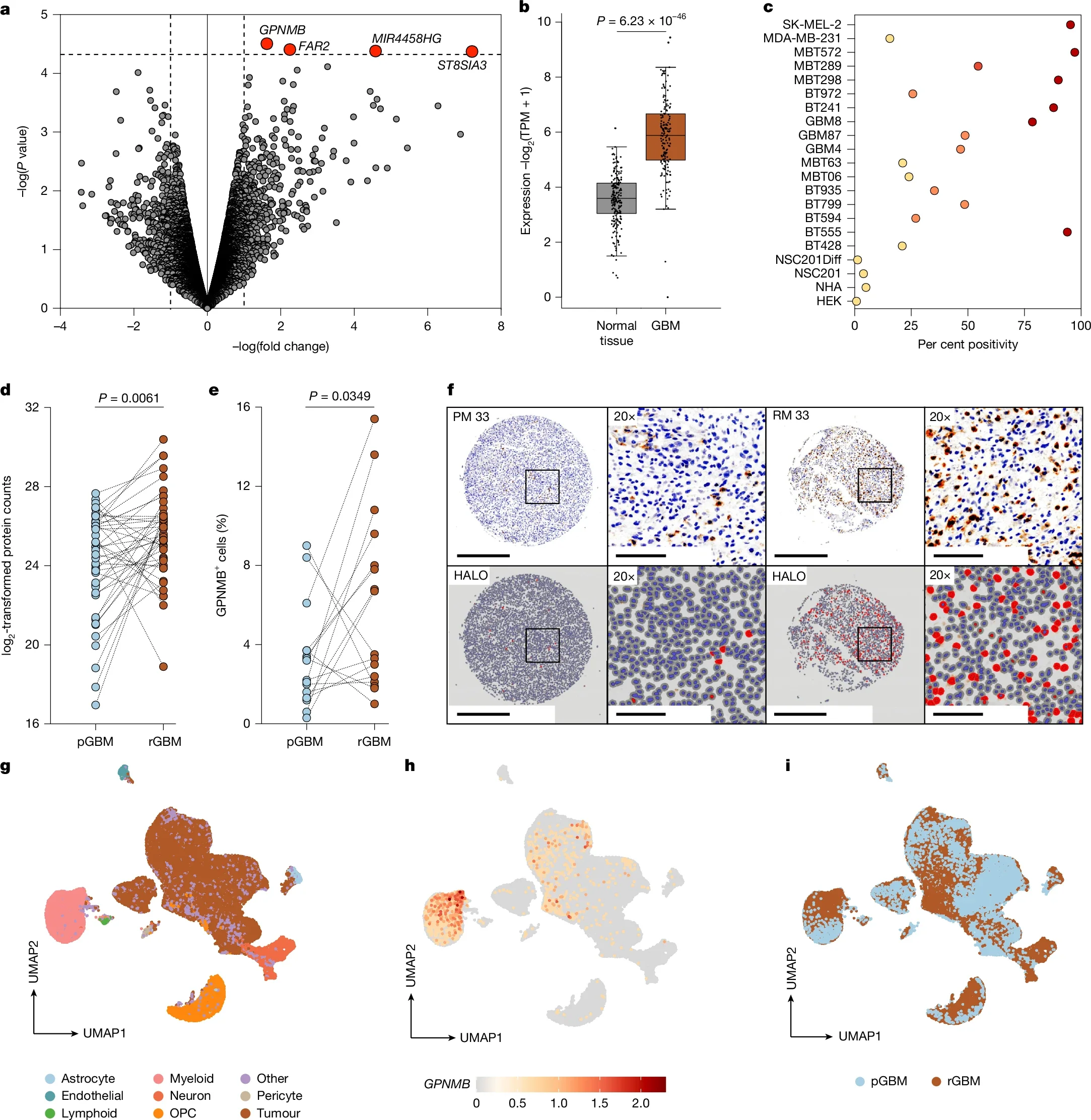
Among genes enriched in CD133-negative glioma stem cells, GPNMB emerged as the most significantly upregulated candidate. GPNMB encodes a glycosylated type I transmembrane protein previously reported across several malignancies.
The investigators then examined its expression across several complementary datasets.
GPNMB expression was significantly higher in GBM than in normal brain in bulk transcriptomic data. Surface profiling across 15 patient-derived glioma stem cell lines showed increased GPNMB relative to non-malignant controls, including neural stem cells and astrocytes. Importantly, analysis of matched primary and recurrent tumors showed that GPNMB protein expression increased at recurrence and was detected across all 86 tumors included in the proteomic dataset.
Single-cell RNA sequencing provided another important observation: GPNMB was not restricted to malignant cells.
Across primary and recurrent human GBM specimens, its expression localized predominantly to malignant and myeloid populations, with greater expression in recurrent tumors. Meanwhile, GPNMB was not detected across multiple regions of healthy adult brain in the tissue analysis performed by the investigators.
That expression pattern created the basis for a dual-compartment strategy.
Instead of viewing myeloid expression as simply an off-tumor obstacle to CAR development, the investigators asked whether it could become an advantage.
GPNMB Appears to Be More Than a Surface Marker
A therapeutically attractive antigen becomes particularly interesting when it also contributes to the biology of the disease.
CRISPR–Cas9 knockout experiments suggested that GPNMB has such a role in GBM. Removing GPNMB from patient-derived glioma stem cells reduced proliferation in vitro, while mice implanted intracranially with GPNMB-knockout tumors survived longer than those carrying GPNMB-expressing tumors.
The effects extended beyond malignant-cell proliferation.
In an immunocompetent mouse glioma model, Gpnmb loss was associated with changes in tumor transcriptional programs, reduced myeloid recruitment and increased lymphoid infiltration. Gpnmb-knockout tumors also shifted away from mesenchymal-like malignant states toward developmental and astrocyte-like states.
This connection is relevant because mesenchymal-like GBM states have been associated with aggressive and treatment-refractory biology, while myeloid-derived signals can contribute to their maintenance. The authors therefore propose that GPNMB participates in a broader tumor–myeloid interaction rather than functioning only as a passive antigen.
Building a GPNMB-Directed CAR-T Cell
The investigators constructed a second-generation CAR using the single-chain variable fragment derived from glembatumumab vedotin, an antibody–drug conjugate previously investigated against GPNMB in other malignancies.
The CAR incorporated a CD8 hinge and transmembrane region, a 4-1BB costimulatory domain and CD3ζ signaling. T cells from three independent healthy donors were engineered and tested against GPNMB-positive patient-derived glioma stem cells.
In vitro, GPNMB CAR-T cells produced potent dose-dependent cytotoxicity across several GPNMB-positive GBM models. Target recognition increased CD25 and CD69 expression and stimulated IFNγ and TNF production. Cytotoxicity was markedly reduced when GPNMB was genetically deleted from target cells, supporting antigen-specific activity.
The next question was whether this activity would survive the much more challenging intracranial environment.
Durable Tumor Clearance in Orthotopic GBM Models
The investigators tested GPNMB CAR-T cells in orthotopic patient-derived xenograft models using intracranial administration.
The results were striking.
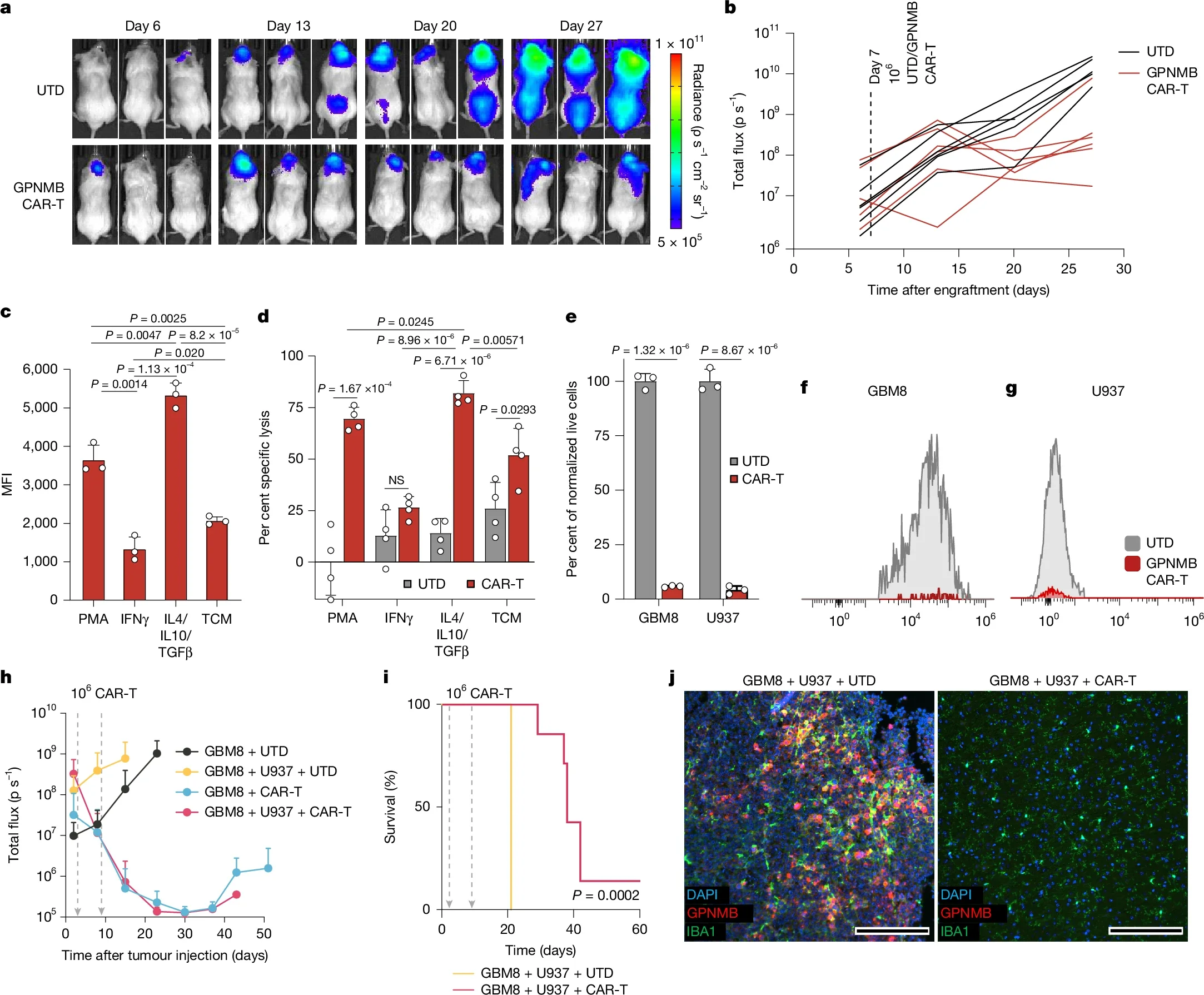
Two doses of GPNMB CAR-T cells produced complete clearance of tumor burden and durable disease control. Responses persisted beyond 160 days in 6 of 7 mice bearing GBM8 tumors and beyond 120 days in all 6 mice bearing GBM4 tumors.
The study then addressed one of the central problems facing CAR-T therapy in solid tumors: what happens after another antigen-directed therapy has already selected for resistant cells?
The authors first treated tumors with CD133-directed CAR-T cells. Residual tumors showed near-complete depletion of CD133-positive cells but retained diffuse GPNMB expression. When GPNMB CAR-T cells were subsequently administered to tumors recurring after CD133-directed therapy, they again produced complete tumor clearance despite treatment beginning at a high tumor burden.
This experiment provides an important proof of principle. A target enriched in residual populations after one antigen-directed therapy could potentially be used to address the escape landscape created by the first treatment.
But GPNMB offered another potential advantage that CD133 did not.
The CAR-T Cells Also Targeted Immunosuppressive Macrophages
The myeloid compartment is where this study becomes particularly relevant to immuno-oncology.
The investigators found that macrophage GPNMB expression was influenced by cell state. Exposure to immunosuppressive cytokines including IL-4, IL-10 and TGFβ, or to glioma stem-cell-conditioned medium, increased GPNMB expression.
GPNMB CAR-T cells then preferentially lysed macrophages conditioned by these immunosuppressive or tumor-derived signals while showing less activity against IFNγ-primed macrophages.
When GBM cells, macrophages and CAR-T cells were placed together, the engineered T cells simultaneously eliminated GPNMB-positive tumor cells and macrophages without an apparent loss of cytotoxic activity against either compartment. Вставленный текст
The effect was reproduced in vivo.
In mice bearing intracranial tumors supplemented with immunosuppressive macrophages, the macrophages accelerated tumor growth and shortened survival. GPNMB CAR-T treatment nevertheless induced profound tumor regression and significantly prolonged survival. Tissue analysis showed near-complete clearance of both GPNMB-positive tumor cells and GPNMB-positive IBA1-positive macrophages.
This distinguishes GPNMB from a conventional tumor-associated CAR target.
The macrophage compartment is not simply collateral expression to be tolerated. In this model, it becomes part of what the therapy is designed to remove.
What Kind of Myeloid Population Is Being Targeted?
The authors further investigated GPNMB-positive macrophage biology using an integrated single-cell RNA-sequencing atlas of myeloid populations from different central nervous system settings.
GPNMB expression was most strongly associated with gene programs involving lipid transport and hypoxia. Genes co-expressed with GPNMB included APOC1, APOE, PLTP and LRP1, while pathway analysis highlighted cholesterol and lipoprotein transport.
GPNMB also correlated more strongly with immunosuppressive M2-like signatures than with pro-inflammatory M1-like programs.
This suggests that the therapy may not simply indiscriminately deplete every macrophage in the tumor. At least in the experimental systems used here, GPNMB preferentially marks a myeloid state associated with immunosuppressive biology.
That distinction could be important for translation. TAMs are heterogeneous, and broad macrophage depletion could remove populations with potentially beneficial immune functions. A target enriched within tumor-supportive myeloid states offers a more selective concept, although whether that selectivity will hold in patients remains unknown.
The Strategy Survived an Intact Immune System
Xenograft experiments can demonstrate direct antitumor activity, but they cannot fully reproduce interactions between CAR-T cells and an intact immune system.
The investigators therefore generated a murinized anti-mouse GPNMB CAR and tested it in immunocompetent mice with orthotopic GL261 gliomas.
Again, treatment produced strong tumor control, with durable responses extending beyond 100 days and no overt toxicity reported in the model. Tissue analysis demonstrated depletion of both GPNMB-positive malignant cells and GPNMB-positive macrophages.
Together with the humanized and macrophage-inclusive models, these experiments support the central mechanism proposed by the study: GPNMB-directed CAR-T cells can operate not only against malignant GBM cells but across the tumor–myeloid interface.
From Tumor Antigens to Ecosystem Antigens
This may be the broader contribution of the paper.
Solid-tumor CAR-T development has often centered on finding the ideal malignant-cell antigen: highly expressed, broadly distributed, absent from essential normal tissues and stable under treatment pressure.
Glioblastoma makes that search exceptionally difficult because heterogeneity is intrinsic to the disease. Even highly active CAR-T cells can create selective pressure that leaves antigen-negative populations behind. Meanwhile, the immunosuppressive microenvironment remains intact and can continue supporting residual disease.
GPNMB suggests another framework.
An antigen could be valuable not because it is perfectly restricted to every malignant cell, but because its distribution connects multiple disease-supporting compartments.
In this case, one CAR recognizes treatment-resistant malignant populations while also attacking GPNMB-positive immunoregulatory macrophages. The therapeutic target therefore becomes a tumor ecosystem rather than a single cellular population.
That does not eliminate the antigen-heterogeneity problem. The authors themselves suggest that multi-antigen or tandem CAR designs could broaden malignant-cell coverage while preserving GPNMB-mediated myeloid targeting. Armored CARs delivering cytokines such as IL-12, IL-15 or IL-18, or local checkpoint blockade, are additional strategies proposed for further development.
The Translational Questions Are Substantial
Despite the magnitude of the preclinical responses, these findings should not be interpreted as evidence of clinical efficacy in patients with GBM.
The study remains preclinical.
Delivery is one immediate challenge. The strongest experiments used intracranial CAR-T administration, which may maximize local exposure while limiting systemic toxicity but adds procedural complexity to clinical translation. The authors identify locoregional administration as a rational strategy for future development.
Safety also requires much deeper investigation.
GPNMB was largely absent from normal adult brain in the tissues examined, which supports a potential therapeutic window in the CNS. However, low-level expression was detected in some normal tissues, including bone and skin, as well as tissues with dense immune populations such as the thymus.
More importantly, deliberately targeting a myeloid population creates questions that conventional tumor-restricted CAR strategies do not face. The long-term consequences of eliminating GPNMB-positive macrophages in the human brain are unknown. The effects on tissue repair, inflammatory regulation and other macrophage functions will need to be defined carefully.
The authors therefore highlight the need for further CNS toxicity studies and long-term safety assessment of myeloid targeting before clinical translation.
There is also no evidence yet that the extraordinary tumor clearance observed in mouse models will translate into comparable activity in patients. Human GBM is more heterogeneous, treatment-exposed and spatially complex than any experimental system can fully reproduce.
You Can Read Full Article Here