Development of bispecifics in multiple myeloma is now branching in several directions at once: newer T-cell engagers are being engineered for less frequent dosing and more manageable toxicity, alternative targets are extending treatment, and multispecific constructs are bringing two myeloma antigens into a single molecule. These therapies are also moving into earlier lines of treatment, where long-term tolerability, immune suppression and treatment burden carry more weight.
Within the BCMA×CD3 platform, etentamig is among the newer T-cell engagers to reach advanced clinical development. In the phase 3 CERVINO trial, it produced an objective response rate of 74.0% versus 45.7% with investigator-selected standard therapy, and cut the risk of progression or death by 60% (HR 0.40). The trial enrolled 393 patients with triple-class-exposed relapsed or refractory MM who had received a median of three prior lines of therapy.
The full CERVINO dataset will be presented at the International Myeloma Society Annual Meeting on September 25, 2026, and hasn’t yet been peer-reviewed. Response depth, MRD negativity, duration of response, subgroup outcomes and longer follow-up will fill in the picture.
CERVINO Brings Randomized Evidence
Much of the early evidence for bispecifics in MM came from single-arm studies in patients who’d already exhausted several major drug classes. Teclistamab established BCMA-directed T-cell engagement in this setting: in MajesTEC-1, it produced a 63% objective response rate and median PFS of 11.3 months in a population with a median of five prior lines.
Etentamig was compared head-to-head with investigator-selected active therapy, carfilzomib-dexamethasone, elotuzumab-pomalidomide-dexamethasone, or selinexor-bortezomib-dexamethasone, so the progression-free survival HR of 0.40 reflects a randomized comparison.
There was also an early overall survival signal: 12-month survival was 87.9% with etentamig versus 72.0% with standard therapy (HR 0.48). The prespecified efficacy boundary for overall survival wasn’t crossed at this interim analysis.
CERVINO doesn’t compare etentamig with another T-cell engager, but a newer BCMA×CD3 construct producing a substantial PFS benefit against active therapy in triple-class-exposed MM is a meaningful result on its own.
Etentamig’s BCMA×CD3 Architecture
The construct pairs two high-avidity BCMA-binding domains with a low-affinity CD3-binding domain, and retained FcRn binding supports a longer half-life. The intent is to keep a strong grip on BCMA-expressing plasma cells while moderating T-cell activation and allowing a less frequent schedule.
That difference already shows up in CERVINO. Patients received a single step-up dose followed by treatment once every four weeks from the start. CRS occurred in 28.3% of patients, mostly grade 1, with no grade 3 or higher events. ICANS was uncommon and limited to grade 1. Treatment-emergent adverse events led to discontinuation in 3.6% of etentamig patients versus 9.6% on standard therapy.
Less frequent dosing matters beyond convenience: step-up regimens, monitoring requirements and repeat clinic visits are a big part of what it takes to deliver a T-cell engager. Monthly administration could make treatment easier to deliver outside large myeloma centers, though CERVINO itself doesn’t establish that community-based delivery.
Binding geometry, CD3 affinity, pharmacokinetics and the specific BCMA epitope recognized can all shape how an engager performs. Linvoseltamab is a good comparison: structural studies suggest that it retains binding despite certain resistance-associated BCMA alterations, including R27P and changes involving the P33 region.
Can Less Exposure Reduce Infection Risk?
In MajesTEC-1, infections occurred in 76.4% of patients on teclistamab, including grade 3/4 infections in 44.8%. Infection, hypogammaglobulinemia and prolonged immune suppression have become central concerns for the whole class.
CERVINO doesn’t change that. Grade 3/4 infections occurred in 27.7% of patients on etentamig versus 19.2% on standard therapy, and grade 5 infections were seen in 1.5% and 3.1%, respectively. The low rate of fatal infection is reassuring, but the higher rate of severe infection with etentamig is worth watching as exposure lengthens. Trials across the class are already testing intermittent administration, outpatient dosing and treatment discontinuation after a deep response.
Cevostamab Shows the Potential of Fixed-Duration Treatment
Cevostamab targets Fc receptor-homolog 5 (FcRH5) instead of BCMA or GPRC5D, and its phase 1 study tested a defined treatment duration: dosing every three weeks for 17 cycles, roughly a year, unless the disease progressed or toxicity became unacceptable.
In the recently published phase 1 study of 324 heavily pretreated patients, nearly half had already had BCMA-directed therapy. At the recommended 160-mg dose, the objective response rate was 44.3% overall and 60.6% in BCMA-naive patients, with median duration of response of 10.4 months overall and 19.7 months in that BCMA-naive group.
The notable part is that responses didn’t necessarily disappear once treatment ended, some stayed durable through treatment-free follow-up. Cevostamab hasn’t shown that fixed-duration therapy matches continuous treatment, but its phase 1 results make treatment duration a real development variable.
GPRC5D and FcRH5 Expand the Target Map
Talquetamab established GPRC5D as a clinically relevant target in heavily pretreated MM, including after prior T-cell redirection. Its target also comes with a distinct toxicities: dysgeusia and other oral effects, skin and nail changes related to GPRC5D expression in keratinized tissues.
Development within GPRC5D continues. Forimtamig uses a 2+1 configuration, two GPRC5D-binding sites and one CD3-binding site, meant to boost avidity for the tumor target while keeping T-cell engagement intact. In its first-in-human study, activity showed up with both intravenous and subcutaneous dosing: a 71.4% objective response rate in the IV cohort and 60.4% in the subcutaneous cohort.
FcRH5 is expressed across the B-cell lineage and at high levels on malignant plasma cells. Cevostamab’s activity in a population with substantial prior BCMA exposure is relevant not only to fixed-duration therapy. FcRH5 expression in the cevostamab phase 1 study was detected in all biomarker-evaluable patients regardless of BCMA expression, and response did not appear to depend on baseline FcRH5 levels.
The Rise of Dual-Antigen Targeting
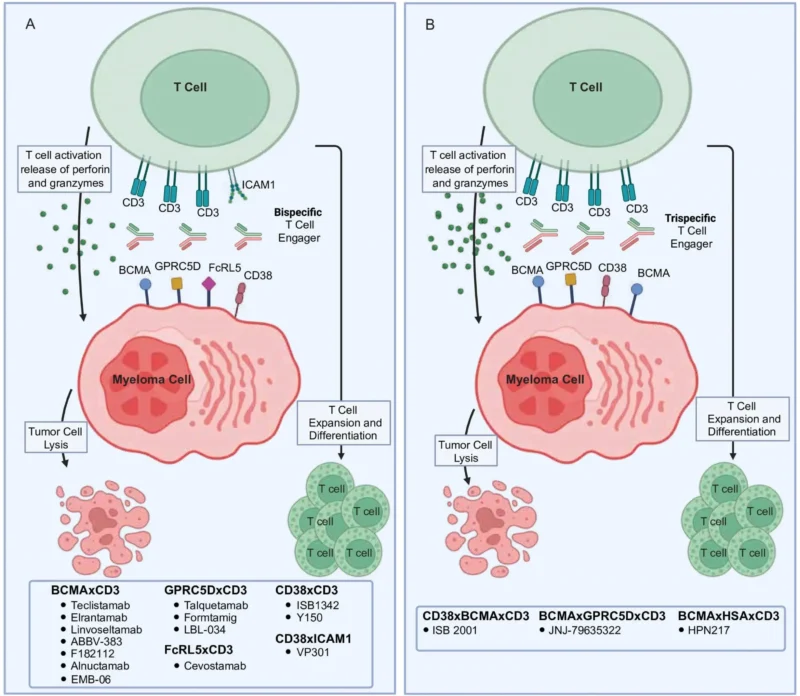
Using different targets sequentially is already part of MM treatment. The combination of teclistamab and talquetamab gave early clinical evidence that simultaneous BCMA and GPRC5D targeting can work well: in the phase 1 RedirecTT-1 study, the recommended phase 2 regimen produced an 80% response rate, including 61% in patients with extramedullary disease.
A follow-up phase 2 study focused on true extramedullary myeloma, one of the toughest MM phenotypes to treat. Among 90 patients, 79% responded and 12-month progression-free survival was 61%. That’s a strong signal in a hard population, but the added immune engagement came with real toxicity: grade 3/4 infections in 31%, and treatment-related deaths.
Attacking BCMA and GPRC5D together may limit the chance for a clone that’s lost or downregulated one antigen to take over, but combining two T-cell engagers also raises the intensity and complexity of treatment. Multispecific engineering offers a way to pursue the same biological idea without giving two separate drugs.
Ramantamig Brings Dual-Antigen Targeting Into a Single T-Cell Engager
Ramantamig, formerly JNJ-79635322, builds BCMA and GPRC5D recognition into one molecule that also engages CD3. Both myeloma targets are built into a single trispecific engager.
MM is made up of evolving subclones, and target expression shifts under treatment pressure. Preclinical studies showed ramantamig could recognize myeloma cells expressing both BCMA and GPRC5D, as well as cells expressing either one alone.
Early clinical activity looks strong. Among 36 patients treated at the recommended phase 2 dose, the objective response rate was 86.1%, and all 27 patients with no prior BCMA- or GPRC5D-directed therapy responded.
These are small early-phase cohorts, but the program has already moved into randomized development. Two phase 3 studies are now comparing ramantamig with teclistamab at different points in relapsed MM. TRIlogy-5 is testing it in patients with one to three prior lines of therapy and plans to enroll around 700 patients, with complete response or better and progression-free survival as primary endpoints.
ISB 2001 Takes a Different Trispecific Approach
ISB 2001, now licensed by AbbVie, pairs BCMA and CD38 recognition with CD3 engagement. CD38 is already a clinically validated myeloma target through daratumumab and is widely expressed on malignant plasma cells, giving this construct a different dual-antigen architecture. The broader pipeline now includes several trispecific configurations rather than one template for adding a third binding domain.
Initial phase 1 results showed a 75% overall response rate across dose levels among 24 heavily pretreated patients. CRS occurred in 70.8%, mostly grade 1 or 2, with no ICANS reported. The cohort is small and follow-up limited, so durability and comparative safety are still open questions.
frontiersin.org
Multispecific Engineering Is Expanding Beyond Antigen Selection
Adding another myeloma antigen is only one axis of multispecific development. Another is changing the signals delivered to the immune cell itself. Some early constructs are building costimulatory signaling directly into the molecule. SAR442257, for example, engages CD38 on the myeloma cell together with CD3 and CD28 on T cells.
Preclinical and ex vivo work suggests adding CD28 costimulation strengthens T-cell activation and cytotoxicity compared with CD38×CD3 engagement alone, and modeling studies point to better immune-synapse formation and T-cell activation even at lower engager concentrations.
This is much earlier-stage than etentamig, cevostamab or ramantamig, but it broadens what multispecific engineering can aim for, though greater T-cell activation will have to be weighed against immune-mediated toxicity.
Earlier-Line Treatment Raises the Safety and Durability Bar
Trials now span earlier relapsed disease, newly diagnosed MM and post-transplant strategies, putting these agents alongside regimens that already produce long remissions.
Newer agents are following: etentamig is being studied with daratumumab against daratumumab, lenalidomide and dexamethasone in transplant-ineligible newly diagnosed MM. Ramantamig is going further still, through a phase 3 study of ramantamig plus daratumumab against established daratumumab-based therapy in newly diagnosed patients not planning upfront transplant, with progression-free survival and MRD-negative complete response at 12 months as co-primary endpoints.
Severe infection, sustained hypogammaglobulinemia and frequent treatment visits mean something different for a newly diagnosed patient expected to stay in remission for years than for someone several relapses in.
Biomarkers Could Matter More as the Number of Engagers Grows
Treatment selection today depends mostly on prior therapies, clinical characteristics, target exposure, regulatory availability and practical logistics. There’s no validated biomarker panel that reliably points to which patient should get a BCMA-, GPRC5D- or FcRH5-directed engager.
A few candidate markers are emerging. Target-antigen density can influence whether an effective immune synapse forms. Soluble BCMA may offer some signal about disease burden and target biology, though its changes aren’t specific enough on their own.
The immune compartment may end up mattering just as much. Studies of multispecific T-cell engagers have linked response to features like cytotoxic T-cell populations, granzyme B expression and immune activation, meanwhile suppressive cell populations and microenvironmental signals have been tied to weaker activity.
For some newer constructs, expression of the tumor target itself may become relevant too: ex vivo analyses of the CD38-directed trispecific SAR442257, for instance, identified CD38 expression as an important predictor of activity.
Immune Engagers Are Beginning to Extend Beyond T Cells
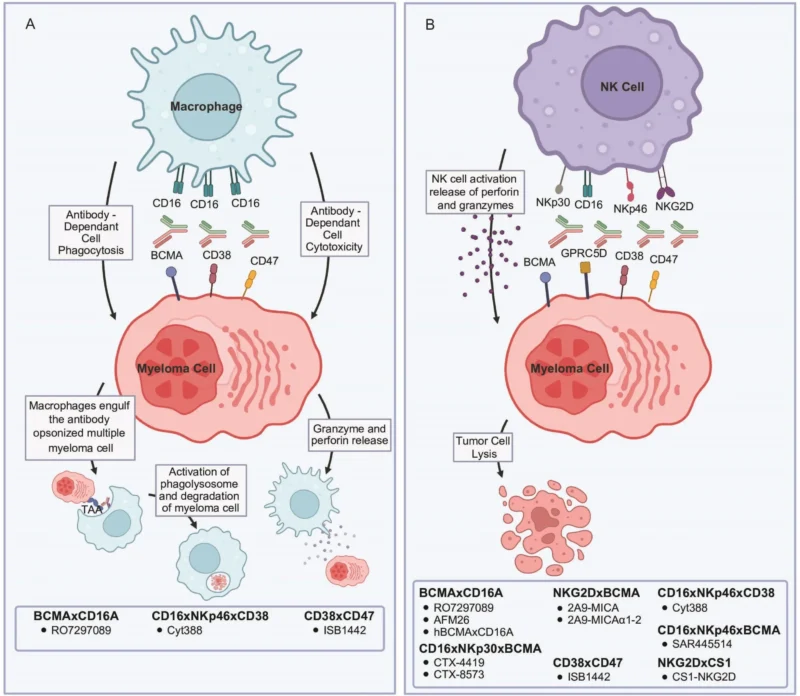
Natural killer cell engagers are being designed to connect myeloma-associated antigens with activating receptors such as NKp46, NKp30, CD16A or NKG2D, and macrophage-engaging approaches are also under investigation. These approaches could drive immune-mediated killing that doesn’t depend on a heavily treated patient’s T-cell compartment.
Some constructs are already fairly sophisticated. CYT-338, for instance, is designed to engage CD38 on myeloma cells while activating NK cells through NKp46 and CD16. Preclinical studies suggest NKp46 engagement can promote cytotoxicity while sidestepping some of the limitations tied to CD38-directed depletion of NK cells.
The Next Wave Is Already Taking Several Forms
T-cell engagers are moving into patients with fewer prior therapies, treatment schedules are getting lighter, and randomized trials are increasingly comparing newer constructs against active myeloma regimens or established engager. Etentamig is among the first of this newer group to post positive randomized phase 3 data. Around it, the rest of the pipeline is already pointing toward where the platform is headed.
FAQ
Is etentamig approved for multiple myeloma?
No. Etentamig remains investigational. The Phase 3 CERVINO trial has reported positive interim results in triple-class-exposed relapsed or refractory multiple myeloma, but the full dataset has not yet been presented or peer-reviewed.
Could monthly dosing make bispecific therapy easier to deliver outside major cancer centers?
Potentially. Etentamig uses a single step-up dose followed by once-every-four-week treatment, which could reduce repeat visits and monitoring compared with more frequent schedules. Whether this translates into easier community-based treatment still needs to be demonstrated.
Can patients eventually stop bispecific therapy after reaching a deep response?
This is increasingly being studied. Cevostamab has already shown that responses can persist after a defined treatment course, while other studies are exploring reduced-frequency dosing and treatment discontinuation after deep responses. Whether fixed-duration treatment can provide the same long-term disease control as continuous therapy remains unresolved.
What happens if multiple myeloma stops responding to BCMA-directed therapy?
Loss of response to one BCMA therapy does not mean T-cell redirection is exhausted as a strategy. GPRC5D and FcRH5 provide alternative targets, while dual-target constructs are being developed to recognize more than one myeloma antigen. The best sequence after BCMA-directed treatment is still being defined.
Could a trispecific T-cell engager prevent antigen escape?
That is one of the ideas behind dual-antigen constructs such as ramantamig, which recognizes both BCMA and GPRC5D. Preclinical studies showed activity against cells expressing both targets as well as cells expressing either target alone. Whether this translates into less antigen-driven relapse in patients requires longer clinical follow-up.
Could a blood test eventually help choose between BCMA, GPRC5D and FcRH5?
Not yet. Researchers are studying antigen expression, soluble BCMA and features of T-cell fitness as potential biomarkers, but there is currently no validated test that determines which T-cell engager target is best for an individual patient.
Why are researchers developing NK-cell engagers if T-cell engagers already work?
T-cell engagers depend partly on the quality of the patient's T-cell compartment, which can be impaired after multiple treatments. NK-cell engagers attempt to recruit a different arm of the immune system through receptors such as NKp46, NKp30 or CD16A. The concept is promising but remains far less clinically mature than CD3-directed T-cell engagement.