The registrational phase III KN035-CN-005 trial met its primary endpoint, demonstrating significantly improved overall survival (OS) with subcutaneous envafolimab plus gemcitabine–oxaliplatin (GEMOX) compared with GEMOX alone in previously untreated advanced biliary tract cancer (BTC).
Median OS was 10.9 versus 8.6 months (HR 0.723; 95% CI 0.585–0.880; P = 0.0016). However, the overall progression-free survival (PFS) comparison did not reach statistical significance.
The findings were presented at ESMO Congress 2026, with the presentation credited to Professor Shukui Qin.
Background
Many patients with BTC present with unresectable or metastatic disease. GEMOX is used in China as an alternative to cisplatin-based chemotherapy.
Envafolimab is a subcutaneously administered anti-PD-L1 antibody. KN035-CN-005 evaluated whether adding envafolimab to GEMOX could improve survival in Chinese patients receiving first-line treatment for advanced BTC.
Methods and Study Design
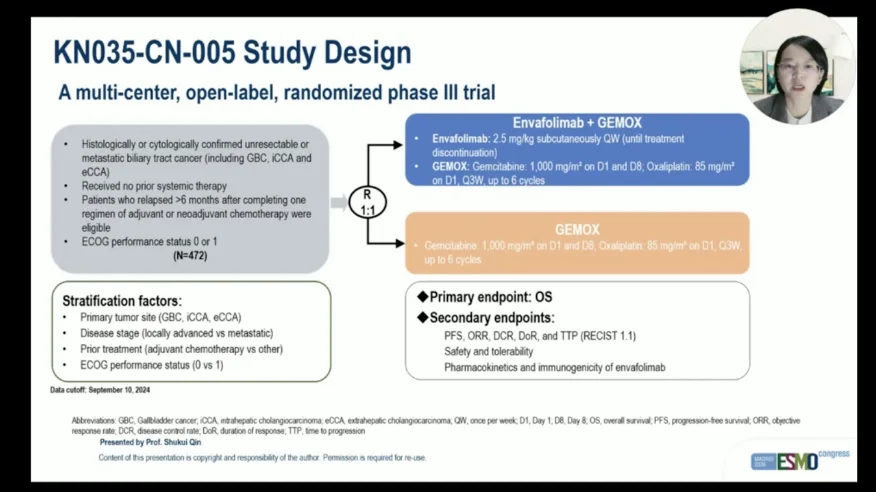
KN035-CN-005 was a multicenter, open-label, randomized phase III trial enrolling patients with histologically or cytologically confirmed unresectable or metastatic BTC, including gallbladder cancer, intrahepatic cholangiocarcinoma, and extrahepatic cholangiocarcinoma.
Eligible patients had ECOG performance status 0–1 and had not received systemic treatment for advanced disease. Patients whose disease relapsed more than six months after completing one regimen of adjuvant or neoadjuvant chemotherapy were eligible.
A total of 472 patients were randomized 1:1 to:
- Envafolimab plus GEMOX: Envafolimab 2.5 mg/kg subcutaneously once weekly, combined with gemcitabine 1,000 mg/m² on days 1 and 8 and oxaliplatin 85 mg/m² on day 1 of each three-week cycle.
- GEMOX alone: The same chemotherapy regimen.
Chemotherapy was limited to six cycles. Envafolimab continued until treatment discontinuation according to the protocol.
Randomization was stratified by primary tumor site, disease stage, prior treatment, and ECOG performance status.
The primary endpoint was OS. Secondary endpoints included PFS, objective response rate (ORR), disease control rate, duration of response (DOR), time to progression, and safety. Tumor response was assessed according to RECIST v1.1.
Of the 472 randomized patients, 462 received treatment: 232 in the envafolimab-plus-GEMOX arm and 230 in the GEMOX-alone arm. The displayed efficacy analyses used these populations.
Results
The presentation listed a September 10, 2024 data cutoff.
- Overall survival: Median OS was 10.9 months (95% CI 9.2–12.1) with envafolimab plus GEMOX versus 8.6 months (95% CI 7.6–9.4) with GEMOX alone. The HR was 0.723 (95% CI 0.585–0.880; P = 0.0016), corresponding to an approximately 28% reduction in the hazard of death.
- Landmark survival: Estimated OS rates were 44.2% versus 29.9% at 12 months, 19.9% versus 10.8% at 24 months, and 12.5% versus 7.7% at 36 months.
- Progression-free survival: Median PFS was 5.4 months (95% CI 4.2–5.6) versus 4.5 months (95% CI 4.2–5.5). The HR was 0.802 (95% CI 0.638–1.007; P = 0.058). A statistically significant PFS improvement was not established.
- Objective response: ORR was 27.6% (64/232) with the combination versus 20.9% (48/230) with GEMOX alone. Complete responses occurred in 2.2% versus 0.4%, and partial responses in 25.4% versus 20.4%.
- Disease control: Disease control rates were similar, at 71.6% versus 71.7%.
- Response duration: Among responders, median DOR was 5.5 months (95% CI 4.1–7.0) versus 4.2 months (95% CI 3.1–6.7). The HR was 0.587 (95% CI 0.339–1.018), with the confidence interval crossing 1. Estimated ongoing-response rates at 12 months were 33.6% versus 9.6%.
Safety
The investigators reported no new safety signals.
The supplied abstract reported immune-related adverse events in 20.7% of patients receiving envafolimab plus GEMOX. Detailed rates of severe adverse events, treatment discontinuation, and treatment-related deaths were not available in the supplied material, limiting a comprehensive comparison of toxicity between groups.
Interpretation
KN035-CN-005 demonstrated an OS improvement with envafolimab plus GEMOX, supported by higher survival estimates at 12, 24, and 36 months.
The overall PFS comparison did not reach statistical significance. Although ORR and response duration numerically favored the combination, these findings should be distinguished from the statistically significant primary OS result.
The presentation also reported favorable findings in a four-month landmark PFS analysis. This additional analysis does not replace the overall PFS comparison, and its interpretation depends on patient selection and the analysis methods.
The study compared envafolimab plus GEMOX with GEMOX alone in a Chinese population. It did not establish comparative efficacy against other immunotherapy–chemotherapy regimens or demonstrate that subcutaneous administration improves clinical outcomes relative to intravenous immunotherapy.
Conclusion
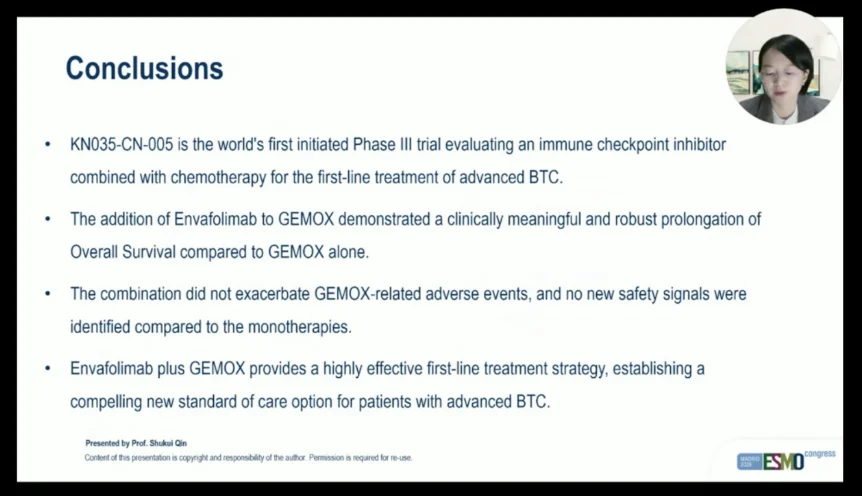
KN035-CN-005 met its primary endpoint, demonstrating significantly improved OS with subcutaneous envafolimab plus GEMOX compared with GEMOX alone in previously untreated advanced BTC.
The overall PFS comparison was not statistically significant, while response rate and response duration numerically favored the combination. These results support the regimen’s potential clinical role, with detailed safety reporting and its position relative to other first-line immunotherapy–chemotherapy options remaining important considerations.
PEARLS/KEYNOTE-091: Long-Term Outcomes With Adjuvant Pembrolizumab in NSCLC