Updated results from the phase III DeLLphi-304 trial showed a sustained overall survival (OS) benefit with tarlatamab compared with chemotherapy in patients with small cell lung cancer (SCLC) progressing during or after first-line platinum-based therapy.
After approximately 23 months of follow-up, median OS was 13.6 months with tarlatamab versus 8.4 months with chemotherapy (HR 0.62; 95% CI 0.51–0.76). Tarlatamab also produced more durable responses and fewer grade ≥3 treatment-related adverse events.
Charles M. Rudin presented the findings at ESMO Congress 2026 (abstract 3808O).
Background
Tarlatamab is a DLL3-targeting bispecific T-cell engager that redirects T cells toward DLL3-expressing cancer cells.
The initial DeLLphi-304 analysis demonstrated improved survival compared with chemotherapy after first-line platinum-based treatment, with median follow-up of 11.2 months. The updated analysis evaluated whether the efficacy and safety findings were maintained with longer follow-up.
Methods and Study Design
DeLLphi-304 was a randomized, controlled phase III trial enrolling adults with SCLC that had progressed during or after first-line platinum-based therapy and ECOG performance status 0–1. Patients with treated or untreated asymptomatic brain metastases were eligible.
A total of 509 patients were randomized 1:1 to:
- Tarlatamab (n = 254).
- Chemotherapy (n = 255): Topotecan, lurbinectedin, or amrubicin.
Randomization was stratified by prior anti-PD-(L)1 therapy, chemotherapy-free interval (<90 days, ≥90 to <180 days, or ≥180 days), presence of brain metastases, and chemotherapy choice.
The primary endpoint was OS. Secondary endpoints included progression-free survival (PFS), objective response rate (ORR), disease control, duration of response (DOR), patient-reported outcomes, and safety. Tumor response outcomes were assessed according to RECIST v1.1.
The updated analysis also examined outcomes in patients with platinum-resistant disease, defined as a chemotherapy-free interval <90 days, and those with baseline brain metastases.
Results
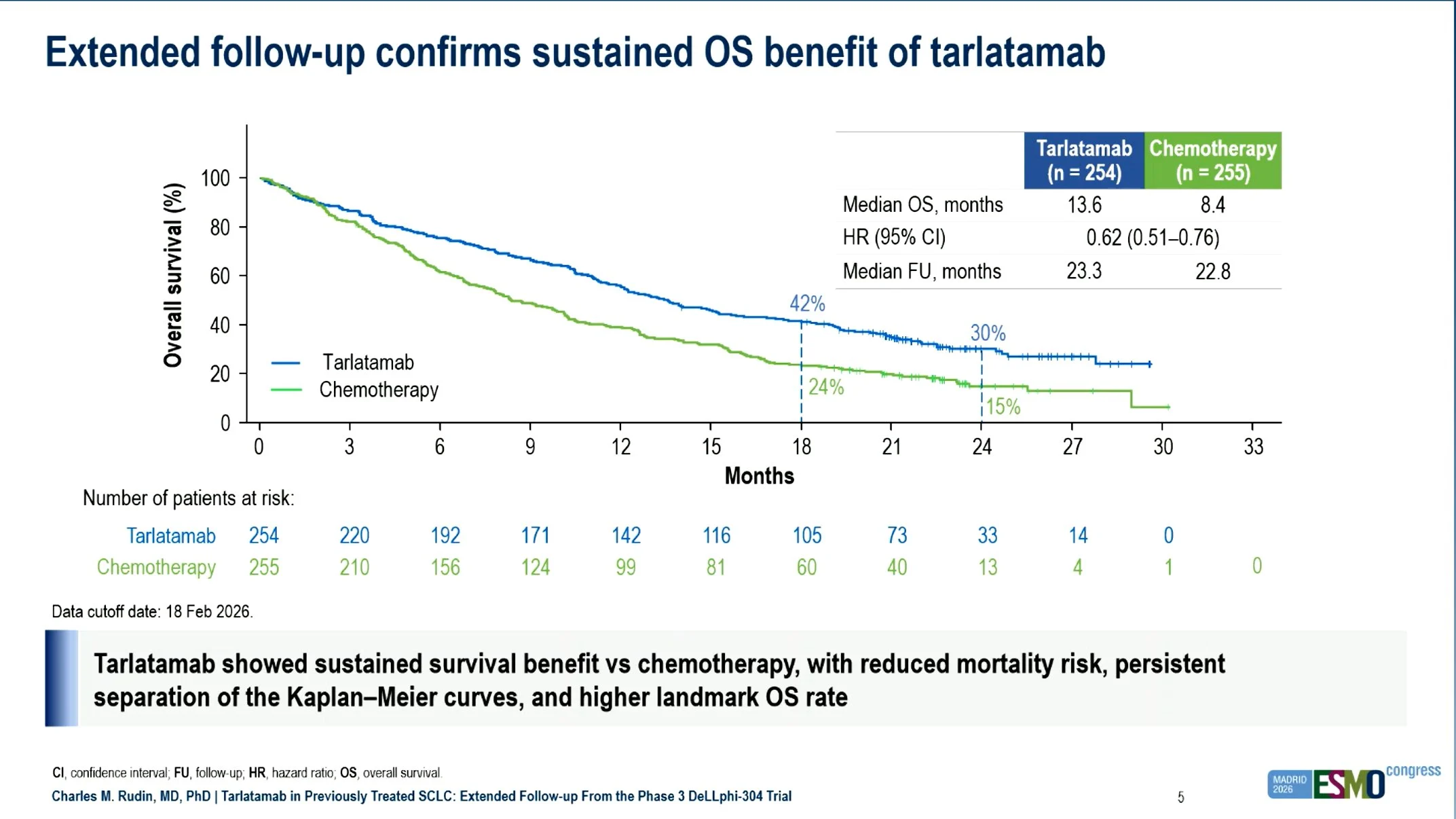
The data cutoff was February 18, 2026. Median follow-up for OS was 23.3 months with tarlatamab and 22.8 months with chemotherapy.
- Overall survival: Median OS was 13.6 months (95% CI 11.9–15.8) with tarlatamab versus 8.4 months (95% CI 7.2–10.2) with chemotherapy. The HR was 0.62 (95% CI 0.51–0.76), corresponding to a 38% reduction in the hazard of death.
- Landmark survival: Estimated 12-month OS was approximately 56% versus 39%, and 18-month OS was 42% versus 24%. At 24 months, OS was approximately 30% versus 15%.
- High-risk subgroups: OS HRs favored tarlatamab in patients with platinum-resistant disease (HR 0.65; 95% CI 0.48–0.86) and baseline brain metastases (HR 0.52; 95% CI 0.38–0.70). These subgroup estimates were consistent with the overall survival benefit.
- Progression-free survival: Median PFS was 4.2 months (95% CI 3.0–4.4) versus 3.2 months (95% CI 2.9–4.2), respectively. The HR was 0.69 (95% CI 0.57–0.84). Estimated 12-month PFS was approximately 21% versus 6%, and 18-month PFS was 16% versus 4%.
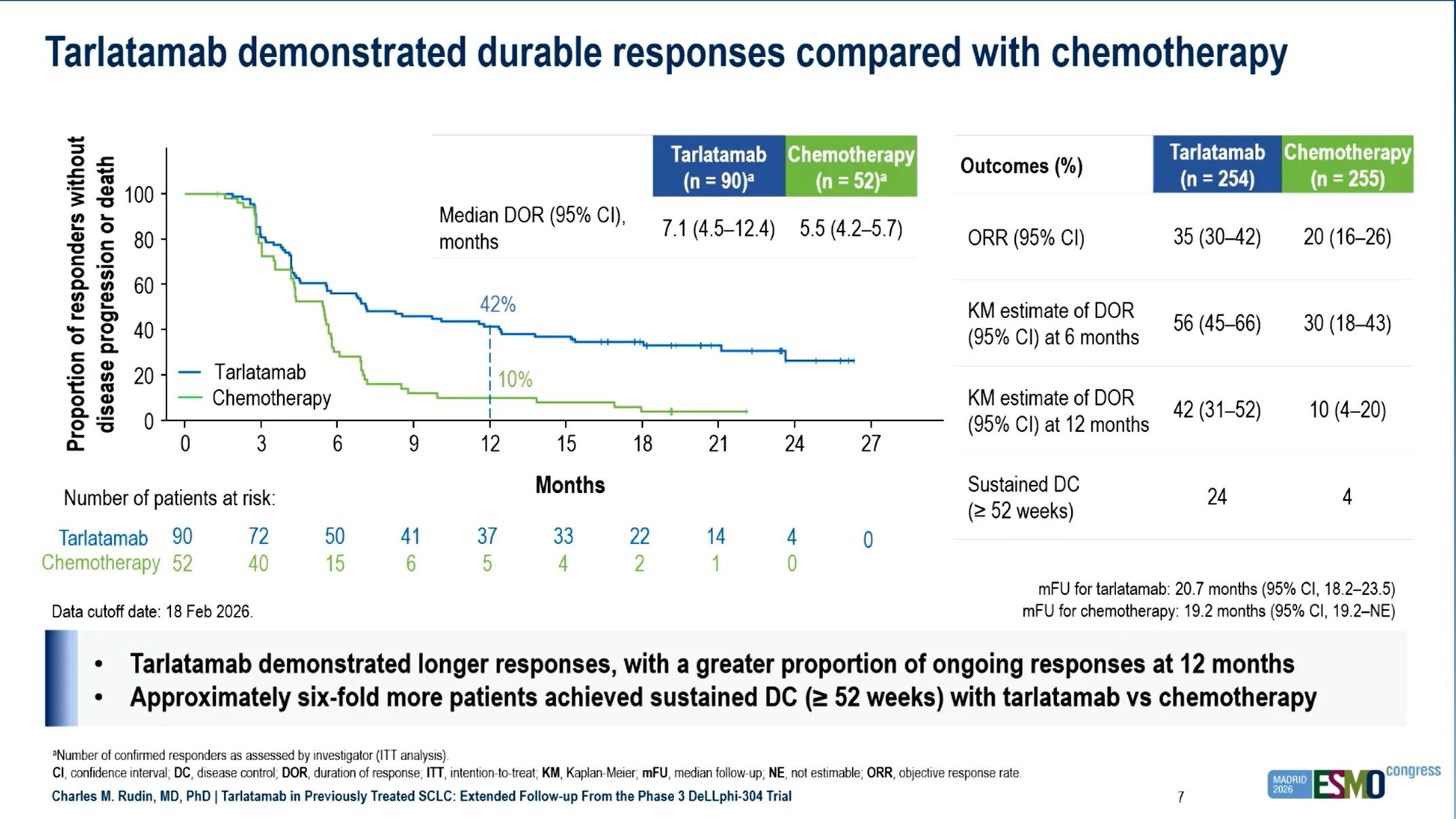
- Objective response: ORR was 35% (95% CI 30–42) with tarlatamab versus 20% (95% CI 16–26) with chemotherapy. There were 90 and 52 confirmed responders, respectively.
- Response durability: Among responders, median DOR was 7.1 months (95% CI 4.5–12.4) versus 5.5 months (95% CI 4.2–5.7). Kaplan–Meier estimates of ongoing response at 12 months were 42% (95% CI 31–52) versus 10% (95% CI 4–20).
- Disease control: Overall disease control rates were 68% versus 64%. Sustained disease control lasting at least 52 weeks occurred in approximately 24% of patients receiving tarlatamab versus 4% receiving chemotherapy.
Safety
Grade ≥3 treatment-related adverse events occurred in 28% of patients receiving tarlatamab versus 63% receiving chemotherapy. Treatment-related adverse events led to discontinuation in 3% versus 7%, respectively.
The reported frequency of treatment-related adverse events decreased over time with tarlatamab, and no new safety signals were identified.
Interpretation
Extended follow-up demonstrated that the survival advantage observed in the initial DeLLphi-304 analysis was maintained. The higher landmark survival rates and greater proportion of ongoing responses at 12 months support the durability of benefit.
Although the difference in median PFS was relatively modest, the landmark PFS and sustained disease-control findings indicate prolonged benefit in a subset of patients.
The reported subgroup estimates were consistent with the overall result, including in patients with platinum-resistant disease and baseline brain metastases. These analyses should be interpreted within the overall randomized trial rather than as independently definitive subgroup comparisons.
Grade ≥3 treatment-related adverse events and treatment-related discontinuations were less frequent with tarlatamab than with chemotherapy. These aggregate findings do not replace assessment of the distinct toxicity profiles of the treatments.
Conclusion
Updated DeLLphi-304 results showed a sustained OS benefit, higher response rates, and more durable disease control with tarlatamab compared with chemotherapy after first-line platinum-based therapy in SCLC.
At approximately two years of follow-up, the OS HR remained 0.62, with estimated 24-month survival of approximately 30% versus 15%. These efficacy findings were accompanied by fewer grade ≥3 treatment-related adverse events and treatment-related discontinuations.
INTerpath-001 Trial: Personalized mRNA Cancer Vaccine in High-Risk Melanoma