
The integration of immune checkpoint blockade into the perioperative management of resectable non-small cell lung cancer (NSCLC) has substantially changed the therapeutic landscape. However, clinical benefit remains heterogeneous, and conventional biomarkers such as PD-L1 expression and tumor mutational burden (TMB) incompletely capture treatment sensitivity.
An increasingly important question is therefore whether dynamic biomarkers of treatment response, particularly circulating tumor DNA (ctDNA) clearance and postoperative molecular residual disease (MRD), can provide additional prognostic information and ultimately support risk-adapted perioperative strategies.
The 2026 Nature study “Biomarkers of nivolumab benefit in resectable non-small cell lung cancer,” by Tina Cascone, Mark M. Awad, Jonathan D. Spicer, Jie He, Shun Lu, Fumihiro Tanaka, Robin Cornelissen, Lubos B. Petruzelka, Yang Gao, Jean-Louis Pujol, Hiroyuki Ito, and colleagues, reports an integrated biomarker analysis from the Phase III CheckMate 77T trial, evaluating ctDNA kinetics, postoperative MRD, pathological response, tumor genomic alterations, TMB, PD-L1 expression, and multivariable machine-learning models in patients receiving perioperative nivolumab.
CheckMate 77T: Perioperative Immunotherapy in Resectable NSCLC
CheckMate 77T evaluated perioperative nivolumab in patients with resectable stage IIA–IIIB NSCLC.
Patients were randomized to neoadjuvant nivolumab plus platinum-doublet chemotherapy followed by surgery and adjuvant nivolumab, or neoadjuvant chemotherapy plus placebo followed by surgery and adjuvant placebo.
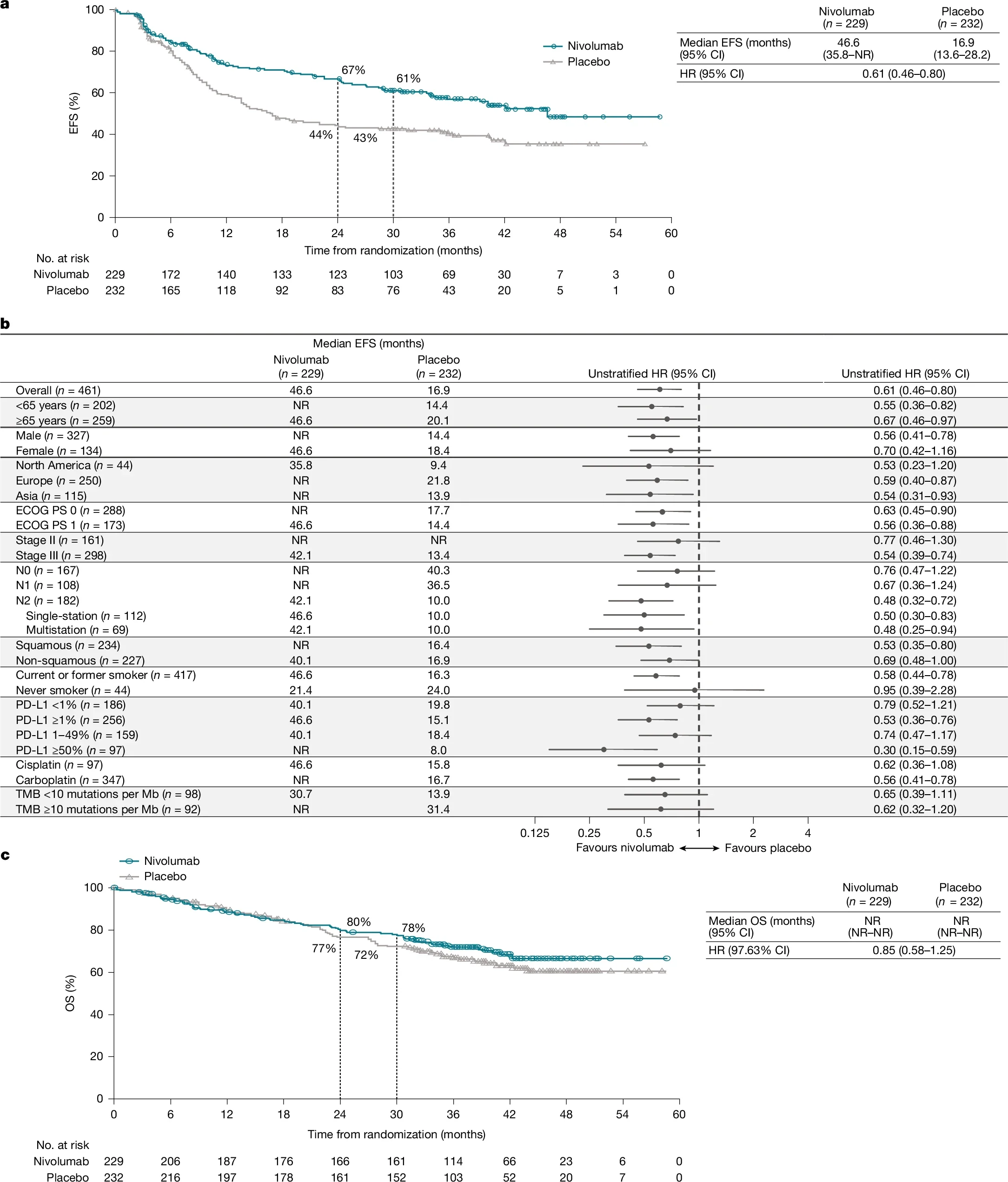
With a median follow-up of 41.0 months, the updated analysis continued to demonstrate improved event-free survival (EFS) with perioperative nivolumab:
- EFS HR: 0.61 (95% CI, 0.46–0.80)
- 30-month EFS: 61% vs 43%
Overall survival remained immature. Median OS was not reached in either group, with 30-month OS rates of 78% with nivolumab and 72% with placebo (HR 0.85; 97.63% CI, 0.58–1.25). The prespecified statistical boundary for significance had not been crossed.
The present analysis extends these clinical findings by examining the molecular and pathological features associated with treatment response and subsequent outcome.
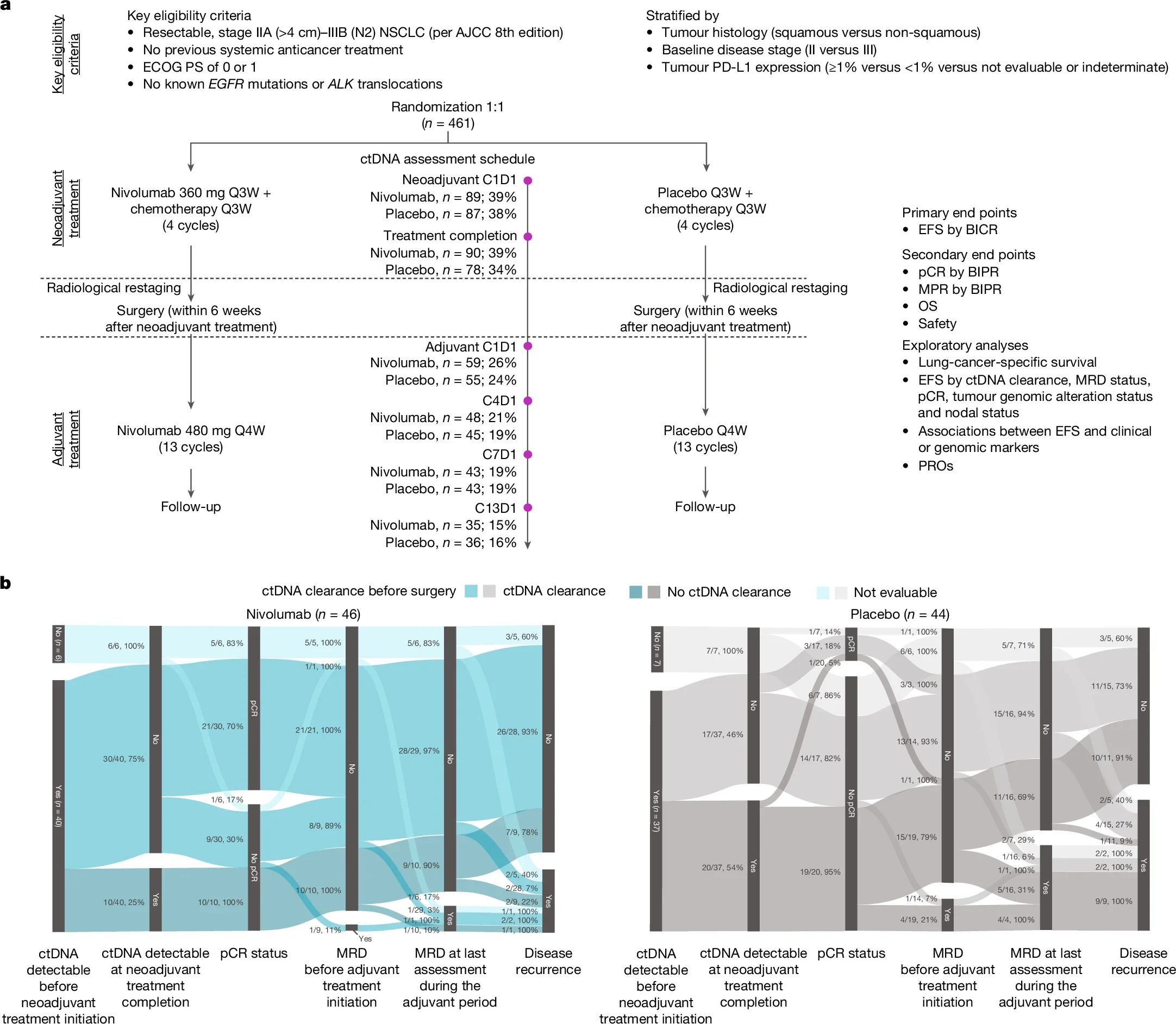
ctDNA Clearance as a Dynamic Biomarker of Neoadjuvant Response
Unlike static baseline biomarkers, ctDNA provides a dynamic measurement of tumor-derived molecular material during treatment.
The biomarker-evaluable population included 190 patients, comprising 98 patients in the nivolumab group and 92 in the placebo group.
Among patients with detectable and evaluable ctDNA before and after neoadjuvant therapy, ctDNA clearance occurred substantially more frequently following nivolumab plus chemotherapy:
- Nivolumab: 66% (50/76)
- Placebo: 38% (24/64)
These findings demonstrate that the addition of PD-1 blockade to neoadjuvant chemotherapy was associated with a higher probability of eliminating detectable circulating tumor-derived DNA before surgery.
Relationship Between ctDNA Clearance and Pathological Complete Response
A particularly important finding was the association between molecular response and pathological tumor regression.
Among nivolumab-treated patients who achieved presurgical ctDNA clearance:
- 50% (25/50) achieved pathological complete response (pCR)
In contrast, among patients without ctDNA clearance:
- 0% (0/25) achieved pCR
In the placebo group, pCR occurred in 12% (3/24) of patients with ctDNA clearance and 2% (1/40) of patients without clearance.
The absence of pCR among nivolumab-treated patients without ctDNA clearance suggests a strong association between persistent circulating tumor DNA and residual viable tumor at surgery.
At the same time, ctDNA clearance and pCR were not completely concordant. Approximately half of nivolumab-treated patients who cleared ctDNA did not achieve pCR, indicating that these biomarkers capture related but non-identical dimensions of therapeutic response.
Integrating Molecular and Pathological Response
The investigators subsequently examined EFS according to the combined status of ctDNA clearance and pCR.
Among nivolumab-treated patients, achievement of both ctDNA clearance and pCR was associated with favorable EFS compared with patients who cleared ctDNA but did not achieve pCR:
- EFS HR: 0.29 (95% CI, 0.10–0.85)
The difference was also pronounced compared with patients who achieved neither ctDNA clearance nor pCR:
- EFS HR: 0.23 (95% CI, 0.08–0.65)
These findings support the concept that molecular and pathological response may provide complementary prognostic information rather than functioning as interchangeable endpoints.
Postoperative MRD and Risk of Recurrence
The analysis also evaluated ctDNA after surgery, when detectable tumor-derived DNA can serve as a marker of molecular residual disease.
Among patients who were MRD-negative after surgery and before adjuvant therapy, subsequent MRD conversion occurred in:
- 8% (4/48) of patients receiving nivolumab
- 20% (9/44) of patients receiving placebo
Critically, all 13 patients who converted from MRD-negative to MRD-positive during the adjuvant period subsequently developed disease recurrence.
This finding establishes postoperative ctDNA dynamics as a particularly strong prognostic signal within this dataset.
Rather than representing only a baseline risk marker, serial ctDNA assessment may capture the emergence of molecular disease after apparently curative surgery.
However, these data should not yet be interpreted as evidence supporting treatment escalation based on MRD positivity. CheckMate 77T was not designed to test an MRD-guided therapeutic strategy.
Persistent MRD Before Adjuvant Therapy
Patients with detectable MRD immediately before adjuvant treatment represented another particularly high-risk subgroup.
None of the patients who were MRD-positive before adjuvant therapy subsequently converted to MRD-negative during the adjuvant treatment period.
Recurrence occurred in:
- 3/4 patients (75%) receiving nivolumab
- 8/8 patients (100%) receiving placebo
Although these numbers are very small, persistent postoperative ctDNA appears to identify a population with substantial residual recurrence risk despite definitive surgery.
Genomic Context of Perioperative Nivolumab Benefit
The investigators additionally explored the relationship between treatment efficacy and genomic alterations involving KRAS, KEAP1, STK11, TP53, CDKN2A, and SMARCA4.
Among nivolumab-treated patients, pCR was observed in:
- 47% of tumors harboring KRAS alterations
- 29% with KEAP1 alterations
- 40% with STK11 alterations
- 34% with TP53 alterations
The corresponding pCR rates in the placebo group were 5%, 0%, 0%, and 3%, respectively.
These observations are particularly relevant for KEAP1 and STK11, given their established association with adverse biology and reduced immunotherapy sensitivity in advanced NSCLC.
Nevertheless, these analyses are exploratory, and the available data do not establish individual genomic alterations as validated predictive biomarkers for perioperative nivolumab.
KEAP1, STK11, CDKN2A and SMARCA4: A High-Risk Genomic Subgroup?
When patients harboring single or co-occurring alterations in KEAP1, STK11, CDKN2A and/or SMARCA4 were analyzed collectively, perioperative nivolumab was associated with longer EFS compared with placebo:
- EFS HR: 0.48 (95% CI, 0.28–0.83)
Among patients without alterations in these genes:
- EFS HR: 0.90 (95% CI, 0.48–1.69)
The apparent magnitude of benefit in the genomically altered subgroup is hypothesis-generating.
It should not be interpreted as evidence that these alterations positively predict nivolumab sensitivity, particularly given the exploratory nature of the analysis and limited subgroup sizes.
Rather, the findings suggest that genomic features associated with unfavorable tumor biology do not necessarily preclude benefit from perioperative immunotherapy.
Tumor Mutational Burden
TMB was also evaluated as a potential biomarker.
Using a threshold of 10 mutations per megabase, the relative EFS effect of nivolumab appeared broadly similar across TMB categories:
- TMB <10 mut/Mb: HR 0.65 (95% CI, 0.39–1.11)
- TMB ≥10 mut/Mb: HR 0.62 (95% CI, 0.32–1.20)
Thus, TMB considered as an isolated dichotomous biomarker did not clearly discriminate relative treatment benefit in this analysis.
Moving Beyond Single Biomarkers: Machine-Learning Integration
A particularly relevant component of the analysis was the use of a random survival forest model integrating clinical and molecular variables associated with EFS.
Across biomarker-evaluable patients, features associated with a lower risk of an EFS event included:
- presurgical ctDNA clearance
- non-N2 nodal status
- pCR
- squamous histology
- nivolumab treatment
Within the nivolumab-treated population, the most informative variables included pCR, higher TMB, higher tumor PD-L1 expression, non-N2 disease, and presurgical ctDNA clearance.
This analysis highlights an increasingly important concept in precision immuno-oncology: response to perioperative immune checkpoint blockade may be unlikely to be captured adequately by any single biomarker.
Instead, integrated models incorporating tumor biology, immune phenotype, disease anatomy, pathological response, and longitudinal ctDNA kinetics may provide a more accurate representation of individual recurrence risk.
Importantly, however, the machine-learning analysis remains exploratory and does not constitute a clinically validated decision model.
Updated Safety
With longer follow-up, no new safety signals were identified.
Treatment-related adverse events of any grade occurred in 89% of patients receiving nivolumab and 87% receiving placebo.
Grade 3–4 treatment-related adverse events occurred in 32% and 25%, respectively.
Two previously reported treatment-related deaths due to pneumonitis occurred in the nivolumab group, with no treatment-related deaths in the placebo group.
From Static Biomarkers to Dynamic Molecular Monitoring
Perhaps the most important implication of this analysis is the transition from baseline biomarker selection toward longitudinal assessment of treatment response.
PD-L1, TMB, and tumor genomics describe the biological state of the tumor before treatment.
ctDNA adds something fundamentally different: it can show how that disease changes during and after therapy.
Presurgical ctDNA clearance may therefore provide a molecular measure of neoadjuvant treatment response, while postoperative MRD may identify residual disease that is not detectable radiographically or clinically.
The particularly strong association between conversion to MRD positivity and subsequent recurrence provides a biological rationale for prospective trials testing ctDNA-guided postoperative treatment strategies.
You Can Read Full Article Here