Immune checkpoint inhibition has reshaped systemic therapy for advanced hepatocellular carcinoma (HCC), but reliable biomarkers for treatment selection remain limited. A new exploratory biomarker analysis from the phase III CheckMate 459 trial provides a comprehensive assessment of tumor genomic features, transcriptional immune programs, PD-L1 expression and circulating immune and stromal markers associated with outcomes following first-line nivolumab versus sorafenib.
The findings suggest that functional characteristics of the tumor immune microenvironment may provide greater information about sensitivity to PD-1 blockade in HCC than tumor mutational burden (TMB) alone.
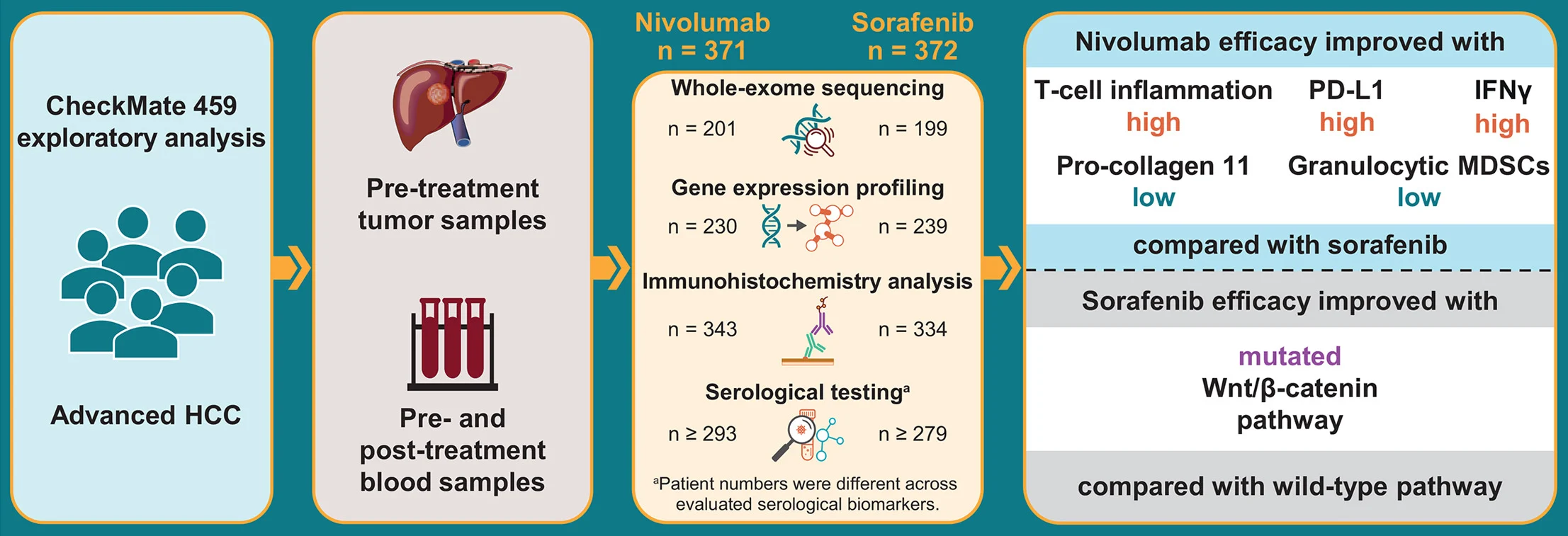
CheckMate 459 compared first-line nivolumab with sorafenib in patients with advanced HCC. Although nivolumab produced a higher objective response rate (ORR) and a favorable safety profile, the original trial did not demonstrate a statistically significant improvement in overall survival (OS). In this subsequent biomarker analysis, pretreatment tumor samples were evaluated using whole-exome sequencing, whole-transcriptome RNA sequencing and immunohistochemistry, together with serological and circulating immune-cell analyses.
Tumor Mutational Burden Does Not Predict Nivolumab Benefit in HCC
TMB has been extensively investigated as a biomarker for immune checkpoint inhibition because increasing numbers of somatic mutations may increase the probability of generating immunogenic neoantigens. However, the CheckMate 459 analysis did not demonstrate an association between baseline TMB and survival with nivolumab.
This finding is consistent with previous observations in HCC and highlights an important biological limitation of TMB. The presence of somatic mutations does not necessarily indicate effective antigen presentation, T-cell priming, intratumoral lymphocyte recruitment or maintenance of an active antitumor immune response. The genomic potential to generate neoantigens and the functional establishment of tumor-directed immunity therefore represent distinct biological processes.
The transcriptomic analyses provided substantially different information.
T-cell Inflammatory Gene Expression Is Associated With Enhanced Nivolumab Activity
A high T-cell inflammation gene-expression signature was associated with improved clinical outcomes with nivolumab relative to sorafenib. The evaluated signature included genes involved in cytotoxic lymphocyte infiltration, chemokine signaling, interferon-associated inflammation and immune activation, including CD8A, CXCL9, CXCL10, CCL3, CCL4, ICOS and IRF1.
Among patients with high T-cell inflammation scores, ORR was 28% with nivolumab versus 10% with sorafenib. Median OS was 20.4 versus 16.1 months, while median progression-free survival (PFS) was 6.2 versus 3.8 months. In contrast, treatment outcomes were more similar between nivolumab and sorafenib among patients with low or intermediate inflammatory scores. Higher expression of several immune-related genes, including CD8A, CD8B, PDCD1, CCL3 and CCL4, was also associated with response to nivolumab.
These observations support the concept that the functional immune state of the tumor may be more informative than mutation number alone. A transcriptionally inflamed HCC already contains evidence of immune-cell recruitment and activation, providing the biological context in which PD-1 blockade may restore or enhance antitumor T-cell activity.
The analysis remains exploratory and does not establish the T-cell inflammation signature as a validated predictive biomarker. Nevertheless, it provides evidence that biomarker development in HCC may need to prioritize functional immune phenotypes rather than relying predominantly on static genomic measurements.
PD-L1 Combined Positive Score Defines an Immune-Enriched Subgroup
PD-L1 expression provided another signal associated with differential outcomes.
Among patients with PD-L1 combined positive score (CPS) ≥10, ORR was 42% with nivolumab versus 12% with sorafenib. Median OS was 21.0 versus 9.5 months, while median PFS was 7.1 versus 3.9 months.
This observation is notable because previous CheckMate 459 analyses based on PD-L1 tumor proportion score showed higher response rates in PD-L1-positive tumors but did not establish a clear relationship with PFS or OS. CPS incorporates PD-L1 expression on both tumor cells and tumor-associated immune cells, potentially capturing a broader component of the immunologically active microenvironment.
The results should not be interpreted as establishing CPS ≥10 as a treatment-selection threshold in HCC. Rather, PD-L1 CPS and the T-cell inflammation signature appear to converge on a broader biological observation: tumors demonstrating evidence of pre-existing immune engagement were associated with greater relative activity of nivolumab.
Wnt/β-Catenin Alterations Require Contextual Interpretation
The relationship between Wnt/β-catenin signaling and immune checkpoint inhibition in HCC has received considerable attention because pathway activation has been associated with impaired dendritic-cell recruitment, reduced T-cell infiltration and an immune-excluded phenotype.
In CheckMate 459, patients with an unaltered Wnt/β-catenin pathway had improved OS with nivolumab compared with sorafenib, with an HR of 0.66 (95% CI 0.47–0.91). However, interpretation of this result requires consideration of the randomized comparator.
Patients harboring CTNNB1 mutations or broader Wnt/β-catenin pathway alterations experienced more favorable survival with sorafenib, whereas these alterations were not significantly associated with OS among nivolumab-treated patients. Consequently, the observed treatment difference in the Wnt wild-type population cannot be interpreted simply as evidence that Wnt/β-catenin alterations are a direct predictive biomarker of nivolumab resistance.
Furthermore, CTNNB1-altered HCC is itself biologically heterogeneous. Although Wnt/β-catenin activation is frequently associated with immune exclusion, the authors note that subsets of CTNNB1-mutated tumors can retain an inflamed phenotype. Mutation status may therefore provide incomplete information without simultaneous characterization of the immune microenvironment.
This interaction between genomic alterations and immune phenotype is particularly relevant for biomarker development. The functional consequence of a mutation may ultimately be more informative than the presence of the mutation itself.
Circulating Immune Biomarkers Capture Systemic Determinants of Response
The study also evaluated circulating biomarkers, extending the analysis beyond the tumor compartment.
High baseline IFNγ was associated with greater nivolumab efficacy relative to sorafenib. Among patients with high IFNγ levels, ORR was 21% with nivolumab versus 7% with sorafenib, accompanied by improved OS and a numerical improvement in PFS.
Granulocytic myeloid-derived suppressor cells (MDSCs) demonstrated an inverse relationship. Patients with low baseline granulocytic MDSC levels had an ORR of 21% with nivolumab versus 5% with sorafenib, together with improved survival outcomes.
These biomarkers represent biologically distinct components of antitumor immunity. IFNγ is closely linked to activated T-cell and NK-cell responses and induction of inflammatory programs, whereas granulocytic MDSCs contribute to systemic and intratumoral immunosuppression through several mechanisms that can impair effective T-cell function.
Their association with clinical outcomes suggests that response to PD-1 blockade in HCC may depend not only on the immune state within the tumor but also on the balance between systemic immune activation and myeloid-mediated suppression.
Pro-C11 Links Extracellular Matrix Remodeling to Immunotherapy Outcomes
A particularly interesting exploratory finding involved pro-collagen 11 (pro-C11), a circulating marker associated with collagen XI formation, fibroblast activity and extracellular matrix remodeling.
Low baseline pro-C11 was associated with improved nivolumab efficacy relative to sorafenib. Among patients with low pro-C11, ORR was 21% with nivolumab compared with 5% with sorafenib, with corresponding improvements in OS and PFS.
This finding introduces stromal biology into the biomarker landscape of HCC immunotherapy. Extracellular matrix composition and fibroblast activity can influence immune-cell trafficking, tissue architecture and the physical accessibility of malignant cells to effector lymphocytes. These processes may be particularly relevant in HCC, which frequently develops in chronically inflamed and fibrotic liver tissue.
However, pro-C11 was also associated with parameters related to cirrhosis, platelet count and viral etiology. The investigators therefore emphasize that it remains unclear whether its association with nivolumab outcomes reflects tumor-specific stromal remodeling, underlying hepatic fibrosis or a combination of both.
The observation should therefore be considered hypothesis-generating, but it broadens the biomarker question beyond tumor cells and lymphocytes to include the structural biology of the tumor microenvironment.
Limited Correlation Between Biomarkers Supports a Multidimensional Model
One of the most informative findings emerged from the correlation analysis.
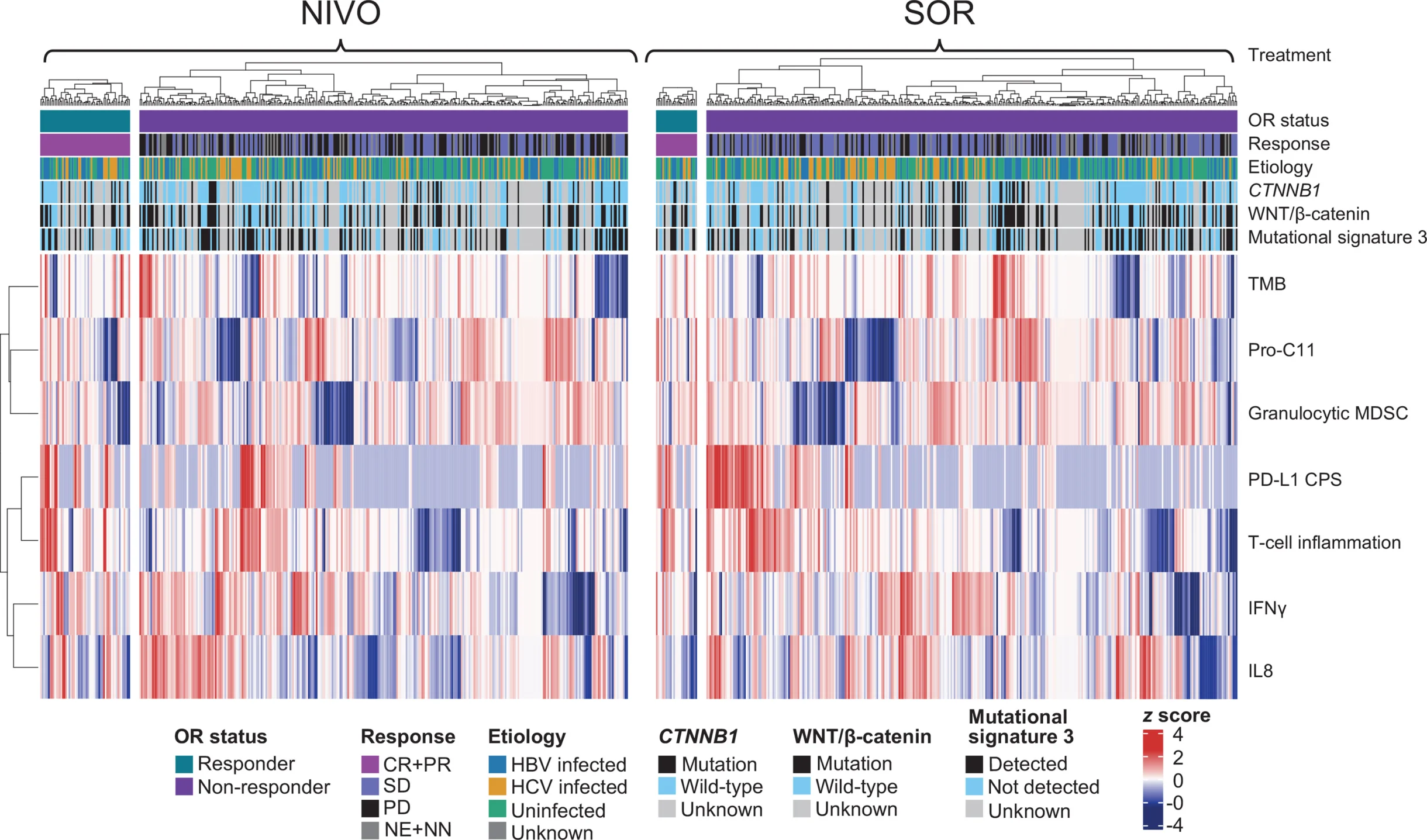
Circulating IFNγ showed only weak correlations with tumor inflammatory gene-expression signatures, while several other candidate biomarkers associated with nivolumab efficacy were similarly weakly correlated with one another. The investigators therefore proposed that these biomarkers may identify different patient populations rather than measuring the same underlying biological phenomenon.
This observation may explain why single-biomarker approaches have struggled to predict checkpoint inhibitor efficacy consistently in HCC.
TMB measures genomic complexity. T-cell inflammatory signatures characterize local immune activation. PD-L1 reflects an important component of immune regulation. IFNγ captures systemic inflammatory signaling. MDSCs represent myeloid-mediated immunosuppression, while pro-C11 may provide information about stromal and extracellular matrix remodeling.
Together, these findings support a model in which sensitivity to PD-1 blockade emerges from the interaction of multiple biological compartments rather than from a single dominant molecular feature.
Translational Relevance in the Contemporary HCC Treatment Landscape
The clinical context of CheckMate 459 is important when interpreting these findings. The trial evaluated nivolumab monotherapy against sorafenib, whereas contemporary first-line treatment of advanced HCC increasingly relies on immunotherapy-based combinations.
The authors specifically caution that biomarkers identified in this analysis cannot automatically be extrapolated to atezolizumab plus bevacizumab, durvalumab plus tremelimumab or nivolumab plus ipilimumab. Each regimen modifies the tumor immune environment through different mechanisms, and prospective validation would be required to determine whether the same biomarker relationships remain relevant.
There are also important methodological limitations. Approximately 45% of patients were not evaluable by whole-exome sequencing and 36% were not evaluable by RNA sequencing. Many samples were archival, tissue source and sample age varied, several biomarker-defined subgroups were relatively small, and the analyses were exploratory rather than statistically powered to establish predictive biomarkers.
Accordingly, none of these biomarkers currently provides a basis for routine treatment selection. Their significance lies primarily in defining biological hypotheses that can be tested prospectively in modern immunotherapy regimens.
You Can Read Full Article Here