CAR T-cell therapy has transformed the treatment of several relapsed or refractory hematologic malignancies, producing deep and sometimes durable responses in patients with otherwise limited treatment options. However, not every patient benefits from CAR T-cell therapy, and even after an initial response, the disease can return.
When CAR T-cell therapy fails, the clinical situation is often complex. Failure may occur early, with the disease never responding adequately, or later, after a period of disease control. Understanding what happens after CAR T-cell therapy therefore requires more than simply identifying whether the treatment worked. The pattern and timing of failure provide important information about the disease and help shape subsequent clinical decisions.
As the use of CAR T-cell therapy continues to expand, recognizing the different patterns of treatment failure has become increasingly important for clinicians managing patients after cellular therapy.
What Happens If CAR T-Cell Therapy Fails?
CAR T-cell therapy does not always lead to a durable response. Some patients have primary refractory disease, meaning the cancer does not respond adequately after infusion, while others initially respond and later develop relapse. Failure can also present as a partial or mixed response, with some disease sites responding while others remain or progress.
The timing and pattern of failure are important. A patient who never responds has a different clinical course from one who achieves remission and relapses months or years later. These differences help define the disease status and determine how urgently further evaluation is needed. (Locke et al., 2020; Cordas dos Santos et al., 2024)
Primary Refractory Disease vs Relapse After CAR T-Cell Therapy
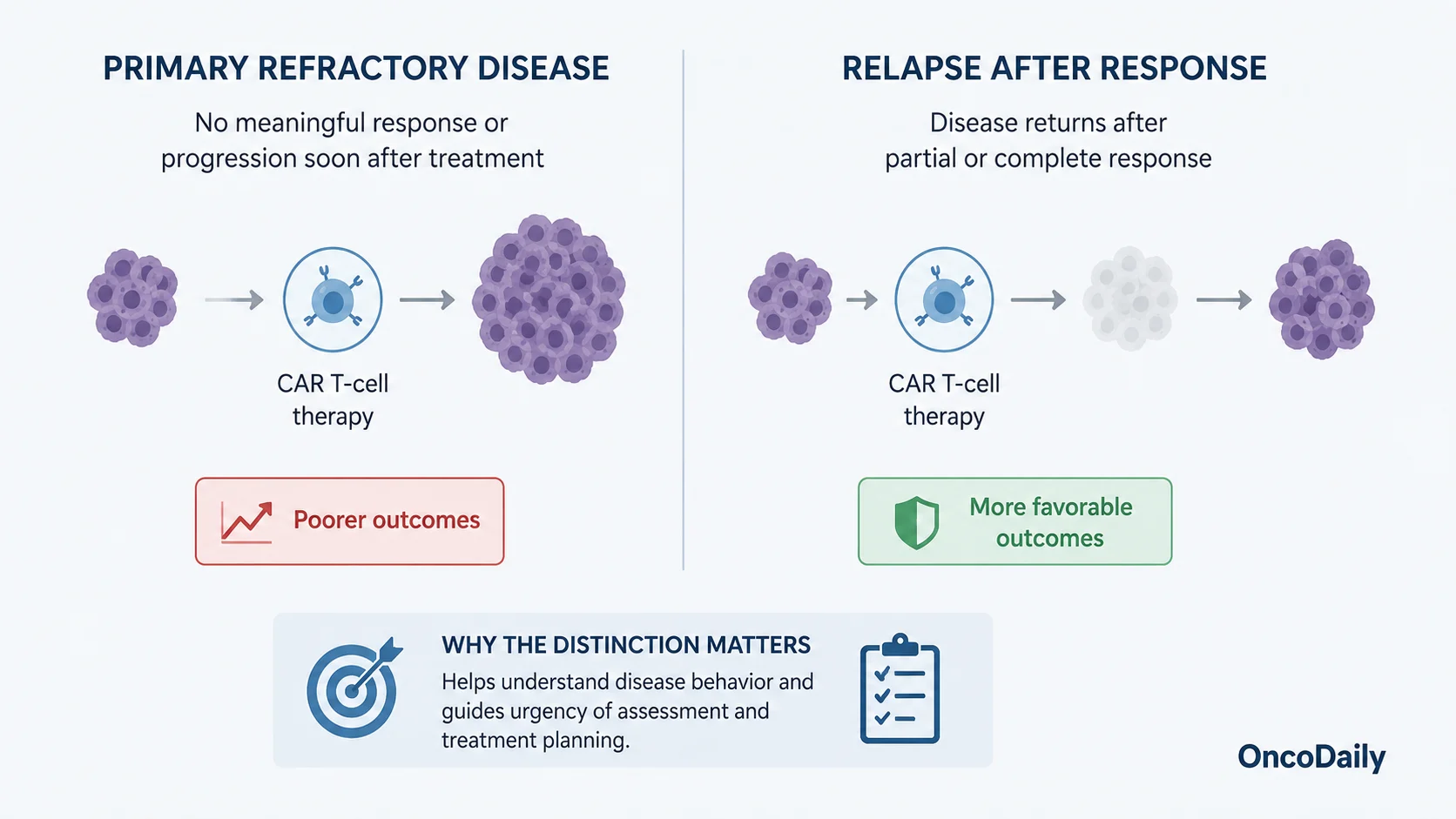
CAR T-cell therapy failure generally falls into two broad categories: primary refractory disease and relapse after an initial response. Primary refractory disease refers to failure to achieve a meaningful response or progression soon after treatment. Relapse occurs when disease returns after a partial or complete response.
Early relapse is generally associated with more aggressive disease and poorer outcomes, whereas patients who remain in remission for longer may have a more favorable clinical course. The depth and duration of the initial response therefore provide important prognostic information. (Corona et al., 2025)
Why the Distinction Matters
Recognizing whether the disease was refractory from the beginning or returned after an initial response helps clinicians understand the clinical behavior of the cancer and determine the urgency of further assessment and treatment planning. (Abramson et al., 2025)
Why Does CAR T-Cell Therapy Fail?
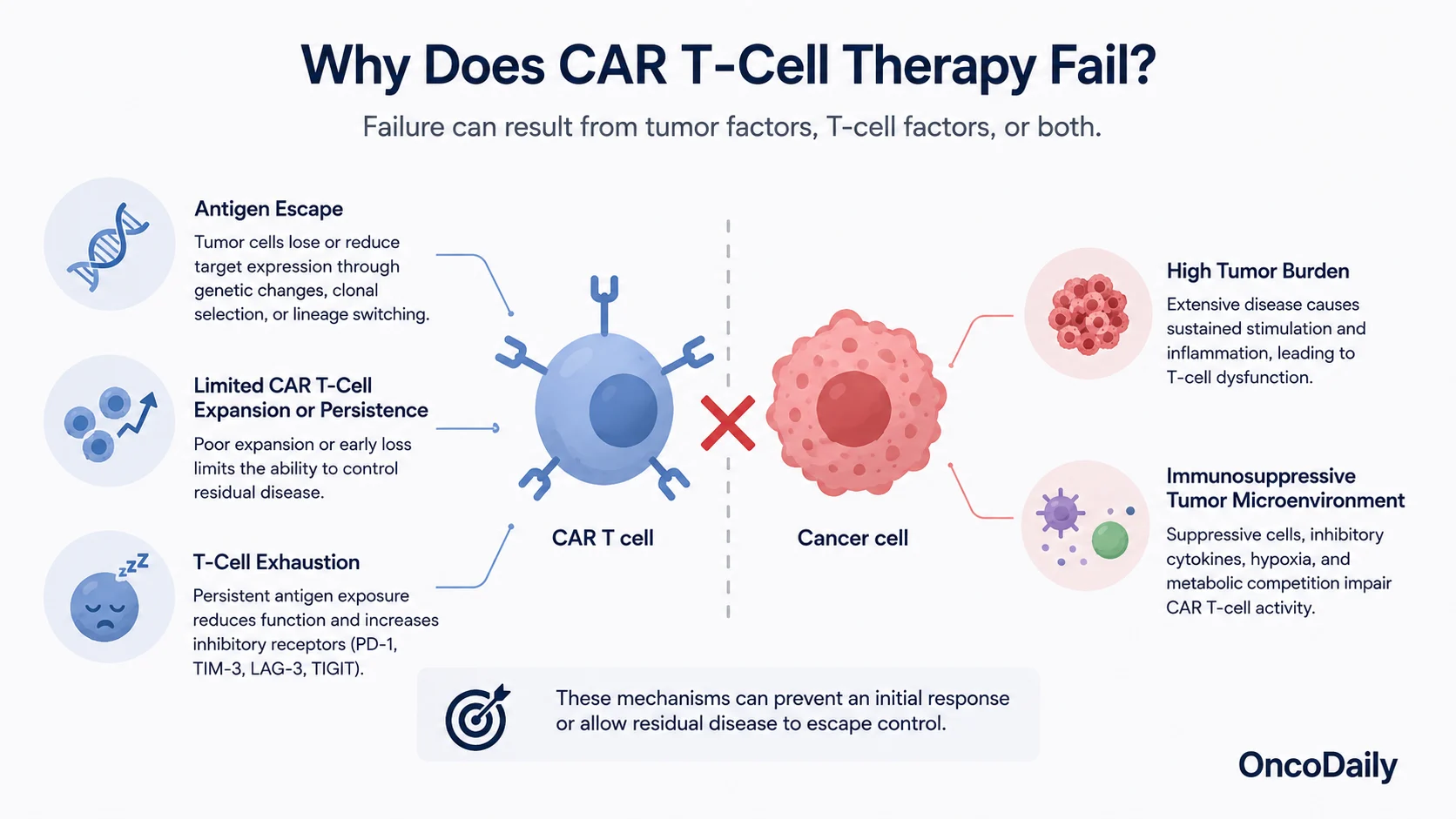
CAR T-cell failure can result from resistance on the tumor side, the T-cell side, or both. Important mechanisms include antigen escape, inadequate CAR T-cell expansion or persistence, T-cell exhaustion, high tumor burden, and an immunosuppressive tumor microenvironment.
Antigen Escape
One of the best-characterized mechanisms is antigen escape, in which tumor cells lose or reduce expression of the target recognized by CAR T cells. This is particularly relevant to CD19-directed therapy and has also been reported with BCMA-directed CAR T-cell therapy. Genetic changes, clonal selection, antigen downregulation, and lineage switching can all contribute. (Legato et al., 2025)
Limited CAR T-Cell Expansion or Persistence
CAR T cells need to expand after infusion and persist long enough to control residual disease. Poor expansion or early loss of CAR T cells can therefore limit treatment efficacy. The fitness and differentiation state of the T cells used for manufacturing can also influence their subsequent expansion and persistence. (Wolyncewicz et al., 2025)
T-Cell Exhaustion
With persistent antigen exposure, CAR T cells can enter a state of functional exhaustion, characterized by reduced proliferation, cytokine production, and cytotoxic activity. Exhausted cells may also show increased expression of inhibitory receptors such as PD-1, TIM-3, LAG-3, and TIGIT. (Wang and Guo, 2026)
High Tumor Burden
Patients with a high tumor burden generally have poorer CAR T-cell outcomes. Extensive disease produces sustained antigen stimulation and systemic inflammation, which can contribute to T-cell dysfunction while making complete tumor clearance more difficult. (Cordas dos Santos et al., 2024)
Immunosuppressive Tumor Microenvironment
The tumor microenvironment can further limit CAR T-cell activity through suppressive immune cells, inhibitory cytokines, hypoxia, and metabolic competition. These factors can interfere with CAR T-cell proliferation, persistence, and cytotoxic function. (Legato et al., 2025)
Together, these mechanisms can prevent an adequate initial response or allow residual disease to eventually escape CAR T-cell control.
How Is CAR T-Cell Failure Evaluated?
When CAR T-cell failure is suspected, the first step is to confirm progression and define its pattern. Evaluation usually combines clinical assessment, imaging, laboratory tests, and, when appropriate, bone marrow examination or repeat biopsy. Formal response assessment is commonly performed around day 28–30 after infusion, although earlier assessment may be necessary when progression is suspected.
Repeat Imaging
FDG-PET/CT is commonly used in lymphoma, while CT or MRI may be more appropriate for other sites of disease. Imaging findings are interpreted together with the clinical picture because inflammatory changes can sometimes complicate early response assessment. (Kwee et al., 2026)
Blood Tests
Blood tests provide information on disease activity, blood-cell recovery, inflammation, and CAR T-cell kinetics. Depending on the malignancy, testing may include blood counts, LDH, disease-specific markers, ctDNA, and CAR T-cell expansion or persistence. (Wolyncewicz et al., 2025)
Bone Marrow and Pathology Assessment
Bone marrow assessment is particularly important in leukemia and diseases involving the marrow, using morphology, flow cytometry, and MRD testing. When relapse occurs, repeat biopsy can also determine whether targets such as CD19, CD22, or BCMA remain expressed and whether the tumor phenotype has changed. (Legato et al., 2025)
You can also read Tumor Irradiation May Improve CAR T Cell Therapy in Solid Tumors on OncoDaily.
Treatment Options After CAR T-Cell Therapy Failure
Treatment after CAR T-cell failure is shaped by the cancer type, timing and pattern of failure, previous treatment, target expression, and overall patient fitness. Depending on the situation, options may include immune-based therapies, targeted agents, transplantation, and clinical trials.
B-Cell Lymphoma
For B-cell lymphoma, treatment may include CD20-directed bispecific antibodies, antibody-drug conjugates, targeted therapies, chemotherapy, radiation, or stem cell transplantation in selected patients. Glofitamab and epcoritamab have demonstrated activity after CAR T-cell therapy. In a prospective phase II study, glofitamab produced an ORR of 76.1% and a CR rate of 45.7% in patients with DLBCL after CAR T failure. (Cartron et al., 2025)
Other options include polatuzumab vedotin and loncastuximab tesirine, depending on disease characteristics and previous treatment. Allogeneic transplantation may be considered in selected patients who achieve sufficient disease control.
Multiple Myeloma
After BCMA-directed CAR T-cell therapy, treatment options include GPRC5D-directed bispecific antibodies, other immune therapies, conventional myeloma treatments, alternative cellular therapies, and clinical trials.
Talquetamab, a GPRC5D × CD3 bispecific antibody, has shown activity in heavily pretreated multiple myeloma, including patients previously exposed to BCMA-directed therapies. Its effectiveness after BCMA CAR T can vary according to prior treatment exposure. (Chari et al., 2022; Krishnan et al., 2025)
You can also read CAR T-Cell Therapy Death Rate: Treatment-Related Mortality, Causes of Death, and Risk Factors on OncoDaily.
Prognosis After CAR T-Cell Therapy Failure
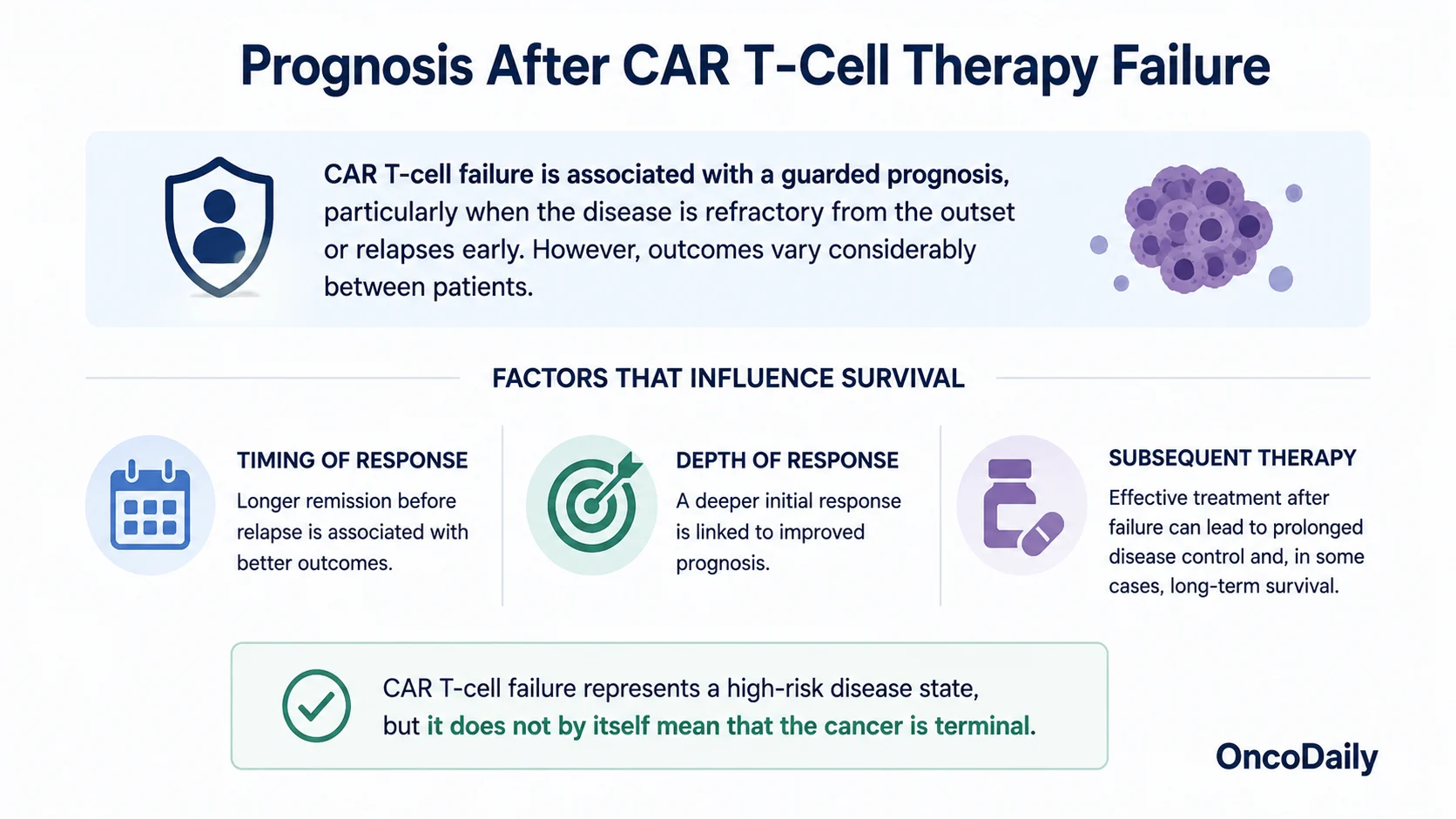
CAR T-cell failure is associated with a guarded prognosis, particularly when the disease is refractory from the outset or relapses early. However, outcomes vary considerably between patients. The timing and depth of the initial response, underlying disease, and ability to control the cancer with subsequent treatment all influence survival.
Patients who remain in remission for a longer period before relapse generally have better outcomes than those with early progression. At the same time, effective subsequent treatment can provide prolonged disease control, and some patients achieve long-term survival. CAR T-cell failure therefore represents a high-risk disease state, but it does not by itself mean that the cancer is terminal. (Abramson et al., 2025; Shah et al., 2025)
FAQ
What does CAR T-cell therapy failure mean?
It means the cancer does not respond adequately to CAR T-cell therapy or returns after an initial response.
What is primary refractory disease after CAR T-cell therapy?
It refers to disease that fails to achieve a meaningful response or progresses soon after CAR T-cell treatment.
Can cancer return after successful CAR T-cell therapy?
Yes. Some patients achieve remission but later develop relapse, which may occur months or years after treatment.
Why does CAR T-cell therapy fail?
Failure can result from antigen escape, limited CAR T-cell expansion or persistence, T-cell exhaustion, high tumor burden, and an immunosuppressive tumor microenvironment.
How is CAR T-cell failure confirmed?
Evaluation may include imaging, blood tests, bone marrow assessment, and repeat biopsy with target-antigen testing when appropriate.
Can CAR T-cell therapy be given again?
In selected patients, repeat or alternative-target CAR T-cell therapy may be considered, particularly in clinical trials.
What treatments are available after CAR T-cell failure?
Options depend on the cancer and may include bispecific antibodies, targeted therapies, transplantation, radiation, and clinical trials.
Does CAR T-cell failure mean the cancer is terminal?
No. CAR T-cell failure indicates a high-risk situation, but some patients can achieve prolonged disease control with subsequent treatment.
Does the timing of relapse affect prognosis?
Yes. Earlier progression generally carries a poorer prognosis than relapse after a longer period of disease control.
What factors influence outcomes after CAR T-cell failure?
Important factors include the underlying cancer, timing and depth of the initial response, disease biology, patient fitness, and response to subsequent therapy.