The phase III CA017-078 (ENERGIZE) trial did not meet its co-primary endpoints of event-free survival (EFS) and pathological complete response (pCR). Adding nivolumab to neoadjuvant gemcitabine–cisplatin, followed by radical cystectomy and adjuvant nivolumab, did not significantly improve either endpoint compared with neoadjuvant chemotherapy followed by radical cystectomy alone.
The ESMO 2026 report by Andrea Necchi (abstract 4736O) included final efficacy results and exploratory circulating tumor DNA (ctDNA) analyses.

ENERGIZE Trial: Can Immunotherapy Improve Perioperative Treatment in MIBC?
Background
Cisplatin-based neoadjuvant chemotherapy followed by radical cystectomy has been a standard treatment for eligible patients with muscle-invasive bladder cancer (MIBC). CA017-078 evaluated whether adding nivolumab before and after surgery could improve outcomes compared with neoadjuvant chemotherapy and surgery alone.
Methods and Study Design
CA017-078 was a randomized phase III trial. The reported comparison included 653 patients with previously untreated, resectable MIBC assigned to:
- Nivolumab-containing arm (n = 325): Neoadjuvant nivolumab 360 mg plus gemcitabine–cisplatin every three weeks for four cycles, followed by radical cystectomy and adjuvant nivolumab 480 mg every four weeks for nine cycles.
- Chemotherapy-alone arm (n = 328): Neoadjuvant gemcitabine–cisplatin every three weeks for four cycles, followed by radical cystectomy.
Randomization was stratified by clinical tumor stage (T2 versus T3/T4a), glomerular filtration rate (50 to <60 versus ≥60 mL/min), and tumor PD-L1 status (≥1% versus <1%/indeterminate).
The co-primary endpoints were EFS and pCR, assessed by blinded independent central review. The final pCR analysis had been conducted previously. Secondary endpoints included overall survival (OS) and safety. Exploratory analyses evaluated associations between ctDNA detection, changes during neoadjuvant treatment, and clinical outcomes.
Results
At a median follow-up of 54.5 months:
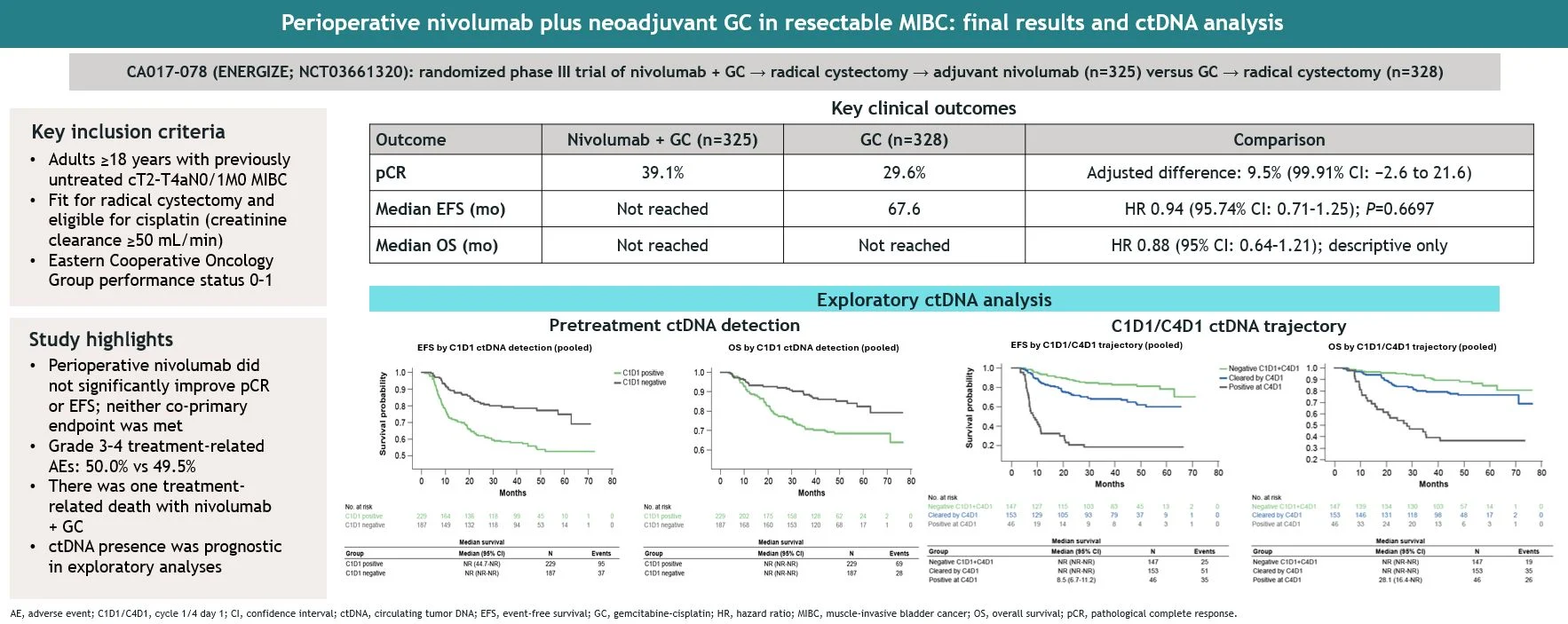
- Event-free survival: There was no statistically significant improvement with the nivolumab-containing regimen (HR 0.94; 95.74% CI 0.71–1.25; P = 0.6697). Median EFS was not reached in the nivolumab arm and was 67.6 months in the chemotherapy-alone arm.
- Pathological complete response: pCR rates were 39.1% versus 29.6%, respectively. The adjusted difference was 9.5 percentage points (99.91% CI −2.6 to 21.6), which was not statistically significant.
- Overall survival: Median OS was not reached in either arm. The HR was 0.88 (95% CI 0.64–1.21). OS data remained immature at the final EFS analysis, and the comparison was descriptive; an OS benefit was not established.
- Safety: The congress abstract reported grade ≥3 treatment-related adverse events in 45.9% of patients receiving the nivolumab-containing regimen and 49.5% receiving chemotherapy alone. The reported safety profile was consistent with the known profiles of the individual agents.
Exploratory ctDNA Findings
Exploratory analyses pooling patients from both treatment arms showed an association between ctDNA detection and clinical outcomes.
Patients with detectable ctDNA before treatment, at cycle 1 day 1, had poorer EFS and OS than those without detectable ctDNA. Outcomes also differed according to ctDNA status during neoadjuvant treatment: patients with persistent ctDNA detection at cycle 4 day 1 had poorer outcomes than those whose ctDNA cleared or remained undetectable.
These findings support the prognostic relevance of ctDNA detection and its trajectory during treatment. However, the pooled analyses do not establish that ctDNA predicts benefit from adding nivolumab or validate a ctDNA-guided treatment strategy.
Conclusion
CA017-078 did not demonstrate statistically significant improvements in EFS or pCR with neoadjuvant nivolumab plus gemcitabine–cisplatin followed by radical cystectomy and adjuvant nivolumab, compared with neoadjuvant chemotherapy and surgery alone. Despite a numerically higher pCR rate, neither co-primary endpoint was met, and an OS benefit was not established.
Exploratory ctDNA analyses associated pretreatment detection and persistence during neoadjuvant treatment with poorer outcomes. Further investigation is needed to determine whether these findings can inform treatment selection.