The first-line treatment landscape of advanced biliary tract cancer (BTC) has changed substantially with the incorporation of immune checkpoint inhibition into chemotherapy. Cisplatin and gemcitabine combined with durvalumab has established chemoimmunotherapy as a contemporary standard, but progression remains common, leaving clinicians with a second challenge: what should happen after chemoimmunotherapy fails?
For a molecularly heterogeneous disease such as BTC, that question increasingly intersects with precision oncology. IDH1 mutations, FGFR2 fusions or rearrangements, HER2/ERBB2 alterations, BRAF V600E mutations, and rare NTRK or RET fusions can create opportunities for biomarker-matched treatment. Yet the existence of an actionable alteration does not guarantee that a patient will ever receive the corresponding therapy. Clinical deterioration, delayed molecular testing, drug availability, reimbursement, and the timing of sequencing can all determine whether an actionable target becomes an actual treatment opportunity.
A large international real-world study by Rimini and colleagues now examines this problem specifically in the modern chemoimmunotherapy era. Rather than asking only whether targeted therapy is active in molecularly selected BTC, the investigators evaluated who actually receives matched therapy after cisplatin–gemcitabine–durvalumab, how outcomes compare with non-targeted treatment, and whether the line in which targeted therapy is delivered may matter.
The findings suggest that precision oncology can remain clinically relevant after first-line chemoimmunotherapy, but they also expose a substantial implementation gap: many patients with actionable disease never reach the treatment their tumor biology would theoretically support.
A Real-World Test of Precision Oncology After Durvalumab
The retrospective study included 1,358 patients with unresectable locally advanced or metastatic BTC treated at 55 centers across 12 countries between February 2022 and April 2025. The cohort included intrahepatic cholangiocarcinoma, extrahepatic cholangiocarcinoma, and gallbladder cancer.
All patients had received first-line cisplatin 25 mg/m² and gemcitabine 1000 mg/m² on days 1 and 8 together with durvalumab 1500 mg on day 1 of a 21-day cycle for up to eight cycles, followed by durvalumab maintenance every four weeks until progression or unacceptable toxicity. Treatment after progression was selected by the treating physician.
Importantly, the study defined actionable alterations according to ESCAT tier I rather than treating every genomic abnormality as therapeutically relevant. The prespecified actionable alterations included IDH1 mutations, FGFR2 fusions or rearrangements, ERBB2 amplification and/or HER2 IHC 3+ overexpression, BRAF V600E mutations, and NTRK or RET fusions.
Because this was not a randomized comparison, the investigators used several statistical approaches to address potential bias, including multivariable Cox models, inverse probability of treatment weighting (IPTW), six-month landmark analyses, and restricted mean survival time analyses. These methods strengthen the observational analysis, although they cannot eliminate the limitations inherent to retrospective treatment selection.
One in Five Molecularly Tested Patients Had an Actionable Alteration
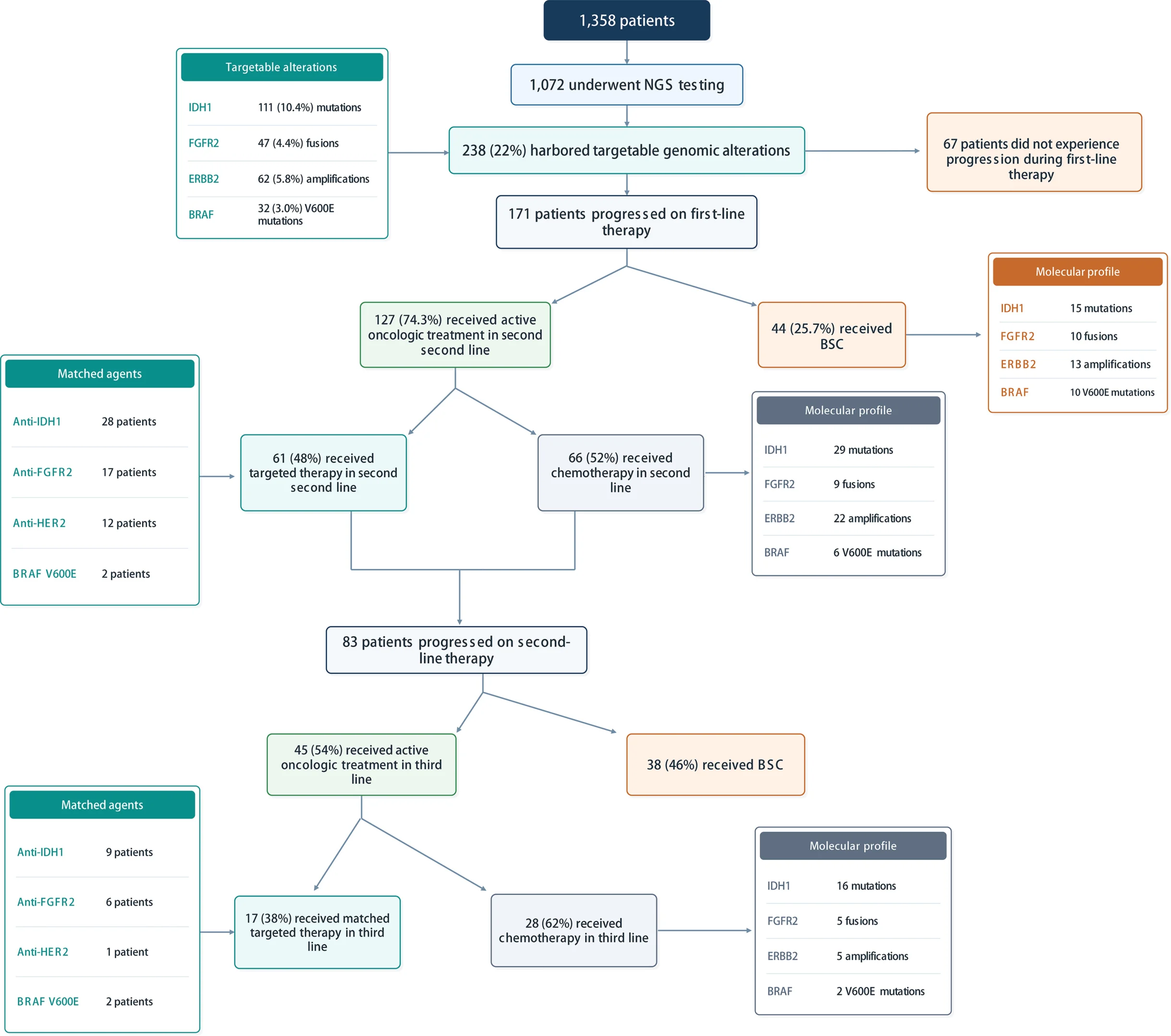
Of the 1,358 patients in the study, 1,072, or 78.9%, underwent molecular testing.
Among those tested, 238 patients, 22.2%, had at least one ESCAT tier I actionable alteration. IDH1 mutations were identified in 111 patients (10.4%), FGFR2 fusions in 47 (4.4%), HER2-positive disease in 62 (5.8%), and BRAF V600E mutations in 32 (3.0%). No NTRK or RET fusions were identified in this cohort.
The distribution reflected the known molecular heterogeneity of BTC. IDH1 mutations and FGFR2 fusions were enriched in intrahepatic disease, whereas HER2 alterations were more frequent in non-intrahepatic tumors.
The study also identified occasional co-occurrence of actionable alterations. Some tumors harbored IDH1 mutations together with FGFR2 fusions or HER2 alterations, while other combinations included BRAF/HER2 and FGFR2/HER2. These observations led the investigators to caution against stopping molecular characterization after identifying a single actionable abnormality and to support comprehensive DNA/RNA profiling where appropriate, particularly because fusion detection may benefit from RNA-based assessment.
But perhaps the most clinically important finding was not how many targets were identified. It was how often those targets actually translated into treatment.
Finding a Target Does Not Mean the Patient Will Receive Targeted Therapy
Among all 238 patients with an actionable alteration, only 76, or 32%, received matched targeted therapy at some point in the second or third line.
Even after restricting the analysis to patients who had progressed after first-line treatment, access remained incomplete. Among 171 evaluable patients, 74 (43.3%) ultimately received a targeted agent. Among those who were sufficiently fit to receive active second-line treatment, 61 of 127 patients, or 48%, received matched therapy.
In other words, the study identified a gap between molecular actionability and therapeutic action.
This gap persisted despite the increasing availability of precision oncology. The investigators found no significant improvement in targeted-therapy use between patients progressing in 2022–2023 and those progressing in 2024–2025.
Access also differed geographically. Molecular testing rates ranged from 60.1% in Eastern European centers to 97.1% in the United States, with significant variation across participating countries. The authors appropriately caution that the study was not designed to compare health systems, but the heterogeneity illustrates how infrastructure can influence whether molecular information is generated early enough to guide treatment.
Participating centers attributed missed targeted-treatment opportunities largely to practical barriers including reimbursement, lack of national or local approval, absence of appropriate clinical trials, and limited access to targeted agents.
Precision oncology therefore depends on more than sequencing a tumor. It requires that molecular testing, interpretation, drug access, and the patient’s clinical fitness align at the moment treatment is needed.
Matched Therapy Was Associated With Longer Survival After Chemoimmunotherapy
The investigators next examined whether receiving matched targeted treatment was associated with better outcomes after progression on cisplatin–gemcitabine–durvalumab.
To make the comparison more clinically meaningful, patients who received best supportive care alone were excluded from the principal post-progression analysis. The comparison therefore involved patients receiving matched targeted therapy versus patients receiving active non-targeted systemic treatment.
Among 125 patients included in this analysis, 74 received matched targeted therapy and 51 received non-targeted treatment.
Median OS from progression after first-line therapy was 24.8 months with matched targeted therapy versus 16.6 months with non-targeted treatment, corresponding to an HR for death of 0.36 (95% CI 0.20–0.63; p=0.0004).
The association remained after multivariable adjustment and persisted across several sensitivity analyses.
After IPTW adjustment, median OS was 23.6 versus 13.6 months (HR 0.35; 95% CI 0.20–0.62; p=0.0003). A six-month landmark analysis also favored targeted therapy, with median OS of 24.8 versus 13.7 months and an HR of 0.38. A time-dependent Cox analysis similarly associated matched treatment with a reduced risk of death.
The consistency across different statistical approaches strengthens the observation that biomarker-matched treatment remains relevant even after patients have already received chemoimmunotherapy.
But the study becomes particularly interesting when treatment timing is considered.
The Strongest Signal Appeared in Second Line
Among 127 patients with actionable alterations who received active second-line therapy, 61 received matched targeted treatment.
Compared with non-targeted therapy, matched treatment was associated with improved outcomes across several endpoints.
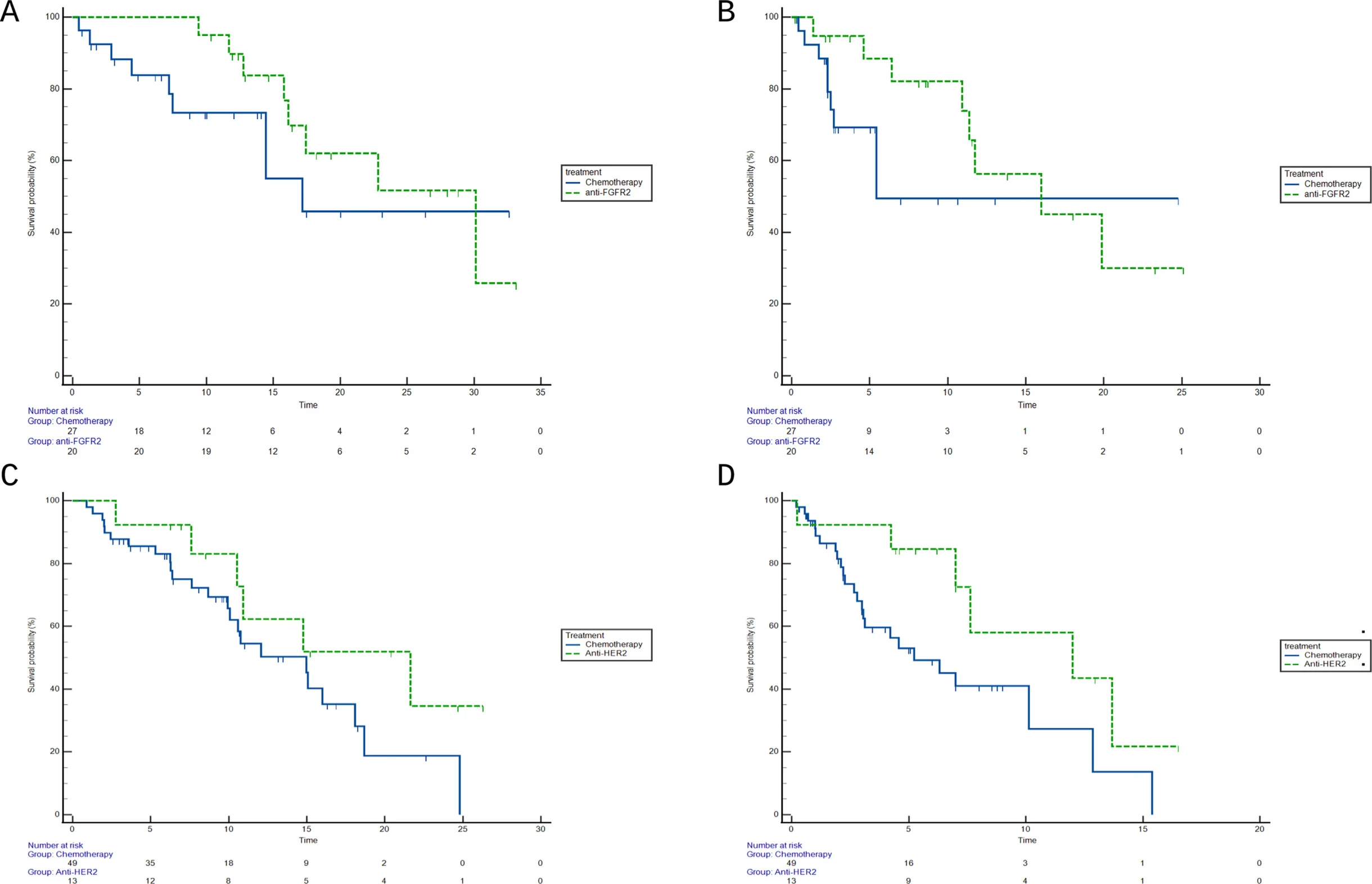
Median OS measured from the start of second-line treatment was 15.4 months with matched therapy versus 9.5 months with non-targeted therapy, corresponding to an HR of 0.50 (95% CI 0.30–0.84; p=0.0009). After IPTW adjustment, median OS was 14.3 versus 7.0 months, with an HR of 0.49.
The advantage was not limited to OS.
Median second-line PFS was 5.9 versus 3.2 months (HR 0.60; 95% CI 0.38–0.95; p=0.028), while objective response rate was 27.1% with matched targeted therapy compared with 9.1% with non-targeted treatment (p=0.010).
These findings suggest that the molecular information generated from a patient’s tumor may have its greatest practical value when it is already available at the first progression after chemoimmunotherapy.
That conclusion, however, needs an important qualification.
Does Targeted Therapy Lose Its Effect in Third Line?
The third-line results appear very different at first glance.
Among 45 patients receiving active third-line therapy, only 17 received matched targeted treatment. No statistically significant improvement in OS, PFS, or response rate was demonstrated compared with non-targeted treatment. Median PFS was 4.7 versus 2.8 months (HR 0.72; p=0.442), and ORR was 20% in both groups.
It would be tempting to interpret this as evidence that targeted therapy should always be used in second line and loses efficacy if delayed.
The study does not establish that conclusion.
The third-line cohort was small, resulting in wide confidence intervals and limited statistical power. Patients reaching later treatment lines also represent a selected population: they must survive previous therapy, maintain adequate performance status, and remain eligible for additional treatment. These factors introduce survivor and selection biases that cannot be fully corrected retrospectively.
The authors therefore explicitly state that their results do not prove that third-line targeted therapy is ineffective or that second-line administration is intrinsically superior.
Instead, the more defensible interpretation is practical: waiting until later lines increases the possibility that patients with actionable alterations will deteriorate or lose access to matched treatment before it can be delivered.
The sequencing question is therefore partly biological, but also logistical.
IDH1 Provides the Largest Molecularly Defined Subgroup
The study also examined individual molecular populations, although subgroup size limited definitive comparisons for several targets.
IDH1-mutated disease provided the largest dataset.
Among 111 patients with IDH1-mutated tumors, 37 received the IDH1 inhibitor ivosidenib at some point during their subsequent treatment course. After excluding patients who had not progressed on first-line therapy, ivosidenib exposure was associated with median OS of 19.9 versus 11.6 months compared with non-targeted treatment (HR 0.38; 95% CI 0.20–0.71; p=0.0025).
After IPTW adjustment, median OS was 27.2 versus 15.2 months.
In second line specifically, median OS from treatment initiation was not reached with ivosidenib versus 6.1 months with chemotherapy, with an HR of 0.39.
These real-world findings are relevant in the context of the established prospective evidence for ivosidenib. However, this observational comparison should not be interpreted as a replacement for randomized trial evidence, particularly because treatment assignment was not randomized.
FGFR2 and HER2 Show Clinically Interesting but Less Certain Signals
The smaller FGFR2- and HER2-defined populations showed numerical outcome differences favoring matched treatment, although most survival comparisons did not reach statistical significance.
Among patients with FGFR2 fusions, those who received an FGFR inhibitor had median OS from first-line initiation of 30.1 months compared with 17.2 months among those treated exclusively with chemotherapy. The difference was numerical rather than statistically significant (HR 0.62; p=0.336).
For HER2-positive disease, 13 patients received HER2-directed therapy, including trastuzumab-containing treatment or trastuzumab deruxtecan. Median OS from first-line initiation was 21.6 versus 15.0 months compared with chemotherapy alone. Again, the survival difference did not reach statistical significance, but ORR was significantly higher with HER2-targeted therapy: 38.5% versus 12.2%.
These subgroup analyses are better interpreted as supportive rather than definitive. Small sample sizes, limited events, heterogeneous agents, and retrospective treatment selection prevent strong conclusions regarding the magnitude of benefit for individual molecular targets. The investigators similarly describe these analyses as exploratory.
Molecular Profiling Should Happen Before It Is Needed
Perhaps the most actionable conclusion from this study concerns neither a particular drug nor a particular molecular alteration.
It concerns timing of testing.
If molecular profiling begins only after progression on cisplatin–gemcitabine–durvalumab, several delays can accumulate: obtaining adequate tissue, sequencing, molecular interpretation, multidisciplinary review, reimbursement authorization, referral to a specialist center, or identification of a clinical trial.
For a patient with rapidly progressive BTC, that delay may determine whether targeted therapy remains clinically feasible.
The authors therefore argue that comprehensive molecular testing should ideally occur at diagnosis of advanced disease or during first-line treatment, allowing the molecular strategy for second line to be established before progression occurs.
This changes the conceptual role of genomic profiling.
It should not be viewed simply as a test ordered when conventional treatment options have been exhausted. In advanced BTC, molecular profiling becomes part of longitudinal treatment planning: first-line chemoimmunotherapy can begin while the molecular landscape is characterized in parallel, allowing the next treatment decision to be made rapidly if progression occurs.
The study also supports comprehensive rather than narrowly sequential testing. The observation that actionable alterations can occasionally coexist means that identification of one target should not automatically terminate further molecular assessment. The authors particularly emphasize the potential value of combined DNA/RNA profiling for detecting clinically relevant fusions.
A Real-World Study Cannot Establish the Optimal Sequence
The size and international scope of this study are strengths. It captures contemporary practice across 55 centers and examines patients who actually received first-line cisplatin–gemcitabine–durvalumab rather than extrapolating from cohorts treated before immunotherapy entered the first-line setting.
Its statistical analyses also attempted to address several important sources of bias.
Nevertheless, the limitations are fundamental to interpreting the results.
Treatment assignment was not randomized. Patients who received targeted therapy may differ from those who received chemotherapy in ways that influence survival independently of treatment. Although multivariable analyses, IPTW, landmark analyses, and time-dependent models reduce some bias, residual confounding cannot be excluded.
Molecular testing platforms were heterogeneous. Later-line chemotherapy regimens differed. Access to targeted therapies varied across countries. Some molecular subgroups were very small, and the FGFR2 and HER2 analyses were largely descriptive. Clinical variables measured at first-line initiation were not systematically updated before later treatments, and the timing of molecular testing itself was not consistently available.
These limitations are particularly important when interpreting the apparent difference between second- and third-line outcomes.
The study provides a strong argument for avoiding missed opportunities, but not randomized evidence that every matched targeted agent must necessarily precede every other second-line option.
The Next Step: Can Precision Therapy Move Even Earlier?
The findings also raise a larger question about the relationship between immunotherapy and targeted therapy in BTC.
At present, the study evaluates a sequential model: first-line chemoimmunotherapy → progression → molecularly matched treatment.
But if a tumor already carries a high-confidence actionable alteration at diagnosis, is waiting for progression always the optimal use of that biology?
The authors point to SAFIR-ABC10, a randomized phase III umbrella trial evaluating matched targeted maintenance after four cycles of first-line chemoimmunotherapy versus continuation of standard treatment in patients with ESCAT tier I or II alterations.
That question represents an important evolution of precision oncology in BTC.
The field is moving from asking whether a molecular target can be treated to asking when in the treatment trajectory that target should be exploited.
You Can Read Full Article Here