At the 2026 ASCO Annual Meeting, Michael R. Conroy and colleagues presented the primary analysis of the phase 1b ARCHER trial evaluating ALK-Vac, a prophylactic peptide vaccine designed to generate T-cell responses against common ALK resistance mutations in patients with advanced ALK-positive non-small cell lung cancer (NSCLC).
Acquired resistance remains one of the major challenges in the management of ALK-positive NSCLC. Resistance frequently emerges through secondary mutations within the ALK kinase domain, ultimately leading to disease progression despite continued tyrosine kinase inhibitor (TKI) therapy. The ARCHER trial explored a novel immunologic strategy aimed at preventing or delaying resistance by vaccinating patients against common ALK resistance mutations before they emerge.
Study Design and Treatment
This first-in-human phase 1b study enrolled patients with advanced ALK-positive NSCLC who remained free of disease progression while receiving standard-of-care ALK TKI therapy.
Patients continued their ongoing TKI treatment and received ALK-Vac, a synthetic long-peptide vaccine targeting seven clinically relevant ALK resistance mutations: I1171T, I1171N, I1171S, L1196M, G1202R, D1203N, and E1210K. The vaccine was administered together with the immune adjuvant poly-ICLC through a priming schedule followed by booster vaccinations.
The primary objectives were safety and induction of vaccine-specific T-cell responses measured by IFN-γ ELISpot assays. Exploratory analyses included circulating tumor DNA and immune-phenotyping studies.
Study Design and Treatment
ARCHER is a single-center, first-in-human phase Ib study (NCT05950139).
Eligible patients had advanced or unresectable ALK-positive NSCLC, remained on standard-of-care ALK TKI therapy, and had maintained disease control for at least four months. Patients with known resistance alterations targeted by the vaccine were excluded.
Participants continued their ALK TKI while receiving ALK-Vac, a synthetic long-peptide vaccine targeting seven clinically relevant ALK resistance mutations:
- G1202R
- L1196M
- D1203N
- E1210K
- I1171T
- I1171N
- I1171S
The vaccination schedule included an initial priming phase followed by booster vaccinations through week 20.
The co-primary endpoints were safety and vaccine-induced immune responses. Secondary endpoints included post-progression genomic alterations, progression-free survival, and overall survival.
Immunogenicity
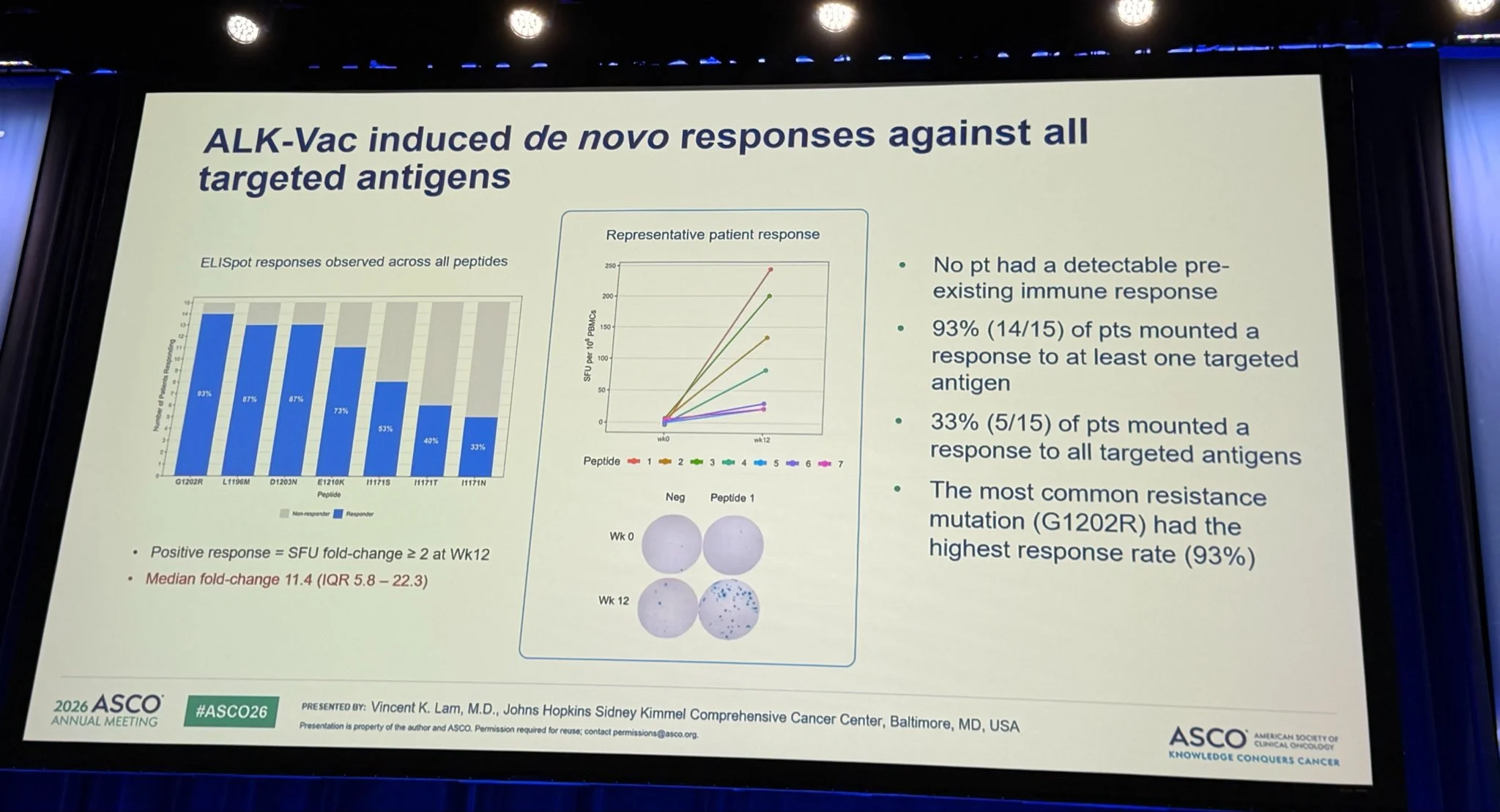
ALK-Vac demonstrated substantial immunogenicity across the targeted ALK resistance mutations.
No patient had a detectable pre-existing immune response against the targeted antigens before vaccination.
Key immunogenicity findings included:
- 93% (14/15) of patients mounted a response to at least one targeted antigen.
- 33% (5/15) mounted responses against all targeted antigens.
- The G1202R mutation, one of the most common ALK resistance alterations, generated the highest response rate
- at 93%.
- Median ELISpot fold-change was 11.4 (IQR 5.8–22.3).
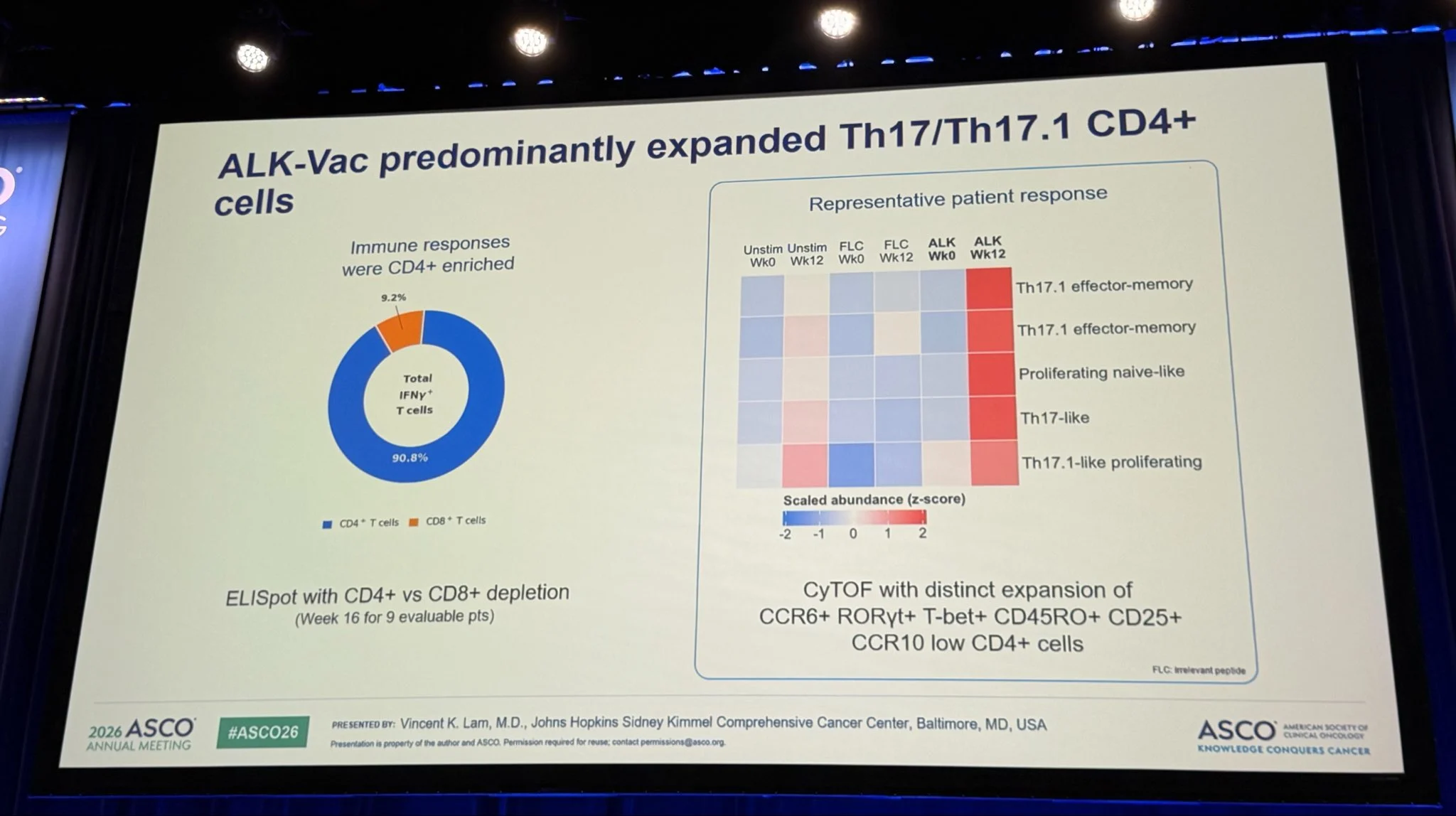
Immune profiling demonstrated that vaccine responses were predominantly CD4+ T-cell mediated.
Among total IFN-γ–producing T cells:
- 90.8% were CD4+ T cells.
- 9.2% were CD8+ T cells.
CyTOF analyses showed expansion of Th17 and Th17.1 effector-memory CD4+ populations characterized by CCR6+, RORγt+, T-bet+, CD45RO+, and CD25+ phenotypes.
Clinical Observations
At the time of analysis, disease control was maintained in most patients receiving concurrent ALK TKI therapy and vaccination.
Only one patient had experienced disease progression.
Molecular analysis of this patient demonstrated:
- Emergence of KRAS G12D bypass resistance.
- No detectable ALK resistance mutation targeted by the vaccine.
These findings provide preliminary evidence that vaccine-induced immune responses may suppress or delay the emergence of ALK resistance mutations, although longer follow-up is required.
Safety
ALK-Vac demonstrated a favorable safety profile.
Key safety findings included:
- No serious adverse events related to treatment.
- No grade ≥3 treatment-related adverse events.
- No cytokine release syndrome.
- No neurotoxicity.
The vaccine was generally well tolerated when administered concurrently with ALK TKI therapy.
Conclusion
The phase Ib ARCHER trial demonstrated that prophylactic vaccination against ALK resistance mutations is feasible, safe, and highly immunogenic in patients with advanced ALK-positive NSCLC receiving ongoing ALK TKI therapy.
ALK-Vac induced de novo immune responses in 93% of treated patients, with responses predominantly mediated by Th17/Th17.1-polarized CD4+ T cells. The observation that the only progression event was associated with KRAS G12D bypass resistance rather than an ALK resistance mutation provides an intriguing early signal supporting the concept of immune interception of oncogenic resistance.
Although based on a small cohort and short follow-up, ARCHER represents one of the first clinical demonstrations that vaccine-based strategies may potentially delay or prevent acquired resistance in oncogene-driven lung cancer.