Naturally selected anti-CD7 CAR T-cell therapy produced complete central nervous system remission in a small Phase I/II cohort of patients with heavily pretreated T-cell acute lymphoblastic leukemia or lymphoblastic lymphoma (T-ALL/LBL). The study also provided direct evidence that intravenously infused CAR T cells can traffic to and expand within the cerebrospinal fluid without excessive neurotoxicity.
Anti-CD7 CAR T in CNS-Involved T-ALL/LBL
Current management of CNS leukemia in T-ALL/LBL relies heavily on intrathecal therapy, CNS-active systemic chemotherapy, radiotherapy in selected cases, and allogeneic hematopoietic stem cell transplantation. Outcomes after CNS relapse are unfavorable, particularly with concurrent bone marrow or extramedullary disease.
CD7 is widely expressed on T-ALL/LBL cells but is also present on normal T cells, creating a risk of fratricide during anti-CD7 CAR T-cell manufacturing. With the naturally selected approach, cells that survive this process, predominantly those with little or no surface CD7, expand to form the final product without additional CD7 gene editing.
Previous studies have reported high complete remission rates with this platform, but its activity and safety in active CNS leukemia remain insufficiently defined.
How the Study Was Conducted
The analysis included patients from two Phase I/II trials, NCT04572308 and NCT04916860, in which CNS involvement was permitted. Naturally selected anti-CD7 CAR T cells were generated using a second-generation murine-based construct with 4-1BB and CD3ζ signaling domains. The product was autologous in 29 patients and donor-derived in one.
Patients received lymphodepletion with fludarabine 30 mg/m² and cyclophosphamide 300 mg/m² daily on days -5 to -3, followed by a single CAR T-cell infusion at 5 × 10⁵ or 1-1.5 × 10⁶ cells/kg.
All patients received twice-weekly intrathecal methotrexate, cytarabine, and dexamethasone as bridging therapy. Individualized systemic chemotherapy was also given to patients with bone marrow or non-CNS extramedullary disease.
Responses in the cerebrospinal fluid, bone marrow, and peripheral blood were assessed on day 28. Cytokine release syndrome and immune effector cell-associated neurotoxicity syndrome (ICANS) were graded using American Society for Transplantation and Cellular Therapy criteria. Allogeneic transplantation after CR was performed according to patient preference.
Patient Characteristics
The study included 30 patients with relapsed or refractory T-ALL/LBL and CNS leukemia: 24 with T-ALL and six with T-LBL. The median age was 23 years (range, 4-44), and patients had received a median of five prior treatment lines. Seven had relapsed after allogeneic transplantation.
At enrollment, 17 patients had CNS-2 disease and 13 had CNS-3 disease, while ten had additional non-CNS extramedullary involvement. High-risk cytogenetic or molecular abnormalities were present in 40%, including STIL::TAL1 in seven patients and TP53 mutations in two.
After bridging therapy, 21 patients achieved CNS-1 status, while 9 still had detectable cerebrospinal fluid blasts. Twenty patients also had residual bone marrow disease before CAR T-cell infusion.
Because all patients received CNS-directed bridging therapy, the overall CNS response cannot be attributed entirely to CAR T-cell therapy. The strongest evidence of direct CNS activity comes from the nine patients with persistent cerebrospinal fluid disease before infusion and from the detection of CAR T-cell expansion in the cerebrospinal fluid.
Anti-CD7 CAR T Cleared Active CNS Leukemia
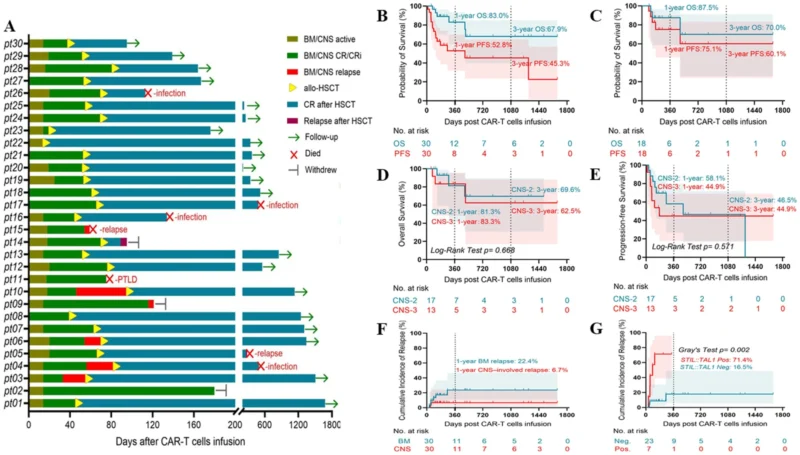
CAR T-cell manufacturing was successful for all 30 patients. Following infusion, all achieved CNS remission, with CNS-1 status and no leukemic blasts detected in the cerebrospinal fluid by flow cytometry. This included the nine patients with persistent CNS disease after bridging therapy.
Among 24 patients with baseline bone marrow involvement, 22 (91.7%) achieved measurable residual disease-negative complete remission. Nine of the ten patients with non-CNS extramedullary disease responded, including six complete and three partial remissions.
CAR T Cells Expanded in the Cerebrospinal Fluid
Following intravenous infusion, CAR T cells were detected in the cerebrospinal fluid, reaching a median peak proportion of 40.5% and a median peak count of 128 cells/mL at 19 days.
Expansion in the cerebrospinal fluid correlated with that in peripheral blood. Patients with persistent cerebrospinal fluid blasts before infusion had higher peak CAR T-cell counts than those who achieved CNS-1 status after bridging therapy: 425 versus 68 cells/mL. This may reflect greater CAR T-cell recruitment or expansion in the presence of local antigen, although the small cohort did not allow its effect on long-term disease control to be determined.
Neurotoxicity Was Manageable
All patients developed cytokine release syndrome, although grade 3 or higher events occurred in only three (10%) and were managed with tocilizumab, corticosteroids, or both.
Four patients experienced neurologic events. Two developed grade 4 ICANS alongside grade 3 cytokine release syndrome, both cases resolved completely with treatment. The other two experienced severe visual disturbances attributed to CNS leukemia. Peak CAR T-cell expansion in the cerebrospinal fluid was not associated with severe cytokine release syndrome or ICANS, suggesting that greater CNS expansion did not increase neurotoxicity in this cohort.
Grade 3 or higher infections occurred in eight patients (26.6%). One died from a severe polymicrobial infection during follow-up, but no treatment-related deaths occurred within 30 days of infusion.
Initial Responses Did Not Always Lead to Durable Disease Control
At a median follow-up of 272 days, estimated overall survival was 83.0% at one year and 67.9% at three years, while PFS was 52.8% and 45.3%, respectively.
Eighteen patients in complete remission underwent consolidative allogeneic transplantation, including five who received a second transplant. In this group, estimated three-year overall survival was 70.0% and PFS was 60.1%. Transplantation was independently associated with longer PFS (HR, 0.30), although the nonrandomized treatment decision may have introduced selection bias.
Eight patients relapsed after CAR T-cell therapy. Two relapses involved the CNS, neither as an isolated site. The one-year cumulative incidence was 6.7% for CNS-involved relapse and 22.4% for isolated bone marrow relapse.
Both CNS relapses retained CD7 expression, whereas CD7 loss occurred in four of the eight relapsed patients and was limited to isolated bone marrow relapse. This suggests that antigen escape may play a greater role in bone marrow relapse than in CNS recurrence.
Baseline CNS Disease and STIL::TAL1 Identified Higher-Risk Patients
Persistent cerebrospinal fluid disease before infusion was independently associated with worse overall survival (HR, 11.50). Although all patients eventually achieved CNS remission, failure to clear CNS disease with bridging therapy may identify more treatment-resistant disease.
STIL::TAL1 was present in five of the eight patients who relapsed, despite occurring in only seven of the 30 patients overall. The one-year cumulative incidence of relapse was 71.4% in STIL::TAL1-positive patients versus 16.5% in those without the fusion. STIL::TAL1 also independently predicted shorter progression-free survival (HR, 4.46).
Three patients with STIL::TAL1 experienced relapse with CD7 loss, raising the possibility that this subgroup is more prone to antigen escape after CD7-directed therapy. With only seven STIL::TAL1-positive patients, this association requires validation before it can inform treatment decisions.
Bottom Line
In this cohort of 30 heavily pretreated patients with T-ALL/LBL, naturally selected anti-CD7 CAR T-cell therapy induced CNS remission in every patient, including those who still had active disease after bridging therapy. Severe ICANS occurred in 6.7% of patients and resolved with treatment, CNS expansion of CAR T-cells did not increase neurotoxicity.
Two factors were linked to worse outcomes: persistent CNS disease at the time of infusion and STIL::TAL1 positivity. Patients who went on to consolidative allogeneic transplantation had longer PFS. The cohort was small and single-center, and follow-up was short, so these results should be viewed as preliminary, but they support continued development of CD7-directed CAR T-cell therapy for a patient population with few other options. Larger studies are needed to clarify the role of post-CAR T-cell transplantation and to identify strategies for preventing antigen-negative relapse.
CAR T-Cell Therapy Death Rate: Treatment-Related Mortality, Causes of Death, and Risk Factors