At the 2026 ASCO Annual Meeting, John V. Heymach and colleagues presented exploratory translational analyses from the phase 3 AEGEAN trial evaluating the impact of neoadjuvant durvalumab on tumor microenvironment (TME) features and their association with event-free survival (EFS) in patients with resectable non-small cell lung cancer (NSCLC).
The phase 3 AEGEAN trial previously demonstrated that perioperative durvalumab plus neoadjuvant chemotherapy improved event-free survival and pathologic complete response compared with neoadjuvant chemotherapy alone. The current analysis explored how durvalumab influences the tumor microenvironment and whether specific immune phenotypes are associated with clinical outcomes.
Study Design and Methods
AEGEAN is a randomized, double-blind, placebo-controlled phase III trial that enrolled patients with treatment-naïve stage II–IIIB (N2) resectable NSCLC.
Patients received neoadjuvant platinum-based chemotherapy with either durvalumab or placebo prior to surgery, followed by adjuvant durvalumab or placebo.
Tumor samples obtained at baseline and at surgery underwent transcriptomic profiling using RNA sequencing. Investigators performed unsupervised clustering analyses based on tumor and microenvironment-related gene expression signatures to identify distinct TME phenotypes.
Baseline Tumor Microenvironment Phenotypes
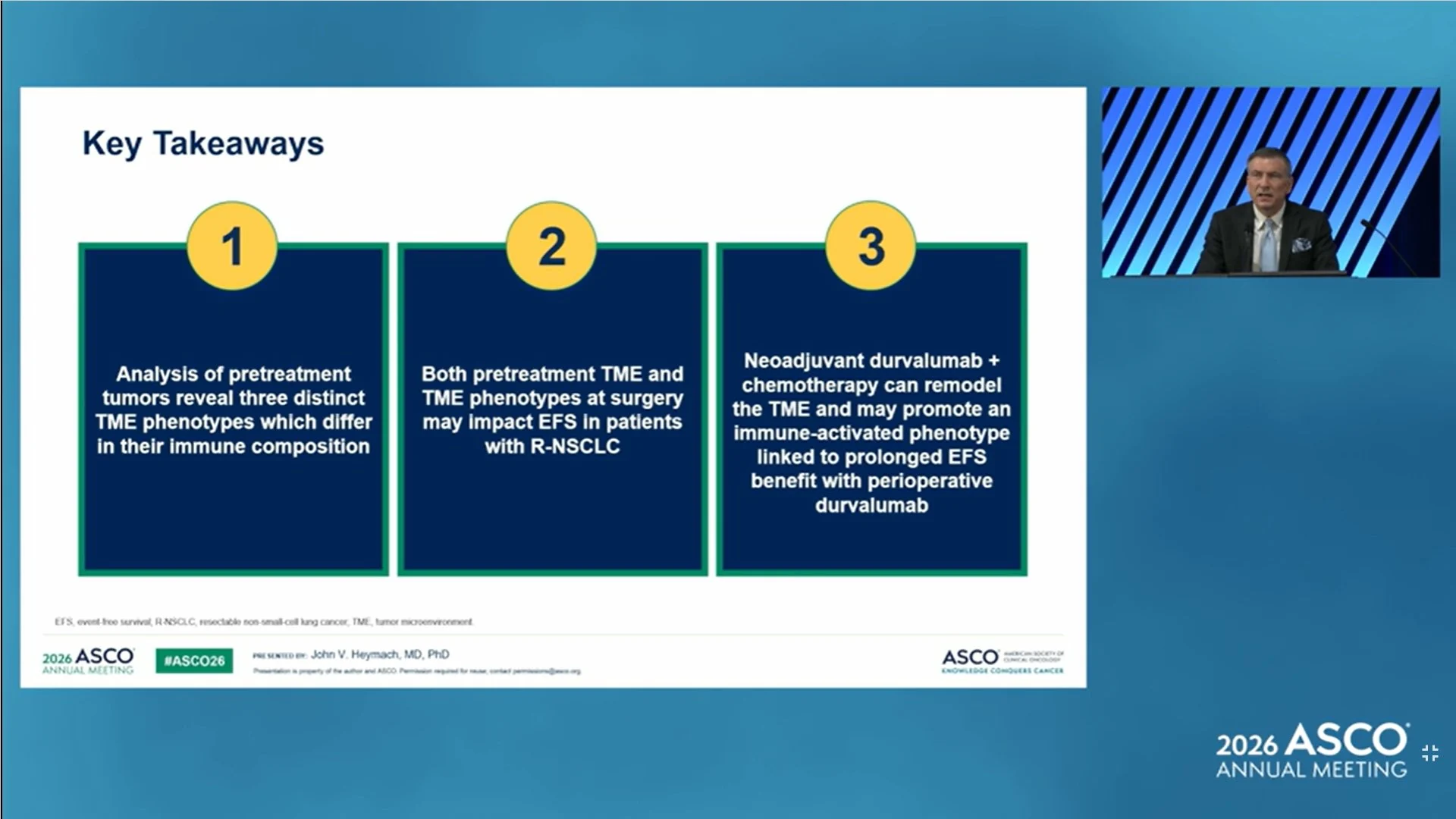
Analysis of pretreatment tumor samples identified three distinct tumor microenvironment phenotypes:
- C1: immune desert
- C2: immune suppressed
- C3: immune activated
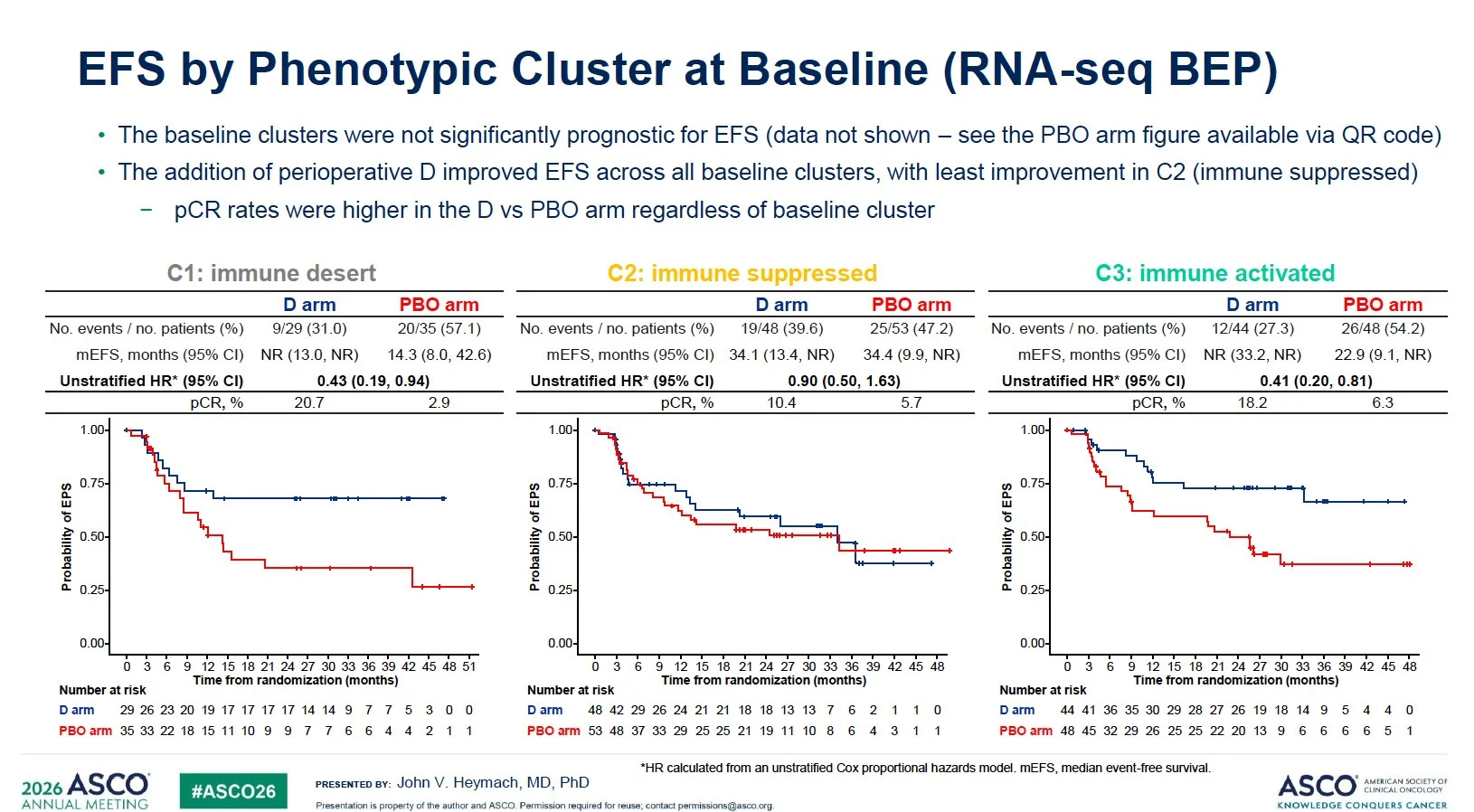
The baseline clusters were not significantly prognostic for event-free survival.
Investigators also observed biological differences between the phenotypes, reflecting distinct immune compositions within the tumor microenvironment.
Impact of Durvalumab on Event-Free Survival
The addition of perioperative durvalumab improved event-free survival across all baseline TME phenotypes, although the magnitude of benefit varied among clusters.
Event-Free Survival by Baseline Phenotype
C1: Immune Desert
- Events: 9/29 (31.0%) with durvalumab vs 20/35 (57.1%) with placebo
- Median EFS: Not reached vs 14.3 months
- HR 0.43 (95% CI, 0.19–0.94)
- pCR: 20.7% vs 2.9%
C2: Immune Suppressed
- Events: 19/48 (39.6%) vs 25/53 (47.2%)
- Median EFS: 34.1 vs 34.4 months
- HR 0.90 (95% CI, 0.50–1.63)
- pCR: 10.4% vs 5.7%
C3: Immune Activated
- Events: 12/44 (27.3%) vs 26/48 (54.2%)
- Median EFS: Not reached vs 22.9 months
- HR 0.41 (95% CI, 0.20–0.81)
- pCR: 18.2% vs 6.3%
The smallest EFS benefit was observed in the immune-suppressed C2 subgroup.
Importantly, pCR rates were higher with durvalumab than placebo across all baseline phenotypes.
Tumor Microenvironment Changes After Neoadjuvant Treatment
Analysis of paired baseline and surgical samples demonstrated that perioperative durvalumab influenced the composition of the tumor microenvironment.
Investigators reported that neoadjuvant durvalumab plus chemotherapy was associated with remodeling of the TME and may promote an immune-activated phenotype.
These findings suggest that the clinical activity of perioperative durvalumab extends beyond direct antitumor effects and includes modification of the immune landscape within the tumor microenvironment.
Clinical Implications
Both pretreatment TME phenotypes and TME phenotypes observed at surgery appeared to influence clinical outcomes in patients with resectable NSCLC.
The findings support the concept that tumor microenvironment composition may help explain differences in treatment benefit and could potentially serve as a biomarker framework for future perioperative immunotherapy strategies.
Conclusion
This exploratory translational analysis from the phase III AEGEAN trial identified three distinct baseline tumor microenvironment phenotypes in resectable NSCLC: immune desert, immune suppressed, and immune activated.
Baseline phenotypes were not independently prognostic for event-free survival. However, perioperative durvalumab improved EFS and increased pCR rates across all baseline TME phenotypes, with the greatest benefit observed in immune-desert and immune-activated tumors and the least benefit observed in immune-suppressed tumors.
These findings suggest that neoadjuvant durvalumab plus chemotherapy can remodel the tumor microenvironment and may promote an immune-activated phenotype associated with prolonged EFS benefit, providing additional biological insight into the mechanism of perioperative immunotherapy in resectable NSCLC.