
Immune checkpoint inhibitors (ICIs) have transformed the treatment landscape across multiple malignancies, yet only a subset of patients derives durable clinical benefit. Although biomarkers such as PD-L1 expression, tumor mutational burden, microsatellite instability, and circulating tumor DNA have improved patient selection, they fail to fully explain the marked variability in treatment response.
Growing evidence suggests that antitumor immunity is not determined solely by tumor-intrinsic characteristics but is also profoundly influenced by systemic metabolism and the gut microbiome. Metabolic pathways regulate T-cell activation, dendritic-cell function, cytokine production, and immune-cell differentiation, while microbial metabolites further shape host immune responses. Despite increasing recognition of this relationship, the specific circulating metabolites that influence immunotherapy efficacy have remained largely undefined.
In a landmark study published in Nature Medicine, Suissa and colleagues performed one of the largest metabolomic investigations ever conducted in cancer immunotherapy. By integrating plasma metabolomics, metagenomics, clinical data, and machine-learning analysis across more than 1,700 patients, the investigators identified histidine as a central metabolic biomarker associated with durable benefit from immune checkpoint blockade.

New Biomarkers for Immunotherapy Success in Metastatic Kidney Cancer
Study Design
The investigators analyzed 4,336 plasma samples and 620 stool samples from 1,714 patients enrolled across 16 independent cohorts in Europe and North America.
Patients represented five major tumor types:
- Non-small cell lung cancer
- Melanoma
- Renal cell carcinoma
- Urothelial carcinoma
- Colorectal cancer
The cohorts included diverse therapeutic strategies, including PD-1 inhibitors, PD-L1 inhibitors, CTLA-4 combinations, chemoimmunotherapy, radiotherapy combined with immunotherapy, tyrosine kinase inhibitor combinations, and fecal microbiota transplantation (FMT).
Unlike previous studies that evaluated baseline samples alone, this analysis incorporated longitudinal plasma collections obtained throughout treatment, allowing investigators to evaluate dynamic metabolic changes associated with clinical response.
Machine Learning Identifies an Eight-Variable Metabolic Signature
To identify clinically meaningful biomarkers, the investigators applied an advanced longitudinal machine-learning framework integrating 154 plasma metabolites together with clinical variables.
Following iterative feature selection, the final predictive model consisted of eight variables:
Clinical variables
- Age
- Body mass index
Metabolic variables
- Histidine
- Succinic acid
- Carnitine
- Docosatrienoic acid
- Hexadecanedioic acid
- Creatinine
The model achieved excellent predictive performance, with an area under the ROC curve (AUC) of 0.88 in the training cohort and 0.73 during external validation. Importantly, the metabolic signature remained reproducible across seven completely independent validation cohorts involving different tumor types and treatment regimens.
Among all variables included in the model, histidine consistently demonstrated the greatest predictive importance, emerging as the dominant metabolic feature associated with prolonged progression-free survival.
Histidine Consistently Predicts Clinical Benefit
Across multiple independent clinical cohorts, patients with higher circulating histidine experienced significantly improved outcomes during immune checkpoint inhibitor therapy.
Elevated plasma histidine was associated with:
- Longer progression-free survival
- Longer overall survival
- Improved recurrence-free survival
- Greater likelihood of durable response to checkpoint blockade
These associations were validated in several independent datasets, including IML1, SABR, AtezoTRIBE, PANDORE, MIND-DC, PRIMM, and the phase III CheckMate-025 trial.
In CheckMate-025, which evaluated nivolumab versus everolimus in metastatic renal cell carcinoma, baseline histidine levels independently predicted both progression-free and overall survival. Notably, patients receiving nivolumab appeared to derive particular benefit from higher histidine concentrations, suggesting that histidine may function not only as a prognostic marker but also as a predictive biomarker of immunotherapy benefit.
Histidine Changes Dynamically During Treatment
One of the study’s most interesting findings was that histidine behaves as a dynamic biomarker.
Longitudinal analyses demonstrated that circulating histidine levels gradually increased in patients responding to immunotherapy, whereas nonresponders generally failed to exhibit this increase.
These observations suggest that plasma histidine may reflect ongoing immune activation rather than simply baseline metabolic status, potentially allowing clinicians to monitor treatment response during therapy.
Histidine Directly Enhances Antitumor Immunity
To determine whether histidine merely correlates with response or actively contributes to immune activation, the investigators performed extensive mechanistic experiments.
In multiple mouse tumor models, oral histidine supplementation significantly enhanced the efficacy of anti-PD-1 therapy as well as combined PD-1 and CTLA-4 blockade.
Histidine supplementation resulted in:
- Delayed tumor growth
- Increased tumor rejection
- Improved overall survival
- Greater sensitivity to immune checkpoint inhibition
These findings suggest that histidine is not simply a passive biomarker but may actively contribute to antitumor immune responses.
Histidine Improves CD8⁺ T-Cell Fitness
Detailed immune profiling revealed several mechanisms underlying histidine’s immunologic activity.
Histidine promoted expansion of pre-effector CD8⁺ T cells within tumor-draining lymph nodes while increasing the number of activated tumor-infiltrating lymphocytes.
In vitro metabolic studies demonstrated that histidine enhanced mitochondrial oxidative metabolism by increasing fatty acid oxidation. This improvement in mitochondrial function preserved proliferative capacity and reduced exhaustion-associated dysfunction after repeated T-cell receptor stimulation.
Histidine also enhanced dendritic-cell antigen presentation and supported activation of both murine and human T cells, providing multiple complementary mechanisms through which systemic metabolism may augment checkpoint inhibitor efficacy.
The Gut Microbiome Determines Histidine Metabolism
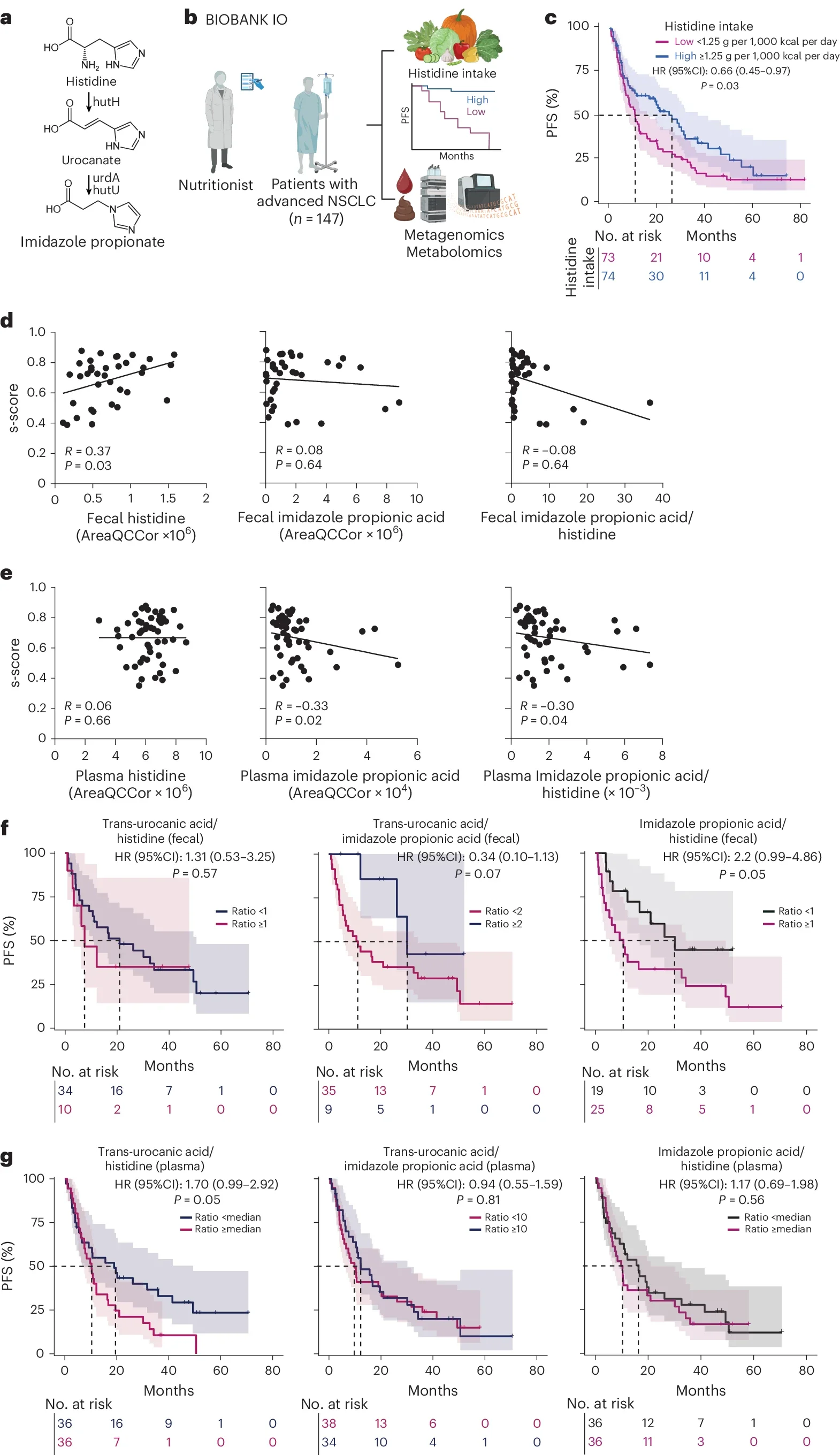
The study further demonstrated that diet alone does not fully determine circulating histidine concentrations.
Although higher dietary intake of histidine-rich foods—including meat, fish, and eggs—was associated with improved progression-free survival, plasma histidine levels depended strongly on gut microbial composition.
Patients with favorable microbiome signatures exhibited higher circulating histidine concentrations, whereas gut dysbiosis redirected histidine metabolism toward imidazole propionate (ImP), a microbial metabolite previously implicated in chronic inflammation and metabolic disease.
Higher ImP levels were associated with:
- Inferior progression-free survival
- Reduced immunotherapy response
- Increased systemic inflammatory signaling
These findings suggest that the clinical impact of dietary histidine depends on an individual’s microbiome, highlighting the close interaction between nutrition, microbial metabolism, and antitumor immunity.
Other Metabolic Checkpoints Identified
Although histidine emerged as the strongest positive biomarker, the machine-learning algorithm also identified several metabolites associated with poor immunotherapy outcomes.
Succinate consistently correlated with inferior progression-free survival across multiple cohorts. As a well-recognized oncometabolite, succinate has previously been linked to chronic inflammation and immunosuppressive signaling within the tumor microenvironment.
Similarly, elevated levels of long-chain fatty acids—including hexadecanedioic acid and docosatrienoic acid—were associated with reduced clinical benefit from checkpoint inhibition, further supporting the concept that systemic lipid metabolism influences immune responsiveness.
Together, these metabolites represent potential metabolic immune checkpoints that may contribute to therapeutic resistance.
Histidine and Immune-Related Toxicity
Interestingly, higher plasma histidine concentrations were not associated with increased severe immune-related adverse events.
Instead, fecal metabolomic analyses demonstrated that higher intestinal histidine levels correlated with a lower risk of grade 3 or higher immune-related toxicities.
These findings raise the possibility that modulation of microbial histidine metabolism could improve both efficacy and tolerability of immunotherapy.
Clinical Implications
This study substantially expands our understanding of immunotherapy biology by demonstrating that systemic metabolism represents a critical determinant of treatment response.
Beyond traditional genomic and immune biomarkers, circulating metabolites may provide clinically actionable information regarding immune fitness.
Future applications could include:
- Plasma histidine as a predictive biomarker for checkpoint inhibitor response.
- Longitudinal metabolomic monitoring during treatment.
- Personalized nutritional interventions.
- Microbiome-directed therapies to optimize histidine metabolism.
- Histidine supplementation as an adjunct to immunotherapy in carefully selected patients.
However, the authors emphasize that prospective clinical trials are still required before histidine supplementation can be incorporated into routine oncology practice.
Read Full Article Here