Zoldonrasib plus daraxonrasib are being evaluated in the phase 1 NCT06040541 trial for patients with previously treated KRAS G12D metastatic pancreatic ductal adenocarcinoma, a setting with no approved targeted therapy and limited benefit from later-line chemotherapy.
At ESMO GI 2026, preliminary results from 60 patients showed objective responses in nearly half of participants, including a 50% response rate in the second-line setting. The dual RAS(ON) inhibitor regimen also achieved high disease control rates, supporting further evaluation in KRAS G12D pancreatic cancer.
Background
Metastatic pancreatic ductal adenocarcinoma remains one of the most treatment-resistant solid tumors. In patients whose disease progresses after first-line therapy, available chemotherapy options provide limited benefit, with objective response rates generally ranging from 3% to 8%, median progression-free survival of approximately 2 to 4 months, and median overall survival of around 5 to 7 months.
KRAS mutations are present in most pancreatic cancers, and KRAS G12D is the most common individual KRAS alteration, occurring in approximately 40% of pancreatic ductal adenocarcinomas. However, there is currently no approved KRAS G12D-targeted treatment for this patient population.
Zoldonrasib, also known as RMC-9805, is an oral inhibitor designed to selectively target active KRAS G12D. Daraxonrasib, or RMC-6236, is an oral multi-selective RAS(ON) inhibitor. The rationale for combining the two agents is to achieve deeper and more sustained suppression of RAS signaling, potentially improving tumor response and delaying the emergence of resistance.
Preliminary results from a phase 1 trial now suggest that this dual RAS(ON) inhibition strategy may have meaningful activity in patients with previously treated KRAS G12D metastatic pancreatic cancer.
Methods
The ongoing phase 1 study, registered as NCT06040541, enrolled patients with KRAS G12D metastatic pancreatic ductal adenocarcinoma who had received at least one prior line of systemic therapy.
Patients received escalating doses of zoldonrasib plus daraxonrasib to evaluate safety, tolerability, and preliminary antitumor activity. The selected dose for expansion was:
- Zoldonrasib 1,200 mg once daily
- Daraxonrasib 300 mg once daily
The reported analysis included patients treated in the second-line setting and patients who had received three or more prior lines of treatment.
Primary assessments included treatment-related adverse events, dose modifications, objective response rate, disease control rate, progression-free survival, and overall survival.
Study Design
As of the February 9, 2026 data cutoff, 60 patients with second-line or later KRAS G12D metastatic pancreatic cancer had received zoldonrasib plus daraxonrasib at the recommended phase 2 dose.
The population was evenly divided between:
- Second-line pancreatic cancer: 30 patients
- Third-line or later pancreatic cancer: 30 patients
Median follow-up was 12.0 months in the second-line cohort and 12.6 months in the third-line or later cohort.
This remains an early-phase, single-arm study. Therefore, the results should be interpreted cautiously until confirmed in larger randomized trials.
Results
Objective responses were seen in nearly half of patients
The combination demonstrated encouraging antitumor activity in both treatment groups.
In the second-line cohort, the objective response rate was 50% with a 95% confidence interval of 31% to 69%. The disease control rate was 97%, indicating that almost all patients achieved either a partial response, complete response, or stable disease.
Among patients treated in the third-line or later setting, the objective response rate was 47% with a 95% confidence interval of 28% to 66%. The disease control rate was 90%.
Outcome Second-Line PDAC Third-Line or Later PDAC
- Objective response rate 50% 47%
- Disease control rate 97% 90%
- Median progression-free survival 9.6 months 7.6 months
- Six-month progression-free survival 71% 59%
- Median overall survival Not estimable 10.5 months
- Six-month overall survival 89% 82%
The median progression-free survival was 9.6 months in the second-line group and 7.6 months in the third-line or later group. These outcomes are notable in a disease setting where later-line chemotherapy commonly provides only a limited duration of disease control.
Overall survival data were still immature in the second-line cohort, and the median overall survival had not yet been reached. In the third-line or later cohort, median overall survival was 10.5 months.
Safety
Almost all patients experienced a treatment-related adverse event. Any-grade treatment-related adverse events occurred in 58 of 60 patients, or 97%. Grade 3 or higher treatment-related adverse events were reported in 35% of patients.
The most common treatment-related adverse events were:
- Rash: 90%
- Diarrhea: 63%
- Nausea: 57%
- Stomatitis or mucositis: 53%
- Fatigue: 28%
- Vomiting: 28%
- Anemia: 20%
The most frequent grade 3 or higher events were rash, reported in 12% of patients, and anemia, reported in 10%.
Other treatment-related events occurring in at least 10% of patients included elevated aspartate aminotransferase, decreased appetite, thrombocytopenia, elevated alanine aminotransferase, and peripheral edema.
No grade 4 treatment-related adverse events were reported. One grade 5 treatment-related adverse event, intestinal perforation, was reported.
The presentation noted that the safety profile did not reveal new or unexpected concerns and was broadly consistent with the known safety profile of daraxonrasib monotherapy.
Dose Modifications
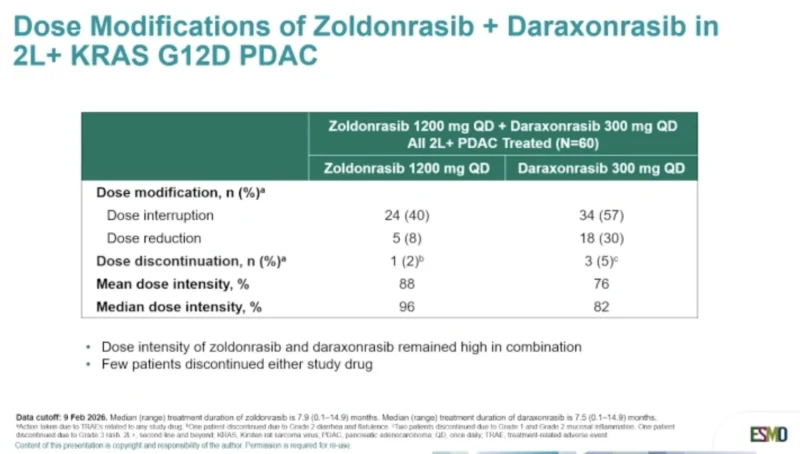
Dose interruptions and reductions were common, particularly for daraxonrasib, but most patients maintained meaningful treatment exposure.
For zoldonrasib:
- 40% required a dose interruption.
- 8% required a dose reduction.
- 2% discontinued treatment.
- Mean dose intensity was 88%.
- Median dose intensity was 96%.
For daraxonrasib:
- 57% required a dose interruption.
- 30% required a dose reduction.
- 5% discontinued treatment.
- Mean dose intensity was 76%.
- Median dose intensity was 82%.
These findings suggest that toxicity management and dose modification were important components of treatment delivery. Nevertheless, permanent treatment discontinuation remained relatively uncommon.
Key Findings
The combination of zoldonrasib and daraxonrasib produced objective responses in approximately half of patients with second-line or later KRAS G12D metastatic pancreatic cancer.
The 50% response rate in second-line disease and 47% response rate in third-line or later disease are notable in a patient population with historically limited response to chemotherapy after disease progression.
Median progression-free survival reached 9.6 months in the second-line setting and 7.6 months in the later-line setting. These results require confirmation, but they suggest the combination may provide more durable disease control than commonly expected with currently available later-line approaches.
The regimen was associated with frequent dermatologic and gastrointestinal toxicities. Rash, diarrhea, nausea, and mucositis were particularly common. However, most patients continued treatment after dose interruption or reduction, and few patients permanently discontinued either drug.
Key Takeaway Messages
KRAS G12D is found in approximately 40% of pancreatic cancers, yet no approved targeted therapy is currently available.
Zoldonrasib plus daraxonrasib achieved an objective response rate of 50% in second-line KRAS G12D metastatic pancreatic cancer.In patients treated in the third-line or later setting, the objective response rate was 47%. Median progression-free survival was 9.6 months in second-line disease and 7.6 months in third-line or later disease. Six-month overall survival reached 89% in the second-line cohort and 82% in the later-line cohort. Rash, diarrhea, nausea, and mucositis were frequent, while grade 3 or higher treatment-related adverse events occurred in 35% of patients. Dose modifications were common, but treatment discontinuation was uncommon and dose intensity remained relatively high.
Conclusion
Zoldonrasib plus daraxonrasib has shown encouraging preliminary activity in patients with second-line or later KRAS G12D metastatic pancreatic ductal adenocarcinoma. Responses were observed in nearly half of treated patients, while disease control rates reached 97% in second-line disease and 90% in the third-line or later setting.
The survival findings are particularly notable, with median progression-free survival of 9.6 months in the second-line cohort and 7.6 months in the later-line cohort. However, these data come from a small, non-randomized phase 1 study and require validation against standard treatment options.
The safety profile was manageable but required active monitoring and dose modification, particularly for rash, gastrointestinal toxicity, mucositis, and anemia. The limited rate of permanent discontinuation suggests that many patients were able to continue therapy despite treatment-related adverse events.
The findings support further development of the regimen in KRAS G12D pancreatic cancer. The planned global phase 3 RASolute 309 trial will compare zoldonrasib plus daraxonrasib with gemcitabine plus nab-paclitaxel in the first-line treatment of RAS G12D metastatic pancreatic cancer.