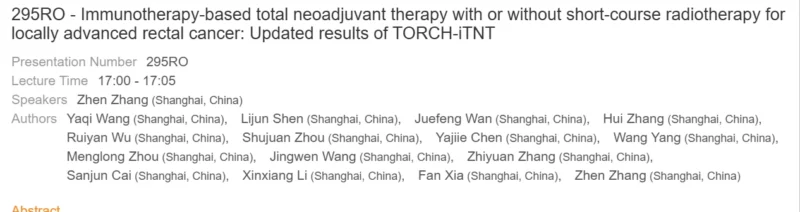
The TORCH-iTNT trial, presented by Zhen Zhang, MD, during an oral session at the ESMO Gastrointestinal Cancers Congress 2026, examined whether short-course radiotherapy can improve outcomes when added to immunotherapy-based total neoadjuvant therapy for patients with proficient mismatch repair locally advanced rectal cancer.
The study compared CAPOX chemotherapy plus the PD-1 inhibitor toripalimab with the same regimen preceded by short-course radiotherapy. Updated findings showed that the radiotherapy-containing strategy produced a substantially higher complete response rate, while maintaining a similar rate of severe thrombocytopenia.
Background
Total neoadjuvant therapy has become an important approach in locally advanced rectal cancer, allowing chemotherapy and radiotherapy to be delivered before surgery. This strategy may improve tumor regression, support sphincter preservation, and increase the chance of organ-preservation approaches for patients who achieve a clinical complete response.
However, long-term functional consequences remain an important concern. Pelvic radiotherapy and rectal surgery can both contribute to bowel, urinary, sexual, and anorectal dysfunction. Therefore, treatment strategies that maximize response while limiting unnecessary treatment burden are highly relevant.
Immune checkpoint inhibitors have transformed treatment for mismatch repair-deficient rectal cancer. Their role in proficient mismatch repair (pMMR) tumors is less established, as these tumors are generally less sensitive to immunotherapy alone.
TORCH-iTNT investigated whether combining toripalimab with CAPOX chemotherapy could achieve meaningful complete response rates in pMMR locally advanced rectal cancer, and whether adding short-course radiotherapy before immunochemotherapy could further improve tumor response.
Methods
TORCH-iTNT is a multicenter, randomized phase II study enrolling patients with pMMR locally advanced rectal cancer. Eligible patients had T3–4 and/or node-positive, non-metastatic disease.
A total of 192 patients were randomized between two treatment groups:
- Group A: Six cycles of CAPOX chemotherapy plus toripalimab.
- Group B: Short-course radiotherapy of 25 Gy in five fractions, followed by six cycles of CAPOX plus toripalimab.
Patients who achieved a clinical complete response were offered a watch-and-wait strategy. Those without clinical complete response were recommended to undergo surgery.
The primary endpoint was overall complete response, defined as the combination of pathological complete response after surgery and clinical complete response in patients managed without immediate surgery.
Secondary endpoints included organ preservation, anorectal function, adverse events, and survival.
By March 20, 2026, treatment had been completed by 158 patients: 75 in Group A and 83 in Group B.
Baseline characteristics were balanced between the two groups. Importantly, most patients had high-risk disease. At least one high-risk feature was present in 152 of 158 patients (96.2%).
High-risk features included low tumor location of 5 cm or less from the anal verge, cT4 disease, cN2 disease, positive mesorectal fascia, or extramural vascular invasion positivity.
This is clinically important because these features are associated with more challenging surgery, higher recurrence risk, and a greater need to consider organ-preserving treatment strategies.
Results of TORCH-iTNT Trial
The addition of short-course radiotherapy was associated with a higher complete response rate.
- In Group A, which received CAPOX plus toripalimab without radiotherapy, 9 of 75 patients achieved clinical complete response and entered a watch-and-wait strategy.
- In Group B, which received short-course radiotherapy before CAPOX plus toripalimab, 27 of 83 patients achieved clinical complete response and adopted watch and wait.
Among patients who underwent surgery, pathological complete response was observed in:
- 19 of 58 patients (32.8%) in Group A
- 23 of 53 patients (43.4%) in Group B
When clinical and pathological complete responses were combined, the overall complete response rate was:
- 37.3% in Group A
- 60.2% in Group B
This represents an absolute increase of 22.9 percentage points with short-course radiotherapy before immunochemotherapy.
The higher response rate in Group B was also reflected in the number of patients able to enter watch and wait. Three times as many patients achieved clinical complete response in the radiotherapy-containing arm compared with the chemotherapy-immunotherapy-only arm.
Disease progression was uncommon in both groups. It occurred in 2 patients in Group A and 1 patient in Group B.
A small number of patients without clinical complete response did not proceed directly to surgery. This included 6 patients in Group A and 2 patients in Group B, who either declined surgery or received further treatment.
Safety
The most common grade 3–4 adverse event was thrombocytopenia.
Grade 3–4 thrombocytopenia occurred in:
- 13.3% of patients in Group A
- 14.5% of patients in Group B
The rates were similar between the groups, suggesting that adding short-course radiotherapy did not lead to a meaningful increase in this severe hematologic toxicity.
The abstract did not report detailed long-term functional or quality-of-life outcomes. These data will be particularly important because the trial aims not only to improve tumor response but also to assess anorectal function and the impact of treatment on organ preservation.
Key Findings
TORCH-iTNT is the first comparative trial to evaluate two immunotherapy-based total neoadjuvant strategies in pMMR locally advanced rectal cancer.
CAPOX plus toripalimab alone produced an encouraging complete response rate of 37.3%, indicating that chemotherapy combined with PD-1 blockade may have clinically meaningful activity even in pMMR tumors.
However, the addition of short-course radiotherapy increased the complete response rate to 60.2%. It also increased the number of patients able to adopt a watch-and-wait strategy from 9 to 27 patients.
Pathological complete response was also higher in the radiotherapy-containing arm, reaching 43.4% compared with 32.8% with CAPOX plus toripalimab alone.
These findings suggest that short-course radiotherapy may enhance the effectiveness of immunochemotherapy in pMMR rectal cancer, potentially improving the opportunity for organ preservation in patients with deep tumor regression.
Conclusion
The TORCH-iTNT trial provides encouraging evidence for immunotherapy-based total neoadjuvant therapy in pMMR locally advanced rectal cancer.
Adding short-course radiotherapy before CAPOX plus toripalimab increased the overall complete response rate from 37.3% to 60.2% and enabled more patients to enter a watch-and-wait strategy.
The findings are especially notable because nearly all treated patients had high-risk disease features. While longer follow-up is needed to assess local control, survival, anorectal function, and the durability of organ preservation, TORCH-iTNT supports further evaluation of short-course radiotherapy followed by CAPOX and toripalimab as a response-intensifying strategy in pMMR rectal cancer.