The fourth week of June brought together important updates across GI Oncology, with expert posts covering colorectal, gastric and gastroesophageal junction, liver, biliary tract, pancreatic, and rectal cancers.
This week’s selection includes updates on KRAS G12C in metastatic colorectal cancer, China’s approval of satri-cel CAR-T therapy in advanced gastric/GEJ cancer, surgical approaches for perihilar cholangiocarcinoma, disitamab vedotin plus tislelizumab and S-1 in HER2-overexpressing gastric/GEJ adenocarcinoma, and multi-omic biomarkers in rectal cancer.
Other posts highlight the PRODIGE 81-TRIPLET-HCC trial, very early-onset metastatic colorectal cancer, biomarker-guided MDT care in gastric cancer, systemically delivered mRNA-LNPs in primary and secondary liver tumors, and HSP47 targeting in pancreatic cancer.
Together, these posts reflect the continued movement of GI oncology toward precision medicine, translational discovery, surgical innovation, and multidisciplinary care.
Mahsa Shirani Lapari — Postdoctoral Research Fellow at Johns Hopkins University; MD, Health MBA | United States
“I am very happy to share that our paper, “Prognostic Significance of KRAS G12C Versus Non-G12C Mutations in Metastatic Colorectal Cancer”, has been published in The Oncologist.
This study focuses on the clinical significance of KRAS G12C mutations compared with other KRAS mutations in metastatic colorectal cancer, an important topic in precision oncology and patient prognosis.
I am truly grateful to Mohd Khushman for giving me the opportunity to work with him and for his guidance and support throughout this project. He is a great researcher and mentor.
I would also like to sincerely thank all the co-authors and physicians involved in this work for their valuable contributions and collaboration. It was a privilege to be part of this team.”
Nicholas Hornstein, MD, PhD — Nicholas Hornstein — Assistant Professor at Northwell Health; GI Medical Oncologist | United States
“A historic day for solid tumor oncology.
China has approved satri-cel (CLDN18.2 CAR-T) for advanced gastric/GEJ cancer, making it the first CAR-T therapy ever approved for a solid tumor. For years, CAR-T has transformed hematologic malignancies while solid tumors remained left in the dust.
CT041-ST-01 (3L+ CLDN18.2+ gastric/GEJ cancer) in The Lancet
• Median PFS: 3.25 vs 1.77 months (HR 0.37)
• Median OS: 7.9 vs 5.5 months (HR 0.69)
• 18-month OS: 20% vs 10%
• Demonstrated superiority over physician’s choice therapy in a heavily pretreated population.
The absolute numbers are not dramatic, but that isn’t the point.
This is the first regulatory approval of a CAR-T for a solid tumor.
Also notable: this happened in China, not the United States.
As China continues to accelerate development of cell therapies, ADCs, and other oncology platforms, it is increasingly becoming the site of first-in-class innovation.
Satri-cel may ultimately be remembered less for the 2.4-month OS gain and more for what it represents:
The beginning of the solid tumor CAR-T era.”
Eduardo Fernandes — Assistant Professor of Surgery at UFRJ; Specialist in Liver, Pancreas, and Biliary Tract Surgery | Brazil
“I am happy to share a very interesting paper published in International Journal of Surgery this week.
This review article, published in collaboration with renowned authorities in the field of cholangiocarcinoma surgery, provides the reader with an extensive overview of modern aspects of surgical approaches for perihilar cholangiocarcinoma.”
Erman Akkus — Medical Oncology Fellow at Ankara University, Faculty of Medicine | Turkey
“ORR: 89%, mOS: 31.9 months
A phase III RCT in western populations is required.
First-Line Disitamab Vedotin, Tislelizumab, and S-1 in HER2-Overexpressing Advanced Gastric or Gastroesophageal Junction Adenocarcinoma: A Single-Arm, Phase II Trial”
Pieter Maerten — Radiation Oncology Resident at UZ Leuven | Belgium
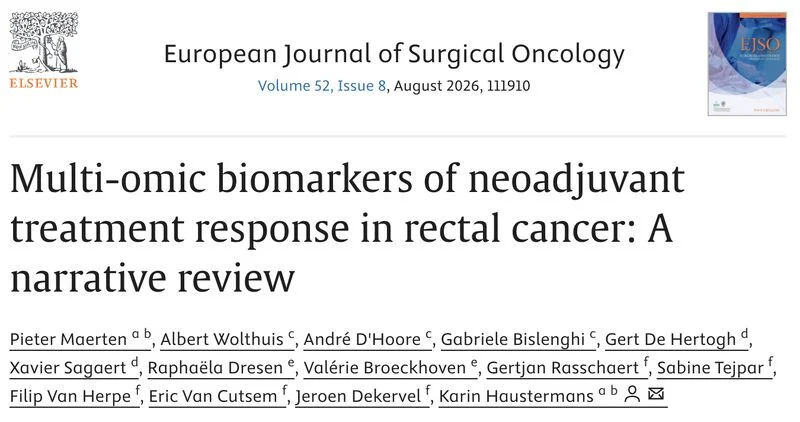
“Excited to share our recently published review on “Multi-omic biomarkers of neoadjuvant treatment response in rectal cancer” in the European Journal of Surgical Oncology.
Neoadjuvant treatment response in rectal cancer remains highly heterogeneous, making it challenging to identify upfront which patients may benefit from organ-preservation strategies.
In this review, we provide an overview of existing and emerging biomarkers across multiple domains, including:
• Genomic and molecular biomarkers
• AI-driven imaging and digital pathology
• Liquid biopsy approaches (cfDNA/ctDNA)
• Patient-derived tumor models
• Microbiome-associated biomarkers
A central theme emerging from the literature is that treatment response is determined by a complex interplay between tumor-intrinsic characteristics, the immune microenvironment and stromal factors.
We also discuss the rapidly expanding role of artificial intelligence and multi-omic integration in improving response prediction and supporting individualized treatment strategies.”
Julien Edeline — Medical Oncologist at Centre Eugène Marquis; Professor of Oncology at Rennes University | France
“Results of the TRIPLET trial published in Lancet Gastro & Hepatology!
Unfortunately, adding anti-CTLA-4 with low-dose ipilimumab to atezolizumab-bevacizumab did not improved outcomes… We need to continue research to make immunotherapy work in more patients. Proud of another great PRODIGE trial!
Philippe Merle, Jean-Marc Phelip, Jean-Frédéric Blanc, Karine Le Malicot et al.
PRODIGE FFCD”
Read more about PRODIGE 81-TRIPLET-HCC on OncoDaily.
Andrea Pretta — Medical Oncologist and Clinical Researcher; Assistant Professor of Medical Oncology at University of Cagliari; Medical Oncology Unit, University Hospital of Cagliari | Italy
“I am pleased to share our latest publication in ESMO Open:
“Distinct molecular and clinical aggressiveness in very early-onset metastatic colorectal cancer: survival and genomic divergence between patients aged 30–39 versus 40–49 years.”
Early-onset colorectal cancer is often regarded as a single clinical entity. Our study suggests that this may not be the case.
In this multicentre real-world analysis of metastatic colorectal cancer diagnosed before the age of 50, patients aged 30–39 years showed:
• shorter overall survival;
• a distinct genomic profile, with enrichment of KRAS alterations and fewer APC alterations;
• a significantly higher prevalence of peritoneal metastases.
These findings support the concept that the youngest patients with metastatic colorectal cancer may represent a biologically distinct subgroup, reinforcing the need to move beyond a “one-size-fits-all” view of early-onset disease.
A sincere thank you to all the co-authors and collaborating centres whose expertise and commitment made this work possible.
Perhaps the next challenge is not simply understanding why colorectal cancer is increasing in young adults, but recognising that not all early-onset disease is biologically the same.”
Maria Maddalena Laterza — Medical Oncologist at Ospedale Santa Maria delle Grazie, GOY( Gastro Oncology Young) | Italy
“Proud to share our latest publication presented at the ASCO Annual Meeting 2026!
“Real-world outcomes of biomarker-guided multidisciplinary management in localized and metastatic gastric cancer.”
I am pleased to share our work evaluating the impact of a structured multidisciplinary team (MDT) approach integrated with molecular profiling in the management of gastric cancer, based on a real-world cohort of 172 consecutive patients treated between 2018 and 2024.
Key findings:
• Biomarker-driven MDT discussions (HER2, PD-L1 CPS, MSI) optimized treatment selection across both localized and metastatic disease.
• In localized gastric cancer:
76% R0 resection rate
Median progression-free survival (PFS): 14.5 months
Median overall survival (OS) not reached after a median follow-up of 32 months.
• In metastatic disease:Median PFS: 7.2 months
Median OS: 15.2 months, compared with 10.4 months before routine MDT implementation.
Objective response rate: 48%
Disease control rate: 68%
• On multivariable analysis, MDT discussion was independently associated with improved overall survival (HR 0.66; 95% CI 0.50–0.87).Why this matters
These real-world data reinforce the value of integrating molecular biomarkers into routine multidisciplinary decision-making, demonstrating that a structured MDT can improve treatment allocation and translate into better clinical outcomes for patients with gastric cancer.
A sincere thank you to all the multidisciplinary colleagues, collaborators, and patients who made this work possible. Team science continues to be the cornerstone of precision oncology.”
Laura Leighton — Postdoctoral Research Fellow at The University of Queensland | Australia
“I’m so excited to see my paper “Systemically delivered mRNA-LNPs transfect primary and secondary liver tumors” published in Molecular Therapy Nucleic Acids this week. This study provides proof-of-concept that systemically-administered anti-cancer mRNA-LNPs may be effective against liver cancer.
We have shown robust expression of a GFP reporter from intravenously-administered mRNA-LNPs, not just in the healthy mouse liver, but in fibrotic and cirrhotic liver and in hepatocellular carcinoma in situ. We also achieved moderate delivery to xenograft models of both primary and secondary liver cancer. This study is an important step towards development of mRNA therapies for liver cancer, and informs the choice of animal model for preclinical studies. We hope it will be of broad interest and value to the field.”
George Sharbeen — Co-Lead, Pancreatic Cancer Translational Research Group at UNSW Sydney | Australia
“I’m pleased to share our new article published in Oncogene, which details the therapeutic potential of targeting HSP47 in both pancreatic cancer cells and cancer-associated fibroblasts.
Our study also identifies an interesting link between HSP47 expression in the tumour cell compartment of pancreatic cancer and overall survival in patients.
A big thank you to our multidisciplinary team of co-authors and the generous support of our funders that made this study possible.”

Find out 10 Must-Read Posts in GI Oncology from the third week of June on OncoDaily.