First-line treatment of HER2-negative advanced gastric and gastroesophageal junction (G/GEJ) adenocarcinoma has become increasingly biomarker-driven. PD-(L)1 expression informs the use of immune checkpoint inhibitors (ICIs), while CLDN18.2 identifies patients who may benefit from zolbetuximab. However, when these biomarkers overlap, there are no head-to-head clinical trials directly comparing zolbetuximab-based and ICI-based strategies.
A Bayesian network meta-analysis published in ESMO Open evaluated the relative efficacy of first-line zolbetuximab plus chemotherapy and ICI regimens across different PD-(L)1 combined positive score (CPS) subgroups in patients with locally advanced unresectable or metastatic G/GEJ adenocarcinoma.
The original study, “Zolbetuximab plus chemotherapy versus immune checkpoint inhibitor regimens by programmed death-ligand 1 combined positive score in locally advanced or metastatic gastric or gastroesophageal junction adenocarcinoma: a Bayesian network meta-analysis,” was authored by K. Shitara, S.Y. Rha, S.J. Klempner, F. Lordick, R. Ranganath, M. Oh, R.H. Getzenberg, G. Gourgioti, X. Chai, and H. Yang.
CLDN18.2 in the Treatment Landscape
CLDN18.2 has emerged as an important therapeutic biomarker in advanced G/GEJ adenocarcinoma. Zolbetuximab, a CLDN18.2-targeting monoclonal antibody, was approved by the FDA in October 2024 in combination with fluoropyrimidine- and platinum-containing chemotherapy for the first-line treatment of HER2-negative, CLDN18.2-positive locally advanced unresectable or metastatic G/GEJ adenocarcinoma.
In the pooled final analysis of the phase 3 SPOTLIGHT and GLOW trials, median overall survival was 16.4 months with zolbetuximab plus chemotherapy versus 13.7 months with placebo plus chemotherapy (HR 0.77; 95% CI 0.67–0.89). Median progression-free survival was 9.2 versus 8.2 months, respectively (HR 0.71; 95% CI 0.61–0.83).
More recent data have also explored the broader clinical relevance of CLDN18.2. In a 2026 European study of 563 patients, CLDN18.2-high expression was observed in 48.3% of the overall cohort using the ≥75% threshold. Among tumors with quantifiable CLDN18.2 expression, 62.9% met the ≥25% threshold. Exploratory analyses suggested possible associations between CLDN18.2 expression and outcomes with other treatment classes, although these findings remain hypothesis-generating.
Find more videos on OncoDaily YouTube TV.
How the Treatments Were Compared
The investigators conducted a systematic literature review to identify randomized controlled trials evaluating first-line ICI-based treatment regimens in locally advanced unresectable or metastatic G/GEJ adenocarcinoma. Of 71 randomized trials identified, five were included in the primary network meta-analysis, representing five regimens: zolbetuximab plus chemotherapy, pembrolizumab plus chemotherapy, tislelizumab plus chemotherapy, nivolumab plus chemotherapy, and chemotherapy alone.
A Bayesian fixed-effects network meta-analysis compared OS and PFS across PD-(L)1 subgroups corresponding to CPS ≥1 to <5, ≥5 to <10, and ≥10. CPS-specific hazard ratios were used for pembrolizumab and nivolumab. For tislelizumab, efficacy estimates were based on tumor area positivity (TAP), the predefined biomarker criterion in RATIONALE-305, with TAP and CPS treated as interchangeable for the analysis.
For zolbetuximab, which targets CLDN18.2 rather than PD-(L)1, PD-(L)1 CPS was not considered a treatment-effect modifier. The intention-to-treat treatment effect for zolbetuximab was therefore applied across CPS subgroups.
Efficacy Across PD-(L)1 CPS
The treatment pattern differed according to PD-(L)1 expression. In the CPS ≥1 to <10 subgroups, zolbetuximab plus chemotherapy showed consistent efficacy and the highest treatment-ranking probabilities for OS and PFS. At CPS ≥10, ICI-based regimens were numerically favored in the primary analysis.
CPS ≥1 to <5
Compared with chemotherapy alone, zolbetuximab plus chemotherapy reduced the hazard of death, with an OS HR of 0.77 (95% credible interval [CrI] 0.67–0.89). Pembrolizumab plus chemotherapy also showed an OS benefit, with an HR of 0.79 (95% CrI 0.65–0.96). Tislelizumab and nivolumab plus chemotherapy did not show statistically significant OS differences from chemotherapy alone.
For PFS, HRs versus chemotherapy alone were 0.71 (95% CrI 0.61–0.83) with zolbetuximab and 0.79 (95% CrI 0.64–0.97) with pembrolizumab. Zolbetuximab had the highest SUCRA values for both OS and PFS, at 84.0% and 93.2%, respectively.
CPS ≥5 to <10
In the CPS ≥5 to <10 subgroup, zolbetuximab plus chemotherapy was associated with an OS HR of 0.77 (95% CrI 0.67–0.89) compared with chemotherapy alone. Pembrolizumab, tislelizumab, and nivolumab plus chemotherapy did not show statistically significant OS differences from chemotherapy alone.
For PFS, the HR with zolbetuximab plus chemotherapy was 0.71 (95% CrI 0.61–0.83). In the indirect comparison with pembrolizumab plus chemotherapy, the PFS HR numerically favored zolbetuximab at 0.75 (95% CrI 0.53–1.06), although the difference was not statistically significant. Zolbetuximab had the highest SUCRA values in this subgroup, at 89.7% for OS and 91.0% for PFS.
CPS ≥10
A different pattern was observed in patients with PD-(L)1 CPS ≥10. All four active regimens reduced the hazard of death compared with chemotherapy alone.
OS HRs were 0.77 (95% CrI 0.67–0.89) with zolbetuximab, 0.67 (95% CrI 0.57–0.79) with pembrolizumab, 0.57 (95% CrI 0.43–0.76) with tislelizumab, and 0.68 (95% CrI 0.58–0.79) with nivolumab. For PFS, the respective HRs were 0.71 (95% CrI 0.61–0.83), 0.65 (95% CrI 0.55–0.77), 0.56 (95% CrI 0.42–0.74), and 0.68 (95% CrI 0.58–0.80).
Tislelizumab plus chemotherapy had the highest SUCRA values in the CPS ≥10 subgroup, at 92.2% for OS and 91.2% for PFS. Overall, ICI-based regimens were numerically favored over zolbetuximab in this subgroup in the primary analysis.
Optimal Zolbetuximab Exposure
Because nausea and vomiting can lead to inadequate zolbetuximab exposure or treatment discontinuation, the investigators conducted a sensitivity analysis among patients with optimal zolbetuximab exposure.
In the CPS ≥10 analysis, zolbetuximab plus chemotherapy was associated with an OS HR of 0.67 (95% CrI 0.57–0.79) compared with chemotherapy alone. This was identical to the estimate for pembrolizumab plus chemotherapy and similar to nivolumab at 0.68 (95% CrI 0.58–0.79), while tislelizumab had an HR of 0.57 (95% CrI 0.43–0.76). For PFS, the HR was 0.66 (95% CrI 0.56–0.78) with zolbetuximab, 0.65 (95% CrI 0.55–0.77) with pembrolizumab, 0.56 (95% CrI 0.42–0.74) with tislelizumab, and 0.68 (95% CrI 0.58–0.80) with nivolumab.
The authors therefore found that, with optimal zolbetuximab exposure, differences between zolbetuximab and selected ICI regimens in the CPS ≥10 population were attenuated. However, these findings remain based on indirect comparisons and may be affected by selection bias.
Important Limitations
The analysis does not provide a direct head-to-head comparison between zolbetuximab and ICIs. Most network links were based on a single trial, and differences in study design, patient populations, biomarker prevalence, follow-up, and subgroup definitions may have affected cross-trial comparisons.
Safety comparisons were outside the scope of the analysis, and Asia-only trials were excluded. MSI-high tumors were included in the ICI trials, but MSI status was not consistently reported according to CPS subgroup. In addition, RATIONALE-305 assessed PD-(L)1 expression using tumor area positivity rather than CPS.
CLDN18.2 status was not assessed in most ICI trials, meaning that comparisons relied on the assumption that CLDN18.2 was not a treatment-effect modifier for PD-1 therapy. The analysis also assumed equivalent efficacy among several chemotherapy backbones to construct the connected evidence network.
CLDN18.2 Beyond Zolbetuximab
The CLDN18.2 landscape is also expanding beyond first-line zolbetuximab. In July 2026, AstraZeneca announced positive phase 3 results from CLARITY-Gastric01, in which the CLDN18.2-directed antibody-drug conjugate sonesitatug vedotin demonstrated a statistically significant and clinically meaningful OS improvement in patients with CLDN18.2-positive advanced gastric, GEJ, or esophageal adenocarcinoma treated in the second-line or later setting.
Notably, the study used a broader CLDN18.2 positivity threshold of ≥25% of tumor cells at any staining intensity, compared with the ≥75% moderate-to-strong membranous staining threshold used for zolbetuximab.
Outside gastric and GEJ cancer, the phase 2 GLEAM study of zolbetuximab plus gemcitabine and nab-paclitaxel in metastatic pancreatic adenocarcinoma did not show an OS advantage, with median OS of 13.7 versus 13.6 months.
CLDN18.2 Testing in 2026
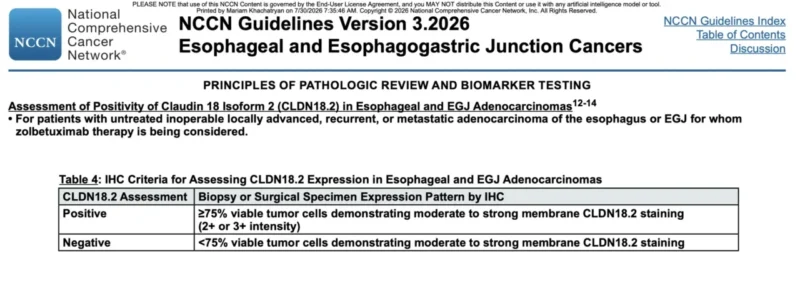
NCCN Guidelines Version 3.2026 include CLDN18.2 testing in the biomarker assessment of advanced gastric and esophageal/EGJ adenocarcinoma when zolbetuximab is being considered. For zolbetuximab selection, positivity is defined as moderate-to-strong membranous staining in ≥75% of tumor cells. Testing is considered alongside other biomarkers relevant to treatment selection, including HER2, PD-L1, and MMR/MSI status.
Takeaway
In this network meta-analysis, zolbetuximab plus chemotherapy showed consistent and clinically relevant efficacy across PD-(L)1 CPS subgroups in patients with CLDN18.2-positive, HER2-negative advanced G/GEJ adenocarcinoma. In patients with CPS ≥1 to <10, zolbetuximab demonstrated a favorable efficacy profile relative to ICI-based regimens. In CPS ≥10, ICI-based regimens were numerically favored in the main analysis, while zolbetuximab showed comparable efficacy to selected ICI regimens when treatment exposure was optimized.
These findings support a biomarker-informed treatment approach integrating both PD-(L)1 and CLDN18.2, while prospective validation is needed.
The full article is available in ESMO Open.