
The final 5-year survival analysis of the WSG TP-II trial adds an important layer to the de-escalation discussion in hormone receptor–positive/HER2-positive early breast cancer. Although the original primary analysis showed a substantially higher pathologic complete response rate with weekly paclitaxel plus trastuzumab and pertuzumab compared with endocrine therapy plus dual HER2 blockade, long-term outcomes were excellent in both treatment arms (Gluz et al., 2026).
This finding matters because HR+/HER2+ breast cancer sits at the intersection of two therapeutic worlds: endocrine sensitivity and HER2 dependency. The clinical question is not simply whether chemotherapy can produce deeper early tumor eradication, but whether selected patients can achieve durable outcomes with less intensive treatment when adjuvant therapy is adapted according to response.
Why WSG TP-II Was Designed
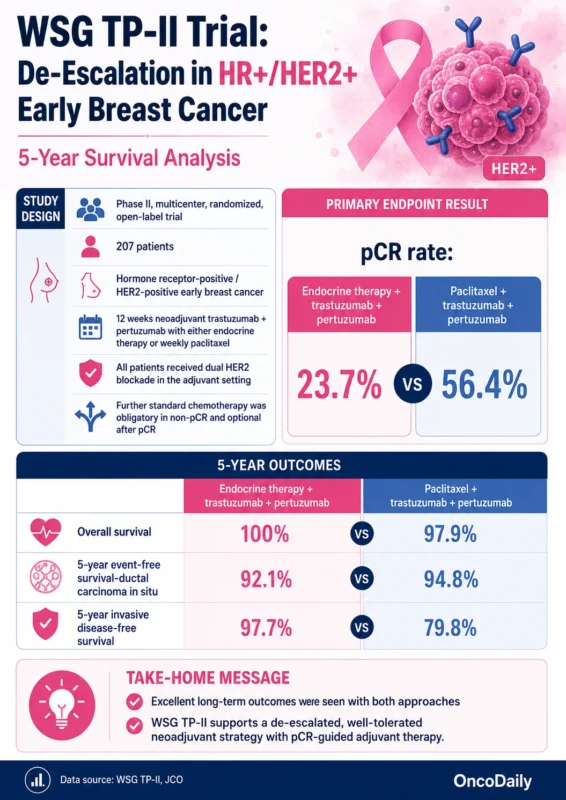
The WSG TP-II trial was a multicenter, randomized, phase II, open-label study designed to compare two short neoadjuvant strategies in patients with HR+/HER2+ early breast cancer.
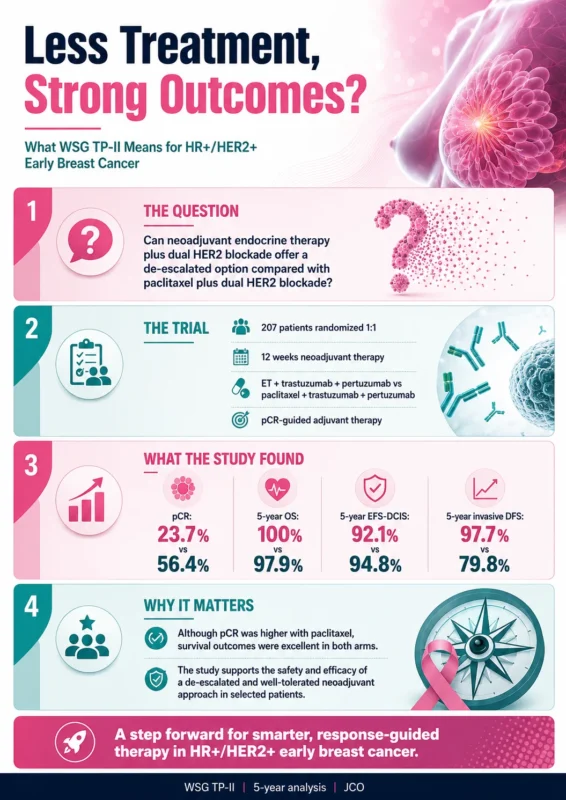
A total of 207 patients were randomly assigned 1:1 to receive 12 weeks of neoadjuvant trastuzumab and pertuzumab combined with endocrine therapy or trastuzumab and pertuzumab combined with once-weekly paclitaxel. The trial’s primary endpoint was pathologic complete response, and the initial analysis showed a clear pCR advantage for the paclitaxel-containing arm: 56.4% versus 23.7% (Gluz et al., 2026).
However, WSG TP-II was not only a pCR trial. Its design also tested a response-guided treatment concept. All patients received dual HER2 blockade in the adjuvant setting. Further standard chemotherapy was mandatory for patients who did not achieve pCR, while additional chemotherapy was optional after pCR.
The Main 5-Year Survival Findings
After 5 years of follow-up, survival outcomes were excellent in both arms.
The estimated 5-year overall survival rate was 100% in the endocrine therapy arm versus 97.9% in the paclitaxel arm. The corresponding 5-year event-free survival including ductal carcinoma in situ events was 92.1% versus 94.8%.
The estimated 5-year invasive disease-free survival was 97.7% in the endocrine therapy arm versus 79.8% in the paclitaxel arm, although the confidence interval in the paclitaxel arm was wide, indicating uncertainty and the need for cautious interpretation in a phase II trial with a limited sample size (Gluz et al., 2026).
The key clinical message is that both treatment strategies were associated with high long-term survival in this population when adjuvant treatment was guided by pCR status.
Why The Results Are Clinically Interesting
The study highlights a central tension in HER2-positive breast cancer: pCR is important, but it is not the whole story.
The paclitaxel arm produced a much higher pCR rate than the endocrine therapy arm. In many HER2-positive trials, pCR has been associated with improved long-term outcomes, particularly in higher-risk disease. Yet WSG TP-II suggests that in HR+/HER2+ early breast cancer, carefully selected patients may still experience excellent long-term outcomes even when the neoadjuvant regimen is less chemotherapy-intensive, provided that postoperative treatment is adapted according to response.
This is especially relevant in HR+/HER2+ disease, where endocrine responsiveness may contribute to disease control and where some tumors may not require the same treatment intensity as more aggressive HER2-positive phenotypes.
A De-Escalation Signal, Not A Chemotherapy-Free Standard
The WSG TP-II results support the safety and feasibility of a de-escalated neoadjuvant approach, but they do not mean chemotherapy can be broadly omitted in HR+/HER2+ early breast cancer.
The endocrine therapy arm had a lower pCR rate, and patients without pCR were required to receive additional standard chemotherapy. Therefore, the excellent survival outcomes reflect the entire treatment strategy, not neoadjuvant endocrine therapy plus dual HER2 blockade alone.
This distinction is essential. WSG TP-II supports response-guided de-escalation, not uncontrolled undertreatment. The trial suggests that short neoadjuvant therapy can help identify patients who may need escalation after surgery and those who may safely avoid additional chemotherapy when deep response is achieved.
What This Means For HER2-Positive Breast Cancer Care
HER2-positive breast cancer has become one of the most important settings for treatment personalization. The field is moving beyond a single question of whether HER2 blockade works. It now asks how much chemotherapy is needed, for whom, and at what point treatment intensity can be reduced without compromising cure.
WSG TP-II contributes to this evolving framework. It shows that in HR+/HER2+ early breast cancer, both endocrine-based and paclitaxel-based neoadjuvant approaches combined with trastuzumab and pertuzumab can lead to excellent 5-year outcomes when followed by pCR-guided adjuvant therapy.
For patients, this matters because de-escalation is not only about avoiding chemotherapy. It is about reducing toxicity, preserving quality of life, and individualizing treatment without sacrificing long-term disease control.
Limitations
Several limitations should be considered. WSG TP-II was a phase II trial with 207 participants, and it was not powered like a large phase III survival trial. The study was open-label, and some survival endpoints had wide confidence intervals. In addition, the final outcomes reflect a response-guided treatment strategy that included mandatory standard chemotherapy for non-pCR patients, making it inappropriate to interpret the endocrine arm as a standalone chemotherapy-free approach for all patients.
Still, the 5-year data are clinically meaningful and add important evidence to the growing body of work supporting de-escalation strategies in selected HER2-positive early breast cancer populations.
Key Takeaway
The final survival analysis of WSG TP-II shows that patients with HR+/HER2+ early breast cancer achieved excellent 5-year outcomes after short neoadjuvant therapy with trastuzumab and pertuzumab combined with either endocrine therapy or weekly paclitaxel, followed by pCR-guided adjuvant treatment.
The paclitaxel arm produced a higher pCR rate, but long-term survival remained strong in both arms. These findings reinforce a key direction in modern HER2-positive breast cancer care: treatment should be effective, but also smarter, more selective, and guided by response.