
Tumor-infiltrating lymphocytes (TILs) have become one of the most important immune biomarkers in breast cancer, particularly in triple-negative breast cancer (TNBC), where the interaction between the immune system and tumor biology strongly influences clinical outcomes.
For years, TIL assessment has relied on expert pathologist evaluation of hematoxylin and eosin (H&E)-stained tumor sections. Although standardized approaches have improved reproducibility, manual scoring remains dependent on specialist expertise, requires significant time, and may be difficult to implement consistently across healthcare systems.
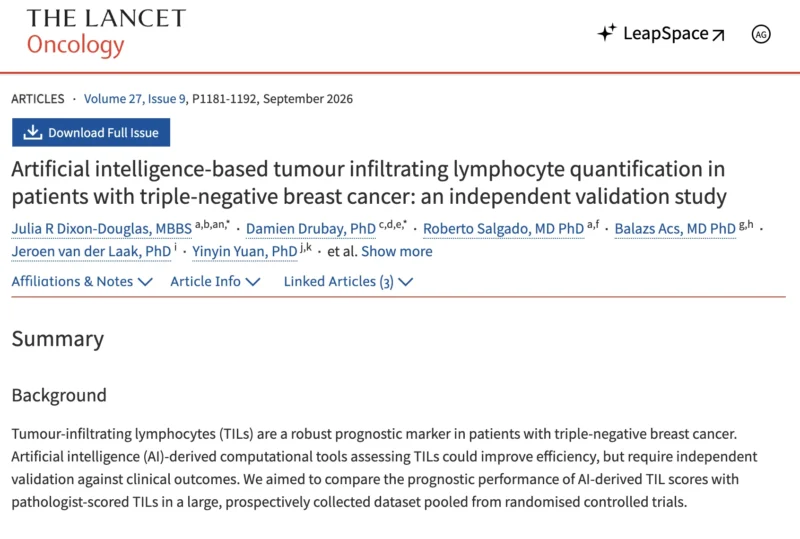
A new study published in The Lancet Oncology evaluated whether artificial intelligence (AI)-based computational tools could provide a reproducible alternative for measuring TILs and predicting outcomes in patients with early-stage TNBC.
The independent validation study, known as CATALINA, assessed previously developed AI algorithms for computational tumor-infiltrating lymphocyte (cTIL) quantification using large clinical datasets derived from randomized clinical trials. The findings provide important evidence supporting the role of digital pathology in immune biomarker assessment.
Why Tumor-Infiltrating Lymphocytes Matter in Triple-Negative Breast Cancer
Triple-negative breast cancer represents one of the most biologically aggressive breast cancer subtypes, characterized by the absence of estrogen receptor, progesterone receptor, and HER2 expression.
Unlike hormone receptor-positive breast cancer, where endocrine therapy provides a major therapeutic advantage, TNBC has historically relied heavily on chemotherapy. However, the recognition that many TNBC tumors contain active immune infiltration has changed the understanding of this disease.
TILs reflect the presence of immune cells within the tumor microenvironment and provide information about the interaction between the host immune system and malignant cells.
Previous studies have demonstrated that higher levels of stromal TILs are associated with improved prognosis in TNBC, including better invasive disease-free survival, distant disease-free survival, and overall survival.
The clinical importance of immune biomarkers has increased further with the introduction of immune checkpoint inhibitors, where identifying patients with immune-active tumors may help refine treatment strategies.
However, translating TIL assessment into routine clinical practice requires methods that are accurate, reproducible, and scalable.
The CATALINA Study: Independent Validation of AI-Based TIL Assessment
The CATALINA study was designed to determine whether AI-derived TIL scores could provide reliable prognostic information compared with traditional pathologist-based evaluation.
Researchers analyzed data from 1,759 patients, including 1,356 patients with complete clinicopathological information, pathologist-scored stromal TILs, and AI-derived cTIL scores available. The dataset included patients with early-stage triple-negative or HER2-positive breast cancer, with outcome analysis focused primarily on early TNBC cohorts.
Two previously validated AI pipelines were independently deployed without retraining or modification. The algorithms generated computational TIL measurements from digitized H&E whole-slide images and were evaluated against clinical outcomes from seven prospective randomized adjuvant breast cancer trials.
This approach was particularly important because independent external validation is required before AI-based biomarkers can be considered for clinical implementation.
AI-Derived TIL Scores Show Prognostic Value
The study demonstrated that AI-derived TIL measurements provided statistically significant prognostic information.
The researchers observed a moderate correlation between computational TIL scores and traditional pathologist-scored stromal TIL measurements, with correlation coefficients ranging from 0.375 to 0.473.
Both traditional stromal TIL assessment and AI-derived TIL scores were independently associated with improved outcomes, including:
- invasive disease-free survival
- distant disease-free survival
- overall survival
After adjustment for clinical and pathological factors, higher TIL levels were associated with reduced risk of recurrence and death.
For invasive disease-free survival, the hazard ratio associated with pathologist-scored stromal TILs was 0.73, while AI-derived percentage lymphocyte scores showed a hazard ratio of 0.80. Similar associations were observed for distant disease-free survival and overall survival.
These results suggest that AI-generated immune measurements can capture meaningful biological information from routine pathology images.
AI Does Not Replace Pathologists, It Expands Access to Immune Biomarkers
Although AI-based scoring demonstrated prognostic value, the study also highlighted an important limitation.
When AI-derived TIL scores were combined with traditional clinicopathological factors and pathologist-based stromal TIL assessment, the additional prognostic contribution of AI measurements was no longer statistically significant.
This suggests that AI currently complements rather than replaces expert pathological evaluation.
The strongest clinical value of AI may come from settings where standardized TIL assessment is difficult to perform due to limited pathology resources, differences in expertise, or high clinical workload.
Digital pathology platforms could eventually allow consistent immune biomarker assessment across institutions and support broader implementation of precision oncology approaches.
The Role of Digital Pathology in Future Breast Cancer Treatment
The emergence of AI-based pathology represents a major shift in oncology diagnostics.
Traditional pathology relies on human interpretation of complex tissue patterns. AI algorithms can analyze thousands of cellular features, quantify immune infiltration, and identify patterns that may not be easily measurable through conventional approaches.
For breast cancer, this technology may become increasingly important as treatment decisions become more dependent on biological characteristics rather than anatomical staging alone.
Future applications may include:
- improved risk stratification in early TNBC
- integration with genomic and immune biomarkers
- identification of patients most likely to benefit from immunotherapy
- standardized assessment across global healthcare systems
However, prospective studies are still required to determine how AI-based TIL measurements should be incorporated into treatment algorithms.
Challenges Before Clinical Implementation
Despite promising results, several challenges remain before AI-based TIL scoring becomes routine clinical practice.
First, algorithms must demonstrate consistent performance across different scanners, staining protocols, institutions, and patient populations.
Second, regulatory frameworks must define how AI-generated pathology biomarkers should be validated and integrated into clinical workflows.
Finally, clinicians must determine whether AI-derived measurements provide meaningful clinical advantages beyond existing pathological assessment.
The CATALINA study represents an important step because it evaluated AI tools in a large independent dataset rather than only in development cohorts.
The Future: From Visual Pathology to Quantitative Immune Profiling
The future of breast cancer pathology is moving toward quantitative, data-driven immune profiling.
TILs have already established themselves as an important biomarker in TNBC. AI technology now provides a potential pathway to make immune assessment faster, more reproducible, and more accessible.
The CATALINA validation study demonstrates that computational TIL scoring can provide clinically relevant prognostic information, supporting the continued development of AI-powered biomarkers in breast oncology.
As immunotherapy and precision medicine continue to evolve, combining digital pathology with molecular and clinical data may help create a more complete understanding of each patient’s tumor biology.
The Bottom Line
Artificial intelligence-based tumor-infiltrating lymphocyte quantification represents an important advance in breast cancer biomarker development.
In the CATALINA independent validation study, AI-derived TIL scores demonstrated prognostic value in early triple-negative breast cancer and improved risk discrimination compared with traditional clinical and pathological factors alone.
Although AI does not replace expert pathology assessment, it may expand access to standardized immune biomarker evaluation and accelerate the transition toward more personalized breast cancer care.
The next generation of breast cancer diagnostics may not only identify what a tumor looks like, but also quantify how the immune system interacts with it.