
Patients with stage II to III HER2-positive breast cancer commonly receive multi-agent neoadjuvant chemotherapy with dual HER2 blockade. These approaches have transformed outcomes, but they can also bring substantial treatment burden, including fatigue, neuropathy, cytopenias, gastrointestinal toxicity, and the practical challenges of prolonged therapy.
As HER2-targeted treatment becomes increasingly effective, researchers are asking whether chemotherapy intensity can be reduced for selected patients without compromising long-term outcomes.
A new secondary analysis of the phase II DAPHNe trial provides encouraging long-term data for an abbreviated neoadjuvant approach using paclitaxel, trastuzumab, and pertuzumab, known as THP. The study also explored whether ultrasensitive circulating tumor DNA, or ctDNA, could add another layer of information for treatment response and future de-escalation strategies.
The findings, published in JAMA Oncology, suggest that 12 weeks of THP may produce excellent outcomes in carefully selected patients with mostly stage II HER2-positive breast cancer. However, the trial was single-arm and nonrandomized, so the results should be viewed as supportive of further research rather than a new universal standard.
What Was the DAPHNe Trial?
DAPHNe, or De-escalation to Adjuvant Antibodies Post-pCR to Neoadjuvant THP, was a prospective phase II trial enrolling patients with stage II to III HER2-positive breast cancer.
All patients received 12 weeks of neoadjuvant paclitaxel, trastuzumab, and pertuzumab before surgery. Subsequent treatment was based on surgical pathology results. Patients who achieved a pathologic complete response, or pCR, could continue HER2-directed antibody treatment without receiving additional adjuvant chemotherapy.
This design tested an important clinical concept. Rather than giving every patient prolonged chemotherapy regardless of response, treatment could potentially be adapted according to how the tumor responds to an initial HER2-targeted regimen.
The updated analysis included 98 patients. Most had stage II disease, while 66.3% had hormone receptor-positive tumors. The median age was 49.5 years.
What Were the Long-Term Outcomes?
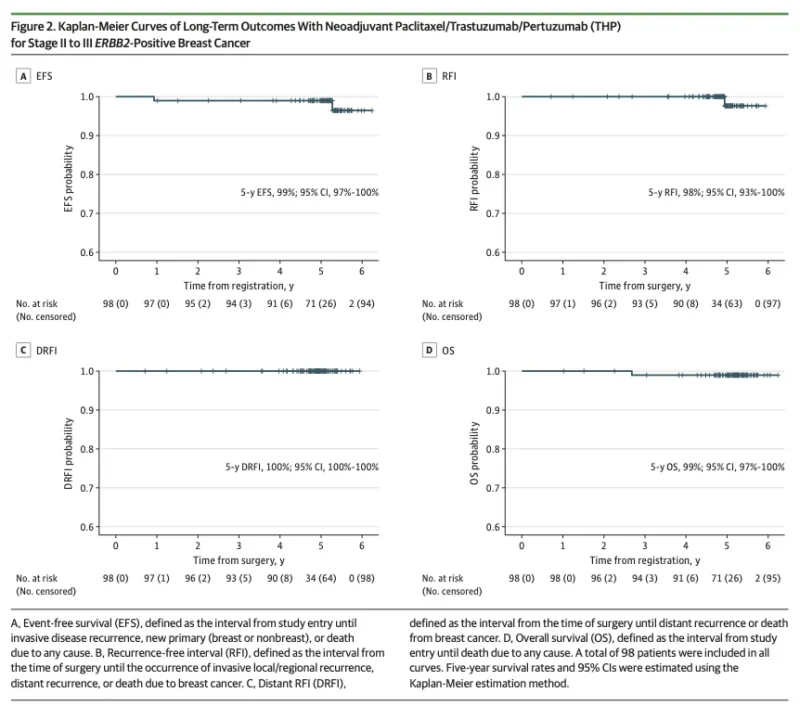
After a median follow-up of 5.2 years, outcomes were highly favorable.
The 5-year event-free survival rate was 99%. The 5-year recurrence-free interval was 98%. The 5-year distant recurrence-free interval was 100%, and the 5-year overall survival rate was 99%.
No distant breast cancer recurrences were observed among the 98 participants during follow-up. One patient developed an ipsilateral local breast recurrence 59 months after surgery. Another patient developed a metastatic neuroendocrine tumor, classified as a nonbreast second primary cancer, and later died from that disease.
These results are notable because the neoadjuvant regimen contained only 12 weeks of paclitaxel-based chemotherapy, rather than a more prolonged multi-agent chemotherapy approach.
Why Did pCR Matter?
In the original DAPHNe analysis, 55 of 97 evaluable patients, or 56.7%, achieved pCR following neoadjuvant THP.
Among patients with pCR, 54 of 55 did not receive additional adjuvant chemotherapy. The current 5-year data suggest that this response-guided strategy was associated with durable disease control in the study population.
Pathologic complete response is already recognized as an important marker of treatment sensitivity in HER2-positive breast cancer. Patients whose tumors disappear from the breast and lymph nodes after neoadjuvant therapy often have favorable long-term outcomes.
However, pCR is not a perfect predictor for every individual patient. This is why treatment de-escalation requires carefully designed prospective trials and long-term outcome data before it can be applied broadly.
Could ctDNA Help Personalize Treatment Further?
The DAPHNe secondary analysis also examined ctDNA in 57 patients with available tumor tissue and serial plasma samples.
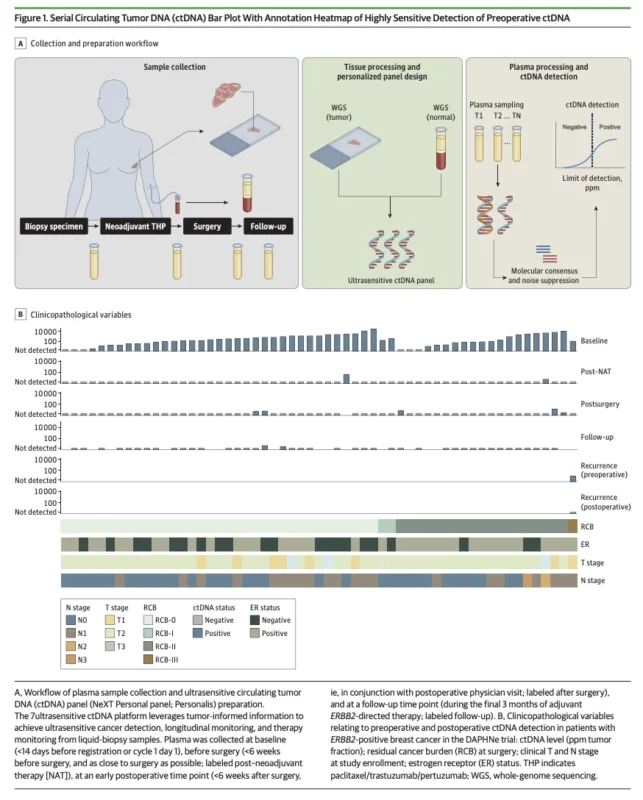
The researchers used an ultrasensitive, tumor-informed assay. Whole-genome sequencing of tumor and matched normal DNA was used to develop personalized panels targeting up to approximately 1,800 tumor-specific variants.
Blood was collected before treatment, before surgery, shortly after surgery, and during the final months of adjuvant HER2-directed therapy.
At baseline, ctDNA was detected in 51 of 57 patients, representing 89.5% of the ctDNA cohort. Detection was especially common in patients with larger tumors or lymph node-positive disease.
After neoadjuvant THP, ctDNA cleared in 49 of 51 patients with detectable baseline ctDNA and available preoperative plasma. This represented a 96.1% clearance rate. Only two patients remained ctDNA-positive before surgery.
The high ctDNA clearance rate reflects the treatment sensitivity of many HER2-positive tumors in this population. It also created an important limitation: because ctDNA became undetectable in nearly all patients after THP, clearance did not clearly distinguish patients who achieved pCR from those who did not.
What Did Postoperative ctDNA Show?
Postoperative ctDNA detection remained uncommon. At the first postoperative time point, ctDNA was detected in 5 of 56 patients. At the late adjuvant time point, it was detected in 2 of 41 patients.
All positive postoperative findings were present at very low levels, below 100 parts per million. The authors stressed that the clinical meaning of ultralow ctDNA levels remains uncertain.
The patient who developed a local recurrence had ctDNA detected at the time of recurrence. After surgical resection, ctDNA again became undetectable. This observation supports the potential value of ctDNA for monitoring disease over time, but it does not establish that ctDNA should yet guide treatment decisions in routine care.
Where Does This Leave De-Escalation?
The DAPHNe study supports an emerging shift in HER2-positive breast cancer. The goal is no longer simply to maximize treatment for every patient. It is increasingly about matching treatment intensity to tumor biology and treatment response.
For selected patients with strong response to neoadjuvant THP, reduced chemotherapy exposure may be possible. However, DAPHNe mainly enrolled patients with stage II disease and did not compare abbreviated THP with standard multi-agent chemotherapy in a randomized design.
The ongoing CompassHER2-pCR trial is expected to provide further evidence. That study is evaluating whether patients with pCR after 12 weeks of taxane therapy plus trastuzumab and pertuzumab can safely avoid further chemotherapy.
For now, the DAPHNe 5-year update offers one of the clearest long-term signals that abbreviated THP may be an effective de-escalation strategy for some patients with early HER2-positive breast cancer. The next step is identifying exactly which patients can benefit from less treatment without giving up durable disease control.