
Thermal ablation is being explored as a less invasive treatment option for selected patients with early-stage breast cancer, but current evidence is still not strong enough to support its routine use as a standalone alternative to surgery.
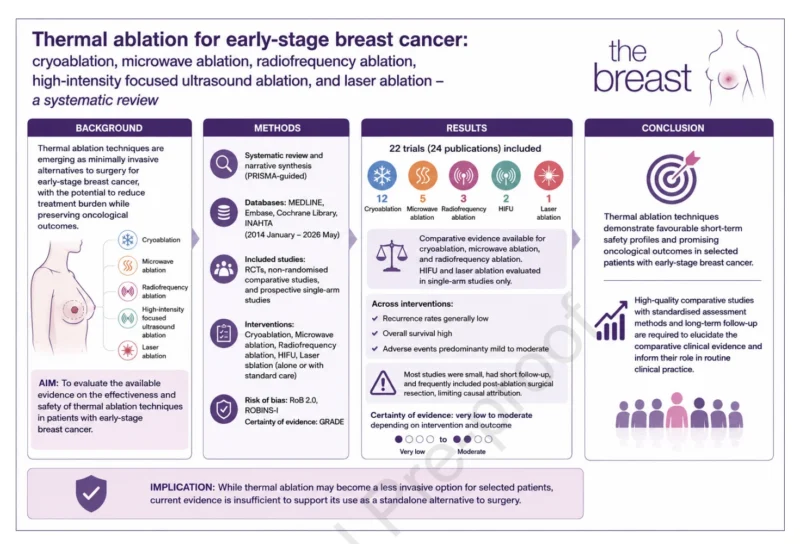
A new systematic review published in The Breast evaluated five thermal ablation approaches: cryoablation, microwave ablation, radiofrequency ablation, high-intensity focused ultrasound ablation, and laser ablation.
The review found generally favorable short-term safety and promising oncologic outcomes across these approaches. However, most studies were small, non-comparative, and heterogeneous. Many also included surgical resection after ablation, making it difficult to determine whether long-term cancer control was truly attributable to ablation alone.
The authors concluded that thermal ablation may be a promising option for carefully selected patients, but higher-quality comparative trials with long-term follow-up are needed before these techniques can be integrated into routine breast cancer care.
Why This Review Matters
Early-stage breast cancer is usually treated with surgery, often through breast-conserving surgery when appropriate.
Over recent decades, breast cancer care has moved toward de-escalation. This shift is seen in the transition from radical mastectomy to breast-conserving surgery and in the narrowing indications for axillary lymph node dissection.
Thermal ablation fits into this broader movement.
Instead of removing a tumor surgically, thermal ablation aims to destroy tumor tissue using heat, cold, focused ultrasound, or laser energy. The potential benefits include lower anesthesia requirements, faster recovery, less treatment burden, and better cosmetic outcomes.
However, breast cancer presents unique challenges for ablation. Tumors may have irregular shapes, microscopic extensions, or diffuse growth patterns. Complete tumor destruction can be difficult to confirm without surgery.
This is why the question is not only whether ablation can destroy breast tumors, but whether it can safely replace surgery in selected patients.
Study Design
The authors conducted a systematic review and narrative synthesis according to PRISMA guidelines.
They searched MEDLINE, Embase, the Cochrane Library, and the INAHTA database for studies published from January 2014 to May 2026.
Eligible studies included randomized controlled trials, non-randomized comparative studies, and prospective single-arm studies in adults with early-stage breast cancer.
The interventions of interest were:
- Cryoablation
- Microwave ablation
- Radiofrequency ablation
- High-intensity focused ultrasound ablation
- Laser ablation
The main outcomes included overall survival, disease-free survival, recurrence, complete ablation rate, residual tumor rate, adverse events, quality of life, and cosmetic outcomes.
The certainty of evidence was assessed using GRADE.
What the Review Included
The review included 22 trials reported in 24 publications.
There were 12 studies of cryoablation, five studies of microwave ablation, three studies of radiofrequency ablation, two studies of high-intensity focused ultrasound ablation, and one study of laser ablation.
Comparative evidence was available only for cryoablation, microwave ablation, and radiofrequency ablation.
High-intensity focused ultrasound and laser ablation were evaluated only in single-arm studies.
This is important because single-arm studies can show feasibility and early safety, but they cannot reliably determine whether ablation is as effective as surgery.
Cryoablation: Most Studied, but Still Limited
Cryoablation was the most frequently studied technique.
The review included 12 cryoablation studies, including one case-control study and 11 single-arm studies.
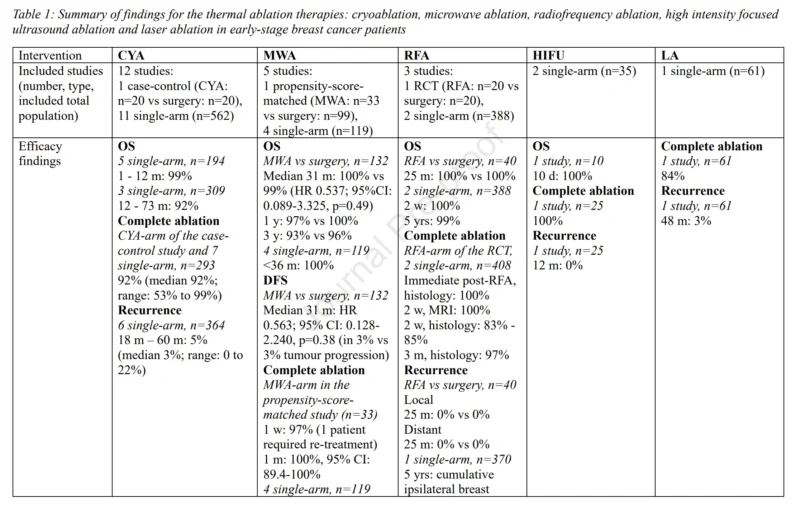
Complete ablation was reported in several studies and was achieved in about 92% of participants overall, although rates varied widely from 53% to 99%.
Recurrence was reported in six single-arm trials involving 364 patients. Across 18 to 60 months of follow-up, recurrence occurred in 5% of patients, with reported rates ranging from 0% to 22%.
Overall survival was high in the available studies. Shorter-term studies reported an OS rate of 99%, while longer-term studies reported an OS rate of 92%.
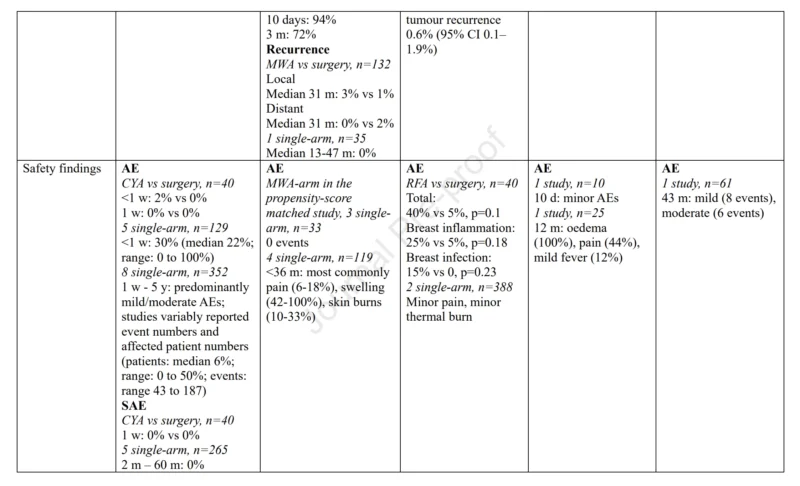
Safety was generally favorable. Serious adverse events were not reported in the studies that measured this outcome. Most adverse events were mild or moderate and included pain, bruising, and hematoma.
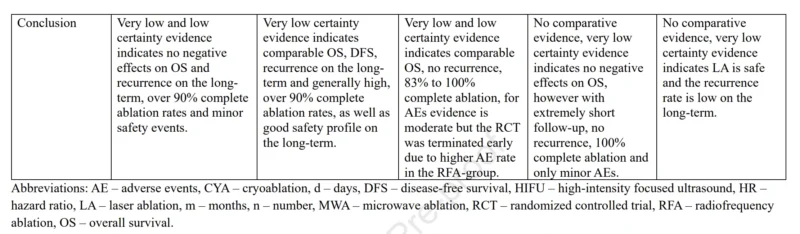
However, the certainty of evidence was low for recurrence and complete ablation and very low for most other outcomes.
Microwave Ablation: Encouraging Data in Older Patients
Five microwave ablation studies were included.
One prospective propensity-score-matched study compared microwave ablation plus endocrine therapy with standard surgery and adjuvant therapy in older patients with HR-positive/HER2-negative invasive breast cancer.
At a median follow-up of 31 months, overall survival was 100% in the microwave ablation group and 99% in the surgery group. Tumor progression occurred in 3% of patients in both groups.
Local recurrence was 3% with microwave ablation and 1% with surgery. Distant recurrence was 0% with microwave ablation and 2% with surgery.
Complete ablation in the comparative study was 97% at 1 week and 100% at 1 month after retreatment of one patient.
Single-arm microwave ablation studies reported complete ablation rates ranging from 72% to 100%.
Safety appeared acceptable, but adverse events varied across studies. Reported events included pain, swelling, skin burns, and skin necrosis.
The certainty of evidence for microwave ablation was rated very low across outcomes.
Radiofrequency Ablation: One RCT, Mixed Safety Signal
Three radiofrequency ablation studies were included, including one randomized trial and two single-arm trials.
The randomized phase II trial compared radiofrequency ablation followed by immediate surgical excision with lumpectomy alone.
At a median follow-up of about 25 months, overall survival was 100% in both groups. No local or distant recurrences were observed.
Complete ablation was 100% in the intervention group.
However, the trial was terminated early because of a higher number of adverse events in the radiofrequency ablation arm.
Postoperative local adverse events occurred in 40% of patients in the radiofrequency ablation group compared with 5% in the breast-conserving surgery group. Breast inflammation and infection were also numerically higher in the ablation group.
A larger single-arm Japanese study using radiofrequency ablation as definitive treatment reported 5-year overall survival of 99.2% and a 5-year cumulative ipsilateral breast tumor recurrence rate of 0.6%.
The evidence from the randomized trial was rated low certainty for overall survival, complete ablation, and recurrence, and moderate certainty for adverse events. Evidence from single-arm studies was rated very low.
HIFU and Laser Ablation: Early Evidence Only
High-intensity focused ultrasound ablation was evaluated in two single-arm studies.
Overall survival was 100% in both studies, but follow-up was short. One study reported complete ablation in all participants and no recurrence within 12 months.
Adverse events were mostly mild and included edema, pain, fever, nausea, vomiting, and skin changes.
Laser ablation was evaluated in one single-arm trial including 61 patients.
Complete tumor ablation was achieved in 84% of patients, and recurrence was 3% at four years. Reported adverse events were mild or moderate.
For both HIFU and laser ablation, evidence certainty was very low.
The Main Limitation: Can Ablation Replace Surgery?
The central question is whether thermal ablation can safely replace surgery.
This review shows that current evidence does not yet answer that question.
A major limitation is that many studies performed surgical resection after ablation. This allowed histopathologic confirmation of complete ablation, but it also means that long-term outcomes may reflect the combined effect of ablation and surgery, not ablation alone.
Another challenge is how to confirm complete tumor destruction when surgery is not performed.
Imaging and biopsy-based follow-up strategies are promising, especially MRI-based assessment, but they are not yet standardized enough to fully replace histopathologic confirmation.
Tumor biology also matters. Thermal ablation may be more suitable for small, well-defined, low-risk tumors. Irregular, diffuse, or lobular tumors may be harder to treat completely with a spherical ablation zone.
Which Patients Might Benefit Most?
The review suggests that future clinical use will likely depend on careful patient selection.
Potential candidates may include patients with small, well-defined, low-risk early-stage tumors, especially those who are older, have comorbidities, are poor surgical candidates, or strongly prefer a minimally invasive approach.
However, these groups still need prospective validation.
An expert panel cited in the review recommended thermal ablation without resection only for well-defined tumors measuring 1 cm or less, axillary-negative disease, luminal A-like biology, and excluding invasive lobular cancers.
This reflects the current cautious approach in the field.
What Future Trials Need to Answer
The authors emphasized the need for high-quality prospective trials.
Future studies should compare thermal ablation directly with breast-conserving surgery in selected patients.
They should include long-term endpoints such as local recurrence, disease-free survival, and event-free survival.
They should also use standardized imaging, biopsy, and follow-up protocols to assess complete ablation.
Quality of life and cosmetic outcomes should be measured consistently, because these are among the key reasons to consider ablation.
Finally, future studies should clarify whether axillary surgery can also be minimized in patients selected for ablation, especially given recent evidence supporting omission of sentinel lymph node biopsy in some clinically node-negative low-risk patients.
Clinical Meaning
Thermal ablation represents an important direction in breast cancer treatment de-escalation.
The approach is attractive because it may reduce treatment burden while preserving cancer control in selected patients.
But the current evidence remains preliminary.
The review found favorable safety and recurrence outcomes across several techniques, but certainty was mostly very low to low. Comparative evidence was limited, and long-term data remain insufficient.
For now, thermal ablation should be viewed as an investigational or carefully selected approach rather than a standard replacement for surgery.
Key Takeaway
This systematic review of 22 trials found that thermal ablation techniques for early-stage breast cancer show promising short-term safety and oncologic outcomes.
Cryoablation, microwave ablation, and radiofrequency ablation had some comparative evidence, while high-intensity focused ultrasound and laser ablation were supported only by single-arm studies.
Complete ablation rates were generally high, recurrence rates were generally low, and adverse events were mostly mild to moderate.
However, the evidence base is limited by small sample sizes, heterogeneous study designs, frequent post-ablation surgical resection, and limited long-term comparative follow-up.
Thermal ablation may become a less invasive option for selected patients with early-stage breast cancer, but current evidence is not yet sufficient to support its routine use as a standalone alternative to surgery.