Postmastectomy chest wall radiotherapy produced a modest increase in local chest wall symptoms but did not significantly worsen overall quality of life, physical functioning, fatigue, pain, body image, arm symptoms, anxiety, or depression over five years in patients with intermediate-risk breast cancer.
The findings come from the quality-of-life substudy of the randomized phase 3 SUPREMO trial, published in The Lancet Oncology. The analysis included UK patients who had undergone mastectomy and were randomly assigned to chest wall radiotherapy or no radiotherapy.
Chest wall symptoms were statistically worse among patients who received radiotherapy, although symptoms improved between years 1, 2, and 5. At five years, clinically meaningful worsening was reported by 13% of patients receiving radiotherapy and 9% receiving no radiotherapy.
The results provide long-term patient-reported evidence for treatment discussions following the main SUPREMO analysis, which found no improvement in 10-year overall survival and only a minimal reduction in chest wall recurrence with postmastectomy chest wall radiotherapy in this intermediate-risk population (Velikova et al., 2026; Kunkler et al., 2025).
Why Were Quality-of-Life Data Needed?
Postmastectomy radiotherapy decisions can be complex for patients whose recurrence risk lies between clearly low-risk and high-risk categories.
Previous evidence supporting radiotherapy after mastectomy largely came from older trials in which systemic treatments, surgical techniques, and radiotherapy planning differed from current practice. More recent guidelines continue to recommend postmastectomy radiotherapy for many patients with node-positive disease, but the balance between recurrence reduction, treatment burden, toxicity, and long-term quality of life remains important.
The main SUPREMO trial addressed survival and recurrence. Its primary analysis showed no effect of chest wall radiotherapy on 10-year overall survival and a reduction of less than 2% in chest wall recurrence.
The quality-of-life substudy was designed to examine another part of the treatment decision: how radiotherapy affects symptoms, physical and emotional well-being, and daily functioning over time.
According to the investigators, SUPREMO is the first large randomized trial to compare quality of life after mastectomy in patients assigned to chest wall radiotherapy or no radiotherapy in the era of multimodality treatment (Velikova et al., 2026).
Who Participated in SUPREMO?
SUPREMO was an international, parallel-group, randomized phase 3 trial.
Eligible women had intermediate-risk breast cancer defined as:
- pT1–2N1 disease
- pT3N0 disease
- pT2N0 disease with grade 3 histology, lymphovascular invasion, or both
All participants had undergone mastectomy and axillary surgery. Appropriate systemic treatment was administered according to contemporary guidelines.
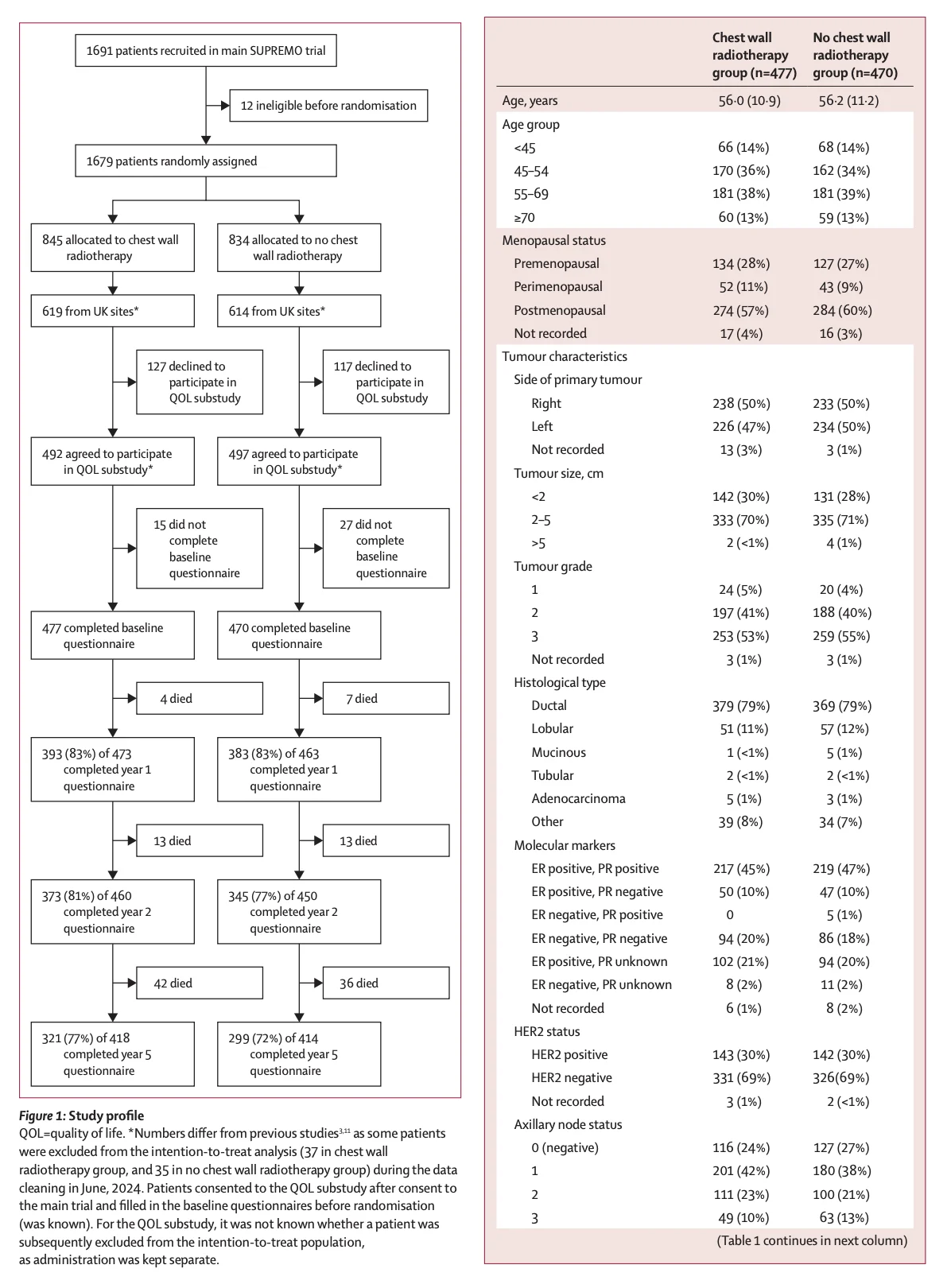
Between August 2006 and April 2013, the study recruited 1,691 patients internationally, of whom 1,679 were randomly assigned:
- 845 to chest wall radiotherapy
- 834 to no chest wall radiotherapy
The quality-of-life substudy was conducted among UK participants. Of 1,233 eligible UK patients, 989 consented, and 947 completed baseline questionnaires.
At five years, 620 patients returned the expected questionnaires, representing 75% of patients who remained eligible at that time point.
How Was Chest Wall Radiotherapy Delivered?
Patients assigned to radiotherapy received 40–50 Gy in 15–25 fractions.
Most participants in the UK quality-of-life substudy received a moderately hypofractionated schedule:
- 40 Gy in 15 fractions: 69%
- 50 Gy in 25 fractions: 11%
- 40 Gy in 20 fractions: 10%
- Other or unrecorded schedules: 10%
Axillary radiotherapy was prohibited. Selected UK centres could include the internal mammary or medial supraclavicular nodes in patients with pN1 disease.
No participants received the more recent 26 Gy in five fractions regimen, limiting direct application of the findings to contemporary ultra-hypofractionated treatment.
How Was Quality of Life Measured?
Patients completed validated questionnaires after surgery but before randomization, and again at 1, 2, 5, and 10 years.
The prespecified quality-of-life outcomes included:
- Global quality of life
- Physical functioning
- Fatigue
- Chest wall symptoms
- Arm and shoulder symptoms
- Body image
- Anxiety
- Depression
Additional analyses evaluated pain, social functioning, sexual functioning, role functioning, and nausea or vomiting.
Because the baseline questionnaires were completed shortly after mastectomy and axillary surgery, patients already reported impaired quality of life, fatigue, insomnia, pain, and chest wall or arm symptoms before radiotherapy began.
Most quality-of-life scores subsequently improved in both treatment groups.
Did Radiotherapy Worsen Chest Wall Symptoms?
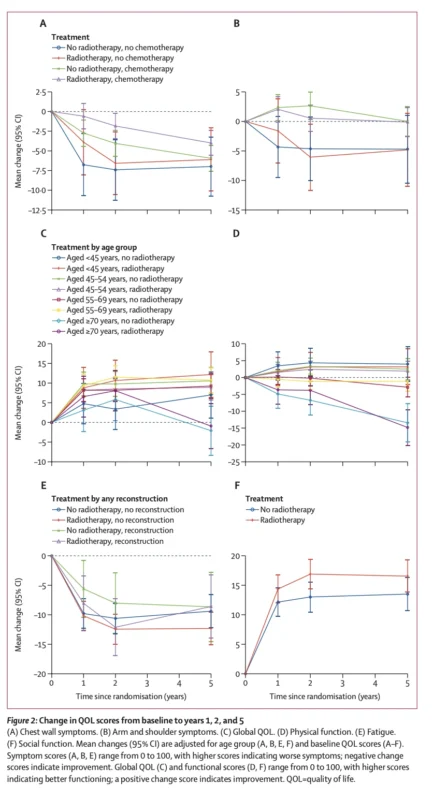
Chest wall symptoms were the principal quality-of-life domain affected by radiotherapy.
Patients receiving chest wall radiotherapy reported statistically worse symptoms than those receiving no radiotherapy, with an effect estimate of 1.99 points:
Effect estimate: 1.99; 95% CI, 0.36–3.62; p=0.017
Symptoms included pain, swelling, sensitivity, and skin-related problems in the treated chest wall area.
At five years, the mean chest wall symptom score was:
- 12.0 with chest wall radiotherapy
- 9.9 without chest wall radiotherapy
Higher symptom scores indicated worse symptoms.
Although the difference was statistically significant, the investigators described the absolute effect as modest.
Did Chest Wall Symptoms Improve Over Time?
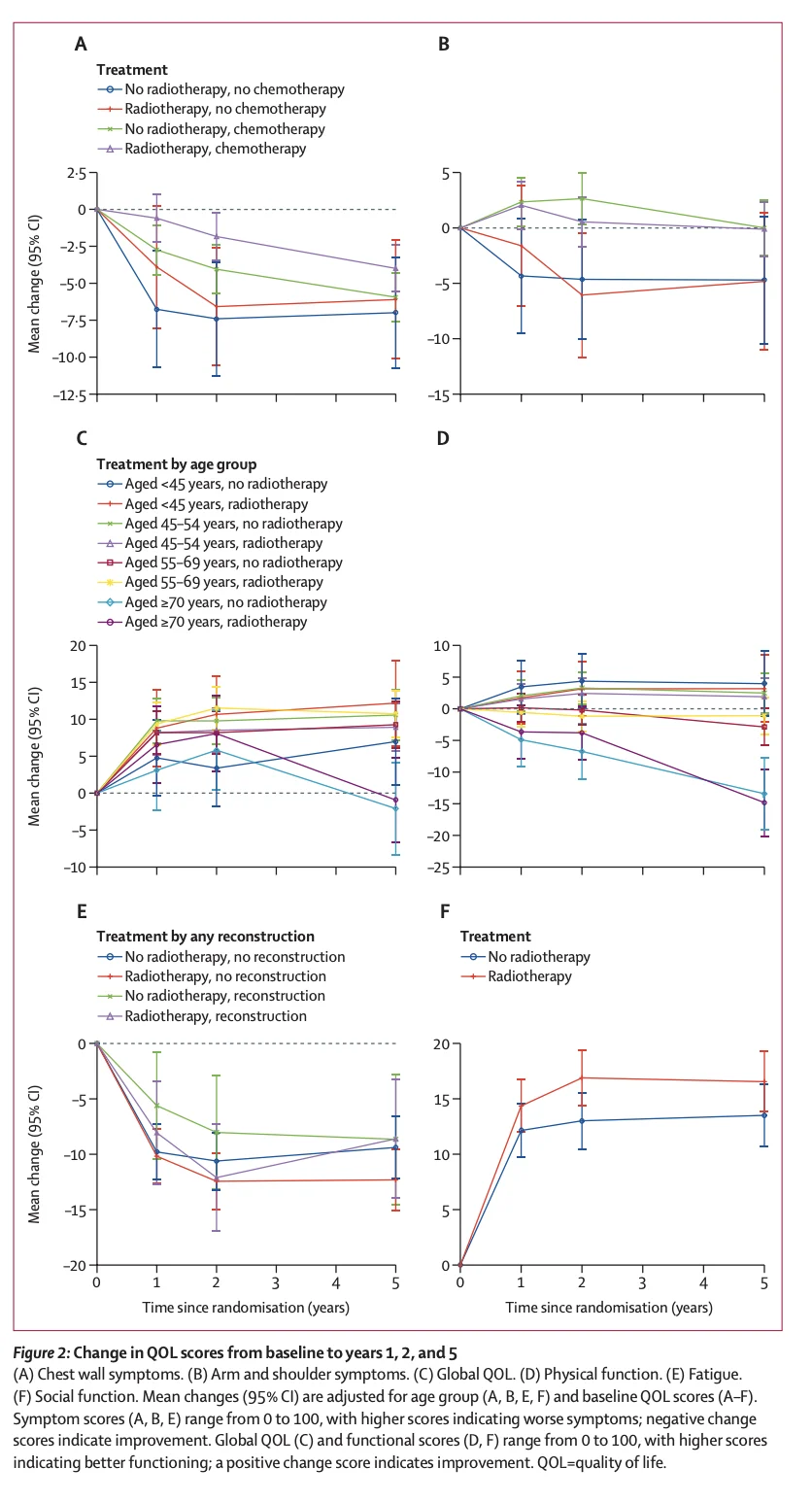
Local symptoms improved progressively after treatment.
Compared with year 1, chest wall symptom scores were better at year 2 and improved further by year 5. This pattern was observed in both treatment groups, although scores remained slightly worse among patients who had received radiotherapy.
A responder analysis examined the proportion of individual patients who experienced clinically meaningful worsening:
At year 1
- Radiotherapy: 16%
- No radiotherapy: 11%
At year 2
- Radiotherapy: 15%
- No radiotherapy: 11%
At year 5
- Radiotherapy: 13%
- No radiotherapy: 9%
The narrowing of the absolute difference over time supports the conclusion that most radiotherapy-related chest wall symptoms were limited and improved during follow-up.
Was Overall Quality of Life Affected?
Chest wall radiotherapy did not significantly affect global quality of life.
Both groups reported substantial improvement from their postsurgical baseline during the first year. Scores improved modestly between years 1 and 2 and remained generally stable through year 5.
The estimated effect of chest wall radiotherapy on global quality of life was:
- 1.15 points; 95% CI, −1.05 to 3.34; p=0.31
The confidence interval crossed zero, indicating no statistically significant difference between the treatment groups.
This finding is important because the increase in local chest wall symptoms did not translate into a measurable deterioration in patients’ overall perception of health and quality of life.
Were Physical Function and Fatigue Different?
No significant treatment-related difference was observed in physical functioning.
The effect estimate for radiotherapy was:
- −0.40; 95% CI, −2.33 to 1.52; p=0.68
Physical-function scores were more strongly associated with age. Younger patients generally maintained better function, while patients aged 70 years or older showed a gradual decline, which the investigators attributed partly to general ageing.
Fatigue was also unaffected by radiotherapy.
Patients had relatively high fatigue scores at baseline, likely reflecting recent surgery. Fatigue improved during the first two years and remained stable through year 5 in both groups.
The radiotherapy effect estimate was:
- 1.17; 95% CI, −1.02 to 3.36; p=0.29
What Happened to Arm and Shoulder Symptoms?
Chest wall radiotherapy did not significantly worsen arm and shoulder symptoms.
The estimated treatment effect was:
- −0.66; 95% CI, −3.01 to 1.69; p=0.58
Symptoms improved over time in both groups and returned to baseline levels or below by year 5.
Chemotherapy, rather than radiotherapy, was associated with less improvement in arm and shoulder symptoms. However, the study did not identify an interaction between chemotherapy and chest wall radiotherapy.
Did Radiotherapy Affect Body Image or Mental Health?
Body image improved over time and did not differ significantly according to radiotherapy allocation.
The treatment effect estimate was:
- 0.05; 95% CI, −0.62 to 0.73; p=0.87
No significant differences were found in anxiety or depression.
Younger patients reported higher baseline anxiety and depression scores than older patients. Anxiety and depression generally improved after the first year, although anxiety worsened over time in the subgroup younger than 45 years.
The study also found no significant treatment effect on pain, role functioning, or nausea and vomiting.
What Was Observed for Social Functioning?
Patients assigned to radiotherapy reported a small statistical improvement in social functioning compared with patients receiving no radiotherapy:
- Effect estimate: 2.89; 95% CI, 0.11–5.67; p=0.042
However, the investigators reported that the reason for this difference was unclear.
Because multiple quality-of-life outcomes and subgroup comparisons were analyzed, isolated nominally significant findings require cautious interpretation. The study did not present the social-function result as evidence of a specific benefit from radiotherapy.
Did Chemotherapy Affect Recovery?
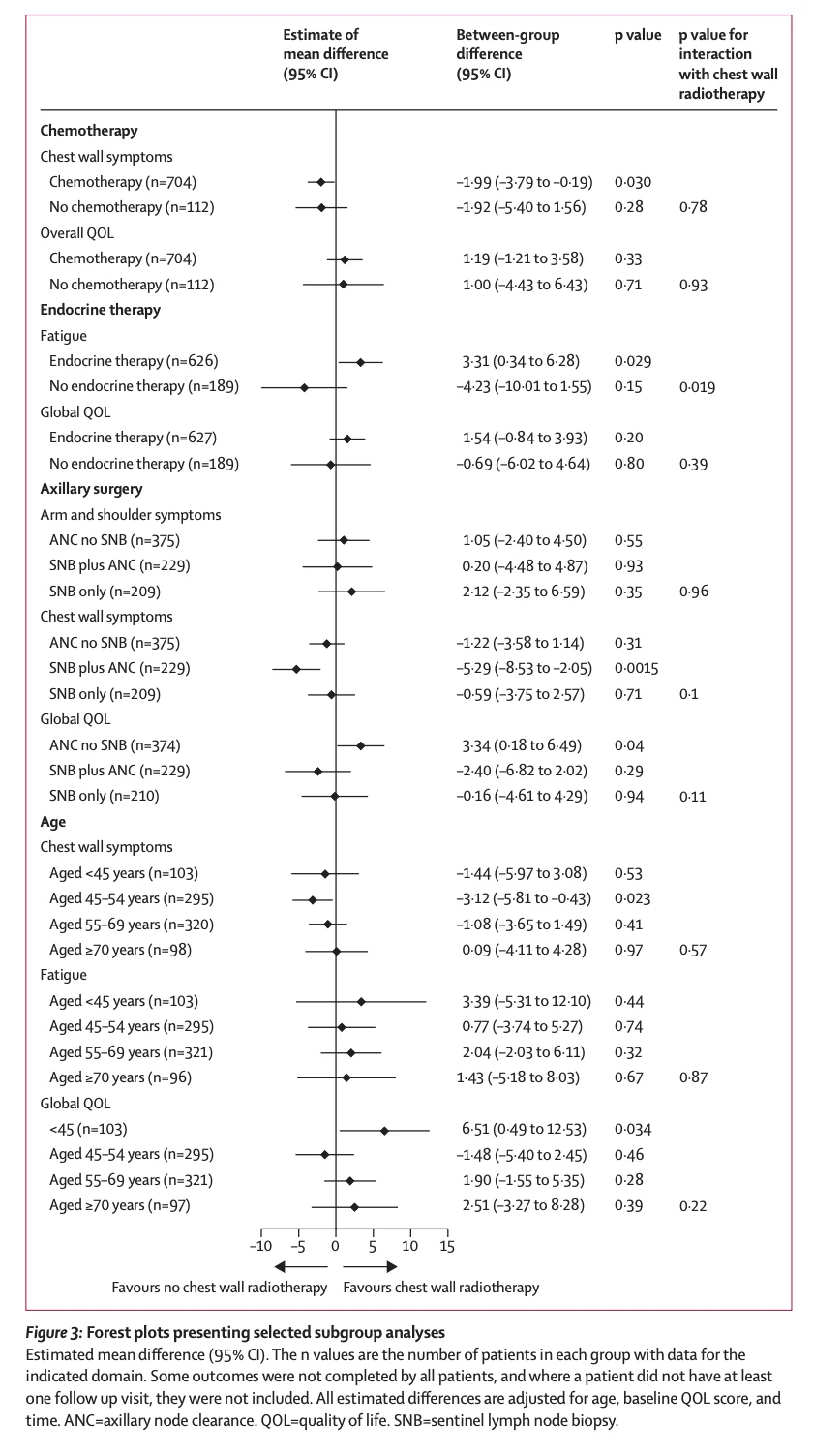
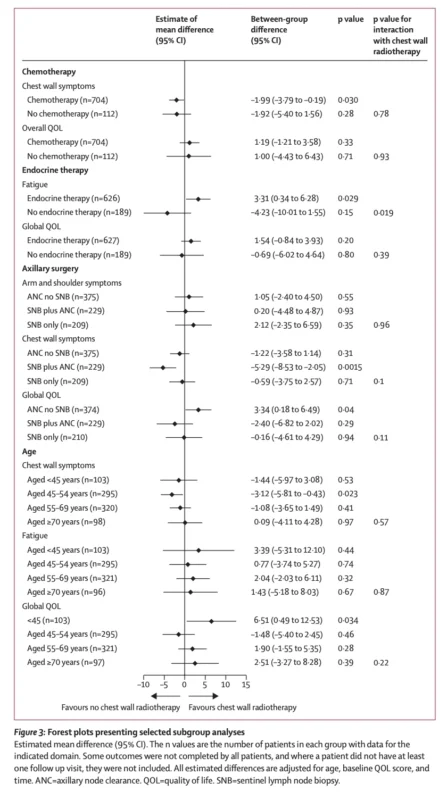
Chemotherapy was associated with less improvement in chest wall symptoms:
- Effect estimate: 2.97; 95% CI, 0.24–5.71; p=0.033
It was also associated with less improvement in arm and shoulder symptoms.
However, no interaction was identified between chemotherapy and chest wall radiotherapy. This means the study did not show that radiotherapy was disproportionately harmful specifically among patients receiving chemotherapy.
Most participants received chemotherapy, while only 142 did not, creating an imbalance that limits interpretation of this comparison.
Why Did Axillary Surgery Matter?
The strongest subgroup signal involved patients who underwent two axillary procedures: sentinel lymph node biopsy followed by axillary lymph node clearance.
In this subgroup, chest wall radiotherapy was associated with significantly worse chest wall symptoms compared with no radiotherapy:
- Model difference: −5.29; 95% CI, −8.53 to −2.05; p=0.0015
No similar increase was identified among patients who underwent only sentinel lymph node surgery or direct axillary clearance without a prior sentinel procedure.
The authors suggested that two-stage axillary surgery might produce greater nerve and tissue injury before radiotherapy begins.
Contemporary axillary management increasingly avoids completion axillary clearance in patients with limited nodal disease. Therefore, the magnitude of this subgroup effect might be lower among patients treated with current less invasive surgical approaches.
Did Breast Reconstruction Change the Results?
Reconstructive surgery was performed in 192 patients, representing 20% of the quality-of-life population.
No significant interaction was found between reconstruction and radiotherapy for the principal quality-of-life outcomes.
Chest wall symptoms were somewhat worse among patients who underwent immediate reconstruction followed by radiotherapy, but subgroup numbers were small and did not support definitive conclusions.
The investigators emphasized that the absence of a major quality-of-life difference does not mean radiotherapy has no effect on reconstruction-related complications. The substudy evaluated patient-reported quality of life rather than rates of infection, capsular contracture, implant exposure, flap necrosis, or reconstruction failure.
How Relevant Are the Results to Current Practice?
Almost 70% of irradiated participants received 40 Gy in 15 fractions, a schedule that remains widely used. The results are therefore relevant to contemporary moderate hypofractionation.
However, treatment approaches have continued to evolve since SUPREMO began enrollment in 2006.
More recent practice includes:
- Less extensive axillary surgery
- Improved radiotherapy planning
- Greater use of immediate reconstruction
- Contemporary systemic treatments
- Five-fraction radiotherapy schedules
The study did not include patients treated with 26 Gy in five fractions and cannot directly define long-term quality-of-life outcomes with that regimen.
Nevertheless, the randomized comparison with a no-radiotherapy group provides evidence unavailable from trials in which every participant received some form of radiotherapy.
What Are the Main Limitations?
The quality-of-life substudy was conducted only in the UK, although the main SUPREMO trial enrolled patients internationally.
Baseline questionnaires were completed after mastectomy and axillary surgery. Consequently, the baseline scores already reflected postsurgical symptoms, and improvement over time occurred in both groups regardless of radiotherapy.
The analysis included multiple outcomes and subgroup comparisons, increasing the possibility that some statistically significant findings occurred by chance.
Approximately 65% of all randomized quality-of-life participants contributed data at year 5. The completion rate among patients still eligible remained high, but attrition reduced the available sample.
The questionnaires were selected more than two decades ago and might not fully capture every issue relevant to current breast cancer care.
The study also did not collect patient-reported acute toxicity before the first follow-up at one year.
What Do the Findings Mean for Shared Decision-Making?
The results do not establish whether an individual patient should or should not receive postmastectomy radiotherapy.
That decision depends on recurrence risk, nodal involvement, tumour biology, systemic therapy, surgical treatment, age, comorbidities, and patient preferences.
However, the study provides important information about the expected long-term patient experience.
For women with intermediate-risk breast cancer, chest wall radiotherapy was associated with a modest increase in local symptoms, but no significant deterioration in overall quality of life, physical functioning, fatigue, pain, body image, arm symptoms, anxiety, or depression.
When considered alongside the main SUPREMO survival results, these quality-of-life data can support more informed discussions about the potential benefits and burdens of treatment.
The Bottom Line
The five-year quality-of-life analysis from the randomized phase 3 SUPREMO trial found that postmastectomy chest wall radiotherapy modestly increased local chest wall symptoms in patients with intermediate-risk breast cancer.
The symptoms improved between years 1, 2, and 5. At five years, clinically meaningful worsening was reported by 13% of patients receiving radiotherapy and 9% receiving no radiotherapy.
No statistically significant differences were identified in global quality of life, physical functioning, fatigue, pain, arm and shoulder symptoms, body image, anxiety, or depression.
Patients who underwent sentinel lymph node biopsy followed by axillary clearance appeared to experience greater local morbidity when radiotherapy was added.
Together with the previously reported absence of a 10-year overall survival benefit, the findings provide evidence for individualized decision-making about postmastectomy radiotherapy in intermediate-risk breast cancer.
References
- Velikova G, Russell NS, Williams LJ, Pollock R, Dixon JM, Loncaster J, Hatton M, Clarke J, Kunkler IH, on behalf of the MRC SUPREMO Trial UK Investigators. Postmastectomy chest wall radiotherapy for breast cancer (SUPREMO): 5-year quality-of-life results from a randomised, controlled, phase 3 trial. Lancet Oncology. 2026;27:959–972.
- Kunkler IH, Russell NS, Anderson N, et al. Ten-year survival after postmastectomy chest-wall irradiation in breast cancer. New England Journal of Medicine. 2025;393:1771–1783.