
A new study published in npj Precision Oncology suggests that serial circulating tumor DNA measurements, analyzed through joint modeling, may help generate patient-specific predictions of outcome in metastatic breast cancer.
The study evaluated patients with hormone receptor-positive, HER2-negative metastatic breast cancer receiving endocrine therapy plus a CDK4/6 inhibitor. Investigators used serial liquid biopsies to track methylation-based tumor fraction over time and linked these longitudinal changes with clinical outcomes, highlighting the potential role of Serial ctDNA Kinetics in metastatic breast cancer monitoring.
Unlike static biomarker approaches, which often rely on one baseline value or a limited change between two timepoints, this study focused on how ctDNA evolves continuously during treatment. This makes Serial ctDNA Kinetics a dynamic tool for understanding molecular response over time.
The key finding was that the most recent tumor fraction estimate was strongly associated with both overall survival and time to treatment discontinuation. Higher tumor fraction was linked with worse prognosis, while declining tumor fraction was associated with more favorable predicted outcomes.
Why This Study Matters
Monitoring metastatic breast cancer remains challenging.
In routine practice, disease assessment usually depends on imaging, clinical symptoms, and sometimes serum tumor markers such as CEA or CA15-3. These tools are useful, but they have limitations. Imaging is performed at intervals, serum markers may lack sensitivity, and clinical progression can sometimes become clear only after meaningful tumor evolution has already occurred.
Liquid biopsy offers another layer of information.
Circulating tumor DNA can reflect tumor burden and treatment response in real time. However, the clinical challenge is not only measuring ctDNA. It is understanding how repeated ctDNA values should be interpreted for an individual patient over time.
This is where joint modeling becomes important.
Joint modeling combines two types of information: longitudinal biomarker data and time-to-event outcomes. In this study, that meant linking serial tumor fraction trajectories with overall survival and time to treatment discontinuation.
Study Design
The study included patients with HR-positive, HER2-negative metastatic breast cancer receiving endocrine therapy plus a CDK4/6 inhibitor at Princess Margaret Cancer Centre.
Patients were enrolled through the Liquid Biopsy Evaluation and Repository Development at Princess Margaret program, known as LIBERATE.
Serial blood samples were collected at baseline and during follow-up visits aligned with routine clinical care and restaging assessments. Plasma samples were analyzed using the Guardant Reveal assay.
The analysis focused on a complete case cohort of 49 patients who had a baseline sample and at least two additional longitudinal tumor fraction measurements. In total, 279 tumor fraction measurements were included.
Overall survival was defined from diagnosis of stage IV breast cancer to death or last follow-up. Time to treatment discontinuation was defined from the start of endocrine therapy plus CDK4/6 inhibition to discontinuation due to progressive disease.
Treatment discontinuation and survival outcomes were updated through September 23, 2024.
What Was Measured?
The study used a methylation-based tumor fraction derived from ctDNA.
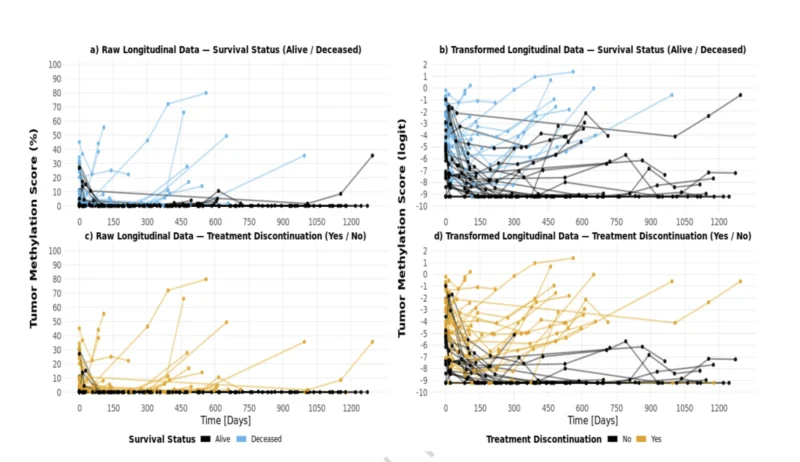
Tumor fraction represents the proportion of circulating DNA signal that is tumor-derived. Because tumor fraction values were highly skewed, investigators transformed the values onto a logit scale, referred to as transformed tumor fraction.
This transformation helped the model better capture changes over time.
The authors then used joint modeling to connect serial tumor fraction trajectories with clinical outcomes. The model incorporated both biomarker evolution and baseline patient characteristics, including age, CDK4/6 inhibitor type, histology, line of therapy, and prior adjuvant treatment.
The Most Recent Tumor Fraction Was Strongly Prognostic
The most recent transformed tumor fraction estimate was strongly associated with both overall survival and time to treatment discontinuation.
For overall survival, each one-unit increase in the most recent transformed tumor fraction was associated with a higher risk of death. The reported hazard ratio was approximately 1.69.
For time to treatment discontinuation, each one-unit increase in the most recent transformed tumor fraction was also associated with higher risk of discontinuation due to progression. The reported hazard ratio was approximately 2.06.
Both associations were highly statistically significant.
In practical terms, this means that a patient’s current ctDNA tumor fraction may carry important information about near- and longer-term clinical risk.
Dynamic Prediction: A Patient-Level Approach
One of the most important parts of the study was the use of dynamic patient-level predictions.
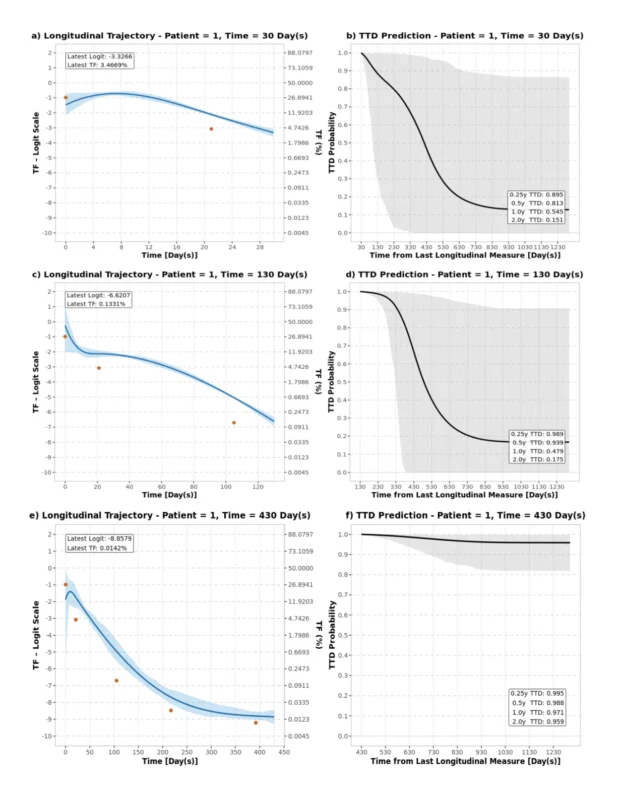
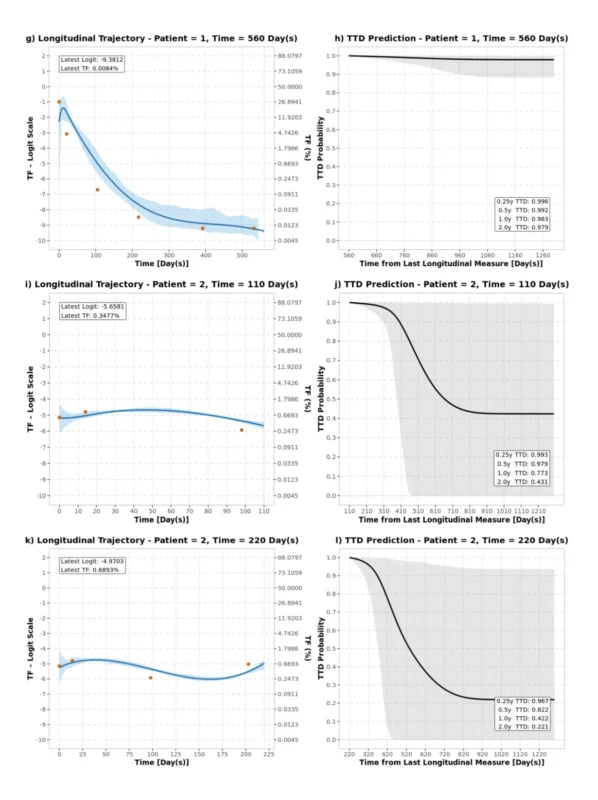
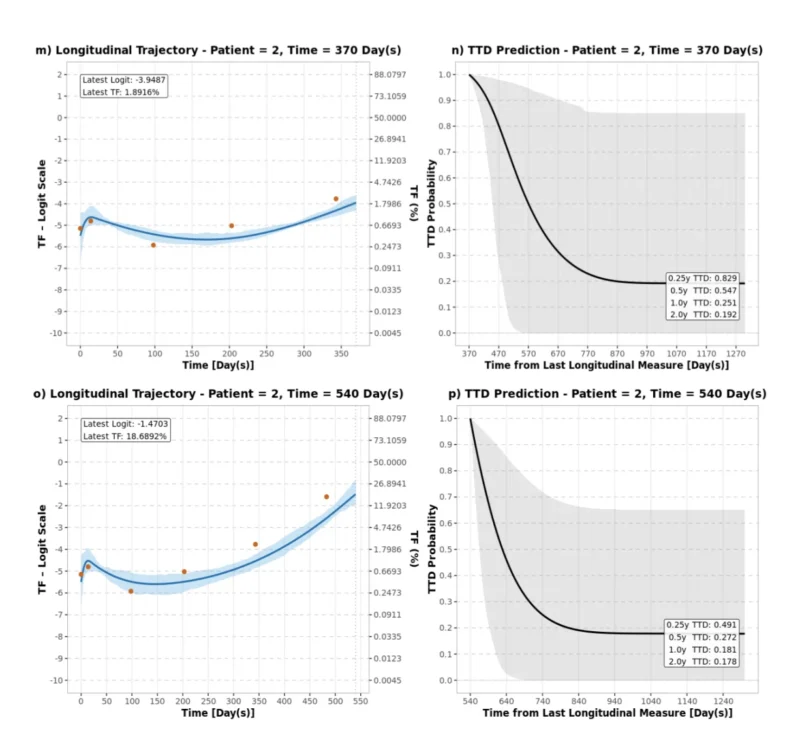
The model did not simply classify patients once at baseline. Instead, it updated survival and treatment-discontinuation probabilities as new ctDNA measurements became available.
For example, if a patient’s tumor fraction declined over time, the model could update the predicted probability of remaining on treatment or surviving over future time horizons. If tumor fraction rose, the model could reflect a higher estimated risk.
This makes the approach more clinically relevant than a one-time biomarker assessment.
The study used prediction horizons of 0.25, 0.5, 1, and 2 years. These timeframes were selected because they are clinically interpretable and may help clinicians think about surveillance, prognosis, and treatment strategy.
What the Figures Show
The study’s visual data support the central message.
The spaghetti plots showed substantial variation in tumor fraction trajectories across patients. Raw tumor fraction values were highly skewed, but logit transformation made the patterns clearer.
The dynamic prediction figures illustrated how individual patient forecasts changed as more ctDNA measurements were added. For some patients, decreasing tumor fraction was associated with improved projected outcomes. For others, rising tumor fraction was associated with worsening predicted survival or shorter time to treatment discontinuation.
The Brier score heatmaps showed that the joint models had acceptable predictive accuracy across many clinically relevant prediction windows, with strongest performance for shorter and intermediate prediction horizons.
Clinical Meaning
This study does not suggest that clinicians should change treatment based on ctDNA tumor fraction alone.
Instead, it proposes a framework for integrating serial ctDNA kinetics with clinical and radiologic assessment.
That distinction is important.
A single ctDNA result may be informative, but serial trends may be more powerful. A declining tumor fraction could provide reassurance in a patient with stable or equivocal imaging. A rising tumor fraction could support closer monitoring, earlier imaging, or discussion of treatment adaptation if supported by future prospective evidence.
The authors emphasize that joint modeling may help contextualize molecular changes over time, rather than replacing standard clinical judgment.
Why Joint Modeling Is Different
Traditional prognostic models often depend on baseline measurements. Some time-dependent models include changing biomarkers, but they may not fully account for the relationship between the biomarker process and the clinical event.
Joint modeling is designed to handle this problem.
It models the biomarker trajectory and the clinical outcome together. This is especially useful when the biomarker is not independent of disease progression, as is the case with ctDNA.
In metastatic breast cancer, tumor fraction can change because of treatment response, resistance, progression, or tumor biology. Joint modeling attempts to capture this evolving relationship.
Potential Future Role
If validated prospectively, this approach could help support more individualized monitoring in metastatic breast cancer.
Patients with sustained molecular response might be candidates for less intensive surveillance. Patients with unfavorable ctDNA trajectories might require closer follow-up, earlier imaging, or consideration of treatment intensification strategies.
The approach may also be incorporated into future liquid biopsy reports as visual trajectory summaries or time-updated risk estimates.
This could make advanced statistical modeling more accessible to clinicians without requiring them to interpret the underlying mathematics.
Limitations
The study has important limitations.
The cohort was small, including 49 patients in the complete case analysis. All patients came from a single academic cancer center. The study focused only on HR-positive, HER2-negative metastatic breast cancer treated with endocrine therapy plus CDK4/6 inhibition.
Patients also needed at least three ctDNA measurements to be included. This may have excluded patients with very rapid progression or early loss to follow-up, potentially selecting for patients with more indolent disease.
The model was internally validated, but external validation in larger and more diverse cohorts is needed.
The authors also note that ctDNA tumor fraction should not be used in isolation to make treatment decisions. Prospective studies are required before joint model-derived predictions can be used in routine clinical practice.
Key Takeaway
This study provides a framework for using serial ctDNA tumor fraction to generate dynamic, patient-specific risk predictions in metastatic breast cancer.
In patients with HR-positive, HER2-negative metastatic breast cancer receiving endocrine therapy plus a CDK4/6 inhibitor, higher recent tumor fraction was strongly associated with worse overall survival and shorter time to treatment discontinuation.
The findings support the potential of longitudinal ctDNA monitoring, combined with joint modeling, to move metastatic breast cancer assessment beyond static biomarkers toward time-updated, individualized prediction.
Prospective validation will be essential before this approach can guide treatment decisions in clinical practice.