
The development of oral selective estrogen receptor degraders has raised the possibility of replacing aromatase inhibitors earlier in hormone receptor–positive, HER2-negative advanced breast cancer. The biological rationale is compelling: estrogen receptor signaling remains central to the disease, while acquired ESR1 alterations can gradually undermine aromatase inhibitor–based therapy. Yet the phase III SERENA-4 trial provides an important reminder that a mechanistically attractive endocrine strategy does not automatically improve outcomes when introduced universally from the beginning of metastatic treatment.
On September 11, 2026, AstraZeneca announced that camizestrant (Etcamah) plus palbociclib did not produce a statistically significant improvement in progression-free survival compared with anastrozole plus palbociclib in previously untreated ER-positive, HER2-negative advanced breast cancer. A numerical PFS improvement was observed, but the trial failed to meet its primary endpoint. Detailed efficacy results have not yet been disclosed.
The result is particularly important because it contrasts with the positive SERENA-6 strategy, in which camizestrant is introduced selectively when an emergent ESR1 mutation is detected during first-line endocrine-based treatment before radiographic progression. Taken together, SERENA-4 and SERENA-6 may help define a more nuanced role for next-generation endocrine therapy: not necessarily replacing aromatase inhibitors upfront for every patient, but intervening when molecular evolution identifies a population more likely to benefit.
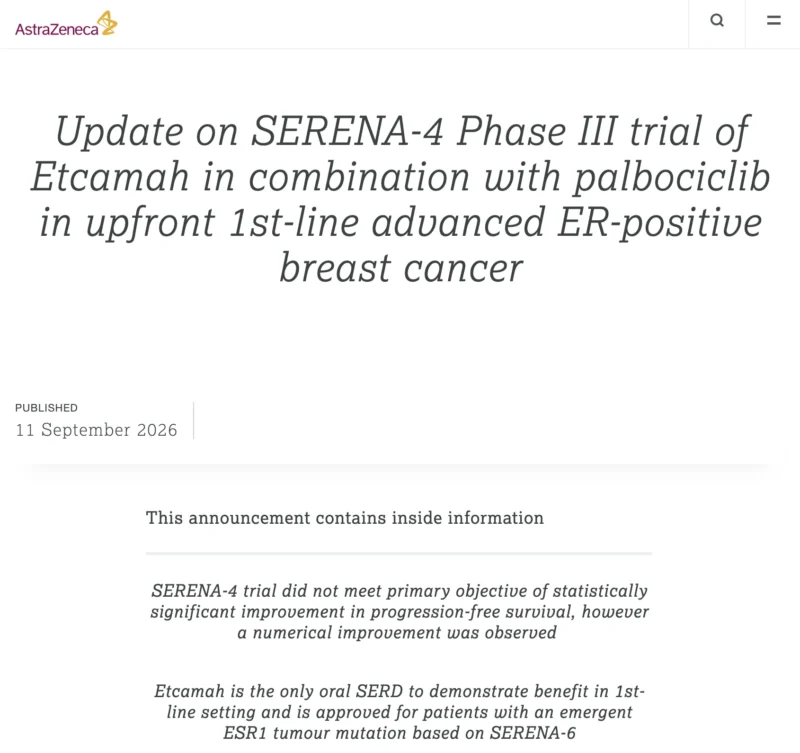
SERENA-4 Tested Upfront Replacement of the Aromatase Inhibitor
SERENA-4 was a global, double-blind, randomized phase III trial comparing camizestrant plus palbociclib with anastrozole plus palbociclib as initial systemic treatment for ER-positive, HER2-negative locally advanced or metastatic breast cancer.
The study enrolled 1,371 patients with newly diagnosed de novo stage IV disease or recurrent advanced disease who had not previously received systemic treatment for metastatic breast cancer. Patients relapsing after early-stage disease were required to have received at least 24 months of standard adjuvant endocrine therapy, with at least 12 months since the last dose of adjuvant aromatase inhibitor therapy without progression on treatment.
The primary endpoint was investigator-assessed PFS. Secondary endpoints included overall survival, PFS2, and health-related quality of life.
This was therefore a direct test of an important clinical hypothesis: could a next-generation oral SERD replace an aromatase inhibitor from day one when both were combined with the same CDK4/6 inhibitor?
The topline answer is no, not on the primary endpoint.
A Numerical PFS Improvement Was Not Enough
AstraZeneca reported that SERENA-4 demonstrated a numerical improvement in PFS with camizestrant plus palbociclib, but the difference did not reach statistical significance.
Without the hazard ratio, median PFS values, confidence intervals, subgroup analyses, or maturity of follow-up, the magnitude of that numerical difference cannot yet be judged.
This distinction matters. A negative primary endpoint does not necessarily mean that the experimental strategy had no biological activity. It means that the prespecified statistical threshold required to establish superiority was not met.
Whether there are clinically informative subgroups, potentially including patients with baseline ESR1 alterations, specific prior endocrine exposure, visceral disease, or other biological characteristics, will only become clear when the full dataset is presented.
For now, the most defensible interpretation is straightforward: camizestrant plus palbociclib has not demonstrated superiority over anastrozole plus palbociclib as universal upfront first-line therapy in the SERENA-4 population.
The Result Makes SERENA-6 More Clinically Interesting, Not Less
SERENA-4 becomes particularly informative when considered alongside SERENA-6.
SERENA-6 used a fundamentally different treatment strategy. Rather than replacing the aromatase inhibitor for every patient at treatment initiation, it used circulating tumor DNA monitoring to identify patients who developed an ESR1 mutation during first-line aromatase inhibitor plus CDK4/6 inhibitor therapy before radiographic progression.
At that molecular point, endocrine therapy was switched to camizestrant while the CDK4/6 inhibitor was continued. Camizestrant combined with a CDK4/6 inhibitor is now approved in multiple regions for HR-positive/HER2-negative advanced breast cancer when an ESR1 mutation emerges during first-line endocrine-based treatment, based on SERENA-6.
The contrast between these studies is biologically important.
SERENA-4 asks:
- Should everyone receive the newer SERD from the beginning?
SERENA-6 asks:
- Should treatment change when tumor evolution provides molecular evidence that the current endocrine partner is beginning to fail?
The negative SERENA-4 result and positive SERENA-6 strategy together may suggest that the value of camizestrant depends not simply on using a more potent estrogen receptor therapy, but on using it in the right biological context.
ESR1 May Be More Valuable as a Dynamic Biomarker Than as a Background Concept
ESR1 mutations are among the best-characterized mechanisms of acquired endocrine resistance in metastatic ER-positive breast cancer. They frequently emerge under aromatase inhibitor selective pressure and can support estrogen-independent activation of the receptor.
This biology provides the rationale for monitoring ESR1 evolution during treatment rather than relying exclusively on baseline testing.
AstraZeneca explicitly emphasized the importance of ESR1 testing following the SERENA-4 result, pointing to the established SERENA-6 strategy. That distinction reflects a broader shift in breast oncology. Traditionally, biomarkers have been measured before treatment and used to select a therapy. Increasingly, liquid biopsy makes it possible to ask a different question: when should therapy change because the tumor has molecularly evolved, even if imaging still shows disease control?
Camizestrant may therefore ultimately be more relevant to an adaptive treatment model than to universal endocrine replacement.
The Negative Trial Also Reinforces the Strength of First-Line AI–CDK4/6 Therapy
The SERENA-4 result should also be interpreted in the context of the effectiveness of the control strategy. Aromatase inhibitor plus CDK4/6 inhibition remains an effective first-line endocrine backbone for many patients with HR-positive/HER2-negative metastatic breast cancer. Demonstrating superiority over this approach requires more than proving that a new endocrine agent is pharmacologically active.
For patients whose tumors remain endocrine-sensitive and have not developed ESR1-mediated resistance, immediately replacing an aromatase inhibitor with a more potent estrogen receptor degrader may not generate enough incremental benefit to produce statistically superior PFS.
This is an increasingly important principle in modern breast cancer development. Moving an active drug earlier is not always advantageous simply because it performs well after resistance develops. Sometimes the most effective sequencing strategy is to preserve a successful treatment until tumor biology provides a reason to change it.
Safety Did Not Appear to Explain the Negative Result
The reported safety profile of camizestrant plus palbociclib was consistent with the established profiles of the individual medicines, and AstraZeneca reported no new safety concerns. This makes the topline result primarily an efficacy question rather than one of excessive treatment-related toxicity preventing effective drug delivery.
Detailed safety data remain necessary, particularly rates of treatment discontinuation, dose reduction, hematologic toxicity attributable to palbociclib, and adverse events associated with camizestrant. However, there is currently no indication from the company announcement that unexpected toxicity drove the failure to meet the PFS endpoint.
One Important Question Is the Choice of CDK4/6 Inhibitor
SERENA-4 combined both endocrine therapies with palbociclib. That design ensures a clean randomized comparison of camizestrant versus anastrozole within the trial, because the CDK4/6 partner is identical in both arms. However, the wider clinical context should be considered when interpreting eventual practice relevance.
The CDK4/6 inhibitor landscape has evolved substantially, and survival data, toxicity profiles, treatment settings, and regulatory positioning differ among palbociclib, ribociclib, and abemaciclib. SERENA-4 should therefore answer the question it was designed to answer: whether camizestrant improves outcomes over anastrozole when both are given with palbociclib.
The negative result should not automatically be extrapolated to every possible first-line camizestrant combination. Conversely, there is currently no evidence from SERENA-4 supporting the assumption that pairing camizestrant with another CDK4/6 inhibitor would necessarily reverse the outcome.
That requires prospective evidence.
Camizestrant Development Is Far From Over
SERENA-4 is one component of a much broader camizestrant program.
AstraZeneca reports that approximately 10,000 patients are being evaluated across the phase III CAMBRIA-1 and CAMBRIA-2 trials in early breast cancer. These studies are exploring camizestrant in intermediate- and high-risk HR-positive/HER2-negative disease, including monotherapy, combination with CDK4/6 inhibitors, and treatment following CDK4/6 inhibition.
A negative metastatic first-line study therefore does not predict the outcome of the adjuvant program.
The biological question is different. Early breast cancer involves eradication of micrometastatic residual disease rather than control of established metastatic clones that have already accumulated extensive therapeutic and evolutionary complexity.
The ultimate role of camizestrant may therefore span several distinct settings: molecularly triggered switching in advanced disease, selected later-line endocrine treatment, and potentially adjuvant therapy if ongoing studies are positive.
What SERENA-4 Teaches About the Oral SERD Class
The result also has implications beyond a single molecule.
The enthusiasm surrounding oral SERDs has sometimes encouraged the assumption that more complete estrogen receptor antagonism should automatically translate into superior outcomes compared with traditional endocrine therapies.
SERENA-4 shows why that assumption must be tested rather than accepted.
The clinical value of an oral SERD depends on at least three variables: which patients receive it, when it is introduced, and what resistance biology is present at that time.
A therapy may offer substantial benefit after a specific resistance mechanism emerges without necessarily improving outcomes when used indiscriminately before that mechanism exists.
That is not a contradiction. It is precisely what biomarker-guided precision oncology should reveal.
From Universal Escalation to Molecularly Timed Switching
Perhaps the most interesting interpretation of SERENA-4 is what it says about therapeutic timing. The trial tested an upfront escalation or replacement strategy: begin with camizestrant rather than an aromatase inhibitor in all eligible patients. SERENA-6 represents an adaptive strategy: begin with conventional endocrine therapy and change it when ctDNA demonstrates emerging resistance.
The latter strategy may ultimately prove more efficient because it preserves a highly effective first-line regimen for patients who continue to benefit while identifying those in whom the tumor is beginning to escape endocrine control. This concept has implications well beyond ESR1.
As ctDNA monitoring becomes more sophisticated, breast cancer treatment may increasingly move from fixed line-based sequencing toward molecularly triggered treatment adaptation.
Instead of waiting for CT scans to document progression, clinicians may intervene at the point when resistance becomes detectable biologically. SERENA-4 does not weaken that paradigm. In many ways, it strengthens the argument that better timing may matter as much as a better drug.
Important Caveats Before Drawing Broader Conclusions
The current information comes from a company topline announcement rather than a full peer-reviewed publication or medical-meeting presentation. No numerical median PFS values, hazard ratio, confidence interval, OS data, PFS2 results, quality-of-life outcomes, or detailed subgroup analyses have yet been disclosed.
For that reason, several questions remain open. It is not yet possible to determine how close the trial came to statistical significance, whether specific subgroups derived greater benefit, whether baseline ESR1 status modified treatment effect, or whether longer follow-up could reveal differences in secondary outcomes. The announcement states that complete data will be shared in due course.
Until then, the topline conclusion should remain narrow and precise.
The Bottom Line
SERENA-4 did not meet its primary endpoint. In 1,371 previously untreated patients with ER-positive/HER2-negative advanced breast cancer, upfront camizestrant plus palbociclib did not significantly improve PFS over anastrozole plus palbociclib, although a numerical advantage was reported. No new safety concerns were identified.
The negative result does not challenge the established role of camizestrant in the very different SERENA-6 ctDNA-guided ESR1 mutation setting. Instead, the two trials together may clarify where oral SERD therapy has the greatest value.
The emerging message is not simply that camizestrant works or does not work in first line. It is more specific, using a next-generation endocrine therapy from the beginning for everyone may not be superior, while introducing it selectively when tumor evolution reveals ESR1-mediated resistance can be clinically meaningful. That distinction may prove more important than the outcome of either individual trial.
SERENA-4 therefore adds an important lesson to precision breast oncology: the future may not belong to universally stronger endocrine therapy, but to better-timed endocrine therapy guided by evolving tumor biology.
Reference
- AstraZeneca. Update on SERENA-4 Phase III trial of Etcamah in combination with palbociclib in upfront 1st-line advanced ER-positive breast cancer. Published September 11, 2026.