
The SENOMAC trial, presented by Jana de Boniface at the 2026 ASCO Annual Meeting, provides important randomized evidence supporting the omission of completion axillary lymph node dissection in selected patients with breast cancer and sentinel lymph node macrometastases.
The study addresses a key question in modern breast surgery: can patients with limited sentinel node involvement avoid the long-term morbidity of axillary lymph node dissection without compromising survival?
Why SENOMAC Matters
Axillary lymph node dissection has historically been used to improve regional control and guide adjuvant therapy in breast cancer. However, it is also associated with persistent arm-related morbidity, including swelling, impaired function, pain, and reduced quality of life.
Previous trials already suggested that some patients with limited sentinel lymph node involvement can safely avoid completion axillary dissection. SENOMAC adds important evidence because it included a larger population and allowed patients with larger tumors and patients undergoing mastectomy, making the results more applicable to routine practice.
How The Trial Was Designed
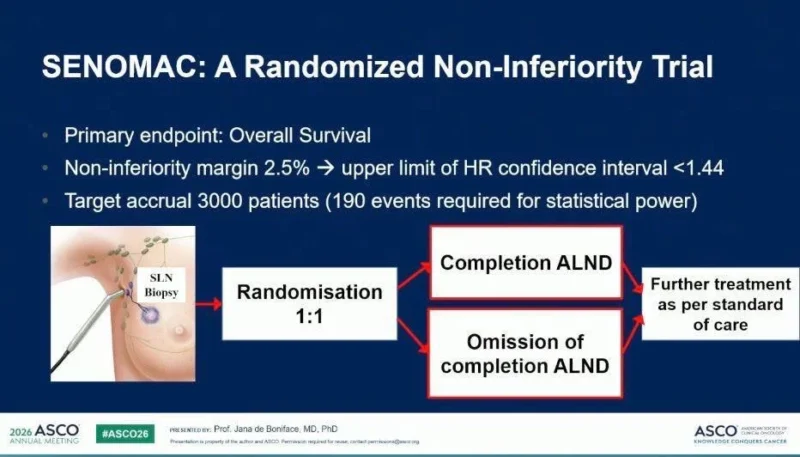
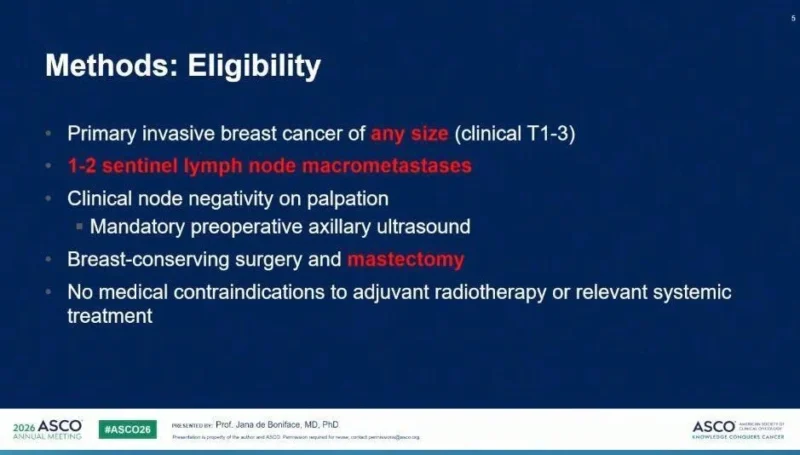
SENOMAC was an international randomized non-inferiority trial that enrolled adult patients with primary invasive, clinically node-negative T1–T3 breast cancer and up to two sentinel lymph node macrometastases.
Patients were randomized 1:1 to either completion axillary lymph node dissection or omission of completion dissection. Adjuvant treatment followed standard-of-care practice.
The primary endpoint was overall survival, with non-inferiority defined by an upper one-sided 90% confidence interval for the hazard ratio below 1.44, using axillary lymph node dissection as the reference group. Breast cancer-specific survival was a secondary endpoint. Patient-reported outcomes were assessed at 1, 3, and 5 years using Lymph-ICF, EORTC QLQ-C30, and BR23 questionnaires (de Boniface et al., 2026).
Survival Outcomes Were Maintained
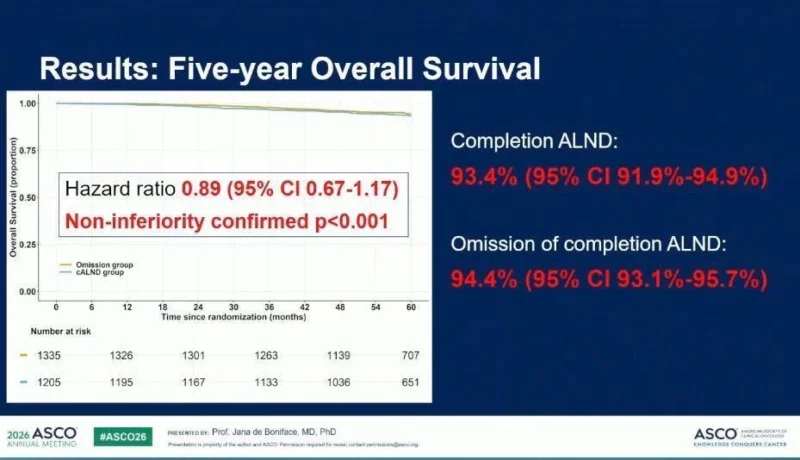
Between January 2015 and December 2021, 2,766 patients were randomized across five countries. The per-protocol population included 2,540 patients, with 1,205 assigned to axillary lymph node dissection and 1,335 assigned to omission.
After a median follow-up of 60.1 months, 196 patients had died, including 75 deaths due to breast cancer.
The 5-year overall survival rate was 93.4% in the axillary dissection group and 94.4% in the omission group. The country-adjusted hazard ratio was 0.84 with a 95% confidence interval of 0.64–1.12.
Five-year breast cancer-specific survival was also similar: 97.3% with axillary dissection and 97.8% with omission. The country-adjusted hazard ratio was 0.86, with a 95% confidence interval of 0.55–1.34.
Both endpoints remained below the prespecified non-inferiority margin, supporting the oncologic safety of omitting completion axillary lymph node dissection in this population (de Boniface et al., 2026).
Arm Morbidity Was Clearly Lower Without ALND
The patient-reported morbidity data are among the most clinically meaningful parts of SENOMAC.
Arm physical function, measured using the Lymph-ICF questionnaire, was significantly better in the omission group. The mean score difference favoring omission was 6.14 at 3 years and 5.71 at 5 years, both statistically significant and clinically relevant.
Similarly, arm symptoms measured by EORTC QLQ-BR23 were more pronounced in patients who underwent axillary lymph node dissection. At 3 years, mean arm symptom scores were 20.80 with axillary dissection versus 10.83 with omission. At 5 years, scores were 19.40 versus 9.31, again favoring omission.
Global health-related quality of life did not differ significantly between the two groups at 3 or 5 years, suggesting that the main patient-reported benefit was specifically related to reduced arm morbidity rather than a broad global quality-of-life difference.
Clinical Meaning
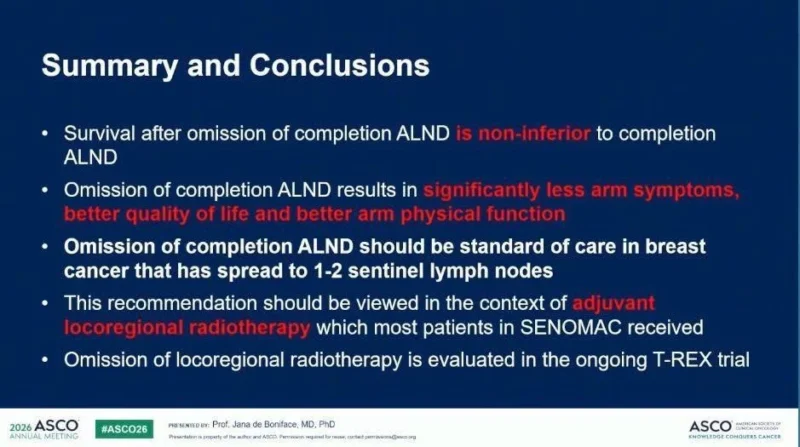
SENOMAC strengthens the evidence base for reducing axillary surgery in breast cancer. For patients with clinically node-negative T1–T3 disease and one or two sentinel lymph node macrometastases, omission of completion axillary lymph node dissection preserved overall survival and breast cancer-specific survival while reducing long-term arm morbidity.
This is important because survival is no longer the only endpoint that matters in early breast cancer care. As systemic therapy, radiotherapy, and imaging improve, the field continues to move toward treatment strategies that maintain oncologic safety while reducing long-term harm.
The trial supports a more selective approach to axillary management, especially for patients in whom completion dissection may add morbidity without clear survival benefit.
Key Takeaway
The randomized SENOMAC trial shows that omission of completion axillary lymph node dissection after sentinel lymph node macrometastases is oncologically safe in selected patients with breast cancer and significantly reduces patient-reported arm morbidity.
These results reinforce the shift toward less invasive breast cancer surgery when survival outcomes can be preserved.