
For patients with hormone receptor-positive, HER2-negative metastatic breast cancer, endocrine therapy combined with a CDK4/6 inhibitor has become a central first-line standard.
The question is no longer whether CDK4/6 inhibition matters. It is how durable the benefit remains after the first line of therapy, how long chemotherapy can be delayed, and whether trial findings are reflected in routine practice.
A real-world analysis published in ESMO Open examined these questions using the Flatiron Health Research Database in the United States.
The study compared first-line ribociclib plus an aromatase inhibitor with aromatase inhibitor monotherapy in women with HR-positive, HER2-negative metastatic breast cancer. The analysis included 5,649 patients treated between January 2020 and January 2025.
After adjustment, ribociclib plus an aromatase inhibitor was associated with longer real-world progression-free survival 2 and longer real-world chemotherapy-free survival compared with aromatase inhibitor alone.
The findings are clinically relevant, especially because mature real-world overall survival data for ribociclib remain limited. However, this was a retrospective real-world analysis, not a randomized trial, and the comparator was endocrine therapy alone rather than another CDK4/6 inhibitor.
Why Postprogression Outcomes Matter
Overall survival remains the most definitive endpoint in metastatic breast cancer. But real-world overall survival can require long follow-up, especially when a treatment has been adopted more recently in routine practice.
For that reason, this study focused on two postprogression endpoints.
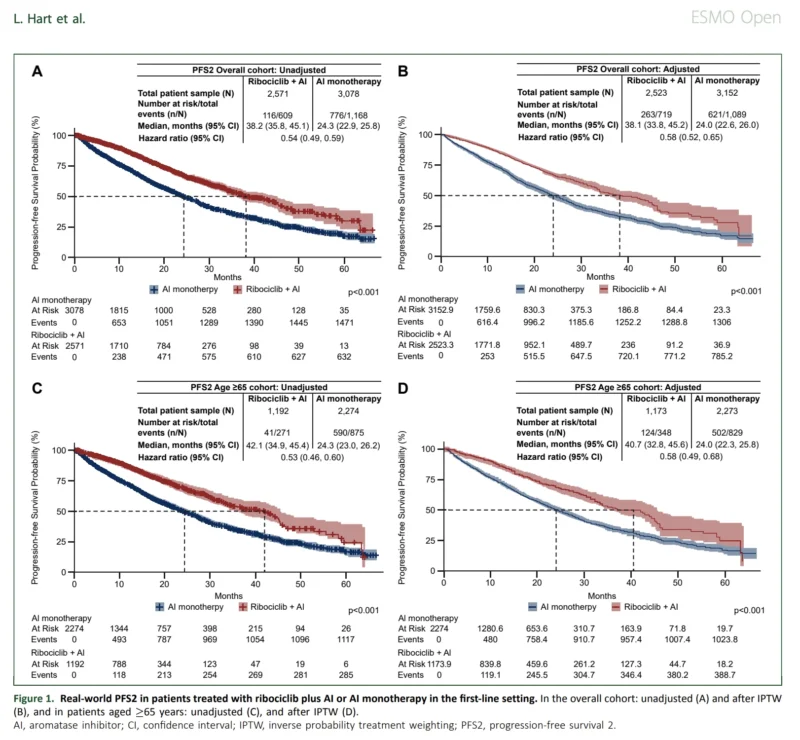
Real-world progression-free survival 2, or rwPFS2, measured the time from the start of first-line treatment to progression during second-line therapy or death during first- or second-line treatment.
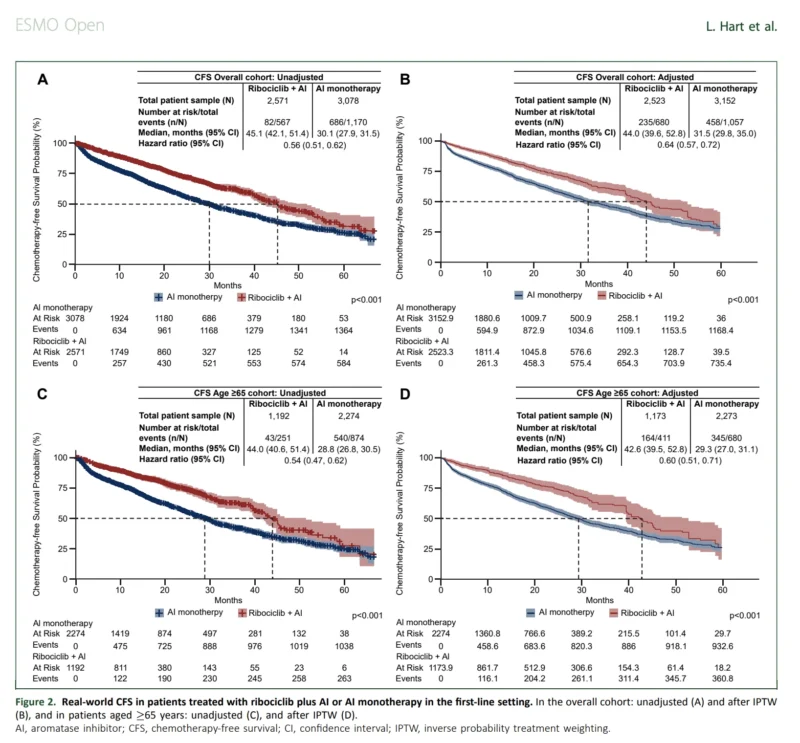
Real-world chemotherapy-free survival, or rwCFS, measured the time from first-line treatment initiation to the start of chemotherapy or death.
These endpoints matter because they capture more than the first treatment response. They reflect whether a first-line strategy may influence the next phase of disease control and how long patients can remain free from chemotherapy.
For patients living with HR-positive, HER2-negative metastatic breast cancer, delaying chemotherapy can be meaningful. It may reduce treatment burden, postpone chemotherapy-related toxicities, and help preserve quality of life.
What Did the Study Include?
The investigators used deidentified electronic health record data from the Flatiron Health Research Database, which includes community and academic oncology practices across the United States.
Eligible patients were women with HR-positive, HER2-negative metastatic breast cancer who started first-line therapy with either ribociclib plus an aromatase inhibitor or aromatase inhibitor monotherapy.
The final cohort included:
- 2,571 patients treated with ribociclib plus an aromatase inhibitor
- 3,078 patients treated with aromatase inhibitor monotherapy
Median follow-up was 15.4 months in the ribociclib plus aromatase inhibitor group and 14.6 months in the aromatase inhibitor monotherapy group.
Before adjustment, patients receiving ribociclib plus aromatase inhibitor were younger than those receiving aromatase inhibitor alone. They also had better documented ECOG performance status but were more likely to have visceral metastases and bone-only metastatic disease.
The authors used inverse probability of treatment weighting to balance observed baseline differences between groups.
Ribociclib Was Associated With Longer rwPFS2
In the adjusted overall cohort, median rwPFS2 was longer with ribociclib plus aromatase inhibitor than with aromatase inhibitor alone:
38.1 months vs 24.0 months
This represented a 14.1-month difference.
The adjusted hazard ratio was:
- HR: 0.58
- 95% CI: 0.52–0.65
This corresponds to a 42% lower risk of rwPFS2 event with ribociclib plus aromatase inhibitor compared with aromatase inhibitor monotherapy.
The Kaplan-Meier curves in the paper show separation between the two groups after adjustment, supporting a sustained difference over the available follow-up period.
Older Patients Also Derived Benefit
The study also examined patients aged 65 years or older.
This subgroup included 3,466 patients, of whom 1,192 received ribociclib plus aromatase inhibitor and 2,274 received aromatase inhibitor monotherapy.
After adjustment, median rwPFS2 was:
- 40.7 months with ribociclib plus aromatase inhibitor
- 24.0 months with aromatase inhibitor monotherapy
The adjusted hazard ratio was:
- HR: 0.58
- 95% CI: 0.49–0.68
This finding is important because older patients are often underrepresented in clinical trials and may be more likely to receive endocrine monotherapy in routine care because of comorbidities, frailty, or concerns about toxicity.
The analysis suggests that, among selected older patients treated in real-world practice, ribociclib plus aromatase inhibitor was associated with longer postprogression disease control than aromatase inhibitor alone.
Chemotherapy Was Delayed
The study also found longer real-world chemotherapy-free survival with ribociclib.
In the adjusted overall cohort, median rwCFS was:
- 44.0 months with ribociclib plus aromatase inhibitor
- 31.5 months with aromatase inhibitor monotherapy
The adjusted hazard ratio was:
- HR: 0.64
- 95% CI: 0.57–0.72
This represented a 36% lower risk of chemotherapy initiation or death.
Among patients aged 65 years or older, median rwCFS was:
- 42.6 months with ribociclib plus aromatase inhibitor
- 29.3 months with aromatase inhibitor monotherapy
The adjusted hazard ratio was:
- HR: 0.60
- 95% CI: 0.51–0.71
The chemotherapy-free survival curves presented in the article show a consistent advantage for ribociclib plus aromatase inhibitor in both the overall population and the older subgroup.
How Do These Results Fit With MONALEESA?
The results are consistent with the broader ribociclib evidence base from the MONALEESA trials, where ribociclib plus endocrine therapy demonstrated overall survival benefit in HR-positive, HER2-negative advanced or metastatic breast cancer.
The present analysis does not replace those randomized data. Instead, it adds real-world evidence focused on postprogression outcomes after first-line treatment.
This distinction is important.
The Flatiron analysis was not designed to test overall survival, and follow-up remains relatively short for mature real-world survival assessment. The study therefore used rwPFS2 and rwCFS as clinically meaningful endpoints that may reflect longer disease control and delayed chemotherapy exposure.
What This Study Does Not Prove
This analysis should not be read as a head-to-head comparison between ribociclib and other CDK4/6 inhibitors.
The comparator was aromatase inhibitor monotherapy, not palbociclib, abemaciclib, or another CDK4/6-based regimen.
It also does not prove causality. Treatment assignment in real-world data is not random. Physicians may choose aromatase inhibitor monotherapy for patients with more indolent disease, greater frailty, comorbidities, patient preference, or lower tolerance for combination therapy. Conversely, patients receiving ribociclib may differ in ways that are not fully captured in electronic health records.
The authors adjusted for measured baseline variables, but unmeasured confounding remains possible.
ECOG performance status was missing in more than one-third of patients, and early breast cancer treatment history may have been undercaptured if patients received prior care outside the Flatiron network.
The proportional hazards assumption was also not strictly met. The hazard ratios should therefore be interpreted as average effects across the follow-up period rather than constant treatment effects over time.
Finally, the study was funded by Novartis Pharmaceuticals Corporation, and several authors reported financial relationships with industry. These disclosures should be considered when interpreting the results.
The Bottom Line
In this large US real-world analysis, first-line ribociclib plus aromatase inhibitor was associated with longer rwPFS2 and longer chemotherapy-free survival than aromatase inhibitor monotherapy in HR-positive, HER2-negative metastatic breast cancer.
The benefit was observed in the overall population and in patients aged 65 years or older.
The findings support the real-world relevance of first-line ribociclib plus endocrine therapy and suggest that its benefit may extend beyond first progression by delaying subsequent disease events and chemotherapy initiation.
However, the study does not establish superiority over other CDK4/6 inhibitors and does not provide mature real-world overall survival data.
For clinical practice, the message is measured but meaningful: in eligible patients with HR-positive, HER2-negative metastatic breast cancer, adding ribociclib to an aromatase inhibitor may help extend disease control and delay chemotherapy compared with endocrine therapy alone.
References
- Hart L, Rugo HS, Sharma P, Sammons S, Gadi VK, Mavros P, et al. Real-world postprogression outcomes after first-line treatment with ribociclib plus aromatase inhibitor versus aromatase inhibitor alone in patients with hormone receptor-positive/human epidermal growth factor receptor 2-negative metastatic breast cancer in the United States of America. ESMO Open. 2026;11(7):108243.
- Hortobagyi GN, Stemmer SM, Burris HA, et al. Overall survival with ribociclib plus letrozole in advanced breast cancer. New England Journal of Medicine. 2022;386(10):942–950.
- Slamon DJ, Neven P, Chia S, et al. Overall survival with ribociclib plus fulvestrant in advanced breast cancer. New England Journal of Medicine. 2020;382(6):514–524.
- Im SA, Lu YS, Bardia A, et al. Overall survival with ribociclib plus endocrine therapy in breast cancer. New England Journal of Medicine. 2019;381(4):307–316.
- Lu YS, Im SA, Colleoni M, et al. Updated overall survival of ribociclib plus endocrine therapy versus endocrine therapy alone in pre- and perimenopausal patients with HR-positive, HER2-negative advanced breast cancer in MONALEESA-7. Clinical Cancer Research. 2022;28(5):851–859.
- Woodford RG, Zhou DDX, Kok PS, et al. The validity of progression-free survival 2 as a surrogate trial end point for overall survival. Cancer. 2022;128(7):1449–1457.