
Endocrine therapy remains the foundation of treatment for hormone receptor-positive, HER2-negative breast cancer.
For many patients, it can control disease for years. Yet resistance remains one of the central challenges in metastatic breast cancer, particularly after exposure to aromatase inhibitors and CDK4/6 inhibitors.
Among the most important mechanisms of acquired resistance are mutations in ESR1, the gene encoding the estrogen receptor. These alterations can emerge during endocrine therapy and are detected in up to 40% of patients whose disease progresses after first-line treatment.
For years, fulvestrant was the main estrogen receptor degrader available in clinical practice. It remains an important option, but its intramuscular administration and pharmacologic limitations created a need for more potent and convenient approaches.
That need has driven the development of oral selective estrogen receptor degraders, or oral SERDs.
A recent review examines how this drug class is reshaping treatment in HR-positive, HER2-negative breast cancer.
The message is clear: oral SERDs are becoming an increasingly important part of the endocrine therapy landscape, especially in ESR1-mutant metastatic disease. But the field is still defining where each agent fits, how to sequence treatment, and when combination therapy may be necessary.
Why Does ESR1 Matter?
The estrogen receptor remains a central driver of HR-positive breast cancer.
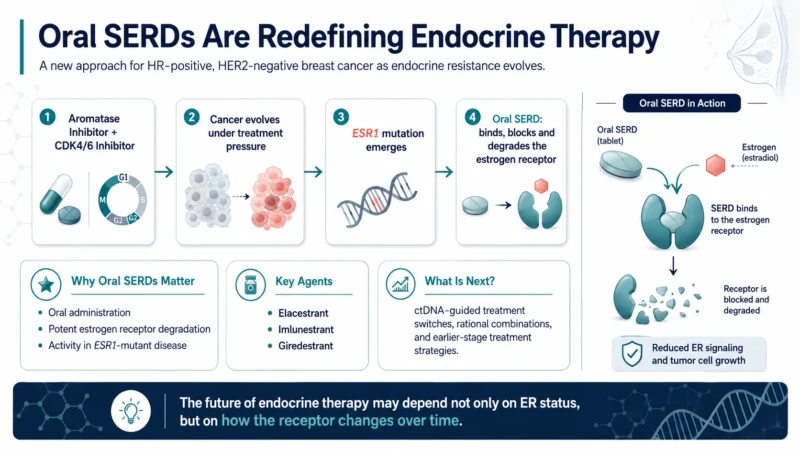
Aromatase inhibitors suppress estrogen production, limiting estrogen receptor signaling. However, cancer cells can adapt. One important route is through acquired ESR1 mutations, which can allow the estrogen receptor to remain active even in low-estrogen conditions.
This creates a clinical problem.
A patient may initially benefit from first-line endocrine therapy and a CDK4/6 inhibitor, but eventually develop resistance that is no longer adequately controlled by continued aromatase inhibition.
Oral SERDs were designed to address this challenge directly.
Rather than only reducing estrogen availability, they bind to the estrogen receptor and promote its degradation. The goal is to reduce receptor signaling more effectively, including in tumors with ESR1 mutations.
What Makes Oral SERDs Different?
Selective estrogen receptor degraders are not entirely new. Fulvestrant has been used for decades in metastatic breast cancer.
The difference is that newer oral SERDs are designed to achieve potent estrogen receptor targeting through oral administration.
This brings several potential advantages:
- Avoidance of intramuscular injections
- More convenient long-term treatment delivery
- Potentially stronger and more consistent estrogen receptor degradation
- Activity in ESR1-mutant disease
- Opportunities for combination treatment with targeted therapies
- However, oral administration alone is not the main story.
The real clinical question is whether these drugs can delay progression, retain activity after prior endocrine therapy, and improve outcomes in molecularly selected populations.
Elacestrant Helped Establish the Clinical Role of Oral SERDs
Elacestrant became the first oral SERD to establish a clear role in ESR1-mutant metastatic breast cancer.
Its development helped demonstrate that oral estrogen receptor degradation could translate into clinically meaningful benefit after progression on prior endocrine therapy.
The review highlights elacestrant as an important second-line option, particularly for patients with ESR1-mutant disease.
This is clinically relevant because ESR1 mutations are often acquired over time. A tumor that was initially endocrine-sensitive may evolve under treatment pressure, making repeat molecular assessment increasingly important.
In this context, liquid biopsy and circulating tumor DNA testing may help identify patients whose disease biology has changed before radiographic progression becomes obvious.
Imlunestrant Expands the Oral SERD Conversation
Imlunestrant is another oral SERD emerging in the treatment landscape.
The review identifies it as a key option in second-line HR-positive, HER2-negative disease, including ESR1-mutant breast cancer.
Its development reflects a broader shift in endocrine therapy.
The field is moving away from thinking only about endocrine-sensitive versus endocrine-resistant disease. It is increasingly asking more specific questions:
- Is ESR1 mutated?
- Has the patient progressed on a CDK4/6 inhibitor?
- Is monotherapy enough?
- Would a targeted combination be more appropriate?
- Can ctDNA identify resistance before clinical progression?
The answer may not be the same for every patient.
Could ctDNA Change When Treatment Is Switched?
One of the most interesting directions in oral SERD development is the use of circulating tumor DNA.
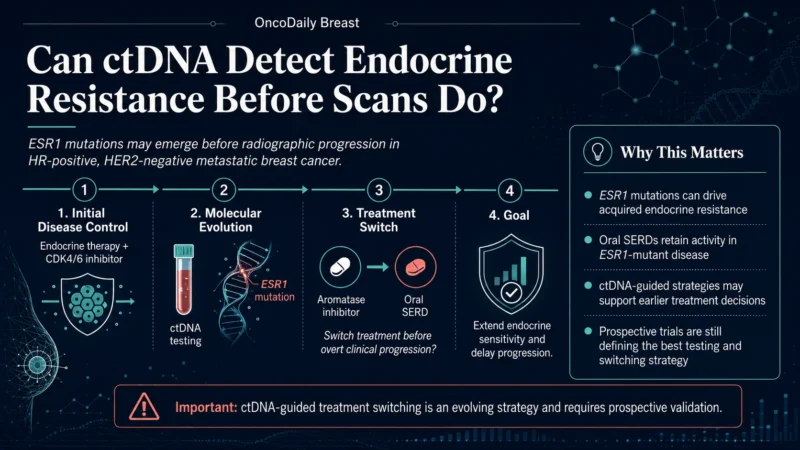
Traditionally, treatment changes are made after radiographic or clinical disease progression. But ESR1 mutations may emerge before scans show clear progression.
A ctDNA-guided approach could allow clinicians to detect molecular resistance earlier and switch endocrine therapy before overt clinical progression occurs.
The review notes that switching to a SERD in response to ESR1 mutation detection may improve disease control.
This is a meaningful idea, but it also raises practical questions.
How often should ctDNA be tested? Which assay should be used? Which ESR1 alterations are clinically actionable? Should every molecular change trigger a treatment switch?
These questions will require further prospective evidence and careful integration into routine practice.
Why Is Monotherapy Not Always Enough?
Oral SERDs have strengthened the endocrine therapy toolbox, but they have not eliminated endocrine resistance.
The review notes that primary resistance to SERD monotherapy remains substantial, affecting approximately 40% of patients.
This is a key limitation.
Some tumors remain dependent on pathways beyond the estrogen receptor. Others may have co-occurring genomic changes that reduce the effectiveness of endocrine treatment alone.
That is why the future of oral SERDs may depend as much on combinations as on monotherapy.
Potential strategies include combining oral SERDs with:
- CDK4/6 inhibitors
- PI3K/AKT/mTOR pathway inhibitors
- Other targeted agents
- Biomarker-guided treatment approaches
The central challenge is not simply finding the next endocrine drug. It is identifying which patients can remain on endocrine treatment alone and which need a more intensive strategy.
Moving Oral SERDs Into Earlier Breast Cancer
The oral SERD field is also expanding beyond metastatic disease.
The review highlights early-stage clinical development, including the lidERA trial, which suggests that oral SERDs may have a role in adjuvant endocrine therapy.
This is a major step for the class.
In metastatic breast cancer, the goal is to delay progression and preserve quality of life. In early-stage disease, the goal is different: reducing the risk of recurrence over years of follow-up.
The bar for evidence is therefore higher.
Long-term efficacy, safety, adherence, quality of life, treatment duration, and the ability to identify patients most likely to benefit will all be important.
The expansion of oral SERDs into earlier disease reflects confidence in estrogen receptor degradation as a therapeutic strategy. But it also means clinicians will need to think carefully about treatment duration, toxicity, sequencing, and the practical burden of long-term therapy.
What Questions Remain?
Despite major progress, several unanswered questions remain.
The optimal sequence of oral SERDs after first-line endocrine therapy is still being defined. It is also unclear whether ESR1 mutation status alone will be sufficient to guide treatment selection.
Other key questions include:
- Which oral SERD is best for which patient?
- Should oral SERDs be used as monotherapy or in combination?
- When should ctDNA testing be introduced?
- Can molecular progression guide treatment before radiographic progression?
- Which patients should receive oral SERDs in the adjuvant setting?
- How should oral SERDs be sequenced with antibody-drug conjugates, targeted therapies, and chemotherapy?
The answers will likely depend on tumor biology, prior therapies, molecular evolution, and patient preferences.
The Bottom Line
Oral SERDs are changing the endocrine therapy landscape for HR-positive, HER2-negative breast cancer.
Their most established role is in endocrine-resistant disease, particularly when ESR1 mutations emerge after prior therapy. Elacestrant and imlunestrant are helping define this new treatment space, while ctDNA-guided approaches may make it possible to identify resistance earlier.
The next phase of development will focus on combination strategies, biomarker-driven treatment selection, and expansion into early-stage disease.
For breast oncology, the importance of oral SERDs goes beyond one new drug class.
They represent a shift toward more precise endocrine therapy, where treatment decisions are increasingly guided not only by hormone receptor status, but by how the estrogen receptor changes over time.