
OPTIMA is one of the most important de-escalation studies presented at the 2026 ASCO Annual Meeting, because it addresses a daily clinical dilemma in early breast cancer: which patients truly need adjuvant chemotherapy, and which patients can safely avoid it?
Presented by Prof. Robert Stein, the phase III randomized non-inferiority trial evaluated whether treatment decisions guided by the Prosigna/PAM50 Risk of Recurrence (ROR) score could reduce chemotherapy use without compromising outcomes in patients with clinically high-risk ER-positive/HER2-negative early breast cancer (Stein et al., 2026).
The results support the use of genomic testing to personalize adjuvant treatment intensity, including in patients traditionally considered higher risk because of nodal involvement or other clinical features.
Why OPTIMA Matters
ER-positive/HER2-negative breast cancer is often treated with endocrine therapy, but chemotherapy is still recommended for many patients with high clinical risk features, especially nodal involvement. However, clinical risk does not always equal biological risk. Some tumors appear high risk based on size or nodal status but have a genomic profile suggesting limited chemotherapy benefit.
This is where gene expression testing becomes clinically important. OPTIMA tested whether the Prosigna ROR score could guide chemotherapy decisions in a large randomized population and help avoid overtreatment while maintaining invasive breast cancer-free survival.
How OPTIMA Was Designed
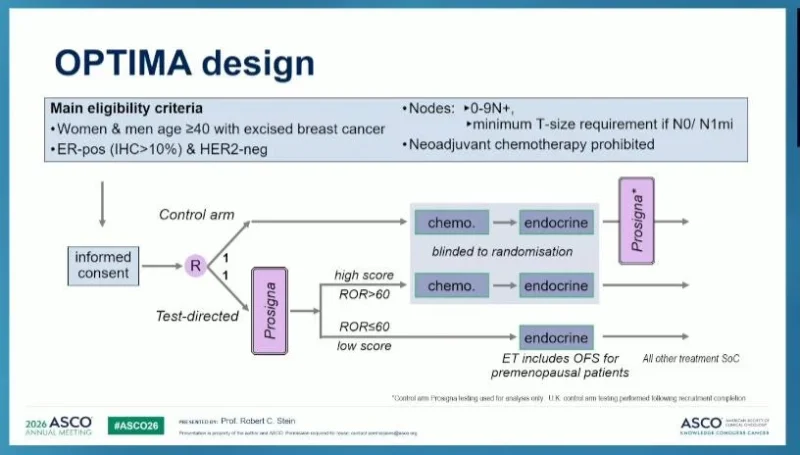
OPTIMA enrolled women and men aged over 40 years with excised ER-positive/HER2-negative early breast cancer who were considered candidates for chemotherapy. Key eligibility criteria included ER positivity, HER2 negativity, and 0–9 involved axillary nodes, with a minimum tumor-size requirement for node-negative disease. Neoadjuvant chemotherapy was prohibited.
Patients were randomized to either a control arm or a test-directed arm. In the control arm, patients received standard chemotherapy followed by endocrine therapy. In the test-directed arm, patients underwent Prosigna testing. Those with a ROR score >60 received chemotherapy followed by endocrine therapy, while those with a ROR score ≤60 received endocrine therapy alone.
For premenopausal patients, endocrine therapy included ovarian function suppression when chemotherapy-induced ovarian insufficiency was absent (Stein et al., 2026).
Study Population
A total of 4,429 patients were randomized, with 2,215 assigned to the control arm and 2,214 to the test-directed arm. In the per-protocol population, 2,061 patients in the control arm and 2,097 in the test-directed arm were included.
The population reflected a clinically higher-risk group. In the per-protocol population, 62% were postmenopausal, 37% were premenopausal, and 0.8% were male. Most patients had node-positive disease, including 73% with pN1 or pN1sn tumors and 19% with pN2 tumors. Importantly, 68% of patients had low ROR score tumors, meaning many patients had clinical risk features but lower genomic risk (Stein et al., 2026).
Main Efficacy Findings
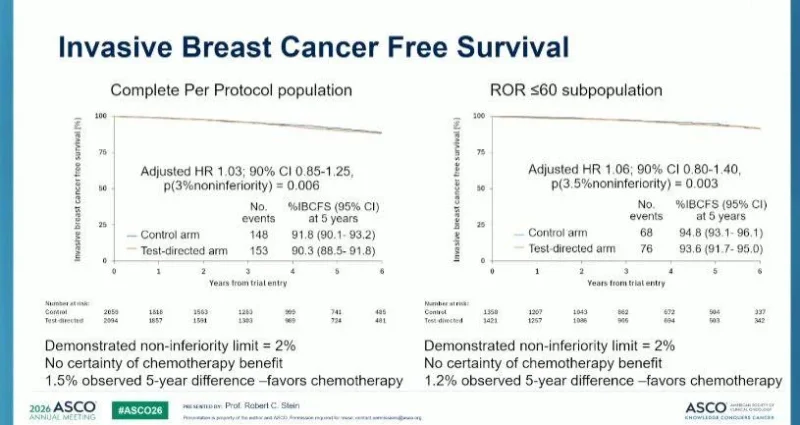
In the complete per-protocol population, OPTIMA demonstrated non-inferiority for the test-directed approach. According to the ASCO 2026 presentation, the 5-year invasive breast cancer-free survival rate was 91.8% in the control arm and 90.3% in the test-directed arm. The adjusted hazard ratio was 1.03, with a 90% confidence interval of 0.85–1.25, and the non-inferiority p value was 0.006.
The observed 5-year difference was 1.5%, favoring chemotherapy, but remained within the predefined non-inferiority boundary. This means the test-directed strategy preserved outcomes while allowing many patients to avoid chemotherapy.
In the low ROR score population, where the clinical question is most relevant, the 5-year invasive breast cancer-free survival rate was 94.8% in the control arm and 93.6% in the test-directed arm. The adjusted hazard ratio was 1.06, with a 90% confidence interval of 0.80–1.40, and the non-inferiority p value was 0.003. The observed 5-year difference was 1.2%, again favoring chemotherapy but remaining within the non-inferiority margin (Stein et al., 2026).
What The Subgroup Analysis Adds
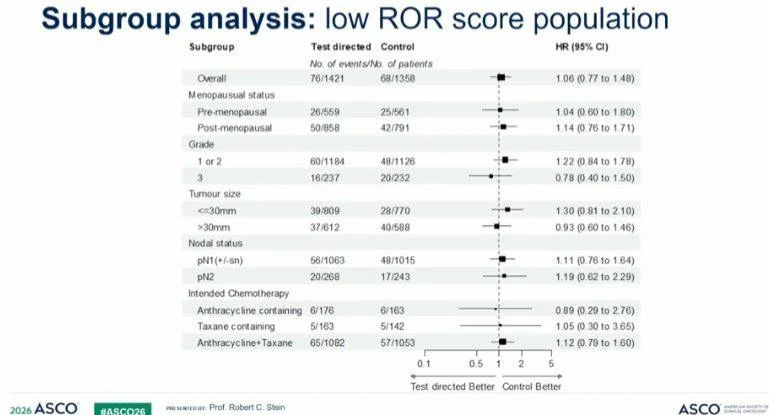
The subgroup analysis in the low ROR score population did not show meaningful heterogeneity by menopausal status, tumor grade, tumor size, nodal status, or intended chemotherapy type. This is clinically important because chemotherapy de-escalation is often more controversial in premenopausal patients and in those with nodal involvement.
The study therefore provides evidence that Prosigna-guided treatment decisions may be useful not only in lower-risk patients but also in selected patients with higher clinical risk features, including node-positive disease. It also supports the concept that ovarian function suppression is an important component of endocrine therapy in premenopausal patients who avoid chemotherapy.
Clinical Meaning
The main message from OPTIMA is not that chemotherapy should be abandoned in ER-positive/HER2-negative early breast cancer. Rather, the trial shows that chemotherapy decisions can be made more precisely when genomic risk is added to clinical risk.
For patients with ROR score ≤60, endocrine therapy alone produced non-inferior invasive breast cancer-free survival compared with standard chemotherapy followed by endocrine therapy. This offers a pathway to reduce unnecessary chemotherapy exposure, avoid short- and long-term toxicity, and personalize treatment based on tumor biology.
The findings are particularly relevant for shared decision-making. Many patients with ER-positive/HER2-negative early breast cancer face difficult choices about chemotherapy. OPTIMA provides prospective randomized evidence that a test-directed strategy can preserve excellent outcomes while sparing chemotherapy for many patients.
Key Takeaway
OPTIMA demonstrates that Prosigna-guided chemotherapy de-escalation is non-inferior to standard chemotherapy-based treatment in clinically high-risk ER-positive/HER2-negative early breast cancer.
For patients with ROR score ≤60, endocrine therapy alone achieved excellent 5-year invasive breast cancer-free survival, supporting the use of genomic testing to avoid overtreatment and move adjuvant breast cancer care toward more personalized decision-making.