
A new phase 1b/2 study will evaluate a combination of patritumab deruxtecan (HER3-DXd) and trastuzumab deruxtecan (T-DXd) in patients with hormone receptor-positive, HER2-low or HER2-ultralow unresectable or metastatic breast cancer.
The HERTHENA-Breast02 trial, registered as NCT07701941, is expected to enroll approximately 220 patients and will determine the safety, tolerability, antitumor activity, and optimal dosing strategy for the two antibody–drug conjugates. The study includes an expansion stage in which the selected HER3-DXd plus T-DXd regimen will be evaluated alongside T-DXd monotherapy.
The trial enters a treatment landscape already reshaped by T-DXd in HER2-low and HER2-ultralow disease and by emerging evidence of HER3-DXd activity in hormone receptor-positive metastatic breast cancer. Unlike studies evaluating the agents individually, HERTHENA-Breast02 asks whether simultaneously directing DXd-based ADCs against HER2 and HER3 can provide additional antitumor activity while maintaining an acceptable safety profile.
According to the latest available registry information, the trial is listed as not yet recruiting, with an estimated study start in August 2026. Daiichi Sankyo is the sponsor.
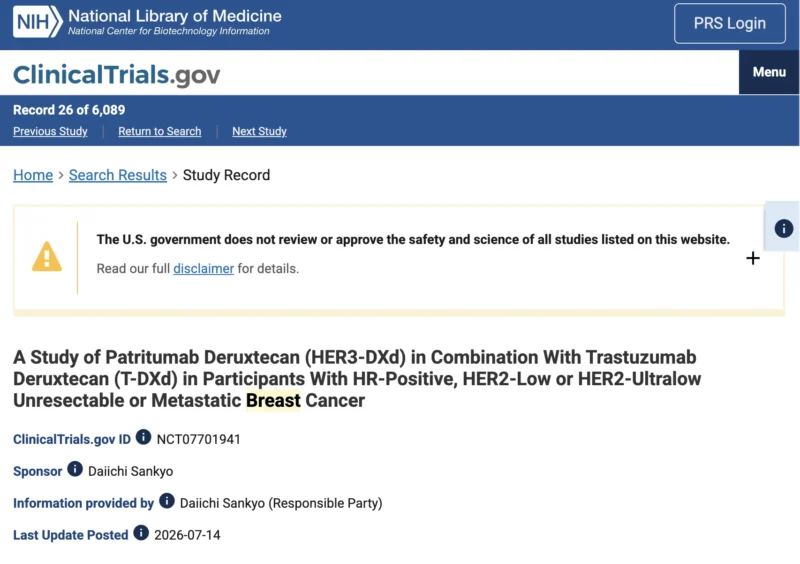
What Is HERTHENA-Breast02?
HERTHENA-Breast02 is a multicentre, open-label, randomized phase 1b/2 study designed specifically for patients with HR-positive, HER2-low or HER2-ultralow unresectable or metastatic breast cancer.
The study’s primary purpose is to establish whether HER3-DXd and T-DXd can be administered together safely and to identify an optimal combination regimen before evaluating its antitumor activity in an expanded population.
The trial uses a two-part design. In Part 1, patients will receive one of two HER3-DXd plus T-DXd combination regimens, referred to in the registry as regimen A and regimen B. Treatment continues until disease progression, death, unacceptable toxicity, or study closure.
Part 2 then moves the selected combination regimen into dose expansion. A separate active-comparator arm will receive T-DXd monotherapy, allowing investigators to characterize the combination against an established ADC treatment in this clinical setting.
Who Can Enter the Study?
HERTHENA-Breast02 is focused on a relatively specific point in the HR-positive metastatic breast cancer treatment pathway.
Patients must have pathologically confirmed unresectable or metastatic breast cancer that is hormone receptor positive. Estrogen receptor and/or progesterone receptor expression must be at least 1%.
Tumors must also be classified as either HER2-low or HER2-ultralow. HER2-low is defined as IHC 1+ or IHC 2+/ISH-negative, while HER2-ultralow is defined as IHC 0 with membrane staining in more than 0% but no more than 10% of tumor cells.
HER2 status will be assessed locally during the dose-regimen determination portion and centrally for the dose-expansion portion. Importantly, the HER2 result must come from tumor tissue obtained in the unresectable or metastatic setting.
Patients must also have radiographically documented progression following their most recent systemic treatment and must be considered refractory to further endocrine therapy.
Previous treatment with a CDK4/6 inhibitor is required. Patients with actionable PIK3CA, PTEN, AKT, or BRCA1/2 alterations who are eligible for approved targeted therapies are generally expected to have received those treatments before entering the study, unless the treatment was contraindicated or inaccessible.
A particularly important feature is that patients cannot have received chemotherapy for unresectable or metastatic breast cancer. Previous neoadjuvant or adjuvant chemotherapy is permitted.
This places HERTHENA-Breast02 at the transition from endocrine-based treatment toward ADC therapy rather than in a heavily chemotherapy-pretreated population.
Why Is T-DXd an Important Comparator?
The choice of T-DXd monotherapy as the comparator in Part 2 is clinically meaningful because T-DXd already has randomized phase 3 evidence in a closely related population.
In DESTINY-Breast06, 866 patients with HR-positive metastatic breast cancer and HER2-low or HER2-ultralow expression who had previously received endocrine-based therapy but no chemotherapy for metastatic disease were randomized to T-DXd or investigator-selected chemotherapy.
Among patients with HER2-low disease, median progression-free survival was 13.2 months with T-DXd versus 8.1 months with chemotherapy, corresponding to a hazard ratio of 0.62. Benefit was also observed in the exploratory HER2-ultralow population (Bardia et al., 2024).
HERTHENA-Breast02 therefore does not simply ask whether another ADC has activity. It tests whether adding HER3-directed ADC therapy to an already active HER2-directed ADC can provide sufficient additional activity to justify the complexity and potential toxicity of combining the two agents.
What Evidence Supports HER3-DXd in Breast Cancer?
Patritumab deruxtecan targets HER3 and delivers a topoisomerase I inhibitor payload.
Its activity in HR-positive metastatic breast cancer was recently demonstrated in the phase 2 ICARUS-BREAST01 study, published in Nature Medicine.
The study enrolled 99 patients with HR-positive, HER2-negative advanced breast cancer who had progressed after endocrine therapy and a CDK4/6 inhibitor and had received one chemotherapy line for advanced disease.
HER3-DXd produced a confirmed objective response rate of 53.5%, with a median progression-free survival of 9.2 months and median duration of response of 9.3 months (Pistilli et al., 2025).
Notably, activity was not confined to tumors with one particular level of HER2 expression. In a post hoc analysis, the objective response rate was 60% in HER2-low disease and 48.7% in HER2-0 disease, with median progression-free survival of 12.8 and 9.1 months, respectively. These exploratory findings should not be interpreted as a direct comparison between HER2-expression groups, but they provide evidence that HER3-directed delivery can remain active across different levels of HER2 expression.
HERTHENA-Breast02 moves HER3-DXd into an earlier setting than ICARUS-BREAST01 because metastatic chemotherapy is not permitted before enrollment.
Why Combine HER3-DXd With T-DXd?
The combination targets two different members of the HER receptor family while using ADCs built around a deruxtecan-based topoisomerase I inhibitor payload.
T-DXd uses HER2 as its target, whereas patritumab deruxtecan directs its cytotoxic payload through HER3.
The clinical question is whether this dual targeting can improve tumor control compared with T-DXd alone in cancers with low or ultralow HER2 expression.
HERTHENA-Breast02 is particularly relevant because HER2 expression in this population is, by definition, limited. Adding an ADC directed against a different tumor-associated receptor could potentially broaden drug delivery within heterogeneous tumors. That remains a hypothesis, however, and the trial is designed to determine whether it translates into meaningful antitumor activity.
The study will also examine the relationship between HER3 protein expression and efficacy and between HER2 protein expression and efficacy, potentially helping investigators understand whether either biomarker can identify patients more likely to benefit from the combination.
Why Will Safety Be Closely Watched?
Combining two ADCs carrying related topoisomerase I inhibitor payloads makes safety characterization particularly important.
For that reason, the primary endpoint of Part 1 is the proportion of patients experiencing treatment-emergent adverse events and serious adverse events. Pharmacokinetic analyses will also measure HER3-DXd, T-DXd, total antibodies, and released DXd payload over treatment.
Existing monotherapy studies provide important context.
In ICARUS-BREAST01, grade 3 or higher treatment-related adverse events occurred in 50.1% of patients receiving HER3-DXd. Fatigue, nausea, diarrhea, and alopecia were among the most frequent treatment-related events. Eight patients had adjudicated HER3-DXd-related interstitial lung disease; six events were grade 1 and two were grade 2 (Pistilli et al., 2025).
In DESTINY-Breast06, adjudicated interstitial lung disease or pneumonitis occurred in 11.3% of patients receiving T-DXd, including three grade 5 events (Bardia et al., 2024).
HERTHENA-Breast02 consequently has strict pulmonary eligibility requirements. Patients with a history of ILD or pneumonitis, current or suspected ILD, or imaging findings in which ILD cannot be excluded are generally ineligible. A previous radiation pneumonitis episode that did not require steroids is an exception specified in the registry.
The trial will therefore need to establish not simply whether the dual-ADC regimen has activity, but whether sufficient exposure to both agents can be achieved without producing unacceptable overlapping toxicity.
Can Patients With Brain Metastases Participate?
Patients with clinically active or symptomatic brain metastases requiring corticosteroids or anticonvulsants for symptom control are excluded.
However, patients with treated or clinically inactive brain metastases can participate if they are asymptomatic and neurologically stable for at least four weeks before treatment.
Patients receiving anticonvulsants prophylactically can also be eligible if the brain metastases themselves remain asymptomatic.
This will allow at least some patients with a history of central nervous system involvement to be represented, although the registry does not identify intracranial efficacy as a primary endpoint.
What Will the Trial Measure?
The two study parts answer different questions.
Part 1 is primarily concerned with safety and regimen selection, with treatment-emergent and serious adverse events serving as the primary endpoint.
Part 2 shifts the focus toward antitumor activity. Its primary endpoint is objective response according to RECIST version 1.1, based on investigator assessment and requiring confirmed complete or partial response.
Secondary assessments include duration of response, disease control, clinical benefit, progression-free survival, time to response, overall survival, and safety. The study will also explore correlations between HER2 and HER3 protein expression and treatment efficacy.
The registry estimates approximately 220 participants, with study completion currently projected for 2031.
Why Could HERTHENA-Breast02 Matter?
ADC development in breast cancer is increasingly moving beyond testing individual drugs sequentially.
HERTHENA-Breast02 represents a different strategy: combining two ADCs directed against distinct surface targets at a relatively early point after endocrine resistance.
The comparison with T-DXd monotherapy will be particularly important. T-DXd already provides substantial disease control in HER2-low and HER2-ultralow HR-positive metastatic breast cancer, meaning that a combination strategy will eventually need to demonstrate not only additional activity but a convincing overall benefit-risk profile.
The trial could also provide information about whether HER3 expression has clinical value as a biomarker in this setting. ICARUS-BREAST01 identified exploratory associations between HER3 distribution and outcomes, but these relationships require further validation (Pistilli et al., 2025).
The Bottom Line
HERTHENA-Breast02 is testing HER3-DXd plus T-DXd as a dual-ADC strategy in HR-positive, HER2-low or HER2-ultralow unresectable or metastatic breast cancer.
Approximately 220 patients are planned for enrollment. Participants must have progressed after endocrine therapy, previously received a CDK4/6 inhibitor, and received no chemotherapy for metastatic disease.
Part 1 will determine the safety and optimal combination regimen. Part 2 will evaluate the selected combination alongside T-DXd monotherapy, with objective response as the primary efficacy endpoint.
The trial builds on established activity of T-DXd in HER2-low and HER2-ultralow disease and emerging evidence for HER3-DXd in HR-positive metastatic breast cancer. Whether combining the two DXd ADCs can improve antitumor activity without unacceptable overlapping toxicity is now the central question.
No efficacy or safety results from HERTHENA-Breast02 are currently available, and the latest registry information lists the study as not yet recruiting.
References
- ClinicalTrials.gov. HERTHENA-Breast02: A Study of Patritumab Deruxtecan (HER3-DXd) in Combination With Trastuzumab Deruxtecan (T-DXd) in HR-Positive, HER2-Low or HER2-Ultralow Unresectable or Metastatic Breast Cancer. NCT07701941. 2026. ClinicalTrials.gov record
- Bardia A, Hu X, Dent R, et al. Trastuzumab deruxtecan after endocrine therapy in metastatic breast cancer. New England Journal of Medicine. 2024;391:2110–2122. doi:10.1056/NEJMoa2407086.
- Pistilli B, Mosele F, Corcos N, et al. Patritumab deruxtecan in HR-positive/HER2-negative advanced breast cancer: a phase 2 trial. Nature Medicine. 2025;31:3492–3503. doi:10.1038/s41591-025-03885-3.