







The management of HER2-positive early breast cancer has evolved substantially with the introduction of dual HER2 blockade and effective neoadjuvant treatment strategies. However, patients with HER2-positive disease do not respond uniformly to the same therapy, highlighting the need for biomarkers capable of identifying differences in tumor biology and treatment sensitivity.
The study demonstrated that conventional biomarkers such as hormone receptor status and HER2 expression remain important predictors of response, while the HER2DX pCR score provides additional biological information beyond standard clinicopathologic characteristics.
Pathologic complete response (pCR) after neoadjuvant therapy has become an important marker of treatment activity in HER2-positive breast cancer, particularly because patients achieving pCR generally experience favorable long-term outcomes. However, predicting which tumors are most likely to achieve complete eradication of invasive disease remains a major clinical challenge.
A secondary analysis of the prospective EA1181/CompassHER2 pCR trial, published in the Journal of Clinical Oncology, evaluated clinical, pathological and genomic factors associated with pCR after neoadjuvant taxane, trastuzumab and pertuzumab (THP).
The findings reinforce a broader movement in HER2-positive breast cancer: moving from classification based only on receptor status toward a more individualized understanding of tumor biology.
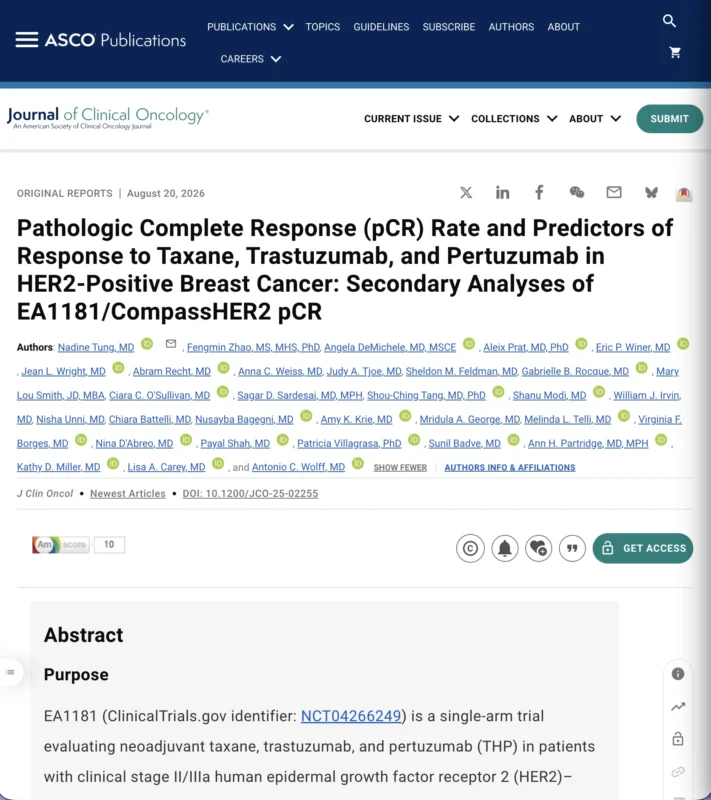
EA1181/CompassHER2 pCR Evaluated Neoadjuvant THP in a Large Prospective Cohort
The EA1181/CompassHER2 pCR trial was a prospective clinical study evaluating neoadjuvant THP in patients with HER2-positive early breast cancer.
The analysis included 2,175 enrolled patients with stage II or IIIA HER2-positive breast cancer.
Patients received neoadjuvant:
- Trastuzumab
- Pertuzumab
- Taxane chemotherapy, followed by surgery.
The primary clinical objective of the trial was to evaluate pathological complete response and subsequent clinical outcomes.
A subgroup of 569 patients also had available HER2DX pCR scores, allowing investigators to assess whether genomic information could improve prediction of treatment response beyond established clinical factors.
Nearly Half of Patients Achieved Complete Response, but Biology Determined Probability of Benefit
Among patients who initiated THP, the overall pCR rate was:
- 43.8%
However, response differed substantially according to tumor biology.
Patients with:
- HER2-positive / estrogen receptor-negative (ER-negative) disease achieved a pCR rate of 63.7%
compared with:
- 32.4% among patients with HER2-positive / estrogen receptor-positive (ER-positive) disease.
These findings highlight that HER2-positive breast cancer is not a single biological entity.
Although all tumors demonstrate HER2 positivity, hormone receptor expression influences tumor dependency, proliferation patterns and sensitivity to HER2-directed treatment.
ER-negative HER2-positive tumors often demonstrate greater dependence on HER2 signaling, which may contribute to their higher response rates with HER2 blockade.
Hormone Receptor Status Remains a Major Predictor of Neoadjuvant Response
The study confirmed the importance of hormone receptor expression in predicting response.
Higher pCR rates were associated with:
- ER-negative disease
- Lower ER expression
- PR-negative disease
- Lower PR expression
These findings are consistent with previous observations that hormone receptor-positive HER2-positive tumors may retain additional endocrine-driven survival pathways, potentially reducing sensitivity to HER2-directed therapy alone.
The results emphasize that HER2 status should not be interpreted independently from the broader biological context of the tumor.
HER2 Expression Level Also Influenced Response Probability
The analysis demonstrated an association between HER2 expression intensity and treatment response.
Patients with:
- HER2 IHC 3+ tumors
were more likely to achieve pCR compared with tumors with lower HER2 expression levels.
Higher HER2 protein expression may reflect stronger dependence on HER2 signaling and greater vulnerability to HER2-directed therapies.
However, HER2 immunohistochemistry alone does not fully capture the complexity of treatment sensitivity, creating a need for additional molecular tools.
HER2DX Adds Genomic Information Beyond Conventional Biomarkers
A central finding of the study was the evaluation of the HER2DX pCR score.
HER2DX is a genomic-clinical assay designed specifically for HER2-positive breast cancer. The pCR score incorporates tumor biological features to estimate the likelihood of achieving pathological complete response after neoadjuvant HER2-directed therapy.
Among the 569 patients with available HER2DX data, a higher HER2DX pCR score was associated with an increased probability of achieving pCR.
Importantly, this association remained significant after adjustment for established clinicopathologic factors, suggesting that HER2DX provides additional predictive information beyond hormone receptor status, HER2 expression and other standard characteristics.
This finding supports continued investigation of genomic biomarkers as tools for refining treatment strategies in HER2-positive breast cancer.
Moving Beyond Stage and Receptor Status Toward Tumor Biology
Historically, treatment decisions in HER2-positive early breast cancer have relied on:
- Tumor size
- Nodal involvement
- ER and PR status
- HER2 expression
While these factors remain clinically essential, they provide an incomplete picture of treatment response.
Two patients with similar stage and receptor status may have different biological vulnerabilities and different probabilities of achieving pCR.
The HER2DX findings contribute to a growing effort to incorporate molecular characteristics into treatment decision-making.
The future of HER2-positive breast cancer management may increasingly depend on identifying:
- Which tumors are highly sensitive to HER2 blockade
- Which patients may require treatment intensification
- Which patients may eventually be candidates for treatment de-escalation
Potential Clinical Implications and Remaining Questions
The ability to predict pCR before treatment begins could have important implications.
Patients with a high likelihood of response may represent candidates for strategies aimed at reducing treatment burden, while patients predicted to have lower sensitivity may benefit from additional approaches.
However, the current study does not establish HER2DX-guided treatment selection as a clinical standard.
Prospective clinical trials are required to determine whether modifying treatment according to HER2DX results can improve long-term outcomes while maintaining safety.
Important unanswered questions include:
- Can HER2DX identify patients who may safely receive less intensive therapy?
- Can it predict recurrence risk beyond pCR?
- Can it guide escalation strategies for patients unlikely to respond to THP?
- How should genomic biomarkers be integrated with emerging antibody-drug conjugates and other targeted therapies?
The Future of Precision Treatment in HER2-Positive Breast Cancer
The EA1181/CompassHER2 pCR analysis demonstrates that response to neoadjuvant HER2-directed therapy is strongly influenced by tumor biology.
The study confirms that ER status, PR status and HER2 expression remain important determinants of response, while HER2DX provides additional genomic information that may improve prediction of pathological complete response.
As HER2-positive breast cancer treatment continues to expand, the challenge will shift from identifying effective therapies to determining which therapy is most appropriate for each individual tumor.
HER2DX represents one step toward that goal by helping characterize biological differences within HER2-positive disease.
Conclusion
The EA1181/CompassHER2 pCR analysis provides important evidence that biological diversity within HER2-positive breast cancer influences response to neoadjuvant THP.
While ER-negative tumors, low hormone receptor expression and HER2 IHC 3+ status were associated with higher pCR rates, the HER2DX pCR score added independent predictive information beyond conventional clinicopathologic factors.
These findings support further evaluation of genomic biomarkers in guiding personalized treatment strategies for HER2-positive breast cancer.
The next stage of research will determine whether tools such as HER2DX can move from predicting response to actively guiding treatment decisions in clinical practice.
Reference
- Tung N, Zhao F, DeMichele A, Prat A, Winer EP, Wright JL, Recht A, Weiss AC, Feldman SM, Rocque GB, Smith ML, O’Sullivan CC, Sardesai SD, Modi S, Irvin WJ, Unni N, Battelli C, Bagegni N, Krie AK, George MA, Telli ML, Borges VF, Shah P, Badve S, Partridge AH, Miller KD, Carey LA, Wolff AC. Pathologic Complete Response (pCR) Rate and Predictors of Response to Taxane, Trastuzumab, and Pertuzumab in HER2-Positive Breast Cancer: Secondary Analyses of EA1181/CompassHER2 pCR. Journal of Clinical Oncology. 2026.
