Treatment outcomes in early HER2-positive breast cancer have improved substantially with HER2-directed therapies, yet clinical management is becoming increasingly complex. Patients classified within the same HER2-positive category can have very different risks of recurrence, probabilities of achieving pathologic complete response, and sensitivity to chemotherapy, endocrine therapy, and HER2-targeted treatment.
This biological heterogeneity is particularly relevant as treatment moves simultaneously toward escalation for patients at higher risk and de-escalation for those expected to have excellent outcomes with less intensive therapy.
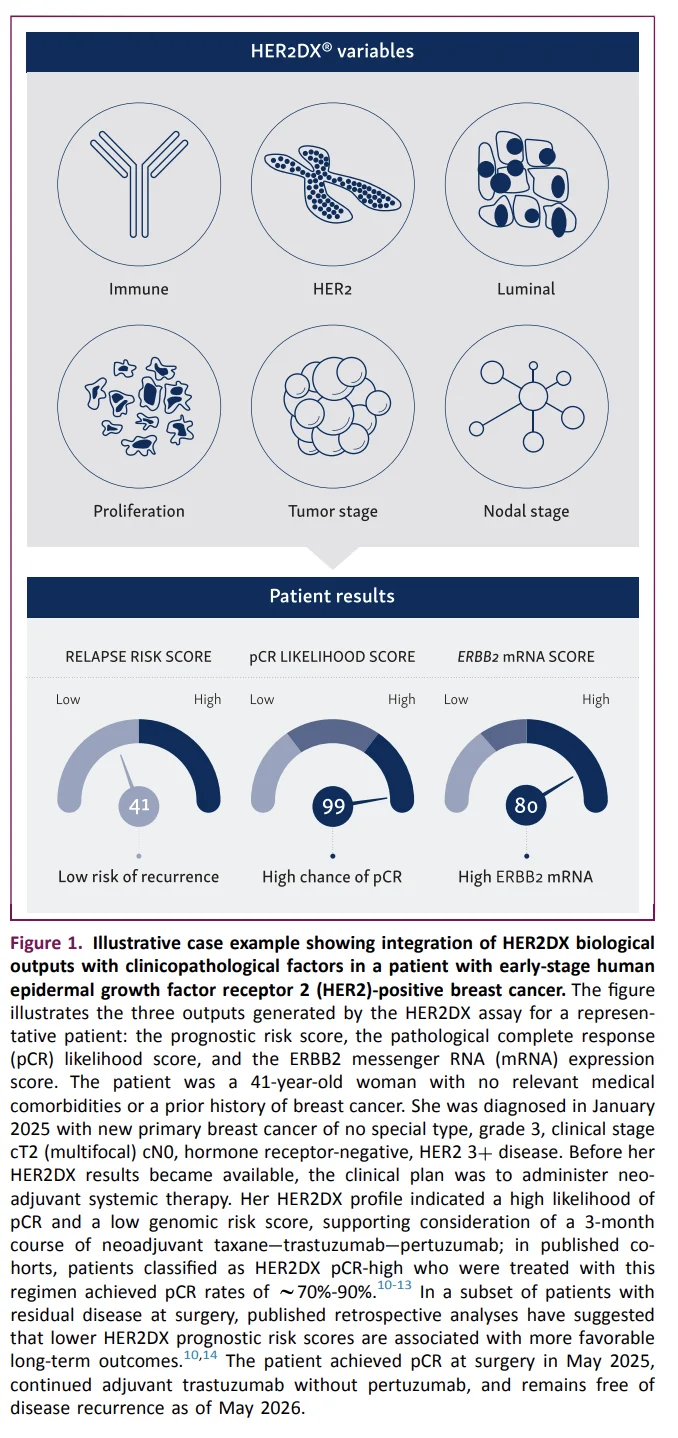
A 2026 review in ESMO Open, led by Sara M. Tolaney and colleagues, examines the growing evidence for HER2DX, a genomic-clinical assay designed specifically for stage I-III HER2-positive breast cancer. Unlike conventional clinicopathological assessment alone, HER2DX integrates tumor biology with tumor size and nodal status to generate three distinct outputs: a relapse risk score, a pathologic complete response probability score, and a quantitative ERBB2 messenger RNA expression score (Tolaney et al., 2026).
The central clinical question is whether these complementary biological measures can eventually help determine not only prognosis, but also how much treatment an individual patient actually needs.
HER2DX Integrates Prognosis, Treatment Sensitivity and HER2 Biology
HER2DX is based on expression of 27 genes together with clinical stage information. Its biological components capture immune activity, luminal differentiation, tumor proliferation and HER2 pathway activation, while tumor size and nodal status provide additional clinical context.
The assay produces three scores on continuous scales.
The HER2DX relapse risk score estimates long-term recurrence risk. The HER2DX pCR score estimates the probability of achieving pathologic complete response following neoadjuvant treatment. The HER2DX ERBB2 score provides a quantitative measure of ERBB2 mRNA expression.
These outputs are not interchangeable.
The review emphasizes that the biological factors associated with long-term prognosis are partly distinct from those associated with short-term treatment response. For example, luminal differentiation may be associated with a more favorable intrinsic prognosis but a lower likelihood of pCR, whereas highly proliferative and immune-active tumors may be more treatment-sensitive despite having less favorable intrinsic biology (Tolaney et al., 2026).
This distinction is important because pCR and recurrence risk answer different clinical questions.
The Relapse Risk Score Adds Prognostic Information Beyond Stage
The HER2DX relapse risk score combines genomic characteristics with tumor size and nodal status to estimate long-term recurrence risk.
Its prognostic value has been evaluated across multiple independent datasets.
An individual-patient-level meta-analysis including 2,518 patients from 11 studies demonstrated that the HER2DX risk score was independently associated with both event-free survival and overall survival after adjustment for conventional variables including tumor stage, nodal status, hormone receptor status and pathologic response.
At 6 years, event-free survival was:
- 93.6% in HER2DX low-risk disease
compared with
- 82.9% in HER2DX high-risk disease.
The absolute difference was 10.7 percentage points, with a stratified hazard ratio of 2.72 for the high-risk group (Villacampa et al., 2025; Tolaney et al., 2026).
The prognostic separation was even greater among patients with residual disease after neoadjuvant therapy. Six-year EFS was approximately 92% in low-risk patients versus 77% in high-risk patients, corresponding to an absolute difference of approximately 15%.
This observation is particularly relevant because more than 85% of patients with residual disease in the studies included in that analysis had not received adjuvant T-DM1.
It suggests that residual disease does not represent a biologically homogeneous state and that baseline genomic risk may provide additional information beyond pathologic response alone.
HER2DX Also Identifies Prognostic Differences in Clinically Low-Risk Disease
The value of HER2DX is not restricted to patients with large tumors or node-positive disease.
In analyses of the APT and ATEMPT trials, which included patients with predominantly stage I HER2-positive breast cancer and relatively few recurrence events, the HER2DX risk score was significantly associated with recurrence-free interval.
In those analyses, conventional characteristics such as histologic grade, hormone receptor status and stromal tumor-infiltrating lymphocytes were not significantly associated with recurrence-free interval (Tolaney et al., 2023; Tarantino et al., 2024).
The Trans-RESPECT analysis provided additional evidence in older patients. Among 154 patients aged 70-80 years with surgically treated HER2-positive early breast cancer, HER2DX risk remained independently associated with relapse-free and overall survival after adjustment for age, stage, nodal status, hormone receptor status and treatment arm (Nozawa et al., 2025).
The clinical importance of these findings lies in treatment intensity.
A patient with anatomically small HER2-positive disease may still have biologically high-risk disease, while another patient with somewhat greater clinical tumor burden may have a substantially more favorable underlying genomic profile.
The pCR Score Estimates Sensitivity to Neoadjuvant Therapy
The HER2DX pCR score was designed to estimate the probability of achieving pathologic complete response after neoadjuvant HER2-directed therapy.
The score is divided into three predefined categories:
- pCR-low: 1-32
- pCR-intermediate: 33-67
- pCR-high: 68-99.
Across retrospective neoadjuvant datasets, pCR-low tumors generally achieved pCR rates of approximately 20%-30%, whereas pCR-high tumors treated with a short course of taxane, trastuzumab and pertuzumab have achieved response rates approaching 70%-90% (Tolaney et al., 2026).
The biological explanation is consistent with the genomic structure of the assay.
pCR-high tumors tend to demonstrate greater HER2 pathway activity, stronger immune infiltration, higher proliferation and less luminal or estrogen receptor signaling. These characteristics are associated with increased sensitivity to HER2-directed therapy and chemotherapy.
By contrast, pCR-low tumors more frequently demonstrate luminal, endocrine-dependent biology.
CompassHER2 pCR Prospectively Validated the Response Gradient
One of the most important advances in the evidence base has come from the EA1181 CompassHER2 pCR trial.
The nonrandomized Phase II study enrolled patients with stage II-IIIA HER2-positive breast cancer who received four cycles of taxane, trastuzumab and pertuzumab.
HER2DX was evaluated prospectively as a prespecified secondary objective in 569 patients.
Among hormone receptor-negative tumors, the pCR rate was:
- 70% in HER2DX pCR-high disease
versus
- 31% in pCR-low disease.
Among hormone receptor-positive tumors, the corresponding pCR rates were:
- 58% versus 18%.
The absolute differences were therefore 39% and 40%, respectively, and the association remained independent of standard clinicopathological variables (Tung et al., 2025; Tolaney et al., 2026).
These findings provide prospective evidence that HER2DX identifies substantial biological differences in sensitivity even among patients receiving the same neoadjuvant regimen.
Can HER2DX Help Identify Candidates for Shorter Neoadjuvant Therapy?
This may become one of the most clinically relevant applications.
Patients classified as pCR-high have repeatedly demonstrated high response rates with approximately 3 months of taxane plus trastuzumab and pertuzumab.
The review cites pCR rates of approximately 70%-90% in this group across published cohorts.
By contrast, pCR-low tumors usually have a high likelihood of residual disease after short-course therapy.
This distinction matters because neoadjuvant HER2-positive breast cancer treatment increasingly involves balancing the probability of pCR against cumulative chemotherapy exposure.
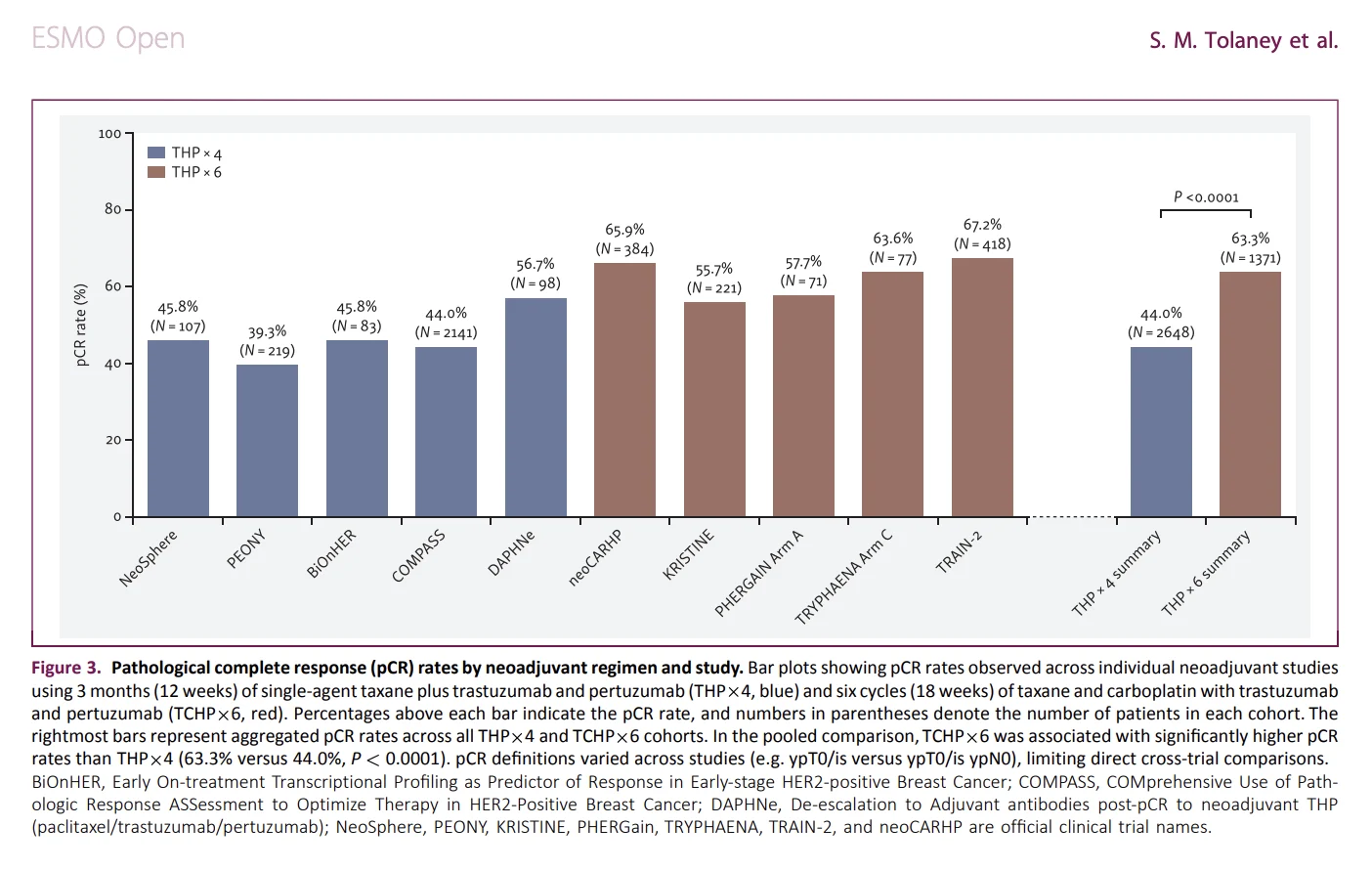
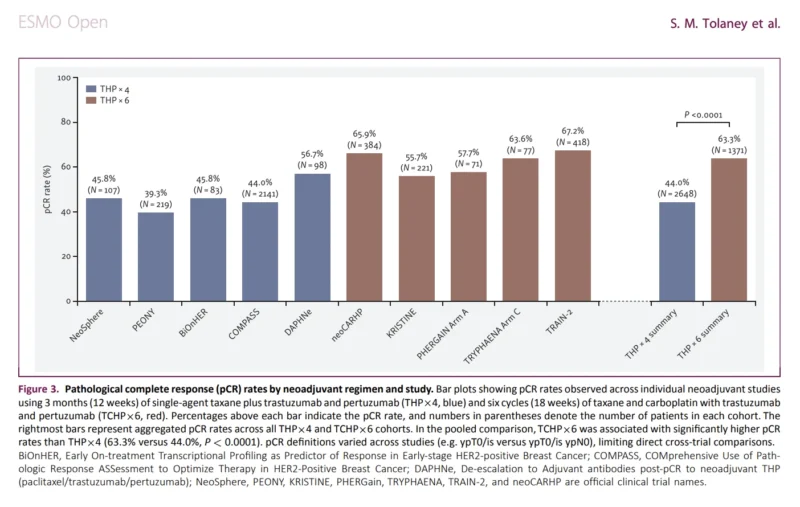
The review compares results across multiple studies evaluating shorter THP regimens and longer carboplatin-containing regimens.
Across pooled datasets summarized in Figure 3 of the review, pCR was approximately:
- 44.0% with 3 months of THP
versus
- 63.3% with six cycles of TCHP.
The absolute difference was approximately 19 percentage points (Tolaney et al., 2026).
However, this is not a randomized pooled comparison, and definitions of pCR varied between studies. The authors therefore emphasize that cross-trial comparisons must be interpreted cautiously.
The potential role of HER2DX is not to assume that shorter treatment is universally equivalent. Rather, it may help identify tumors in which a high probability of response is already present despite reduced chemotherapy exposure.
Treatment Duration May Matter as Much as Chemotherapy Intensity
An important nuance in the review is that de-escalation does not simply mean reducing the number of chemotherapy agents.
Duration also matters.
The Phase III HELEN-006 trial showed that 18 weeks of weekly nab-paclitaxel with trastuzumab and pertuzumab achieved a pCR rate of 66.3%, compared with 57.6% with TCHP.
Similarly, the neoCARHP trial reported similar pCR rates with taxane plus trastuzumab and pertuzumab, with or without carboplatin, when both strategies were delivered for approximately 18 weeks: 64.1% versus 65.9% (Chen et al., 2025; Gao et al., 2025).
These findings indicate that shortening therapy and reducing chemotherapy intensity are separate concepts.
A biologically selected patient who may achieve pCR after only 12 weeks of THP represents a different de-escalation strategy from a patient receiving a less complex regimen over 18 weeks.
HER2DX could potentially help distinguish between those scenarios, although randomized biomarker-guided evidence is still required.
The pCR Score May Also Reflect Endocrine Sensitivity
HER2-positive/hormone receptor-positive breast cancer is particularly heterogeneous because both HER2 and estrogen receptor pathways may contribute to tumor biology.
The review proposes that the HER2DX pCR score captures a biological continuum between chemotherapy sensitivity and endocrine dependence.
In the PerELISA trial, endocrine responsiveness was assessed after short-term letrozole.
The proportion of tumors demonstrating endocrine response decreased substantially across HER2DX categories:
- 89.7% in pCR-low tumors
- 65.0% in pCR-intermediate tumors
- 16.7% in pCR-high tumors.
The association was statistically significant (P = 0.001) (Guarneri et al., 2022).
These findings suggest that pCR-low disease may not simply represent treatment-resistant biology. In HR-positive tumors, it may instead identify a more luminal, endocrine-responsive state that is relatively less dependent on chemotherapy.
This remains hypothesis-generating, but it could become important as treatment strategies increasingly attempt to distinguish patients who require cytotoxic therapy from those whose disease is predominantly endocrine driven.
The ERBB2 Score Adds a Quantitative Measure of HER2 Biology
The third HER2DX component measures ERBB2 mRNA expression.
Unlike immunohistochemistry, which categorizes HER2 expression using discrete thresholds, the HER2DX ERBB2 score quantifies transcriptomic expression on a continuous scale.
Scores are classified as:
- ERBB2-low: 1-32
- ERBB2-intermediate: 33-50
- ERBB2-high: 51-99.
Validation across 1,425 tumors showed an area under the receiver operating characteristic curve of approximately 0.96-0.98 for distinguishing clinical HER2 status (Prat et al., 2022; Torres et al., 2023).
However, approximately 10%-15% of tumors classified as HER2-positive by conventional testing were HER2DX ERBB2-low.
Central pathology review provides insight into this discordance.
Among ERBB2-low tumors undergoing reassessment, 57% were reclassified as clinically HER2-negative, 21% demonstrated intratumoral HER2 heterogeneity and only 21% were confirmed as conventionally HER2-positive (Sanfeliu et al., 2026).
The ERBB2 score therefore may be particularly useful in complex or borderline HER2 cases, although it does not replace standard immunohistochemistry or in situ hybridization.
Importantly, HER2DX ERBB2-low is not equivalent to the clinical HER2-low category used for antibody-drug conjugate eligibility.
They represent different biological and diagnostic concepts.
HER2DX Changed Planned Treatment in Nearly Half of Patients
Clinical validity does not automatically translate into clinical utility.
One of the most important additions to the HER2DX evidence base is therefore a prospective real-world decision-impact study conducted across 12 hospitals in Spain.
The study included 297 patients with newly diagnosed stage I-III HER2-positive breast cancer and 34 medical oncologists who had no previous experience with the assay.
Treatment recommendations were recorded before and after HER2DX results became available.
HER2DX changed the planned therapeutic strategy in:
- 48% of patients.
Approximately three-quarters of the treatment modifications involved de-escalation, including avoidance of anthracyclines, reduced chemotherapy intensity, omission of one HER2-targeted agent or shorter anti-HER2 treatment duration.
A smaller proportion underwent escalation based on higher-risk biological profiles.
Physician confidence also increased after receiving HER2DX results, including when the original treatment plan remained unchanged (Martínez-Sáez et al., 2025).
These results demonstrate that HER2DX can influence real clinical decisions.
They do not yet demonstrate that HER2DX-guided treatment changes improve patient outcomes.
That distinction remains central to interpreting the assay.
HER2DX May Be Most Relevant Where Standard Clinical Factors Leave Uncertainty
The review proposes several settings in which additional biological information may be particularly useful.
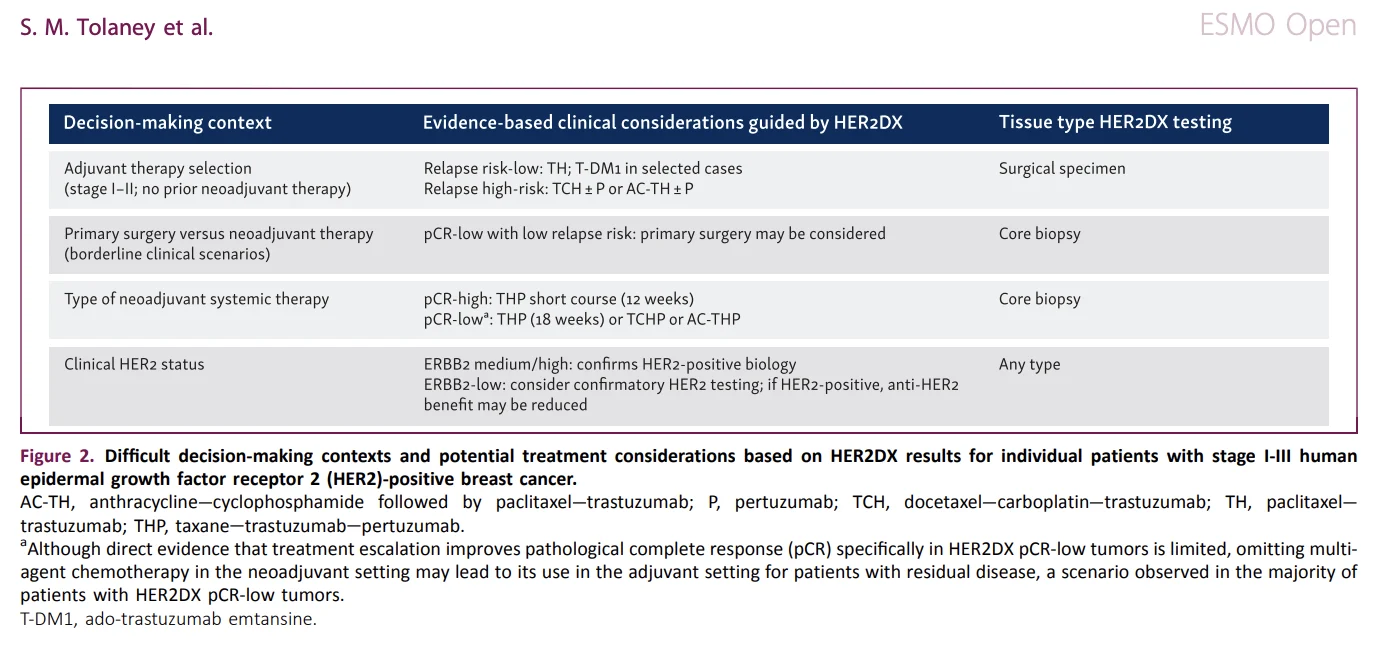
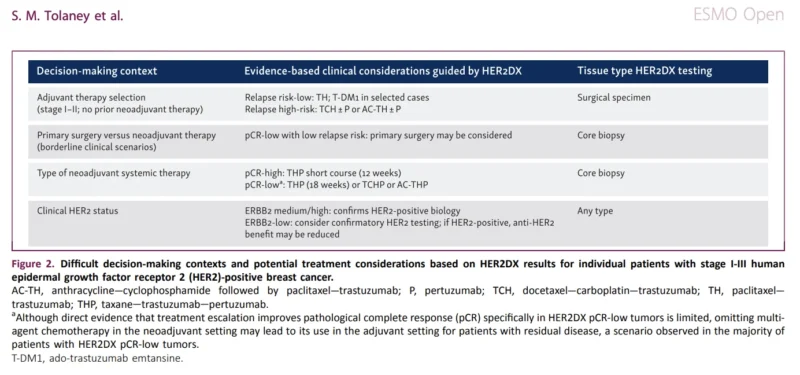
After primary surgery for stage I-II disease, clinicians may need to choose between relatively limited systemic therapy and more intensive chemotherapy plus HER2 blockade.
In borderline node-negative tumors of approximately 1.5-3 cm, there may be uncertainty between upfront surgery and neoadjuvant therapy.
In the neoadjuvant setting, HER2DX pCR biology may help estimate whether a short THP regimen is likely to achieve a deep response or whether residual disease is highly probable.
After surgery, HER2DX risk may add prognostic information when residual invasive disease remains.
The figure on page 7 of the review summarizes these difficult clinical settings and illustrates how HER2DX could complement, rather than replace, clinical stage and conventional pathology.
HER2DX Should Not Currently Be Used to Omit Standard Post-Neoadjuvant Therapy
This limitation is particularly important.
Patients with residual invasive HER2-positive disease after neoadjuvant therapy have traditionally received T-DM1, and trastuzumab deruxtecan has now demonstrated improved outcomes compared with T-DM1 in higher-risk residual disease populations.
HER2DX can identify patients with residual disease who nevertheless have a relatively favorable genomic prognosis.
However, the review explicitly states that HER2DX is not currently validated to justify omission of T-DM1 or another established post-neoadjuvant therapy (Tolaney et al., 2026).
This is a key distinction between prognostic information and treatment-predictive evidence.
A low genomic risk score may indicate a favorable expected outcome, but it does not prove that removing an effective standard therapy is safe.
Prospective biomarker-guided studies are required before HER2DX can be used for that purpose.
The DEFINITIVE Trial Will Test HER2DX-Guided Treatment Directly
The next step is prospective strategy validation.
The DEFINITIVE trial (NCT06446882) is a randomized multicenter study across Europe and Israel evaluating HER2DX-guided treatment against standard-of-care management in stage II-III HER2-positive breast cancer.
In the experimental arm, treatment is assigned according to HER2DX risk and pCR scores.
The primary objective is particularly relevant to the de-escalation discussion: to improve health-related quality of life without compromising pCR rates.
Early operational data from the first 122 screened patients demonstrated a 94.3% testing success rate and a median turnaround time of 7 working days, supporting the feasibility of real-time centralized genomic testing (Tolaney et al., 2026).
HER2DX is also being incorporated into CompassHER2-RD, evaluating T-DM1 with or without tucatinib after residual disease, and continued analyses from CompassHER2 pCR will examine longer-term outcomes.
These studies should help determine whether biological classification can move from prognosis and treatment discussion toward prospective treatment assignment.
HER2DX and ctDNA May Eventually Provide Complementary Information
The review also points toward a future in which baseline tumor biology and longitudinal molecular monitoring are integrated.
HER2DX provides information before treatment about intrinsic recurrence risk, expected pCR probability and ERBB2 expression.
ctDNA offers a different type of information: whether molecular disease is changing during therapy or remains detectable after treatment.
The authors propose that combining baseline HER2DX profiling with longitudinal ctDNA dynamics could eventually support a more adaptive strategy in early HER2-positive breast cancer.
A patient could therefore potentially be assessed according to both:
- what the tumor is biologically at baseline
and
- how the tumor responds molecularly over time.
That concept remains investigational but fits with a broader transition in breast oncology toward dynamic rather than static risk assessment.
Current Limitations
HER2DX has a growing evidence base, but several limitations remain.
Much of the evidence comes from retrospective translational analyses, patient-level meta-analyses and prospective decision-impact studies rather than randomized trials demonstrating that HER2DX-guided therapy improves clinical outcomes.
The assay is currently not incorporated into ESMO, ASCO or NCCN therapeutic algorithms.
The updated 2025 SEOM-GEICAM-SOLTI guideline recognizes HER2DX as a potential tool to support individualized discussions in selected situations, but prospective validation remains ongoing.
Treatment regimens also differ substantially across the studies used to validate HER2DX, making direct extrapolation into every contemporary therapeutic setting difficult.
The assay should therefore currently be viewed as a complementary biological decision-support tool rather than an independent determinant of therapy.
The Evolving Role of HER2DX
The clinical problem HER2DX attempts to address is becoming increasingly relevant.
HER2-positive early breast cancer now has multiple highly effective treatment options, ranging from relatively short taxane-HER2 blockade strategies to multi-agent chemotherapy, dual HER2 blockade and increasingly active antibody-drug conjugates.
Greater therapeutic effectiveness creates a new challenge: overtreatment becomes increasingly possible in patients whose tumors are highly treatment sensitive, while inadequate treatment remains a concern for biologically high-risk disease.
HER2DX attempts to separate these dimensions. The relapse risk score estimates long-term prognosis. The pCR score estimates treatment sensitivity. The ERBB2 score provides quantitative information about HER2 pathway activation.
Together, they provide a biological framework that conventional stage and receptor status alone cannot fully reproduce.
The key unanswered question is no longer whether HER2DX contains clinically relevant information. A substantial body of evidence suggests that it does.
The next question is whether using that information to escalate or de-escalate treatment prospectively will preserve or improve outcomes while reducing unnecessary toxicity.
Randomized strategy trials such as DEFINITIVE will be central to answering that question.
References
- Tolaney SM, Tung N, Wolff AC, et al. HER2DX in early-stage HER2-positive breast cancer: a review of clinical utility. ESMO Open. 2026;11(9):108345. doi:10.1016/j.esmoop.2026.108345.
- Prat A, Guarneri V, Pascual T, et al. Development and validation of the new HER2DX assay for predicting pathological response and survival outcome in early-stage HER2-positive breast cancer. EBioMedicine. 2022;75:103801.
- Villacampa G, Pascual T, Tarantino P, et al. HER2DX and survival outcomes in early-stage HER2-positive breast cancer: an individual patient-level meta-analysis. Lancet Oncology. 2025;26(8):1100-1112.
- Tung NM, Zhao F, DeMichele A, et al. Predicting pathologic complete response from clinicopathologic variables and HER2DX genomic test in stage II/III HER2-positive breast cancer treated with taxane, trastuzumab and pertuzumab: secondary results from EA1181/CompassHER2 pCR. J Clin Oncol. 2025;43(suppl 16):501.
- Martínez-Sáez O, Tapia M, Marín-Aguilera M, et al. Clinical decision impact of HER2DX in early-stage HER2-positive breast cancer: results from a prospective real-world study. ESMO Real World Data and Digital Oncology. 2025;8:100123.
- Sanfeliu E, Martínez-Romero A, Marín-Aguilera M, et al. Associations of the HER2DX genomic test with biological and pathologic features in HER2-positive breast cancer. Clin Cancer Res. 2026;32(3):570-580.
- Chen XC, Jiao DC, Qiao JH, et al. De-escalated neoadjuvant weekly nab-paclitaxel with trastuzumab and pertuzumab versus TCHP in HER2-positive early breast cancer: HELEN-006. Lancet Oncology. 2025;26(1):27-36.
- Loibl S, Park YH, Shao Z, et al. Trastuzumab deruxtecan in residual HER2-positive early breast cancer. N Engl J Med. 2026;394:845-857.