
Neoadjuvant treatment with chemotherapy plus trastuzumab and pertuzumab has substantially improved outcomes in early HER2-positive breast cancer. However, HER2-positive disease is not biologically uniform.
Some tumors achieve a pathological complete response after treatment. Others have residual disease. Some patients remain free of recurrence for years despite lower pathological response, while others recur despite pCR. This heterogeneity has increased interest in genomic tools that may provide information beyond standard clinicopathological features.
A real-world study published in The Breast evaluated the HER2DX genomic assay in patients with stage I–III HER2-positive breast cancer treated with trastuzumab- and pertuzumab-based neoadjuvant therapy.
The analysis found that HER2DX pCR and risk scores were associated with pathological response and invasive disease-free survival. The findings suggest that HER2DX may provide complementary information for treatment stratification, although prospective trials are still required before the assay can guide routine treatment escalation or de-escalation.
What Is HER2DX?
HER2DX is a genomic assay developed for early-stage HER2-positive breast cancer. It integrates clinicopathological variables with gene-expression information from four biological signatures: immune activity, proliferation, luminal differentiation, and HER2 amplicon expression.
The assay generates a pathological complete response score, a prognostic risk score, and an ERBB2 messenger RNA score.
The objective is not to replace standard HER2 testing, hormone receptor status, tumor stage, or nodal status. Instead, HER2DX is designed to add biological information that may help identify tumors more likely to respond to neoadjuvant treatment and patients with different long-term recurrence risks.
The Real-World Cohort
The retrospective, single-center study included 156 patients with stage I–III HER2-positive breast cancer treated at University Hospital A Coruña in Spain between 2015 and 2022.
All patients received trastuzumab- and pertuzumab-based neoadjuvant therapy, with or without chemotherapy. Most patients had stage II disease, while more than one-quarter had stage III disease. About half had node-positive disease, and 58.3% had hormone receptor-positive tumors.
The overall pathological complete response rate was 51.3%.
HER2DX testing was successfully performed in 111 pretreatment tumor samples, representing 71.2% of the full cohort. In this genomic-evaluable group, the pCR rate was 52.3%.
Hormone Receptor Status Remained Important
The study confirmed that hormone receptor status remained closely associated with pathological response.
Patients with hormone receptor-negative tumors had a pCR rate of 72.3%, compared with 36.3% among those with hormone receptor-positive disease. Hormone receptor-positive status was associated with a significantly lower likelihood of pCR in multivariable analysis.
HER2 immunohistochemistry also showed an association with response in univariable analysis. Tumors with HER2 IHC 3+ had a pCR rate of 55.9%, compared with 20.0% among tumors with HER2 IHC 2+ and positive in situ hybridization.
However, HER2 IHC 3+ did not remain independently associated with pCR after multivariable adjustment. This finding raises an important point: standard HER2 protein expression may not fully capture the biological dependence of a tumor on HER2 signaling.
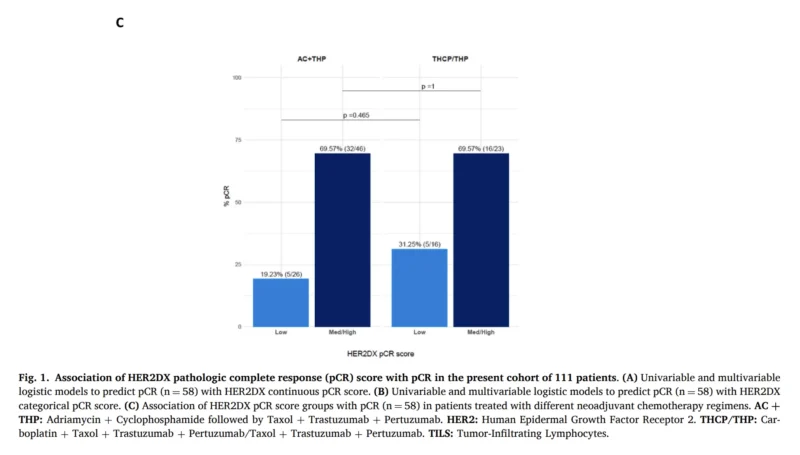
HER2DX pCR Categories Identified Different Response Groups
The HER2DX pCR score was assessed both as a continuous score and as predefined categories.
When examined as a continuous measure, the HER2DX pCR score was associated with pCR in univariable analysis but did not remain statistically significant after adjustment for other variables.
The categorical analysis was more informative.
Patients classified as HER2DX pCR-low had a pCR rate of 23.8%. In comparison, pCR was achieved in 70.7% of patients in the medium category and 67.9% of those in the high category.
When the medium- and high-score groups were combined, they had a significantly greater likelihood of achieving pCR than the low-score group. The adjusted odds ratio was 4.83 (95% CI, 1.72–14.65; p=0.004).
This result suggests that the categorical HER2DX pCR classification may help distinguish tumors with a lower probability of response to trastuzumab- and pertuzumab-based neoadjuvant therapy.
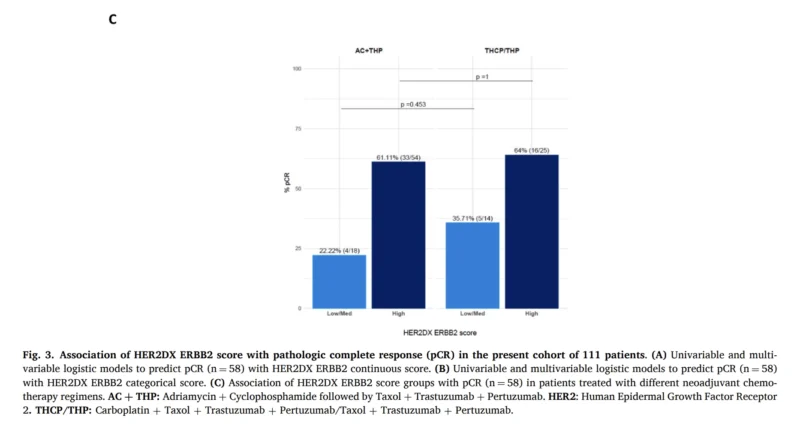
ERBB2 mRNA Expression Provided Additional Information
The HER2DX ERBB2 score was independently associated with pathological complete response when analysed as a continuous variable.
The adjusted odds ratio was 1.80 (95% CI, 1.22–2.77; p=0.005).
This is relevant because HER2-positive breast cancer includes tumors with different degrees of HER2 pathway activation. Standard immunohistochemistry measures HER2 protein expression, while the HER2DX ERBB2 score reflects ERBB2 messenger RNA expression.
In this cohort, ERBB2 messenger RNA expression appeared to provide information beyond HER2 IHC. This does not suggest that genomic testing should replace conventional HER2 testing. It supports the idea that both measures may capture different aspects of HER2 biology.
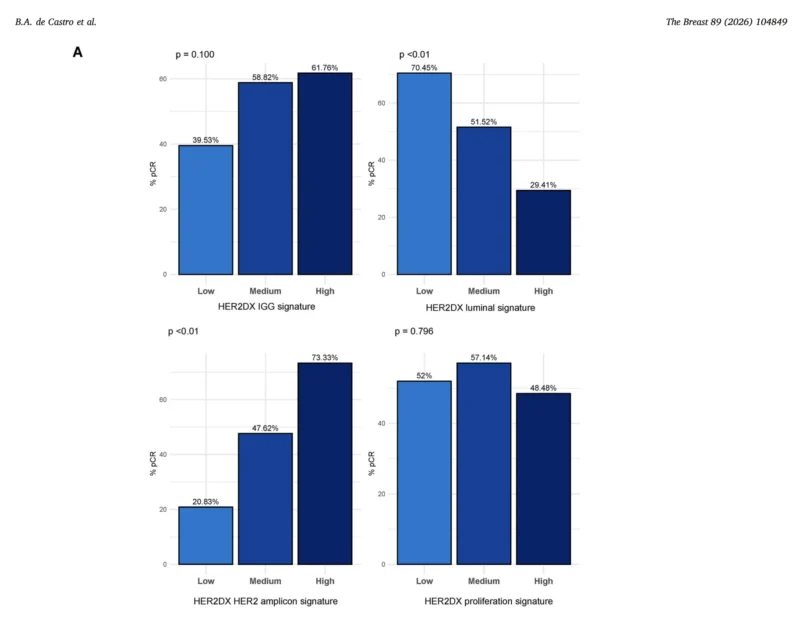
Different Gene Signatures Were Linked to Different Outcomes
The individual HER2DX gene-expression signatures also showed distinct associations with response.
Higher immune and HER2 amplicon signature scores were associated with higher pCR rates. In contrast, a higher luminal differentiation signature was associated with lower pCR rates.
The luminal differentiation signature was also associated with improved invasive disease-free survival.
These findings are consistent with the biological diversity of HER2-positive breast cancer. Some tumors appear more HER2-driven and immune-enriched, while others have more luminal and endocrine-responsive characteristics. These phenotypes may have different patterns of treatment response and long-term risk.
The proliferation signature was not significantly associated with pCR or invasive disease-free survival in this cohort.
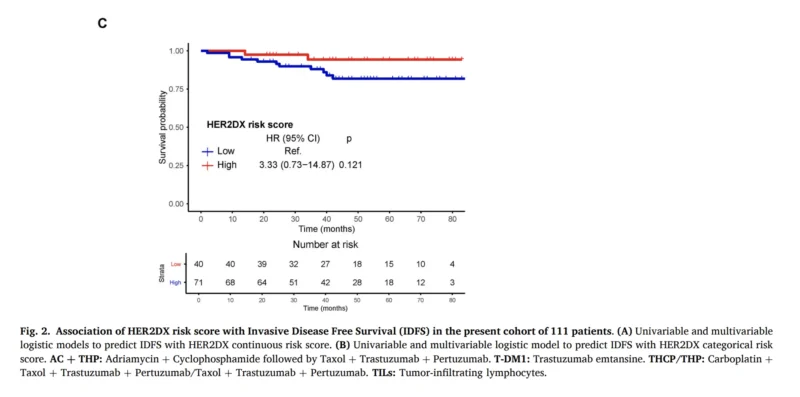
HER2DX Risk Score Was Associated With Invasive Disease-Free Survival
Median invasive disease-free survival was not reached during follow-up. At 100 months, 80.8% of patients remained relapse-free.
The continuous HER2DX risk score was independently associated with invasive disease-free survival. The adjusted hazard ratio was 2.84 (95% CI, 1.24–6.48; p=0.010).
The predefined high-risk category also showed a numerical trend toward poorer invasive disease-free survival compared with the low-risk group, although this did not reach statistical significance. The limited number of events may have reduced the ability to detect a clear difference between the risk categories.
Hormone receptor status was also associated with invasive disease-free survival in the cohort. The authors reported better outcomes in hormone receptor-positive disease, which may reflect the distinct biology and later relapse pattern seen in this subtype.
pCR Did Not Fully Define Long-Term Risk
Pathological complete response is an important endpoint in HER2-positive breast cancer. It is associated with treatment sensitivity and helps guide postoperative treatment decisions.
However, in this cohort, pCR was not significantly associated with invasive disease-free survival.
At three years, invasive disease-free survival was 90.5% among patients who achieved pCR and 91.6% among those who did not. Thirteen of the 21 invasive disease-free survival events occurred in patients who had achieved pCR.
This result should be interpreted carefully because the study was relatively small and the number of recurrence events was limited.
Still, it reinforces an important clinical issue: pCR is not the only marker of long-term risk. Patients with high-risk baseline disease can recur despite pCR, and genomic risk information may provide additional context beyond pathological response alone.
What Could This Mean for Treatment Individualization?
The potential clinical role of HER2DX is linked to treatment personalization.
Some patients may be candidates for reduced chemotherapy intensity if they have a favorable genomic profile and high likelihood of response. Others may need treatment-intensification strategies or closer surveillance if they have lower predicted sensitivity or a higher genomic risk profile.
This study does not demonstrate that HER2DX-guided treatment decisions improve outcomes. It also does not establish which treatment components can safely be omitted in patients with favorable scores.
Prospective trials are needed to determine whether HER2DX can reliably guide chemotherapy selection, dual HER2 blockade strategies, or postoperative management.
Ongoing studies, including the DEFINITIVE trial and CompassHER2-pCR, are evaluating how HER2DX may be incorporated into treatment algorithms for early HER2-positive breast cancer.
Important Limitations
This study was retrospective and conducted at a single institution. Neoadjuvant regimens were not randomly assigned, and the majority of patients received anthracycline-containing therapy.
HER2DX was available for 111 patients, while the invasive disease-free survival analysis included a limited number of events. Longer follow-up is needed to better define recurrence risk and survival outcomes.
The authors also reported financial relationships and institutional interests related to Reveal Genomics, the company associated with HER2DX. These disclosures do not invalidate the findings, but they underline the importance of continued independent validation.
The Bottom Line
This real-world study found that HER2DX pCR categories were associated with pathological complete response, while the continuous HER2DX risk score was independently associated with invasive disease-free survival in early HER2-positive breast cancer treated with trastuzumab- and pertuzumab-based neoadjuvant therapy.
The results support HER2DX as a potentially useful complementary genomic tool. However, they are not sufficient to support routine HER2DX-guided treatment escalation or de-escalation outside prospective clinical trials.